
Italian American Reconciliation
A rapturous Shanley revival—an intoxicating tempest of lyrical fervor, raw emotion, and fragile psyche; as tumultuous as it is tender. A true theatrical storm.
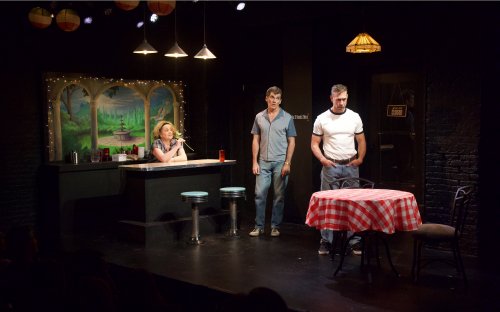
Mary Testa, Robert Farrior and Wade McCollum in a scene from John Patrick Shanley’s “Italian American Reconciliation” at The Flea Theater (Photo credit: Scott Aronow)
The mercurial heart—addled, erratic, and thoroughly operatic in its contradictions—beats at the center of Italian American Reconciliation, John Patrick Shanley’s simultaneously ribald and redemptive “urban folk tale,” now receiving a spirited and surprisingly tender staging at The Flea Theater’s intimate Siggy Theater.
Written during the high tide of Shanley’s fame—just after his Oscar win for Moonstruck and before his canonization as a playwright with Doubt—Italian American Reconciliation is often treated by theater cognoscenti as the middle child of the Shanley family: less groundbreaking than Savage in Limbo, less bruising than Danny and the Deep Blue Sea, and certainly less refined than the Pulitzer Prize-winning masterpiece that would follow. And yet, to dismiss this whimsical, booze-soaked, leather-jacketed Valentine would be to miss a minor gem glinting under a Little Italy streetlamp.
Strands of white lights — at once festive and nostalgic — interlace above, accompanied by Chinese lanterns whimsically adorned with the red, white, and green of the Italian flag. These flourishes instantly ground us in a neighborhood where culture is not just inherited, but celebrated with flair. The stage itself is cleverly divided into three evocative zones: stage right reveals the bar of the soup shop backed by a fountain nestled in a forest motif, a surreal touch that hints at both urban grit and dreamlike longing. Center stage, a simple red tablecloth anchors the scene in the rituals of family and familiarity, a modest icon of shared meals and unspoken histories, doubling duty for the restaurant as well as Huey’s kitchen table. To stage left, a bright terrace bursting with flowers sings of romance and possibility, a domestic Eden perched delicately at the edge of the everyday.
The story, spun with the shameless fervor of a barroom raconteur, is told to us by Aldo (Robert Farrior), a rakish bachelor and connoisseur of romantic chaos, who regales us with the woes of his hapless best friend Huey (Wade McCollum). Huey, who has long since divorced the mercurial, borderline feral Janice (Linda Manning), finds himself incapable of moving on, his taste buds dulled by heartbreak, his sense dimmed by longing. In an act of misguided gallantry, he ditches his current girlfriend, the earthbound and endearingly exhausted Teresa (Mia Gentile), to once again pursue Janice, the woman who haunts him like a badly tuned aria. Naturally, Aldo is dragged into the maelstrom.
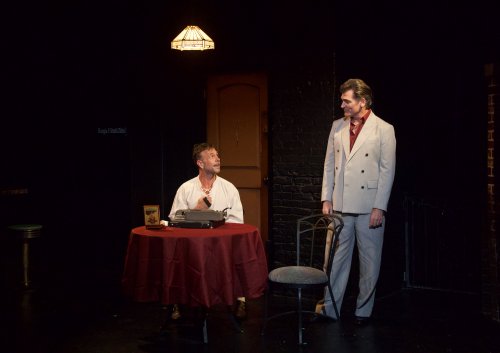
Farrior, doubling as narrator and agent of chaos, engages the audience with a kind of swaggering self-awareness—less Greek chorus, more Guy at the End of the Bar Who Has Seen Things. His Aldo is the sort of man who would dance to “Volare” not ironically but as a philosophy of life. Farrior rides the rhythm of Shanley’s florid, working-class poetry with aplomb, landing somewhere between wise guy and philosopher, while director Austin Pendleton wisely leans into this balance, allowing the production to teeter joyfully on the edge of theatrical indulgence without tipping into caricature.
If Shanley’s text is a tightrope walk of tone, then Linda Manning’s Janice is its windstorm. The role demands danger—real danger—and Manning meets the challenge head-on, crafting a woman whose volatility is almost magnetic. She exudes both heat and menace, yet somehow manages to elicit compassion in spite of (or perhaps because of) the character’s ferocious brokenness. It’s no small feat to make an audience feel for a woman who once shot a dog for love, but Manning’s performance suggests the act was less cruelty than tragic theatrical flourish.
Counterbalancing the melodrama is Mia Gentile’s Teresa, a performance grounded in warmth and weary humor. Gentile captures the heartbreak of the sensible woman who’s tired of being sensible. Her scenes with Mary Testa’s Aunt May—the kind of widowed sage who can deliver tough love and a punchline in the same breath—are among the production’s most emotionally honest. Testa, ever reliable, brings gravitas and warmth, tempering the script’s excesses with humanity.
The most elusive role is that of Huey, and Wade McCollum faces an uphill climb. The character is, by design, a sad sack, an emotional masochist whose decisions defy logic. Yet McCollum leans into the part’s sincerity with enough conviction to make Huey’s moon-eyed quest for love feel less pathetic than tragicomic. Eventually, he wins us over—perhaps not as a romantic lead, but as a man so blinded by love that he’s willing to wade into madness for another taste.
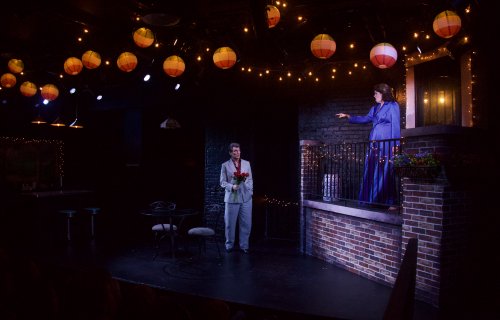
Robert Farrior and Linda Manning in a scene from John Patrick Shanley’s “Italian American Reconciliation” at The Flea Theater (Photo credit: Scott Aronow)
Pendleton’s direction once again reveals a deft touch for tone. He embraces the absurdity inherent in Shanley’s script but never loses sight of the aching human need underneath. He orchestrates this quirky, bruised symphony of yearning with a careful hand, allowing the comedy to bubble but never boil over, always pulling back to reveal the tender desperation at the play’s core.
In a production rich with visual nuance and dramaturgical intent, Scott Aronow’s scenic design emerges as a masterstroke of spatial storytelling. The stage is not merely a setting but a meticulously orchestrated landscape, ingeniously partitioned to serve the shifting emotional and narrative rhythms of the play. Each division feels purposeful, almost architectural in its dramaturgy, guiding the audience’s gaze and emotional focus with an understated elegance.
Annie Garrett-Larsen’s lighting design, meanwhile, operates with the precision of a seasoned conductor, orchestrating light and shadow to underscore the play’s emotional crescendos and diminuendos. Her use of illumination is not simply functional but deeply expressive — drawing the audience into moments of aching intimacy one moment, and then casting the stage in a stark, revealing glare as tensions mount the next. It is a visual choreography of attention and atmosphere.
Ariel Pellman’s costume design further enriches the tapestry, anchoring the characters in a vividly realized late-twentieth-century Italian-American milieu. Her work is suffused with a kind of textured nostalgia — not the saccharine kind, but something tougher, more lived-in. There’s a reverence here for the Little Italy neighborhood mythologies and cultural signifiers: a suit that hangs heavy with inherited bravado, dresses whispering of generations past, gold chains gleaming like inherited heirlooms of identity. It’s costume design as ethnography — attentive, evocative, and beautifully attuned to the world these characters inhabit.
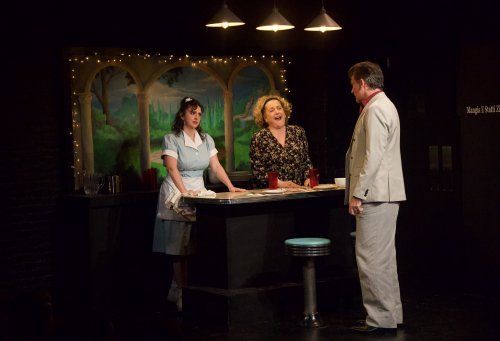
Mia Gentile, Mary Testa and Robert Farrior in a scene from John Patrick Shanley’s “Italian American Reconciliation” at The Flea Theater (Photo credit: Scott Aronow)
The final scene, set delicately upon Janice’s modest terrace, unfolds with a quiet, aching poetry that lingers long after the lights dim. It is here, in this suspended twilight of possibility, that the emotional core of the play crystallizes. We witness Huey and Janice in a moment of connection — fragile, tentative, and imbued with a depth that suggests both a beginning and an end. Is this a rekindling or a farewell? A first true meeting of souls, or the final, flickering echo of something that never quite found its form?
Shanley, in his characteristically elliptical and emotionally raw fashion, refuses to grant us the comfort of certainty. And in that refusal lies the scene’s exquisite power. He understands, with a kind of bruised wisdom, that love — like identity — is not a fixed state but an ongoing act of negotiation, a reconciliation that defies neat resolution. There is no punctuation here, only ellipsis. The terrace becomes a liminal space, not just between indoors and out, but between what has been and what might still be. It is a breathtakingly unresolved conclusion, one that trusts the audience to sit with ambiguity, and to recognize in it the very texture of being human.
Italian American Reconciliation may not be peak Shanley, but in the capable hands of this cast and creative team, it becomes something rare: a flawed but full-hearted theatrical reverie, equal parts barroom confessional and back-alley sonnet. It may be second-tier Shanley, but even Shanley’s second tier can outshine the top shelf of lesser playwrights.
Italian American Reconciliation (through October 26, 2025)
The Siggy at The Flea Theater, 20 Thomas Street, in Manhattan
For tickets, visit http://www.tickettailor.com
Running time: 100 minutes without an intermission


Leave a comment