
Blood Orange
A play dealing with the ultimate consequences of trauma in the lives of adolescent girls.
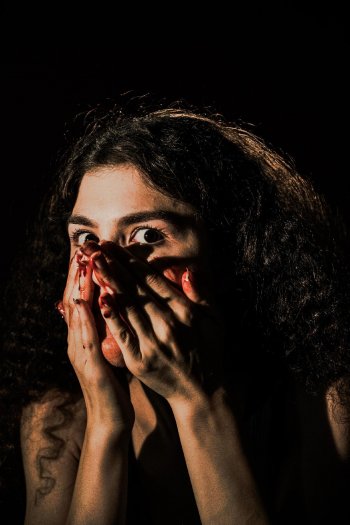
A scene from Abigail Duclos’ “Blood Orange” at the Jeffrey & Paula Gural Theatre of A.R.T./New York Theatres (Photo credit: Courtesy of El Alia Theater)
Human beings are capable of psychologically compartmentalizing events that impact them physically and mentally. The ability is most often applied in circumstances involving some type of trauma, again, either physical or mental. Regardless of the age of the individual, the process can be complex and disabling, but it is especially disruptive to children and adolescents who are negotiating their world and how they fit in that world.
Blood Orange by Abigail Duclos is a play dealing with the ultimate consequences of trauma in the lives of two adolescent girls, with a third acting as a contrast. Vernice Miller skillfully directs three excellent actors in exploring how some teenage girls manage the challenges of adolescence when faced with tragedy and physical and psychological abuse. Miller and Duclos have added an interesting element to this production by having the three principals perform in repertory. It is a dark, disturbing drama worth experiencing.
At first glance, it didn’t appear that this approach would work, especially given the requirements of a theater review, but in consideration of the repertory approach, it adds an intriguing dynamic to the performances of the three characters. Each actor must understand the experience of each girl, and if done well, it can inform how those characters are presented, possibly leading to a richer, fuller understanding of the characters.
The main character is Faye, who is struggling with her mother’s depression following the violent death of her father. On the night I saw the show, Maria Müller perfectly embodied Faye as a girl who, at times, seems to be emotionally balanced but is clearly in a liminal space between sane and psychotic. She is struggling to manage her grief over the death of her father, the depression of her mother, and as a part of that process, has created a fantasy world involving a roadkill animal she keeps in her refrigerator.
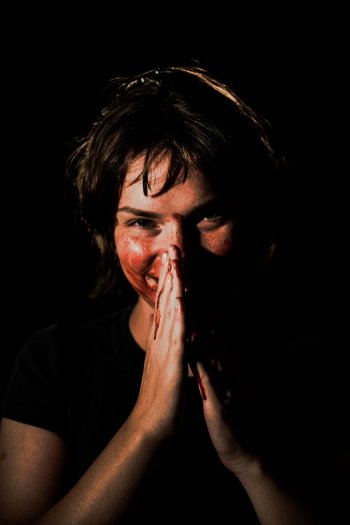
A scene from Abigail Duclos’ “Blood Orange” at the Jeffrey & Paula Gural Theatre of A.R.T./New York Theatres (Photo credit: Courtesy of El Alia Theater)
Faye is the alpha female to her friend Eden, a character solidly embodied by Ana Moioli. Eden is also an adolescent girl struggling with dysfunctional parents. She is being emotionally and possibly physically abused by her father without her mother defending her. She is also attracted to girls to the point of obsession. It is the dynamic in the relationship with Faye, mainly under the surface, that keeps her tied to Faye even in the face of cruelty.
Georgia is a balancing character in the chaos of the relationship between Faye and Eden. She is also emotionally damaged, with her behavior being acted out through sexual relationships with boys and men. Giorgia Valenti is solid in her portrayal of a 17-year-old woman/child struggling with narcissistic tendencies as she tries to make sense of the world in which she feels trapped.
Much of Faye’s behavior, both positive and negative, is focused on her mother, Mariah, strongly portrayed by Doreen Oliver. Mariah has been in a depressed and withdrawn state since the death of her husband three weeks before the time of the play. Faye has been her mother’s primary caregiver since the death of her father, and in the process has been trying a variety of things to get her mother to at least acknowledge Faye’s existence.
The show opens with one of these efforts being acted out, with Eden punching Faye in the stomach to create a bruise, hoping it would get her mother’s attention. It does not work, but later in the show, Mariah does make an appearance when all three girls are together in the kitchen. The result, involving tomato soup, sets back the reemergence of Mariah into the world.
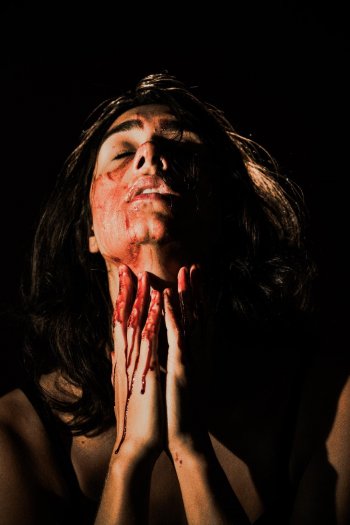
A scene from Abigail Duclos’ “Blood Orange” at the Jeffrey & Paula Gural Theatre of A.R.T./New York Theatres (Photo credit: Courtesy of El Alia Theater)
Faye’s slide into insanity is related to the death of her father and the finding of the roadkill on the same day. The dead animal, kept in the refrigerator, is gradually transformed into a religious figure by Faye. Eden, in her obsession with Faye, agrees about the mystical nature of the roadkill to the point where they both begin to pray to it.
Georgia is the only person who sees the dead animal for what it is and recoils from the encounter. She learned of it from Eden, who, in an effort to connect more directly with Georgia, revealed it. Faye, not happy about that event, begins to act out more directly psychotic behavior that ultimately leads to a dark and disturbing ending.
The production design is well-suited for the small venue, with scenic and property design by Ningning Yang, sound design by Laura Pereira, and lighting design by Hayley Garcia Parnell. Whitney Fabre’s costume design is effective in support of the setting and characters. A small dance sequence and some actions are choreographed by Amelia Estrada, who is also the associate director.
Blood Orange (through September 27, 2025)
Et Alia Theater
Jeffrey & Paula Gural Theatre of A.R.T./New York Theatres, 502 W. 53rd Street, in Manhattan
For tickets, visit, http://www.eventbrite.com/e/blood-orange-tickets-1487053349599
Running time: 110 minutes without an intermission


Leave a comment