
Rob Lake Magic With Special Guests The Muppets
No illusions are shattered in this suite of conjuring, yet failure to gild the lily reveals to the magician (and us) how quickly an audience can disappear.
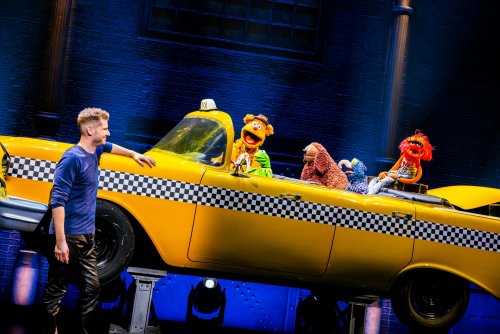
A scene from Rob Lake Magic With Special Guests The Muppets (Photo credit: Evan Zimmerman)
Rob Lake’s résumé, that modern ledger of self-mythology and metrics, is replete with the sort of factoids that glitter brightly in a press release: a million tickets sold, some 80 million cumulative views on social media (the new alchemical proof of relevance), a quarter-finalist turn on America’s Got Talent, the honorific distinction of being the youngest magician ever to receive a Merlin Award, a tenure as resident headliner at the Atlantis resort in the Bahamas. To this glittering procession of credentials he may now add a new, somewhat quixotic line: “Performed on Broadway.” It has the faint ring of an achievement reached not by inevitability but by sheer will, the way a cruise-ship crooner might one day find himself improbably booked at Carnegie Hall for a single afternoon recital.
The production in question—carrying the unwieldy yet industriously descriptive title Rob Lake Magic With Special Guests The Muppets, which just yearns for some sort of punctuation (other than the comma after “Muppets” and before “which” which doesn’t count) —was intended to be a bit of holiday confectionery at the Broadhurst Theatre. But even the seductive nostalgia of Kermit the Frog, Miss Piggy, Fozzie Bear, The Great Gonzo, Rowlf the Dog, and the eternally percussive Animal could not forestall the inevitable. Sluggish ticket sales, a confused sense of its own audience, and the sheer improbability of its conceit have brought the show to an abrupt end nine weeks early: it will shutter this Sunday, November 16, having logged 20 previews and a mere four official performances. What might have been dismissed as a harsh but accurate accounting of a family-friendly diversion has, in real time, transformed into an autopsy. If there is a lesson, it is that magic—on Broadway of all places—must itself be conjured with more than mirrors and smoke; it requires intention, shape, charisma, and an animating imagination.
The first and most glaring problem is that Broadway, now more than ever, is a marketplace governed by the gravitational pull of celebrity. This is not a lament so much as a fact of late-capitalist theatergoing: the non-musical or spectacle-driven event that can move full-price tickets without a marquee name is a unicorn. If the gods are kind, perhaps two such productions appear in a decade. Without “Huge” Jackman to anchor the enterprise, albeit at somewhat objectionable price tags, producers are left to improvise. An exception to the rule, Alex Edelman, the comedian all by himself, (no halved woman, no ring of fire, no deck of cards) sold out Broadway’s Hudson Theatre for months.

A scene from Rob Lake Magic With Special Guests The Muppets (Photo credit: Evan Zimmerman)
In lieu of a boldface name, Lake and his producers pursued the next best thing: The Muppets, those transgenerational icons of American whimsy. It should have worked. If you can’t get Lady Gaga, get Miss Piggy. And indeed, the logistics are impressive—these beloved creatures are puppeteered live onstage; their Broadway debuts come complete with pre-recorded vocals by Matt Vogel, Eric Jacobson, and the venerable Dave Goelz. Yet the brilliance of the idea evaporates in execution. Shall we discuss the use of pre-recorded vocals that ignore synching what is actually happening on stage? We didn’t accept it with Milli Vanilli, but we cut Miss Piggy beaucoup slack? The Muppets are grafted onto the evening like decals on a rented car, brightening the exterior without adding meaning to the vehicle. There is no narrative architecture to house them, no dramaturgical reason for their presence. Kevin J. Zak’s “additional material” provides the faintest rationale for their appearances: Kermit engages in a quasi-celebrity magic trick; Gonzo offers to fire himself from a cannon; Miss Piggy indulges in Fifth Avenue retail therapy; Fozzie offers a morsel of Broadway stand-up from a box seat that cries out—indeed yelps—for some former President’s bad night at Ford’s Theater. ”All right, Mrs. Lincoln, but what did you think of the show?”
If the Muppets are deployed as window dressing, the illusions themselves are a museum of inherited gestures. Lake presents the familiar canon of contemporary stage magic: the bifurcated assistant, the levitating woman afloat above a bed of water (which, in its defense, has the best stage accoutrements of the evening), the interlocking wedding rings that actually make it back to their owners, the transmogrified paper rose born of a Kleenex, the sealed-box prediction trick. These are the old reliables, charming chestnuts of the craft. And to be fair, if it is your first encounter with such wonders in the flesh, they retain an undeniable potency. Something impossible happens before your eyes, and for a moment one senses the naïve astonishment that once greeted Houdini or Blackstone.
But the long shadow of 20th-century spectacle looms large. When David Copperfield made a woman vanish, he seemed to risk something existential—his illusions were staged with the gravitas of a metaphysical wager. Doug Henning, all fringe and mystical glow, imbued the form with a countercultural buoyancy. Lake’s versions, by comparison, feel perfunctory, the delivery mechanical rather than miraculous. To deploy the same tricks as one’s predecessors is no sin, but to do so without reimagining them—or without doing them better—is a kind of aesthetic resignation.
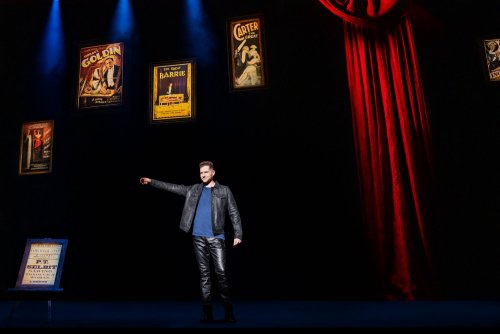
A scene from Rob Lake Magic With Special Guests The Muppets (Photo credit: Evan Zimmerman)
Underlying all of this is the curious absence of directorial authorship. Bethany Pettigrew is listed as a “creative consultant,” but the show feels as though it has been mounted without the steadying hand of anyone trained to translate spectacle into theater. Lake, left alone to navigate the treacherous waters of stage banter, never quite locates a rapport with his audience. His comedic exchanges with his felt-and-foam castmates land with notes of awkwardness, as though each has rehearsed in different rooms, guided by different sensibilities. The production design—sets that look faintly provisional, music cues inflated to the point of self-parody—might satisfy the low-stakes environment of a luxury resort, where distraction is its own currency. On Broadway, however, shabbiness becomes accusation. Audiences can forgive many things, but not indifference.
The tragedy—minor, but nevertheless instructive—is that the show contains the seeds of something that might have worked. One imagines a director of theatrical panache—say, Julie Taymor, whose production of Mozart’s The Magic Flute still thrills audiences of all ages every year at the Metropolitan Opera—reshaping the raw material into a whimsical phantasmagoria: a structure with a spine, an integration of The Muppets into the illusions themselves, a sense of aesthetic unity, a story however slight. Above all, such a director might have coaxed a stage persona out of Lake, who seems less a performer than a technician. With intention and artistry, this odd little project could have blossomed into genuinely charming family entertainment.
Instead, Rob Lake Magic… offers a reminder, pointed and a little melancholy, that not even magic is immune to the demands of craft. Without a coherent vision, without the gentle architecture that transforms tricks into theater, the illusion collapses. And in its wake, we are left to ponder an irony worthy of The Muppets themselves: that in a show ostensibly designed for utter astonishment, the most surprising thing may be how little enchantment was conjured.
Rob Lake Magic With Special Guests The Muppets (through November 16, 2025)
Broadhurst Theatre 235 West 44th Street, in Manhattan
For tickets, visit http://www.telecharge.com
Running time: 80 minutes without an intermission


Leave a comment