News Ticker
- December 13, 2025 in Off-Broadway // BUM BUM (or, this farce has Autism)
- December 12, 2025 in Musicals // The Faggots and Their Friends Between Revolutions
- December 12, 2025 in Cabaret // Mary Foster Conklin — Mirrors Revisited (50th Anniversary)
- December 11, 2025 in Cabaret // Kathy Kaefer — Kiss Me Once: Stories from the Homefront
- December 11, 2025 in Off-Broadway // The American Soldier
- December 9, 2025 in Off-Broadway // This World of Tomorrow
- December 9, 2025 in Cabaret // A Noel Coward Celebration — Steve Ross & Friends
- December 7, 2025 in Off-Broadway // Diversion
- December 5, 2025 in Off-Broadway // Meet the Cartozians
- December 5, 2025 in Features // Tom Stoppard: An Appreciation
- December 4, 2025 in Off-Broadway // Practice
- December 4, 2025 in Cabaret // Eddie Bruce — The Magic & Music of Tony Bennett
- December 3, 2025 in Interviews // Interview with Ty Jones, Classical Theater of Harlem
- December 2, 2025 in Features // Gingold Theatrical Group’s 20th Anniversary Gala at The Players
- December 2, 2025 in Interviews // The American Soldier – An Interview with Douglas Taurel
Archive
Instead of a satirical take as in the film "The Candidate" (1972) or HBO’s television series "Veep," the treatment of the subject here is realistic in the mode of Norman Lear’s 1970’s situation comedies such as Maude. The toll of the campaign on Laura’s good-natured husband Arthur, her troubled nine year-old daughter Sophie and her resourceful young campaign manager Nick are insightfully explored.
[more]
The Ballet Hispanico wants to be meaningful while at the same time entertaining. It is a difficult course to chart—just look at the Alvin Ailey American Dance Theater—and, so far, the entertainment element seems to have taken charge. There’s nothing wrong with wanting to please an audience, but, let’s face it, others do it better. Mr. Vilaro has kept the technical level of the dancers and the productions at a very high level and shouldn’t be afraid to shock, move and confound his audiences—along with making them happy.
[more]
Leonard Nimoy intended "Vincent" as a vehicle for himself that would showcase his talents. In this Off-Broadway premiere presented by Starry Night Theater, "Vincent" is now such an outlet for Nimoy’s worthy successor James Briggs in this entertaining and insightful production.
[more]
Featuring a talented and engaging cast as well as an inventively designed set that adds tremendous production value, "House Rules" would seem to have all the necessary elements of a successful production. However, though the technical and theatrical aspects of this production are undoubtedly successful, the message of this story is somehow lost along the way. Somewhere down the line, this heartfelt family story devolves into a set of characters with clichéd motivations and almost no character growth; characters who are far too often put into storylines which never receive that oh-so-satisfying payoff that differentiates an exceptional theatrical experience from the ordinary.
[more]
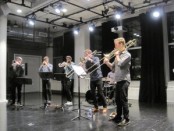
The Douglas-Westerlies music, whether its subject is lament or celebration, protest or affirmation, is artistically coherent: testing and stretching traditional genres, the music is about forward movement, about the exploration of “Great American Themes” as they end in felicitously determined encouragement and optimism. This music's informing energy and spirit shine and summon. Audience and listeners are invited into a musical experience in which history provides context, inspiration and goad; references to the political, musical and cultural past do not tether the music to old habits but liberate it for new conversations. Together, Douglas, Royston and the Westerlies generated a warm and rich brass-and-percussion sound; the Westerlies' happy virtuosity, discipline and irrepressible affection for the full range of their instruments' sounds make them a perfect collaborative partner for Douglas' genre mixing and generously imaginative expansion of the artistic possibilities of trumpet, trombone and drums.
[more]
Under Gabrielle L. Kurlander’s intricate direction," Votes" presents a moving and personal picture of the real lives and feelings of an extremely powerful couple in America. Votes brings a more human side to their relationship – recalling how Melanie, played by Lisa Wright-Mathews, and William Jefferson (Wayne Miller), met as law students at Yale. It shines a light on their early plans to do some good in the world – all with a twinkle in their eyes as Melanie recalls how she first fell in love with the “pimply kid from Arkansas.” As this couple ages, they question if it was all worth it and consider what they are actually playing for, as this Election 2016 offers the bold chance to do something different.
[more]
"The Effect" investigates the emotional, physical and ethical effects of drug testing, certainly a hot button issue in our time when we have come to expect a pill to solve all of our problems. The scientific portions are made human as we see them through the eyes of Connie and Tristan who must do everything at the same time as foils in the experiment. The parallel stories of test takers and warring doctors with a past history add to the visceral and intellectual pull of the play.
[more]
"Wonderful Town" is one of those musical comedies which seem to get better as they age due in this case to the classic quality of the Bernstein/ Comden & Green score and the witty book by Fields and Chodorov. Director Evan Pappas has given the Musicals Tonight! revival a bright, breezy, high-spirited production that is certain to put a smile on your face, while for a change you can go out humming the songs. Much more should be seen of Elizabeth Broadhurst who sparkles as would-be writer Ruth Sherwood.
[more]
it’s significant that Steve Martin has won five Grammy Awards for albums he’s made–two in the category of “comedy,” and three in the category of “music.” He loves to play the banjo (an instrument, incidentally, that has a prominent role, along with the fiddle, in the music we hear in “Bright Star.”) He’s collaborated with Edie Brickell on two albums. And their ongoing musical collaboration has provided the foundation and inspiration for this engrossing musical play.
[more]
Rachel Hauck’s scenic design is the most outstanding feature of the interminable "Antlia Pneumatica." Ms. Hauck accurately and vividly represents the Texas ranch setting by an elaborate kitchen counter top in the center of the bare stage that is surrounded by shrubbery. It’s very functional as much of the activities involve preparing a feast.
[more]
And Ensemble Pamplemousse, an exciting and distinctive six-member “composer performer collective” founded in 2003, and performing at Miller Theatre for the first time, had all sorts of fine surprises to offer. Each of the musicians composes and performs; each seems able to play several traditional and non-traditional instruments, though their publicity material identifies one primary instrument of each. All six, fresh off their extensive recent European tour – Natacha Diels/flutes, Jessie Marino/cello, Andrew Greenwald/drums, David Broome/keys, Bryan Jacobs/electronics and Ross Karre/miniature drumset – contributed equally to their recent Pop-Up performance.
[more]
Nearly thirty speakers glorified Solomons, but none quite as well as himself who appeared in three bits that deftly paid tribute to—and simultaneously gently poked fun at—his two choreographic mentors. Watching Solomons’ Martha Graham and Merce Cunningham hand puppets debating their individual philosophies of the art of dance, while getting their personality foibles down perfectly, was the highlight of the program. This was the rare Horse’s Mouth in which the object of the show performed.
[more]
Shoving a grapefruit into Mae Clarke’s face in "Public Enemy," George M. Cohan’s "Yankee Doodle Dandy" song and dance numbers for which he won the Academy Award for Best Actor, and the “Top of The World, Ma!” finale from "White Heat" are among the exciting factual highlights of this old-fashioned chronicle.
[more]
Thomas Kail (one of the geniuses behind Hamilton) has staged the world premiere of Sarah Burgess’ riveting "Dry Powder" in as cool a fashion as Rachel Hauck’s cobalt blue set with its cubes and rectangular modules that are rearranged for the various scenes by stage hands dressed as stockbrokers. This A-list cast best known for their television roles, along with talented Sanjit De Silva as Landmark’s moral CEO, give us indelible, full-bodied performances. Making his Broadway debut after his eight seasons on "The Office," Krasinski (sleekly dressed in Dior and Ermenegildo Zegna) is the idealist who wants to make the world a better place for his wife and daughter and new child on the way, although he likes his job which makes it possible for him to own a yacht. He has promised Jeff (Sanjit De Silva), the CEO for Landmark, that none of his employees will lose their jobs. All our sympathy goes to him.
[more]
The prime instigator of the events, John Adams, was rotund and abrasive. Here he is played by the handsome Santino Fontana who was Prince Charming in the recent Broadway production of Cinderella. Though Mr. Fontana bears no physical resemblance to Adams he conveys his rage, frustration and humanity with his dynamic performance. Fontana’s soaring voice captures the emotion and humor of the score, particularly on "Is Anybody There?"
[more]
Posner has turned Chekhov’s four-act play into two-part meta-theater: not only do the actors acknowledge the audience and solicit our participation, but they each have a monologue addressed directly to us. The actors sit around the stage when they are not in a scene, almost like they are attending a rehearsal. Aside from the obvious use of contemporary American vernacular, Posner has fun with iconic Chekhov lines that have grown stale. When asked why she always wears black, Mosh at first says, “Black is slimming,” before giving her original answer (“I’m in mourning for my life.”) He has changed Mosh and Dev’s story, giving them a different ending. While Chekhov’s Konstantin talks of the theater needing new forms, Posner’s version is the very new form that was predicted all those years ago. Finally, Posner has added an epilogue in which the actors address the audience one by one and give us a new take on the original ending.
[more]
In the hands of someone other than Timothy Olyphant, Strings McCabe might be a self-pitying monster too extreme to take seriously. However, this brilliantly accomplished actor has just the right amount of blarney to make Kenneth Lonergan’s "Hold On to Me Darling" one of the most satisfying plays in town. And you will learn a good deal about the lives of the rich and famous and how they get away with the antics they commit.
[more]
The authors of "Straight" would have you believe that in 2016 26-year-old straight- acting investment banker Ben, living in Boston where same sex marriages have been legal for the last eight years, would still be in the closet. Seeing girlfriend Emily for the last five years since senior year at college, Ben finds sex with men more satisfying than with women, but he does not see himself as gay. He has just begun a sexual relationship with almost 21-year-old Boston College student Chris and he doesn’t want Emily to find out. However, Emily’s roommate is moving out and she wants him to move in. After all, it is five years and what is he waiting for?
[more]
Much of "Locusts Have No King" by J. Julian Christopher appears to be in the well-mined terrain of Mart Crowley’s "The Boys in the Band," Edward Albee’s "Who’s Afraid of Virginia Woolf?" and the works of Terrence McNally. Gay relationships are explored in blistering detail but gradually there is the Jean Genet bombshell that the action takes place in the contemporary Long Island rectory where they all live.
[more]
"Bright Star," the new bluegrass/country music comedy-drama, rises—just barely—above Hallmark Network romance level thanks to its energetic score by the Hollywood star, Steve Martin (music and book) and singer-songwriter Edie Brickell (lyrics) and an astonishing, charismatic performance of Carmen Cusack in her Broadway debut.
[more]
This was a particularly satisfying showing by the Juilliard Dances Repertory. It’s good to know that there is hope for the future of dance represented by these students, all of whom displayed fine technique and understanding of the different works. Also, the respect and care paid to these three choreographic geniuses makes it clear that they won’t soon be forgotten.
[more]
The last piece of the concert was James MacMillan's substantive and moving 1994 "Seven Last Words from the Cross," a 35 minute piece of seven different movements, varying in length from nine to one-and-a-half minutes each, for choir and orchestra. As the piece progresses through the final Passion drama, from Jesus' plea for forgiveness for his executioners to his exhausted last breath, MacMillan explores aspects of prayer and petition, anguish and fear – Jesus' and humanity's – in music that bears close allegiance to Romantic liturgies and Requiems. Here, the Choir and the orchestra were elegant, boys and men singing with superb control, lush expressivity … and their usual clear diction.
[more]
Swedish novelist and playwright Jonas Hassen Khemiri’s new play, "The Hundred We Are," presents an emotionally compelling view on the different stages of one’s self encountered over a lifetime. From the time we are born, until the time of our passing, we learn to adapt to our surroundings and transition from life phase to life phase, with our evolution as a human being marked as life’s most important journey. Audiences are in for a treat as this provocative and progressive new play examines many of the important social issues occurring throughout the world in a fresh and truly thought-provoking way.
[more]
Scott Ellis’ direction avoids caricature, even in the most broadly drawn characters like the man-hungry Ilona, the gigolo Steven and the scared, but pragmatic clerk Sipos. He make the one touch of melodrama, involving Maraczek’s marriage, seem human and a touch tragic, helped by Mr. Jennings subtle, but exuberant performance. He also draws a tender performance from Ms. Benanti who gets to use the more operatic part of her marvelous voice.
[more]
The staging is unusual in that no punches are thrown. When the actors are supposed to be delivering their blows, they stamp their feet which is actually more sinister and startling. The cast clap in unison to punctuate various dramatic moments. The ringside bell is live, delineating each of the six scenes, in Matt Hubbs’ sound design. During the fight scenes, the boxers face the audience and we hear what they are thinking moment by moment, rather than see their punches. Nick Vaughan’s set doubles beautifully as gym, boxing ring and locker room. During the first boxing match, ropes on a frame are moved around to give the audience different views of the ring. Austin R. Smith’s subtle lighting helps direct attention to the right spot throughout the play. All of this leads to a remarkable and memorable evening in the theater.
[more]
Directed by the author, "Wolf in the River" is an environmental production as the audience is invited to sit in folding chairs around a mound of earth with forlorn flowers, garbage and debris. However, there are set pieces and props located in the four corners of the venue as well. When the play begins, a man sitting in the audience gets up, strips off his shirt and shoes, and becomes the play’s narrator and master of ceremonies, as well as one of the characters. In an unnamed Southern American location, we are on the banks of a river (the audience is the river) filled with alligators. Six actors in pasty make-up wander around the outer perimeter of the room. Although the program does not explain their presence, the script reveals that they are the ghosts of those who have perished in the river.
[more]
One problem with reviving musicals from the pre-Sondheim era is that they were often created around the talent of a big, unique star like Ethel Merman, Bob Hope, Mary Martin, Al Jolson, Fanny Brice or Eddie Cantor. Unfortunately, not only are these talents not around, there are very few oversized personalities in musical theater today. Musicals Tonight!’s revival of the Jule Styne/Comden & Green musical, "Do Re Mi," runs into this problem. Originally tailored to fit comedians and singers Phil Silvers, Nancy Walker, Nancy Dussault, John Reardon, and Al Lewis, their presence is sorely missed.
[more]
Virtually performed all in English with some Spanish for comic effect," ¡Figaro! (90210)" is true to the art form with recitative and arias, that is sung speech and grand solos rather then integrated dialogue and songs that characterize traditional musical comedy. Supertitles are projected above the stage for anything that may be vocally indecipherable.
[more]
For the winter concert of their eleventh season, the twenty-three member C4: The Choral Composer Conductor Collective – elected to honor “Unusual - music of the strange, the absurd, the surreal.” The evening included three premieres, all by current C4 composers, among the eight pieces performed. Some of the works were splendid and some weren't, but all were presented with C4's characteristic superb musicianship and artistic integrity as well as their willingness to take risks.
[more]
“He was tied to the life of jazz clubs,” said Billy Stritch of Cy Coleman, the subject of The 92nd Street Y’s Lyrics & Lyricists Series Presents: "Witchcraft: The Jazz Magic of Cy Coleman." Mr. Stritch was the personable host, artistic director, and performed on piano and was a vocalist along with four other talented singers during this very entertaining and jazzy concert.
[more]
Darja, the grounding force of the entire production, is played with rawness and vigor by Marin Ireland. Ms. Ireland—no stranger to the New York stage as of late—delivers an unnerving performance as a woman who has had no run of good luck in her time in America. Jumping in time between the early 1990’s, the year 2014, and stopping in the middle (2006) along the way, Ireland’s performance is riveting and heartfelt from beginning to end—no matter the decade.
[more]
Seth Rudetsky and Jack Plotnick’s libretto mocks all the famous disaster films of the seventies, like 'Jaws,' "Earthquake," "The Poseidon Adventure," "The Towering Inferno," "Ben," etc., and squeezes every Bible worthy catastrophe onto the Nederlander stage, all the while using hit songs from the seventies, sung live, to punctuate the libretto with music that makes singing—and dancing—along difficult to avoid.
[more]
“He was the premier balladeer of his generation and the first African-American to sing a song on network radio,” Malavet declared of the entertainer. Billy Eckstine (1914-1993) was a Virginia born African-American jazz and pop singer, bandleader and songwriter. He sang with the bands of Earl Hines, Duke Ellington and Count Basie. During a career lasting over 50 years, Eckstine had several hit singles, toured extensively and appeared on major television network programs.
[more]
«
1
…
88
89
90
91
92
…
114
»
Copyright Jack Quinn, 2001-2023