News Ticker
- December 14, 2025 in Broadway // Oedipus
- December 14, 2025 in Interviews // Conversation with Dominick LaRuffa Jr.
- December 14, 2025 in Off-Broadway // The Surgeon and Her Daughters
- December 14, 2025 in Features // Notes Toward a One-Man Play About Scammers, Character, and Control
- December 14, 2025 in Features // A Seasonal Salon Worth Noting
- December 13, 2025 in Off-Broadway // BUM BUM (or, this farce has Autism)
- December 12, 2025 in Musicals // The Faggots and Their Friends Between Revolutions
- December 12, 2025 in Cabaret // Mary Foster Conklin — Mirrors Revisited (50th Anniversary)
- December 11, 2025 in Cabaret // Kathy Kaefer — Kiss Me Once: Stories from the Homefront
- December 11, 2025 in Off-Broadway // The American Soldier
- December 9, 2025 in Off-Broadway // This World of Tomorrow
- December 9, 2025 in Cabaret // A Noel Coward Celebration — Steve Ross & Friends
- December 7, 2025 in Off-Broadway // Diversion
- December 5, 2025 in Off-Broadway // Meet the Cartozians
- December 5, 2025 in Features // Tom Stoppard: An Appreciation
Archive
The troupe attracted a wide-ranging audience to The Sam space at The Flea, even a few youngsters there to see their first live dance performance, and, with the exception of one section, “Thumbs,” performed by Nic Petry and Kazin, which might been perceived as naughtily sexual, they were in for many treats: jaunty barefoot tapping (“Top Hats”); a male Sugar Plum Fairy, Dylan Baker, who was so proud of his toe shoe technique that he shined a flashlight on his every foot jiggle (“Flashlight”); and “A Chorus Line” of young dancers from the Dalton School getting their first taste of professional dancing under the lights in front of an audience.
[more]
Some novels are more stage-worthy than others, and "C.S. Lewis’ The Screwtape Letters" is not among those that are. As adapted for the stage by Max McLean--who also directs the production with a flair for the grotesque--and Jeffrey Fiske, "C.S. Lewis’ The Screwtape Letters" is an unfortunate jumble of gibberish and gobbledygook, told at breakneck speed by Brent Harris, who is playing His Abysmal Sublimity Screwtape.
[more]
Director Ivo Van Hove’s stage version of the Paddy Chayefsky cult film "Network" gives Bryan Cranston the role of a lifetime as Howard Beale, the UBS news commentator who has a nervous breakdown on air and then becomes a media messiah. The high tech production designed by long-time van Hove associate Jan Versweyveld with video design by Tal Yarden is riveting throughout its two hour intermission-less running time by putting the audience in the news studio and making us complicit in the action.
[more]
A hard-edged picaresque fable is what playwright Lynn Nottage came up with in her enjoyable, "Fabulation, or The Re-Education of Undine" that premiered in 2004. A two-time Pulitzer-Prize winner for Drama, Ms. Nottage is in a lighter mood here but her comic sequences have a bracing tone and the dialogue has her customary skillful depth. We’re in the exaggerated territory of "Watermelon Man" and "Bonfire of the Vanities."
[more]
The holiday season is in for an irreverent satirizing in Gary Apple’s musical comedy "Christmas in Hell," a rude and entertaining fable for adults. With book, music and lyrics by Apple, a writer/producer for television, the show now being produced by The York Theatre Company is a diverting antidote to all the mindlessly clichéd holiday cheer that is everywhere. With some clever lyrics, hummable tunes and a colorful cast of characters, "Christmas in Hell" is a delightful little musical parody which is a change of pace for the season before us. It does require a good deal of suspension of belief of both kinds.
[more]
That it involves the relatively new phenomenon of gay parenthood gives it an added impact. That it is written with a thorough understanding of the complexities of gay parenthood vs. conservatives-in-liberal-clothing keeps it constantly edgy. And, that it has a relatively positive ending makes it a valuable addition to this literature in a season when Michael McKeever’s popular "Daniel’s Husband" excited interest in a storyline also involving gay marriage, one with a decidedly dire conclusion.
[more]
Though it was common practice centuries ago, perhaps the final take-away from "Bitter Greens"--a new play by Clea DeCrane--is that an actor should not perform in her own work. In the play, DeCrane portrays Reyna, a character that is both confused and confusing. She’s also more than a little aloof. When Reyna announces that she’s going “to go on a cleanse,” another character, Caitlin (Jessica Darrow), asks her, “A cleanse from what, vegan bites and vitamin water?”
[more]
Elice is no stranger to biographical musicals. His "Jersey Boys" is still running off-Broadway. Here he was inspired to divide the eponymous character into three personalities: the Star (the sensational, charismatic Stephanie J. Block), the current, living legend; the Lady (Teal Wicks, fascinating in this bridge role), the mid-career Cher; and the Babe (Micaela Diamond in a gutsy, eager performance) the young Cher just discovering herself guided by her Svengali, Sonny Bono (Jarrod Spector, not a physical match to Bono, but a fine singer and actor).
[more]
Mr. Goode’s structure is creatively simple, the eight reindeers offer their foul-mouthed sometimes conflicting testimony one by one. Rudolph is unable to appear as he is confined to a padded cell in a catatonic state. Goode’s writing is unabashedly crude, staunchly politically incorrect and often very funny. The play premiered in Chicago in 1994 and this production has assembled a terrific group of actors who each bring their distinctive comic skills to these goofy roles.
[more]
The multimedia performance art event “Sleeping Beauty Dreams” opened its two-night run at the
[more]
Gradually, as the course of a year passes, we learn about the characters’ trouble-filled off-stage lives: Rory is coping with being part of a broken family; Bernard suffered loss early in life, and his wife now has medical issues. The growing friendship between the two opposites is obviously meant to create an occasion for epiphany. Too obviously. The drama in the characters’ contrasting lives plays out with boilerplate predictability. It’s all just a little too pat.
[more]
The world premiere of "The Apple Boys: A Barbershop Quartet Musical" is a delightful show that pays tribute to this uniquely American art form. In a mash-up of history it also recognizes a great many famous New Yorkers placing them at Coney Island or Central Park at the same time. With a clever book by Jonothon Lyons (one of the quartet of talented actors who appear in the show) and melodic music and lyrics by Ben Bonnema, The Apple Boys is great fun with ample puns that almost get by you, accomplished close harmony by its cast of four playing all 40 characters, and a plot so far-fetched that it could have been true in the manner of tall tales.
[more]
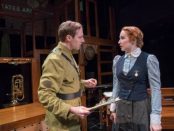
One of the beauties of the book by Mills and Reichel is that all of the characters in the large dramatis personae are very well defined and we have no trouble knowing who is who. Reichel’s direction and staging make the characterizations clear and consistent. Fishman’s Grace is efficient, fair-minded and heroic, always coming up with good ideas to make sure that things run more smoothly and we root for her throughout the story. As the assured, ambitious Suzanne, Skyler Volpe is very feisty, witty and acerbic, in the manner of an Eve Arden role. Chanel Karimkhani’s Helen, the farm girl, is constantly getting into trouble, not least of which is her problem being late most of the time and her naïveté and lack of sophistication. As the oldest operator and a married woman, Lili Thomas’ Bertha is a rock of stability when others are falling apart. Cathryn Wake’s very French Louise is a firecracker, always speaking her mind - even if it gets her into trouble. Christine O’Grady’s choreography for the dance hall scenes for the women and the doughboys is redolent of ballroom dances of the period. The show’s one flaw is that there is not enough tension until almost the very end when the war comes a little too close for comfort.
[more]
Except for “Santa Baby” and “The Little Drummer Boy,” virtually every Christmas song in existence is wonderfully performed during the pleasant holiday extravaganza, Ruben & Clay's Christmas Show (aka Ruben & Clay’s First Annual Christmas Carol Family Fun Pageant Spectacular Reunion Show). Even the now controversial "Baby, It's Cold Outside" is heard though revised lyrics.
[more]
This nonsensical, broad comedy is penned by the clever Greg Kotis ("Urinetown"). Songs and arrangements by Steven Gross are whimsical and entertaining, and costume designer Whitney Locher presents her vaudevillian best in this frothy piece. Led expertly by director Ilana Becker, the cast bludgeons, connives and wiggles their way through this slice of holiday slapstick; young and old, the actors’ comic timing is well-honed and the fun they have performing this piece is entirely infectious.
[more]
In 90 minutes, Ms. Raffo packs in a great deal. We learn about Iraq’s past and present, religious lore, marital conflicts, unrequited love and the hardships of immigrants. The stiff treatment is schematic rather than polished and the resorting to soliloquies feels off. Without a defined plot, it plays out as a limp multi-character study that’s resolved with a talky and unconvincing denouement. Raffo does create appealing characters including the substantive title role which she herself plays.
[more]
It’s a very presentational show. The six ensemble members comprise a sort of group narrator, working in tandem to relate the memories of the Thomas character for the audience—sometimes sorting out how it all really happened and sometimes taking on the roles of characters from the memories. Nicholas Barasch plays wide-eyed “Dylan,” who is totally swept up in holiday magic. Naomi Louisa O’Connell is his mother and Dewey Caddell his father. Extended family and friends are played by Margaret Dudasik, Polly McKie and Ashley Robinson.
[more]
Though vastly different from each other, all four operas dealt either directly or indirectly with time, with the ways in which the past -- personal, historical, mythic -- influences the present. Each work, though short, provided a compelling immersion in a very particular and individual moment.
[more]
“Why did I marry such an idiot?!” exclaims Deanna about her goofy husband Keaton. Not only is he an inept drug dealer but he has also kidnapped a seal who is presently in human form and her vengeful relatives are now on the warpath. These are the outlandish plot points of playwright Krista Knight's charming "Selkie" where mirth merges with darkness.
[more]
Tom Stoppard, our most cerebral modern playwright, has finally written a play that one would have expected from him all along. "The Hard Problem," his first play in ten years, is literally about concepts in neuroscience and its characters are psychologists, scientists and mathematicians all studying the brain. While the story and its outcome are intriguing, like many Stoppard plays, the characters are not likeable and you will find yourself not rooting for anyone. (Most likely, many real scientists aren’t lovable people either.) Jack O’Brien, who has previously directed Stoppard’s "The Coast of Utopia," "The Invention of Love," and "Hapgood," all for Lincoln Center Theater, has chosen his LCT cast without household names just as did the original London production in 2015 by Nicholas Hytner for Britain’s National Theatre.
[more]
"Quicksand," Nella Larsen’s 1928 award-winning first novel, has been given an ambitious, epical stage adaptation by Everyday Inferno Theatre Company working out of the IRT Theater. While Regina Robbins’ script for this Harlem Renaissance literary work basically is an assigning of the text of the novel to a company of 13 actors, it is the work of director Anaïs Koivisto who makes this swirling production feel adventurous in creating both a community and a specific world. EITC’s mission statement is to create “adventurous theatrical productions of new or rarely produced texts that tell women's stories in a unique, entertaining, and accessible manner,” and this lives up to its goal.
[more]
The flier for "Shadows," subtitled "A Dance Musical," calls it “a Gothic ghost love story,” adding, “It’s Twyla Tharp meets Stephen King.” If only. "Shadows," written by Randall David Cook (book) and Edison Woods, Maxim Moston and Karen Biskho (music and lyrics) and choreographed and directed by Joey McKneely, does tell a love story and does have a good deal of dancing, but the eerie romance doesn’t rise to the complex Gothic levels of Stephen King and the choreography is far less creative than Twyla Tharp’s.
[more]
Overbearing nuns, eccentric priests and confusing religious tenets are detailed with stand-up comedy gusto by performer Martin Moran in recounting his Colorado Catholic upbringing during his absorbing self-written confessional solo play,"The Tricky Part." Following that familiar list of targets and lively audience interaction, the main thread of the show is disclosed.
[more]
Although Chua is less interested in beauty for beauty's sake than Andersen, the look and sound of "The Emperor's Nightingale" is still stunning, drawing on a wealth of traditional Chinese art forms to both enliven and culturally ground the story. Leading the way are Joseph Wolfslau's period-inspired score and You-Shin Chen's eye-popping set, which pays lovely tribute to the art of Chinese paper cutting. Leslie Smith's lighting design nicely highlights all of the wonderful colors in Chen's set, as well as those found in Karen Boyer's lambent costumes, which do imaginative justice to human and animal alike.
[more]
Her quietly wry, gently self-deprecating autobiographical lecture demonstration, “Minimalism and Me,” was the first half of a program devoted to her early works. These works more often than not caused more chin scratching than accolades. From the virtually motionless “Tank Dive” to the giddy, if slight, “Eight Jelly Rolls,” her intellectual processes—including stacks of graph paper jottings that guided her and her dancers on stage (or on gymnasium floors, museum exhibition rooms and outdoor spaces)—were sensible yet challenging to the status quo of the 1960’s when she did her first choreographic experiments with her all-female quintet.
[more]
Pink’s “Perfect” was the exhilarating finale of singer Christopher Caswell’s vivacious cabaret act, "Step into the Sun." Fourteen eclectic, mostly unconventional numbers were performed in 75 easygoing minutes with depth, humor and virtuosity. Interspersed with the musical portions was his expertly crafted biographical patter delivered with skillful comic timing and emotional resonance. It all added up to an entertaining theatrical self-portrait.
[more]
In a time of fake news, these timely and topical questions are raised in the delightful new Broadway play "The Lifespan of a Fact," a dramatization by Jeremy Kareken & David Murrell and Gordon Farrell of the essay/book by writer John D’Agata and fact checker Jim Fingal, both who appear as two of the three characters in this play. Stars of stage and screen Daniel Radcliffe, Cherry Jones and Bobby Cannavale are having a field day in this amusing and provocative romp in roles that they have played before and are not too taxing but are played by them to the hilt. The fact that this is based on a true story adds to the piquancy of the play – although to be absolutely truthful the original editing job took seven years while only five days go by in the play.
[more]
Rattlestick Playwrights Theater is presenting a theatrical event by Idaho theater poet Samuel D. Hunter ("The Whale," "A Bright New Boise," "The Few," "Pocatello," "The Healing," "The Harvest"): a long one-act masterpiece (Clarkston), a 40-minute communal dinner served on picnic tables of what the characters would be eating and a curtain raiser, "Lewiston," which has the same themes and symbols as the later play. Taken as a whole this is a remarkable achievement, probably the best Hunter has created so far. Director David McCallum must be given some of the credit for this magnificent evening, and in particular actor Edmund Donovan who isn’t so much performing as living his character of Chris in "Clarkston."
[more]
Visually impressive due to the inventive work of scenic designer Donald Eastman and director Arthur Adair’s fine staging, "Chasing the New White Whale" is playwright Mike Gorman’s muddled attempt at an epic drama of drug addiction in the contemporary United States. Herman Melville’s classic 1851 novel "Moby-Dick" is metaphorically employed and heavy-handed references and motifs abound.
[more]
"Life X 3" was first seen in 2003 at the Circle in the Square. This revival is tauter and funnier. Perhaps this smaller venue refracts the play in a different way, but these four actors are more convincingly real, not to mention greater pains in the butt. As the title implies, they get three chances to reveal—and revel in—their egos and idiosyncrasies, each succeeding part bringing out both nuances and bombshells.
[more]
The attempt to draw comparisons between two disparate one-act plays by Brian Friel proves forced and effortful. In a program note for "Two by Friel," now playing at the Irish Repertory Theatre, director Conor Bagley writes, “Although written over three decades apart, 'Lovers: Winners' and 'The Yalta Game' speak to each other in sacred whisperings.” In the event of seeing them performed back-to-back, those 'whisperings' prove so faint, they can barely be heard.
[more]
While Alex Roe’s minimalist production is both sharp and engrossing, the play offers viewers several problems. Aside from the three main characters, the play has 23 other speaking roles with actors doubling and tripling in multiple roles. Those unfamiliar with the Hungarian names as well as the history may have trouble following the twisty drama as the events pile up. Ardrey uses the awkward device of a narrator actually called the “Author” (played by Joel Rainwater) which helps a greatly but this also leads to a good deal of excess information. At almost three hours, "Shadow of Heroes" is an investment in time but it does pay off in the end. There are very few plays since Shakespeare which attempt as this one does to dramatize such a large chunk of history on stage.
[more]
Ostensibly about domestic abuse, the evidence is all offstage and we must surmise this from the defeated condition of the heroine Irene played by Ms. Daly. Her husband Gerry (John Procaccino) is involved in some shocking, nefarious business revealed to the characters on stage but never revealed to the audience, nor is the confidential project her brother Teddy (Mr. Daly) claims to be working on which will make his fortune. As such, the thrills are all a matter of guesswork, rather than actual events.
[more]
«
1
…
53
54
55
56
57
…
114
»
Copyright Jack Quinn, 2001-2023