News Ticker
- December 14, 2025 in Broadway // Oedipus
- December 14, 2025 in Interviews // Conversation with Dominick LaRuffa Jr.
- December 14, 2025 in Off-Broadway // The Surgeon and Her Daughters
- December 14, 2025 in Features // Notes Toward a One-Man Play About Scammers, Character, and Control
- December 14, 2025 in Features // A Seasonal Salon Worth Noting
- December 13, 2025 in Off-Broadway // BUM BUM (or, this farce has Autism)
- December 12, 2025 in Musicals // The Faggots and Their Friends Between Revolutions
- December 12, 2025 in Cabaret // Mary Foster Conklin — Mirrors Revisited (50th Anniversary)
- December 11, 2025 in Cabaret // Kathy Kaefer — Kiss Me Once: Stories from the Homefront
- December 11, 2025 in Off-Broadway // The American Soldier
- December 9, 2025 in Off-Broadway // This World of Tomorrow
- December 9, 2025 in Cabaret // A Noel Coward Celebration — Steve Ross & Friends
- December 7, 2025 in Off-Broadway // Diversion
- December 5, 2025 in Off-Broadway // Meet the Cartozians
- December 5, 2025 in Features // Tom Stoppard: An Appreciation
Archive
The play is carefully plotted, and the tragic action that Snider builds runs its course in a logical, plausible fashion. But something about "Death of a Driver" never quite catches fire. The story has gravity but lacks the sense of pity and terror that tragedy is famously supposed to invoke. Maybe it’s partly due to the fact that the play is so brief, and that its short scenes sometimes take place years apart, creating a kind of herky-jerky quality. Maybe it’s because the world of the play is relatively narrow—with the lack of supporting characters preventing us from getting a full sense of the Kenyan culture and political landscape.
[more]
Devilishly enigmatic and culminating in an eerie denouement, playwright Jorge Ignacio Cortiñas' stylized warring brothers yarn "Recent Alien Abductions" confidentially veers tonally, seemingly goes off on tangents and holds interest for much of its off-kilter 90 minutes.
[more]
Being described as a “theatre event,” the unwieldy titled "Rocco, Chelsea, Adriana, Sean, Claudia, Gianna, Alex" is a throwback to the happenings and performance art of the 1960’s, without having the same visceral effect. Based on original work by the devising company, playwright Dan Hasse attempts to be up to the minute by including a great many hot button issues, but the endless scenes and vignettes seem to be part of a checkoff list of items to include rather than any great need to link these disparate topics.
[more]
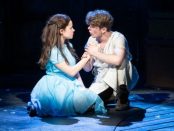
Molly Gordon and Colton Ryan in a scene from MCC Theater’s new musical “Alice By Heart”
[more]
Lanford Wilson’s celebrated humanistic style and spirit are wonderfully evoked by playwright Linda Faigao-Hall in her moving family drama "Dying in Boulder." Its articulate characters confront life’s challenges including death, birth, and disappointment with stalwart resolve, humor and mysticism. At times it seems overly leisurely but falls into place as it reaches its lovely conclusion.
[more]
Brooklyn United Live’s Finale Piece Heart-pounding rhythms, precision choreography, a
[more]
Another — and perhaps unexpected — benefit of having Nathan around was that Sinoway had a built-in support system on set. Once, when Sinoway was feeling overwhelmed during a tech rehearsal of Manifesto — a previous collaboration of theirs — Nathan put his hand on Sinoway’s shoulder and just let him cry.
[more]
However, the play may not be to the taste of regular Mint theatergoers as it seems much more dated that the usual lost masterpieces rediscovered at this esteemed venue. Thomas Scott is so rigid in his thinking that he is against not only dancing beer, and theater, but also the Literary Society which has put on "Twelfth Night," a Shakespeare comedy in which the young lady playing Viola had to wear pants. In general except for singing hymns, Scott is against all pleasures. A great many of his neighbors no longer take exception to these activities and his own family could desperately use the money they are being offered to better themselves.
[more]
As directed by Benson, special mention goes to Primack, Quint, Payne, and Wexler for their strong and playful commitment to their characters, followed by the efforts of Mazzoccone, Porter and Belch. All the actors can be credited with bringing moments of levity and ingenuity to their parts. Favorite line in the whole play--an aside from Fabian, delivered expertly by Ungar--“If this were played upon a stage now, I could condemn it as an improbable fiction.” Ship sailed!
[more]
Howard Lindsay and Russel Crouse’s 1946 Pulitzer Prize winning political play, "State of the Union," should be, by all accounts, dated in its depiction of the 1948 presidential political campaign with 1940’s references to people no longer household names. However, it seems more relevant than ever thanks in part to Laura Livingston’s smart and sassy revival for Metropolitan Playhouse, whose mission is to explore America’s diverse theatrical heritage. Her crackerjack production of this fast-paced political and romantic comedy moves like a house on fire and lands every one of its jokes. In addition, the play is so wise about the ways of backroom politics and Lindsay and Crouse have isolated a great many post-W.W. II issues that are now front page news again that this well-written and well-crafted comedy, although a period piece, has a great deal to say once more. Great fun will be had by all, both Republicans and Democrats, as well as independents.
[more]
In “Star Dust,” a 2016 ballet tribute to David Bowie, Rhoden displayed his mordantly campy side in a series of scenes, each devoted to a famous Bowie number, beginning with Brandon Gray leading the company in “Lazarus,” setting the format for the rest of the ballet. His face streaked with makeup, his hair aglow with color, Gray prowled proudly about the stage mouthing the words that Bowie sang. He seemed very satisfied with himself.
[more]
Usually considered one of Sondheim’s lesser musicals, albeit with one of his best scores--and needless to say, that’s saying a lot--this production provides a heft and a story that are sorely lacking in previous versions. There is no denying or gainsaying its power to impress, as each and every song comes through with its capacity to build characters and tell stories. If the stories are less than satisfying in earlier productions, that’s due more to bookwriter George Furth (adapting the original play by George S. Kaufman and Moss Hart) than to Sondheim or to his other collaborators, each of who has provided an impeccable contribution to the current enterprise.
[more]
The York Theatre Company is to be applauded for taking the risk of staging this famously controversial musical in its New York premiere. It is also fulfilling its mission to bring to the stage musicals of quality that might not be done elsewhere. As Alan Jay Lerner is one of the legendary giants of the musical theater, it is a pleasure to be able to see this lost musical in a workable version. However, despite the excellent staging by director Emily Maltby, "Lolita, My Love," the casting still seems problematic and the musical is ultimately disappointing. And while music director Deniz Cordell has performed yeoman's work reconstructing the score and playing it entirely solo at the piano, John Barry’s music is not aided by being heard in this cut-down orchestration.
[more]
A scorching and ingeniously plotted exploration of feminism versus rape culture in the contemporary United States is achieved in "Good Friday." Playwright Kristiana Rae Colón’s audacious, fierce and gripping topical drama is ultimately a provocative vigilante yarn strewn with off and onstage violence that’s dynamically presented.
[more]
BalletNext is a company founded by Michele Wiles, former prima ballerina of American Ballet Theater. Wiles has developed a symbiotic relationship with the University of Utah where she trains professional ballet dancers who are simultaneously getting degrees in various fields. In exchange, she has bodies on which she can develop her skills as a choreographer. And she arranges public performances, giving her students real stage experience. These performances always include live musicians, which is a particular pleasure compared to so many companies that use canned music.
[more]
In this madcap universe, passengers on a jet are caught in a space warp known as a “corn hole” that was caused by Amazon’s tampering with the atmosphere to speed up delivery times, Amazon is developing a female sex robot, and an insidious virus is unleashed. This pestilence manifests itself by causing people to become “furries” where they identify as animals and wear appropriate physical embellishments. The population has internet chips implanted in their heads, “Blow Hole” a cross of Facebook and YouTube is the prime communications platform, and “twats” go viral on “Twatter.”
[more]
The property is now more than a half-century old. But this production makes it seem as though the 1964 iteration were merely an English-language version of a classic from even longer ago. There’s a greater feeling of immediacy than perhaps ever before. Hearing the characters speak and sing in the tongue that their real-life 1905 contemporaries would have used is deeply moving. What a shame that so many speakers of Yiddish from decades past never got the chance to experience the musical in this guise.
[more]
Mystery writer Patricia Highsmith ("Strangers on a Train," "Carol," "The Talented Mr. Ripley") was famously alcoholic, depressive, misogynistic and racist. She was unique as an internationally famous writer who had created in Tom Ripley the only serial killer ever created by a woman writer. In "Switzerland," Joanna Murray-Smith, one of Australia’s most successful playwrights, has written a play about the last days of this reclusive writer’s life. Directed by Dan Foster, the initially fascinating premise takes a sharp turn into territory that requires a good deal of suspension of disbelief.
[more]
The show’s talented mastermind is Preston Max Allen. Mr. Allen’s rollicking score is a pounding collection of catchy pop and showtune melodies matched with sharp lyrics. Allen’s well-crafted book is comical, suspenseful and problematic. However, there’s too much of it. The characters are all cleverly fleshed out, the milieu is authentically rendered, but the rambling structure is a drag.
[more]
Director Ciarán O’Reilly handles O'Casey's abrupt tonal shifts well, transitioning from laughter to tears to horror with barely a hint of contrivance. A top-notch production team greatly aids O’Reilly's quest for authenticity, turning the performance space into an impressive simulacrum of war-torn Dublin. Leading the effort is Charlie Corcoran whose incredibly detailed set spreads out into the audience, where a gloomy, ramshackle corridor deposits theatergoers into seats bracketed by crumbling brick walls and overhung with clotheslines burdened by the tenants' latest washings.
[more]
Thompson does good work as Billie—she looks like her and sounds like her when singing. Too bad, though, that her songs are all ballads. It would have been nice to hear her sing something more upbeat from the Holiday catalog, perhaps toward the end of the show. Ryan gives us a Malcolm who looks like a scholar and sounds like a practiced orator. And Barnes creates a Yusuf whose early death has made him an eternal adolescent: frozen forever, somewhere between youth and manhood. Perhaps, though, with Emmy’s help, Yusuf can somehow grow out of this awkward stage—dead though he may be.
[more]
With the audience sitting ringside on three sides of the new theater, and performed by Masden and Belcher at the top of their game, The Light is thrilling theater. Their Gen and Rashad are both sympathetic, attractive characters and their story and their dilemma is entirely gripping. As the former football star (and a boxing pro in The Royale seen at Lincoln Center’s Mitzi E. Newhouse Theater,) Belcher has a tremendous physical presence. Masden is so articulate as the school principal that she elevates the debate to a high level of drama. Even if there are coincidences or sudden revelations that are hard to believe, this play that makes use of the themes of both the #MeToo and Black Lives Matter movements is cracklingly provocative theater. And like an excellent boxing match, director Vaughn has her actors come out ready to spar from the moment they enter the stage.
[more]
This wasn’t just a political statement about gender stereotypes, but a sensitive work of art that made its points through fine choreography, costuming, lighting (smartly designed by Jennifer Hill, creating a wide range of ambiances) and music. Half-Heard accomplished this without beating the audience members over the head.
[more]
Westchester Broadway's Ain't Misbehavin'--the 208th offering at this venerable dinner theater--is indeed in good hands. For starters, it is directed by none other than Richard Maltby Jr., who conceived and directed the original New York production, some four decades ago.
[more]
Welcome to "The Waiting Game," a play by Charles Gershman, which has the makings for a meaningful drama, but never really amounts to much. A large part of the problem is the nondescript and dull staging, as directed by Nathan Wright, which doesn’t really bring any of the characters alive. And then there’s the writing, also nondescript and dull, does nothing to make the characters real--nor does it contain anything resembling exposition.
[more]
Welch and the play’s director, Jonathan Weber, seem to be going for a sort of Ionesco-esque ambience here. The story unfolds in a broadly played, cartoonish way. Occasionally, a satirical jab at ivory-tower academics will land, thanks to Welch’s depiction of the shallow and creepy professor, who—as played by the bearded Slone—looks like he just stepped out of a daguerrotype. But, generally speaking, this comedy is rambling, unwieldy and not especially funny. (Few audience laughs were audible during the performance under review.) In the last stretches of the play, a meta element is introduced, with the characters talking about having entered “the epilogue” stage of the story. Once we’ve stumbled into this self-referential territory, it becomes even harder to engage in any real way with the play.
[more]
Clark has chosen to direct the play as though it were drawing room comedy. Beginning and ending the play with a game of cards, there is the suggestion that for Edgar and Alice this is all a series of games. Outsiders cannot understand this, particularly her cousin Kurt who visits them for the first time in 15 years. Whether this is the fault of the new translation or the belief that modern audiences unfamiliar with Strindberg’s psychological nightmares would have trouble sitting through this disturbing ritual, the effect is to make "The Dance of Death" seem very superficial, as though Neil Simon had chosen to rewrite an Eugene O’Neill tragedy simply for laughs.
[more]
It has been well publicized that the Harper Lee estate filed a lawsuit in February 2018 alleging that the play deviated too much from the novel. They should not have worried. As directed by Bartlett Sher, Aaron Sorkin’s astutely scripted "To Kill a Mockingbird" with Jeff Daniels as Atticus Finch is a magnificent and moving theatrical experience that treats the novel with respect and dignity. The additions and changes from the novel only make the material more stage worthy and a better experience in the new medium. Harper Lee’s justly famous lines about it being a sin to kill a mockingbird and never knowing a person until you walk around in his or her skin brought an audible reaction from the audience at the performance under review, demonstrating that they were with the story all the way.
[more]
"The Whole World Was Watching: My Life Under the Media Microscope" is the autobiography of the South Carolina native journalist and television production figure Frank Beacham that was published in November 2018. A portion of it details his six-month involvement with Welles while they were attempting to produce a "King Lear" video project, aborted by his death at the age of 70. Instead of an artfully whimsical take, this adaptation gives us a lumpy Welles 101, ticking off familiar events laden with the tritely imparted theme of the artist versus cold Hollywood capitalism.
[more]
"Bonnie’s Last Flight" peppers its character moments with humorous sketches and air travel anecdotes. Some don’t hit their mark, but most do. There’s an especially amusing and thoughtful moment where the audience is handed landing cards on which they’re invited to “lighten their emotional luggage upon arrival.” All “passengers” are asked to “write down whatever’s been weighing you down: a fear, a hurt, a grudge, anything you’re ready to let go of—anything to lessen the emotional kilos you carry around. When we do our trash collection shortly we will also take the emotional waste you wish to dispose of. Namaste.” I’m quite certain every person in the audience felt better after their card was taken out with the trash, present company included.
[more]
The 1970 play was originally adapted by playwright Saul Levitt (who previously turned the Pulitzer Prize winning novel "Andersonville" into a successful trial play) from Berrigan’s free verse version based exclusively on the trial transcript. Not seen in New York in 30 years, "The Trial of the Catonsville Nine" has been reimagined in a new version making use of additional sources by Jack Cummings III, artistic director of the innovative Transport Group theater company. A powerful experience, the revival proves to be a provocative investigation of what a citizen should do when he or she feels that the government is engaged in immoral actions.
[more]
The York production has been directed and adapted by Marc Acito who has condensed the original two act script into a long one-acter. Realizing that the original setting of 1948 for a tenth year college reunion with no reference to W.W. II or returning veterans does not make a lot of sense, he has moved the romantic comedy plot up to 1959 with some new appropriate references to the fifties (Davy Crockett caps, McCarthyism). Although the story seems to flow well enough the new problem is that with the deletion of some of the plot and dialogue, the characters seem to have been reduced to one-dimensional stereotypes which gives the actors a great deal more to do in order to make them real.
[more]
Yaël Farber’s adaptation of Strindberg’s classic "Miss Julie," "Mies Julie" shifts the scene and setting from 1880’s Sweden to the Karoo in South Africa on Freedom Day in 2012--or the anniversary of Nelson Mandela’s election in 1994--which is long after apartheid was outlawed. Such changes shift Strindberg’s focus on the class system to matters of racism and apartheid today, when, despite any suggestions that we’ve transcended such problems, racist incidents continue to be in the news every day. They also make the play far more relevant than the antique penned by Strindberg, although ironically, it was far ahead of its time when it was written.
[more]
«
1
…
50
51
52
53
54
…
114
»
Copyright Jack Quinn, 2001-2023