
High Spirits (New York City Center Encores!)
This rarely revived 1964 musical begins with a séance and glows like a theatrical ghost—forgotten, but full of vintage pleasures…a show so worth summoning.
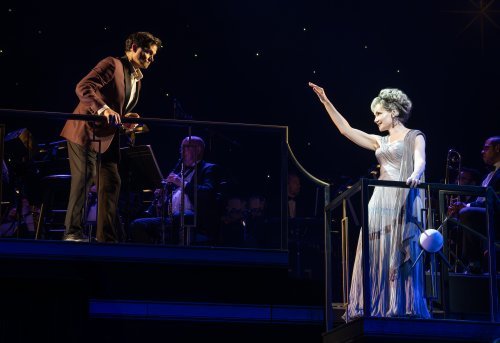
Steven Pasquale as Charles and Katerina Lenk as Elvira in a scene from Encores!’ revival of “High Spirits” at New York City Center (Photo credit: Joan Marcus)
The afterlife has always enjoyed a sturdy tenancy on the musical stage, but High Spirits—Hugh Martin and Timothy Gray’s tuneful graft onto Noël Coward’s Blithe Spirit—has, until now, seemed a ghost itself: spoken of fondly by aficionados, seldom seen, and rarely summoned with conviction. That City Center Encores! has revived it, in its first professional New York outing since 1964, makes its long absence feel less like neglect than a curious collective lapse in memory. For this effervescent score and Coward’s indestructible farce reveal themselves, in performance, to be not merely viable but positively tonic.
Under Jessica Stone’s direction, High Spirits is presented with a spareness that registers as notable even within the intentionally stripped-down aesthetic long associated with Encores! The concert format, here, feels less like a stylistic choice than a visible process: once again scripts remain firmly in hand, and the performers give the impression of artists still negotiating their relationship to the material in real time. At moments we are treated to some hilarious spontaneous reactions, tongue-in-cheek banter when one actor has turned too many pages in his or her binder.
Coward’s premise remains intact: the urbane novelist Charles Condomine, here embodied by a warmly flustered Steven Pasquale, is caught between the living and the dead, and between two marital temperaments. His present wife, Ruth (Phillipa Soo), is composed, rational, and increasingly exasperated; his first wife, Elvira (Katrina Lenk), is a flirtatious revenant conjured by a séance that should have been little more than parlor sport. The triangle is less romantic than metaphysical, but its emotional stakes—jealousy, nostalgia, the ego’s hunger to be adored—are recognizably human. That familiarity is part of the property’s durability: from its wartime West End triumph to David Lean’s 1945 film and the many revivals since, Blithe Spirit has prospered by flattering our suspicion that love never quite releases its hold, even at the grave.
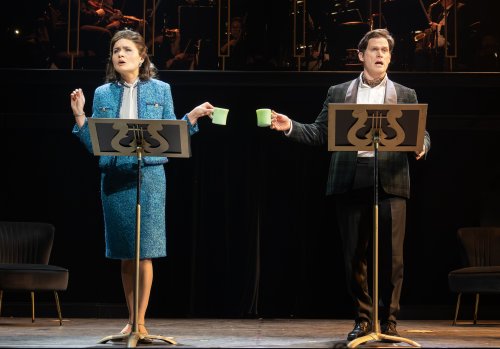
Phillipa Soo as Ruth and Steven Pasquale as Charles in a scene from Encores!’ revival of “High Spirits” at New York City Center (Photo credit: Joan Marcus)
What High Spirits adds is not reinterpretation but embellishment. Martin and Gray, with Coward himself initially at the helm, did not attempt to “fix” a play that wasn’t broken; they sweetened and expanded it. Songs are folded into a streamlined book (further tweaked here by Billy Rosenfield), and Madame Arcati—Coward’s eccentric medium—blooms into a star vehicle, with production numbers and an entourage. One can see why the piece has puzzled modern directors hungry for conceptual hooks: it is, unapologetically, a well-made musical comedy in the mid-century mode not asking for any unnecessary surgery, more cocktail than manifesto.
But the score is the argument. These melodies do not clamor; they waft. They arrive with the gentle confidence of songs written in an era when a tune was expected to carry its own emotional freight. Under Mary-Mitchell Campbell’s assured baton, the Encores! orchestra—29 players deep—moves easily from brassy éclat to bluesy languor. Crucially, the numbers are not decorative afterthoughts. They sharpen character and propel the action, sidestepping the dead weight that so often afflicts musicalizations of straight plays.
The cast meets the material with style and clarity. Soo, in “Was She Prettier Than I?,” lets vulnerability flicker beneath Ruth’s polish, catching the quiet panic of a woman measuring herself against a husband’s memory. Lenk makes Elvira less a stock coquette than a seductive force of nature, gliding through “You’d Better Love Me” and the darkly comic “Faster Than Sound” with a teasing, dangerous lilt that closes out the first act. Pasquale, amiable and vocally generous, charts Charles’ oscillation between devotion and vanity, especially in the contrasting duets that serve as each marriage’s private anthem—the pining “Forever and a Day” for Elvira and the disarmingly direct “If I Gave You” for Ruth. That Pasquale and Soo share a real-life marriage lends their exchanges an added, if unquantifiable, glow.
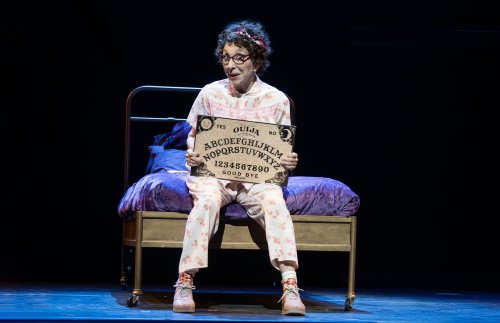
Andrea Martin as Madame Arcati in a scene from Encores!’ revival of “High Spirits” at New York City Center (Photo credit: Joan Marcus)
Still, the evening belongs, as it must, to Madame Arcati. Andrea Martin seizes the role with the relish of a performer who knows that precision, not mugging, makes farce sing. Even tethered to Encores!’ inevitable music binders, she radiates command. Her number “Talking to You,” ostensibly an address to her Ouija board, becomes a comic coup when the board doubles as a discreet prompt; the joke lands not as a cheat but as a wink at theatrical artifice itself. Traces of Martin’s legendary SCTV brilliance peek through, yet her Arcati is never a caricature—more a woman joyfully certain of her own peculiar gifts.
Around the principals, the production is handsomely supported. Rachel Dratch as the Condomines’ maid brings new meaning to “walk that walk” in that she has so many postures and tempi (dependant on who’s asking and for what purpose) and a late in the evening reveal in a bathrobe with her head bandaged is an absolute riot. Jennifer Sánchez as Mrs. Bradman lends a gentle normalcy as compared to the other wives, dead or alive. They both lend texture to roles that can easily fade into function, and Campbell Scott’s double turn as both doctor and a lightly sketched Coward-narrator adds a layer of urbane framing. Jessica Stone’s direction honors the play’s devilry without embalming it, and Ellenore Scott’s choreography animates the ensemble with a stylized vitality. The so-called “beatnik” acolytes of Arcati move in patterns that are by turns staccato and fluid—Fosse by way of a cubist dream—suggesting spiritual transmission through the body. Their commitment and precision belies the famously brief rehearsal periods of these concert stagings.
Jennifer Moeller’s costumes situate the proceedings squarely in the 1960s, a period frame that flatters the score’s mid-century lilt while lending the evening a faintly mod gloss. Her collaboration with the makeup designer Katie Gell is especially canny in the case of Elvira, who materializes not merely as a ghost but as a vision—rendered in cool, silvered tones that give her the sheen of a lunar deity. If death alone did not secure her an advantage over the living, the styling certainly does; Elvira does not just haunt Charles, she outshines his reality.
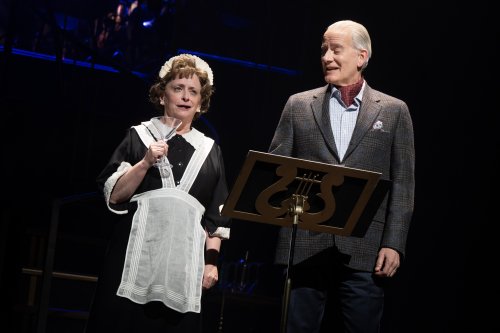
Rachel Dratch as Edith and Campbell Scott as Dr. Bradman/Noel Coward in a scene from Encores!’ revival of “High Spirits” at New York City Center (Photo credit: Joan Marcus)
Bradley King’s lighting operates as an emotional barometer throughout. It adds a buoyant sparkle to Madame Arcati’s “Bicycle Song,” then pivots gracefully into the shadowed and spectral atmospheres that attend Elvira’s appearances, sculpting the stage into zones of flirtation, melancholy, or mischief as required. The design does a quiet but crucial storytelling work, delineating the border between the mortal and the metaphysical.
David Zinn’s scenic assignment is, by comparison, modest—this is an Encores! concert staging, after all, where scenery is often more suggestion than environment. Yet constraint breeds invention. The sight gag of the two identical armchairs that lift into the air and thwart Charles’s attempts at repose is executed with delightful precision, a small but potent reminder of Coward’s mechanical sense of comedy. The most evocative spatial gesture, however, is the use of the staircase—an extension of the conductor’s podium—which becomes a kind of liminal runway between worlds. Elvira claims it memorably for her solos, especially “Home Sweet Heaven,” ascending and descending as if testing the boundary between her celestial address and her earthly attachments. In such moments, the production finds a visual poetry that belies its otherwise minimal means.
Can High Spirits live again beyond the concert hall? This performance makes a persuasive case. Skylar Fox’s nimble illusions hint at the theatrical magic a full production might unleash, and one can imagine contemporary stage technology amplifying the story’s supernatural playfulness without swamping its civility. For all its ghosts, the show’s real subject is the comedy of attachment—how the past courts us, how the present competes with memory. In an era that often mistakes volume for vitality, High Spirits offers something rarer: sophistication with a pulse. A fuller revival would not feel like exhumation but like a welcome return from the beyond. And the pleasure it affords—urbane, melodic, lightly irreverent—feels not nostalgic but joyfully medicinal.
High Spirits (through February 15, 2026)
New York City Center Encores!
New York City Center, 131 West 55th Street, in Manhattan
For tickets, visit www.nycitycenter.org
Running time: two hours and 20 minutes with one intermission


Leave a comment