
Amahl and the Night Visitors
Gian Carlo Menotti's one-time operatic Christmas staple returns a new with mezzo-soprano Joyce DiDonato in Kenny Leon's astute revival.
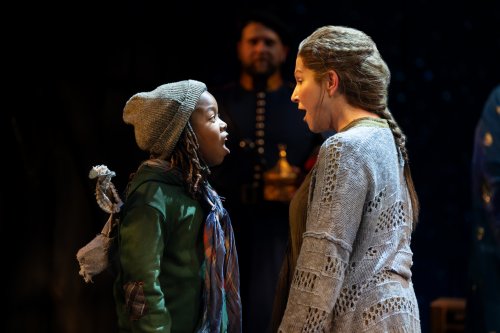
Albert Rhodes, Jr. and Joyce DiDonato in a scene from the Lincoln Center Theater and the Metropolitan Opera production of Gian Carlo Menotti’s “Amahl and the Night Visitors” at the Mitzi E. Newhouse Theater (Photo credit: Julieta Cervantes)
Gian Carlo Menotti’s one-act Christmas opera, Amahl and the Night Visitors, used to be a holiday staple in the 1950s and 60s appearing on NBC annually from 1951 – 1965. Lincoln Center Theater in association with the Metropolitan Opera is trying to revive that tradition with their charming new production at the Mitzi E. Newhouse Theatre. Director Kenny Leon who seems to be everywhere these days has chosen his cast from Broadway and Off Broadway, the Metropolitan Opera and regional opera theater companies. This small lively production starring internationally famed mezzo-soprano Joyce DiDonato may not only create some converts to opera but restore the reputation of Menotti’s forgotten work.
The story is a variation on the tale of the Three Magi which librettist Menotti recalled from his childhood in Italy. Now reset in the present rather than Biblical times, Amahl, a disabled boy who uses a crutch to walk and has a vivid imagination, watches a bright star in the evening sky. His Mother worries as they have neither food nor fuel. Three knocks on the door wake them up, but Amahl’s mother is so used to his imaginative lies that she does not believe there are three kings seeking rest on their journey to visit a special child who has just been born. The Mother tells Amahl to get the neighboring shepherds and have them bring what gifts they can to aid in her limited hospitality to the three kings. Dancing and singing result.

Phillip Boykin, Todd Thomas and Bernard Holcomb in a scene from the Lincoln Center Theater and the Metropolitan Opera production of Gian Carlo Menotti’s “Amahl and the Night Visitors” at the Mitzi E. Newhouse Theater (Photo credit: Julieta Cervantes)
After the neighbors have left and the others have gone to sleep, the Mother fondles the gift of gold that is to be given to the special child, gold that would keep her going a long time. She is stopped by the three kings’ Page who accuses her of stealing. When Amahl comes to her defense, King Melchior wakes up and donates the gold to the mother who refuses it. She says she has waited for such a special child all her life and wishes she had some gift to send. Amahl offers his crutch and at that moment a miracle occurs and he finds he can walk. With his mother’s blessing, Amahl joins the three kings on the rest of their journey.
Originally written in 1951 as the first opera specifically composed for television, the score (to orchestrations completed by distinguished composer Samuel Barber) was played by Arturo Toscanni and the NBC Orchestra. For this chamber production at Lincoln Center Theater’s Mitzi Newhouse Theater, the score has been reduced to two pianos and an oboe, conducted by Steven Osgood. Whereas other Menotti operas of the 1950s flirt with atonal music, the new piano reduction is both lovely and melodic. As the Mother, a role mezzo DiDonato has long wished to sing, her remarkable range holds her in good stead in her three arias (the first one about Amahl’s lies and fantasies, the second about “what shall I do with this boy” when they hear the knocks at the door, and the third about the gold meant for the Christ child. Boy soprano Albert Rhodes, Jr. has the innocence and curiosity of the imaginative child Amahl but at the erformance under review his voice seemed to strain to reach his top notes.
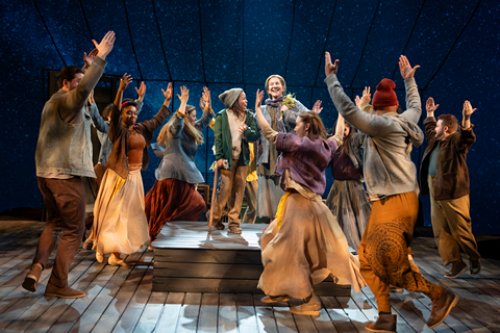
Albert Rhodes, Jr., Joyce DiDonato and the cast of the Lincoln Center Theater and the Metropolitan Opera production of Gian Carlo Menotti’s “Amahl and the Night Visitors” at the Mitzi E. Newhouse Theater (Photo credit: Julieta Cervantes)
It was a clever to device to have the three kings each have a different voice quality though they rarely had a chance to harmonize together: bass Phillip Boykin as King Balthazar, tenor Todd Thomas as King Melchior and baritone Brian Jeffers subbing for Bernard Holcomb as King Kaspar. As their Page, bass Johnathan McCullough always looking out for them brought an authority the others lacked. Dancers Manuel Palazzo, Bryanna Strickland and Madeline Wright did well with Ioana Alfonso’s folk dance choreography which put one in mind of those of Agnes de Mille. Oboe player Jesse Barrett who wove his way through the audience and the shepherd neighbors on stage helped tie the entire work together. The nontraditional casting adds a universality that would not have been present in performances in the fifties and sixties when the opera was first staged.
Leon’s direction uses the round stage at the Mitzi E. Newhouse well, distributing the action all over Derek McLane’s skeletal house set. While the home of these poor people only has a large pedestal for a bed, his projection designs for the twilight, sundown and starry sky are quite impressive. Adam Honoré took his lead on the variations in the lighting from storyline as the opera takes place on Christmas Eve until sunrise the next morning, and highlights the observance of the Star of Bethlehem. The costumes by Emilio Sosa were sumptuous for the three kings (in three primary colors) and just warm enough in earth tones for the shepherd neighbors.
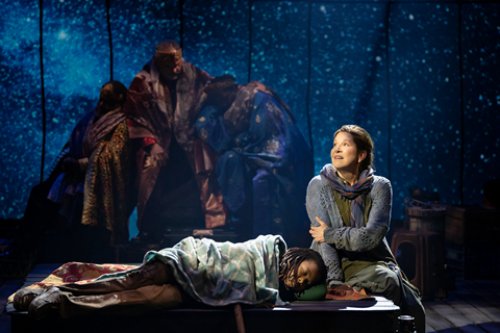
Albert Rhodes, Jr., Joyce DiDonato (foreground) and Phillip Boykin, Todd Thomas and Bernard Holcomb (background) in a scene from the Lincoln Center Theater and the Metropolitan Opera production of Gian Carlo Menotti’s “Amahl and the Night Visitors” at the Mitzi E. Newhouse Theater (Photo credit: Julieta Cervantes)
The Mitzi E. Newhouse has been used at least twice before for chamber opera productions in co-productions with the Metropolitan Opera (Virgil Thompson and Gertrude Stein’s Four Saints in Three Acts in 1973 and the new setting of Lynn Nottage’s Intimate Apparel by composer Ricky Ian Gordon in 2022). The Newhouse proves once again to be an excellent venue for small music presentations as it brings the singers and the performance close to the audience so that the voices do not have to be amplified. Kenny Leon’s production of Amahl and the Night Visitors is fine for both children and adults, those familiar with opera and those who are still novices.
Amahl and the Night Visitors (through January 4, 2026)
Lincoln Center Theater in association with the Metropolitan Opera
Mitzi E. Newhouse Theater, 150 W. 65th Street, in Manhattan
For tickets, call 212-875-5456 or visit http://www.lct.org
Running time: 60 minutes without an intermission


Leave a comment