
Celebration of Song — Freedom and Hope (Open House New York 2025)
A mix of protest anthems, folk standards, and Broadway classics filled the Gothic nave. The synergy between performers and place was unmistakable. The Church of the Transfiguration—home to the Episcopal Actors’ Guild since 1923—has long been the beating heart of New York’s theater community. Its acoustics invite intimacy, its history confers gravitas, and its spirit remains defiantly inclusive.
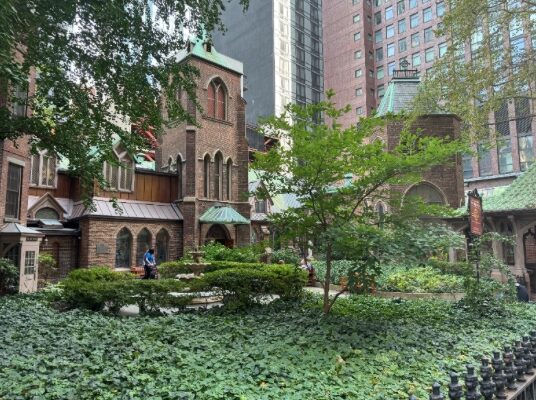 Church of the Transfiguration, 1 East 29th Street, affectionately known as “The Little Church Around the Corner”. https://maps.app.goo.gl/JsH8JeYRZFCL6VPSA?g_st=ipc%5B/caption%5D
As part of this year’s Open House New York festival, the Episcopal Actors’ Guild presented Celebration of Song — Freedom and Hope at the Church of the Transfiguration, affectionately known as The Little Church Around the Corner. It was an inspired afternoon of music and fellowship—part history lesson, part hymn, and part rallying cry. A mix of protest anthems, folk standards, and Broadway classics filled the Gothic nave, and by the end, every face in the pews was smiling.
Stephen Cornine, who not only accompanied but also sang, opened the program with quiet assurance. His reflective solo combined musician’s poise and singer’s warmth—an understated prayer for hope after hardship that set the emotional tone for the hour. Cornine’s dual role as pianist and vocalist gave the afternoon both structure and soul.
Camille Marshall followed with a haunting “Remember My Forgotten Man.” On the line “Brother, can you spare a job for my forgotten man?” her phrasing carried Depression-era gravity but felt unforced—an elegant echo of endurance and empathy. Written by Harry Warren and Al Dubin for Gold Diggers of 1933, it was a cinematic plea for compassion toward the unemployed and war veterans left behind in the nation’s hardest years.
Ariana Johns offered a hushed, crystalline “Imagine.” “You may say I’m a dreamer, but I’m not the only one” drifted softly through the sanctuary, drawing listeners inward. John Lennon’s vision—later also credited to Yoko Ono—was never just a pop song but an invitation to picture a borderless, greedless world built on shared humanity, and Ariana’s delivery made that dream feel freshly possible.
Leslie Middlebrook Moore ignited the room with “March of the Women.” “Shout, shout—up with your song!” she commanded, her clear soprano and crisp articulation turning a century-old suffrage anthem into something timelessly defiant. Ethel Smyth composed it in 1910 to lyrics by Cicely Hamilton as the official rallying cry of the women’s movement, and its fire still blazes in every repeated chorus.
Evangeline Johns followed with a luminous “Forever Young.” “May you always do for others and let others do for you” became a benediction, her gentle vibrato offering the purest kind of optimism. Bob Dylan wrote it as a father’s blessing to his son, a wish for grace, wisdom, and kindness that Evangeline transformed into a prayer for everyone in the room.
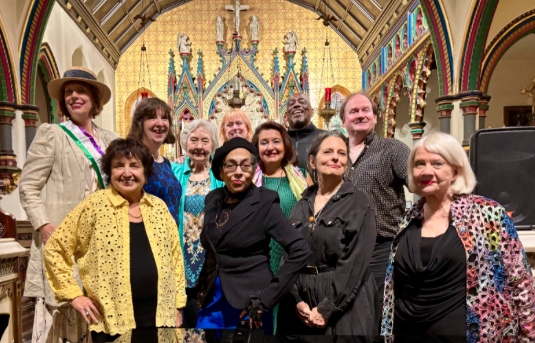
First row on steps left to right Camille Savitz , Camille Marshall, Pangia Macri and Jenny Lynne Stewart 2nd 2 rows left to right Leslie Middlebrook, Claudia Dumschat (musical director),Evangeline Johns , Ariana Johns,Maria Ciccaglione, Stacey Robinson, Stephen Cornine
Then came Broadway grandeur as Jenny Lynne Stewart delivered “The Impossible Dream.” “To fight the unbeatable foe” rang out like a manifesto, her final sustained note met with mid-song applause. Written by Mitch Leigh with lyrics by Joe Darion for Man of La Mancha, the song was conceived as Don Quixote’s declaration of moral purpose—an anthem for anyone who refuses to surrender their ideals, no matter how unreachable.
Camille Savitz’s tender “The House I Live In” drew warmth from simplicity. When she sang “The howdy and the handshake of a child in my town,” her phrasing grounded patriotism in human connection—an idea perfectly suited to this sanctuary of artists. Composed by Earl Robinson with lyrics by Lewis Allan (the pen name of Abel Meeropol), the song was created during World War II as an inclusive vision of American democracy, celebrating shared humanity rather than flag-waving nationalism.
Pangia Macri took a creative turn with “Comin’ Through the Rye,” reworking the familiar folk song with new lyrics. Her version bridged old melody and modern meaning, reminding us that freedom also means the freedom to reinterpret tradition. Originating from Robert Burns’s 1782 poem, long set to a Scottish folk tune, it has shifted from flirtatious pastoral to cultural touchstone—its endurance proving that folk songs, like people, evolve to fit their moment.
Maria Ciccaglioni brought crystalline purity to “Somewhere” from West Side Story. “Hold my hand and we’re halfway there” floated effortlessly, embodying Bernstein’s dream of compassion through melody. With music by Leonard Bernstein and lyrics by Stephen Sondheim, the song was written as a prayer for understanding—a fragile, soaring moment where love imagines the world that prejudice denies.
At the organ, Claudia Dumschat transformed “We Shall Overcome” into a majestic toccata. Her performance turned protest into praise—each chord swelling like stained-glass light refracted into sound. Rooted in a 1901 gospel hymn by Charles Albert Tindley and later carried by Pete Seeger and the civil rights movement, it was originally a promise of endurance through faith, and here it rose as both lament and triumph.
The finale belonged to Stacy Robinson, whose commanding baritone powered “Make Them Hear You” from Ragtime.“Go out and tell our story—let it echo far and wide,” he sang, his voice resonant and resolute. Created by composer Stephen Flaherty and lyricist Lynn Ahrens, the song was written as Coalhouse Walker Jr.’s final appeal to justice—a plea for truth to outlive tragedy, demanding that memory itself become an act of resistance.
The synergy between performers and place was unmistakable. The Church of the Transfiguration—home to the Episcopal Actors’ Guild since 1923—has long been the beating heart of New York’s theater community. Its acoustics invite intimacy, its history confers gravitas, and its spirit remains defiantly inclusive. Under the umbrella of Open House New York, which each October opens hundreds of cultural and architectural landmarks to the public, this little church once again reminded visitors why art and faith have always shared the same language: hope.
For one golden October afternoon, that language was sung in harmony—and the echo still lingers.
UPCOMING EVENTS AT THE EPISCOPAL ACTORS’ GUILD
Sunday, November 9 at 3:00pm
Annual Memorial Service with memorial address by Mary Beth Peil
Monday, December 8 at 7:00pm
A Noel Coward Celebration with Steve Ross & Friends
LEARN MORE AND GET TICKETS AT http://WWW.ACTORSGUILD.ORG/EVENTS
Further Reading on TheaterScene.net
- Ragtime at Lincoln Center – A glistening new revival of the modern classic whose anthem “Make Them Hear You” remains timeless.
- West Side Story – A New Vision – Revisiting Bernstein’s masterpiece of love and division.
- Man of La Mancha in Concert – Exploring the enduring power of “The Impossible Dream.”
- Lennon: Through a Glass Onion – A theatrical journey through the songs and spirit of John Lennon.
- Turning 15 on the Road to Freedom – The story behind “We Shall Overcome” and a movement’s voice.


Thank-you beyond thanks for this plain out rave review of our “golden afternoon”. So lovely to have these written words to commemorate an uplifting cascade of freedom and hope songs. We couldn’t be happier for your kind words.