
ON THE TOWN WITH CHIP DEFFAA… FROM “THE LAST FIVE YEARS,” TO “TARTUFFE,” TO COHAN, AND MORE…
I’m glad “The Last Five Years” has made it to Broadway. It is, alas, far from a perfect production—I’ll explain that in a bit—but that glorious Jason Robert Brown score offers plenty of rewards.
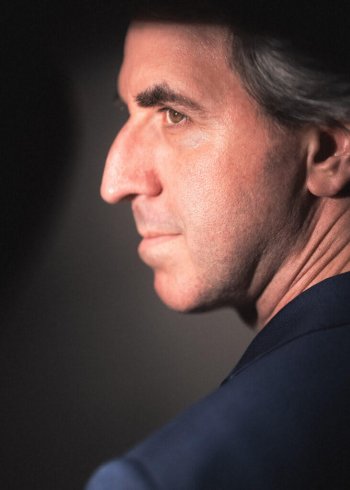
Composer/lyricist Jason Robert Brown
by Chip Deffaa
Editor-At-Large
Okay, faithful readers, I’ve got some great stuff to share in this week’s column. First, let me tell you briefly about the things I’ll be chatting about this week. And then, after the introduction, I’ll go into more detail.
I’ve enjoyed seeing new productions of two plays I’ve long appreciated. I’m glad “The Last Five Years” has made it to Broadway. It is, alas, far from a perfect production—I’ll explain that in a bit—but that glorious Jason Robert Brown score offers plenty of rewards. I was glad I was there in Broadway’s Hudson Theatre, right from the first poignant piano notes head at the start of the show. And Adrienne Warren gives a performance—warm, and honest, and musical throughout—that’s not to be missed. From her very first song, I was pretty much falling in love with her. The production is warmly recommended—even if some significant shortcomings in this production sure disappointed me. The material deserves better; Jason Robert Brown deserves better. (Be patient, dear readers! I’ll explain what I mean by all of that in my mixed-to-positive review, once we get past this column’s introduction.)
And oh! What an unexpected treat it was to see “Tartuffe,” directed by Lauren Palmeri, at the Frank Sinatra School of the Arts, one of New York’s top performing-arts high schools. I try to see a show or two at the great arts schools each year, if my schedule permits; you can see some of the most talented members of the rising generation in such student productions. (I first saw—and reviewed—Ansel Elgort and Timothee Chalamet when they were teens in student shows, for example.) I walked over to the Sinatra School after a recording session; our recording studio happens to be right nearby. I was not planning to review the show, but to simply check it out (or maybe just catch the first act, since I was tired from a full day in the studio). But it was a remarkably good production! Kudos to Palmeri and all involved. One student, Harrison Gan—remember that name; he’s an artist-to-watch!—performed with a level of commitment, conviction, and sustained high energy that I haven’t seen in any high-school or college production in seven years (not since I saw Oscar Williams in a high school production of “The Last Five Years”). More details on the Sinatra School’s “Tartuffe” and the talent I saw in a bit, after I get through this column’s introduction.
And oh yes, my readers–please share in my happiness; I’ve got so much to celebrate right now! On Sunday–my birthday–the soundtrack album for my motion picture “George M. Cohan Tonight!,” starring the great Jon Peterson, will be released ; it’ll be available both as a physical CD and in digital form. (It’s the 46th album that I’ve produced or co-produced.) My ongoing “George M. Cohan project”—as I think of it—has been an important, and rewarding, part of my life since I was just nine years old. What a ride it has been!
And there’s still more to celebrate! We’ve just finished recording a podcast version of my show “Irving Berlin In Person.” It’s the complete show, just as it was presented at the 13th Street Theater, now in podcast form. (We’re mixing and mastering it now.) The podcast will go “live” in about a month, to launch a musical-theater series. If you’d like to see a trailer for our podcast, search for “Irving Berlin In Person—the Off-Broadway Show” on YouTube. Our producers have sponsors, and would like to make podcast versions of all of my shows. I can’t wait!
I’m busy producing more albums. I’m also holding auditions, both online and in-person, specifically looking right now for some male and female singing actors who can play characters who are about 18 years old—for some recording projects and some podcast projects. For more info, or to submit an audition demo by Email, Email me at Footloose518 @aol.com. Please put the word “audition” in the Email’s subject line.
And now that the introduction is out of the way, let’s get down to the nitty gritty. First, let me tell you more about “The Last Five Years.” It’s an important musical. The new production, although flawed in some important ways, still has much to savor.
* * *
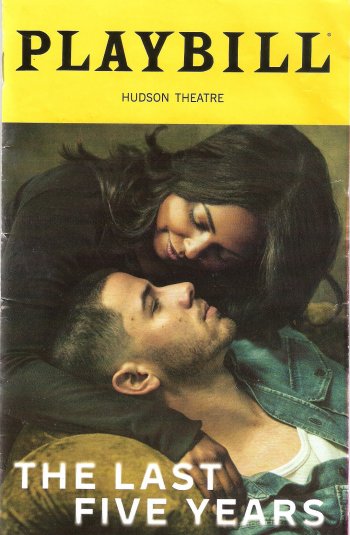
“The Last Five Years” at the Hudson Theatre, Broadway Playbill
“The Last Five Years”—with book, music, and lyrics by Jason Robert Brown–has had a special place in my heart since the original production opened, Off-Broadway, at the Minetta Lane Theatre in March of 2002. Jeffrey Kummerlen and I went to the opening, not knowing what to expect; and we left the theater, at night’s end, feeling we’d seen a near-perfect little show. Unique, honest, moving. Co-stars Norbert Leo Butz and Sherie Rene Scott, directed well by Daisy Prince, both gave equally strong, memorable, well-balanced performances. The co-stars both had so much spunk and spirit, and emotional range; the musical gave them the best roles of their careers. The score was rich, varied, and affecting.
In those days, covering entertainment for The New York Post, I tried to see absolutely everything in New York—as much as humanly possible in terms of theater, jazz, and cabaret. (Health issues make it impossible for me to go out every night now, the way I did back then; and I have to spend more time than I’d like, these days, in doctors’ offices.) But “The Last Five Years” was my personal favorite show of that season, and I happily voted for it as best musical in the Drama Desk Awards.
At the Drama Desk Awards ceremony, I was delighted when the show was honored for having the best music and the best lyrics. (I thought then—and still think—that Jason Robert Brown was the best musical-theater composer of his generation.) After the awards ceremony, I spotted Brown—looking very happy—and his father—looking very proud; I offered congratulations, and snapped a picture of them together at that good night.
In 2013, Second Stage Theater mounted an Off-Broadway revival of “The Last Five Years.” A year or two later, a film adaptation of the musical (co-starring the terrific Anna Kendrick and Jeremy Jordan) came out. (Now I want to watch the DVD again!) And I’ve enjoyed catching occasional productions of the musical, here and there, over the years. Someone’s always doing a production somewhere.
When it was announced that “The Last Five Years” was coming to Broadway in 2025, that was one show I was really looking forward to. And when lights went down at the Hudson Theater as the performance was about to begin, my hopes were high.
I smiled, just hearing the first few sweet/sad notes on piano that open the show. Brown is capable of creating achingly beautiful music. And the music that opens and closes the show is just about perfect.
When Adrienne Warren (as “Cathy”) began singing, “Still Hurting,” my heart melted. She won me over immediately. The warmth and beauty of her supple voice, the emotion, the truthfulness, the strength—all of these things had me under her spell. And every word was crystal clear. (That held true, throughout the night; and it’s something you can’t take for granted in the theater these days. Credit the actors for impeccable enunciation and credit Cody Spencer for first-rate sound design; every word, every note came through impeccably.)
The nine-piece orchestra (music director, Tom Murray) sounded great throughout the night. It’s bigger than the orchestra was in the original Off-Broadway production, and I like that. (In fact, I wish the producers could have given Brown a few more musicians; he could have made good use of them; but I understand economic realities.) Brown’s distinctive arrangements and orchestrations serve the show well, too; and he deserves recognition for that. Sometimes he’ll add subtle accents—unexpectedly punctuating the music in ways I really like–that make all of the difference.
When Warren was singing that first number, I felt confident I’d be in for a wonderful night. Her singing was just sublime. I was delighted. My expectations were high.
Then Nick Jonas (as “Jamie”) began singing his first number, “Shiksa Goddess.” And my heart sank. He simply wasn’t putting it over. That’s a terrific number, if done well. Jonas was sort of relaxed, and amiable, and low-key. But that’s not enough! He was too low-key in his approach, too understated. And a fear hit me: “If he does the whole show in this amiable, low-key kind of way, it won’t have anywhere near the impact it should.”
I’ve always enjoyed Nick Jonas’ work, going back to when he was a kid in “The Sound of Music” at New Jersey’s Paper Mill Playhouse. He has an appealing voice, an easy-going manner, and an innate likeability. He definitely has a congenial personality. All good qualities for a performer to have.
But at the performance of “The Last Five Years” that I caught, Jonas’ energy onstage seemed—overall– notably less than Warren’s. She seemed much stronger, and had more presence on stage, throughout. I kept hoping that maybe Jonas was choosing to deliberately hold back at the start, so as to give his performance room to build over time. (Oftentimes, that’s a wise choice for an actor to make.) I kept hoping that soon he’d find a moment to make our hearts soar along with his. But that never happened. He stayed pretty much on that same relaxed-but-sort-of-lower-energy level throughout. Pleasant enough, to be sure–but not compelling.
And for this musical to work properly, both characters have to be equally strong. To me, watching this production felt almost like I was watching Cathy’s story, and Jamie was a supporting player. (I’ve also seen productions where the opposite was true—when the actor playing Jamie was so much stronger than his counterpart, the show felt too much like Jamie’s story.)
If the show is done night, we need to feel strongly for both Jamie (an ambitious, rising novelist, whose career is his top priority) and for Cathy (an aspiring but not-too-successful actress, who comes to realize she’s not finding enough fulfillment from either her career or her relationship with Jamie).
Ingeniously, Brown shows us scenes from five years of their lives—presenting Jamie’s scenes in chronological order from his courtship with Cathy, through their marriage, through his cheating on her and their breakup; and Cathy’s scenes in reverse-chronological order, from the disheartening end of their relationship going back to its promising beginning. It’s a tough show to do. But—if done well—it’s a breathtaking show. If the show is done just right, we care deeply about both characters, and we feel for both of them. We share in their elation and sorrow.
I watched the current Broadway production, feeling that Nick Jonas—giving us an all-too-mild interpretation of Jamie—was miscast. In some intangible way, Jamie has to come across as having a “leader” type of personality. But Jonas comes across as more of a natural “follower.”
And Whitney White’s direction did not serve the show well at all. I wasn’t sure if she even really “got” the show. (I want to be clear, I’m not knocking her abilities as a director generally; she’s certainly done excellent work as a director elsewhere, and earned an Obie Award for her direction of “Our Dear Dead Druglord.” But not every director is good for every show. And I don’t like the way she’s directed this musical at all.)
In this production, the two characters, Jamie and Cathy, both came across as pleasant, and nice, and likeable, and civil. But there was almost no tension, no drama on stage. Jonas seemed pretty much like an agreeable boy-next-door type; Warren seemed like an agreeable girl-next-door type. Their relationship, in this production, simply didn’t seem to work out. But so what? Their weren’t any real sparks between them. We didn’t become invested in them; and we didn’t care as much as we might have that their relationship petered out.
Watching the performance, I took my rewards where I could. Warren’s voice is beautiful, and she had good songs to sing. Jonas has got a disarmingly appealing personality. The score is rich and varied; I was glad to hear it “live” once again, and in a theater I really like.
But if done properly, “The Last Five Years” takes us on a real emotional roller coaster. We feel each character’s desires; and we feel each character’s pains. We find ourselves sympathizing at times more with Jamie, at other times more with Cathy. There are times when we might even be angry with one character or the other. (“How could you do that?”) We’re being taken on two different emotional journeys. And—if the show is done right–we understand equally both characters’ points of view.
But very little of that was happening in this production. I had trouble believing that these two had ever even been passionately in love with one another. I didn’t feel the right chemistry.
And it killed me to see lines that should have gotten surefire laughs fall flat. Not every actor has a strong instinct for comic timing. But then the director must step in and guide the actor to find the humor, even if it means specifically coaching a performer as to when to take a beat, or how to inflect a phrase or emphasize a word.
There were numbers I love that could have—should have—paid off better. You can add a bit more vaudevillian flair to “A Summer in Ohio.” (The Hudson is a pretty big theater, seating about a thousand people; you can certainly play the scene a bit bigger than it was played the night that I attended.) And add more schmaltz to “The Schmuel Song,” please! If you perform it with zest, and give it some good ethnic flavoring, some Yiddish inflections, it simply works better. (Nick Jonas tried at one point—tentatively and not too convincingly–to do a Jewish accent, but it wasn’t coming naturally to him.)
Each song in “The Last Five Years” is different. Each has its own tone and feel, and message to convey. If you find the full value in “The Next Ten Minutes,” “Nobody Needs to know,” “Goodbye Until Tomorrow,” and “I Could Never Rescue You,” the show not only becomes more interesting, the storytelling becomes clearer. But repeatedly in this production, opportunities were missed. And the show, at times, simply felt becalmed. (I found myself wishing that Daisy Prince or Jason Robert Brown had been chosen to direct this production.)
Still, Warren’s singing was so enjoyable in its own way; she held me throughout the show. And , I might add, she certainly looked great. The costumes by Dede Ayite, favoring earth tones, were very flattering. And the show, with scenic design by David Zinn, has been handsomely mounted. Transitions between scenes were seamless.
But Nick Jonas, playing an all-too-bloodless Jamie, held me only intermittently in this production. Sometimes, when he seemed to be doing too much the same way for too long, I found my mind wandering. I was watching him, but thinking of others I’d seen who have done this role better.
I remembered young Oscar Williams performing the role with such fire and passion and assertiveness that every scene crackled with life. (We could have used some of his energy here!)
I was wondering how Ben Levi Ross—who impressed me so much, starring last year in Brown’s musical, “The Connector” (directed by Daisy Prince)—might handle the role of “Jamie” in ”The Last Five Years.” Ross was certainly interesting throughout “The Connector”—he was always likeable, while also projecting a clear, strong, burning ambition to get ahead. His singing voice is not as pretty as Nick Jonas’s; but as a performer, he’s got more of an edge to him. And the role of “Jamie” needs that. (I think of Jonas as more of a “sunshine singer.” Ross has some darker emotional colors in him, which adds interest.) I’d love to see Ben Levi Ross in the role of “Jamie” some place, someday.
Curiously, as Nick Jonas sang, I found myself remembering the concerts Bing Crosby gave on Broadway when I was younger; Crosby was an American institution; he’d sold zillions of records; his annual Christmas-time TV specials always drew big audiences. Crosby’s publicist for his Broadway run, Marilyn LeVine, whom I knew and liked, was sure the concerts would sell out quickly; Crosby was a “name” with countless fans. (I was one of them.) But Crosby—all amiable and relaxed, and casual (just like Jonas)—simply didn’t generate enough electricity in the theater. Even his fans left feeling sort of let-down. I couldn’t help remembering that, as I watched Jonas.
At the conclusion of “The Last Five Years,” the other night at the Hudson Theatre, I rose to applaud—as much to honor the enduring strength of the musical, which I’ve always admired, as to honor this particular production. Warren and Jonas took just one bow, and exited the stage.
I’m glad I got to see “The Last Five Years” once again. I’m very selective about what I go out to see these days. (Health issues necessitate that. And there’s a lot of work I want to get done before the barn doors close.) It was important to me to see this show. And there was much I enjoyed; I left the theater gently smiling. The show—which I’ve always found very true to life–certainly resonates with me. I can identify, in various ways, with Jamie. (And I woke up this morning with one of the show’s best songs, “The Next Ten Minutes,” running through my head.)
I’m glad “The Last Five Years” has come to Broadway; that should help stimulate more productions of the show in regional theaters and colleges. And I’m all for that. I like Jason Robert Brown’s work. (Incidentally, if you’d like to hear more of Brown’s work, tickets are on sale now for the concert “An Evening with Jason Robert Brown & Shoshana Bean, hosted by Frank DiLella,” at Guild Hall in East Hampton, Saturday, May 24th.)
But this new Broadway production of Brown’s musical “The Last Five Years”–could have—and should have—been much better. I wish Daisy Prince or Brown could have directed it.
* * *

Program cover from “Tartuffe” at the frank Sinatra School of the Arts
Some of the most rewarding shows I’ve seen this year—like Broadway’s productions of “Gypsy” and “Sunset Boulevard,” and City Center’s production of “Ragtime” (which will be transferring to Broadway next season)—were ones that many theater buffs correctly predicted would be major events. Great material, great stars. This season’s justly celebrated productions of “Gypsy,” “Sunset Boulevard,” and “Ragtime” were hot tickets from the moment they were announced.
But I could never have predicted, at the start of this season, that some of the most vivid theatrical performances I’d witness this season would be by students. The Frank Sinatra School of the Arts’ production of “Sweeney Todd” (directed by Dr. Jamie Cacciola-Price, with vocal music direction by Heidi Best), which I caught in March, was as satisfying and fully realized as any student production of a musical I’ve ever seen. That’s the only high-school or college production of any musical that impressed me so strongly that I actually went back to see it a second time. (And I enjoyed it every bit as much, the second time I went.)
I recently went to see the Sinatra School’s production of “Tartuffe” (directed by Lauren Palmeri) after a long day in the recording studio. I had no intention of reviewing it. I was tired; I thought I might just catch the first act and then head home for some much-needed rest. But the play was so terrifically well-done, I was caught. I stayed and enjoyed every minute of that play. I’ll tell you about the production as a whole in a bit. But first I want to tell you about one performer in particular who was exceptional.
A student actor named Harrison Gan stole the show. He had me with him from the moment he strode onto the stage. And when he began to speak—every single word bristling with energy—I initially worried that he was burning through his stockpile of energy too quickly. I thought, “He won’t be able to sustain that high-energy outpouring throughout a whole performance.” (I certainly couldn’t have done that, in my acting days.) But he did! He held nothing back. It’s rare—and wonderful—when you see a performer of any age commit so wholeheartedly to a performance. Extremely rare to see someone so young do it, and do it so brilliantly.
Gans, playing the role of “Orgon,” was putting absolutely everything he had into his performance. I was sitting in a front-row seat (which for six decades has been my favorite seat to have in any theater or club). I could see the perspiration on his brow. Lots of hard-earned sweat! I found myself remembering sitting front-row center with Brock Wade when “Chicago” first opened on Broadway in the 1970s; we could see all the perspiration on the brows of the brilliant Gwen Verdon and Chita Rivera as they danced “The Hot Honey Rag.” Their work was electrifying! And, we could also see–sitting in the front row–it really was work.
Gan committed himself 100% to the part he was playing. I like that! I found myself remembering too, as I watched him, how exciting it was when Betty Buckley appeared on the Broadway scene. She became (and still is) my favorite Broadway diva. It wasn’t just her exceptional voice that got to me, it was the total conviction she brought to each role she played. Whether she was appearing in a great show or a not-so-great show, she compelled our attention by her fierce commitment; I was mesmerized by her work. I’m not saying that Gans, a high-school student, is performing at the same level of talent as the incomparable Ms. Buckley; but he brings to the stage an intensity of commitment and conviction that made me recall how I felt the first time I saw a young Betty Buckley in shows.
Watching “Tartuffe,” I couldn’t possibly have walked out of the theater at intermission (as I’d originally contemplated); Gan had me riveted. And for a student to do that is rare.
Gans caught every laugh in the play. And every emotional twist and turn. His performance was broad, at times campy. But always compelling. On that stage he was living 100% in this irresistible state of heightened reality.
Moliere wrote “Tartuffe” in 1664. Putting over a play that was written so long ago isn’t easy for American teens of today to do. But Gan had the audience with him. And when he stomped off the stage for his first exit—never letting the energy lag for a moment, never breaking character even slightly (as high-school performers so often do)—he carried the whole stage with him. It’s rare when you see a performer of any age—much less one who appears to be perhaps 17—exit with such irresistible flair. And I was elated. Gan earned the huge hand that he got when he made his exit.
I was quietly taking notes, throughout. In the 18 years that I spent reviewing for the New York Post—going out nightly, seeing as much as I could—I got in the habit of taking notes on every show I saw, whether I intended to review that particular show or not.
My first note on Gan’s performance was just one word: “Astonishing.” The last time I noted that a youth’s performance struck me as “astonishing” was seven years ago when I saw Oscar Williams play “Jamie” in a high-school production of “The Last Five Years”; I’d already enjoyed Williams’ work on Broadway and at Lincoln Center, but his passion, zeal, and total investment in the role of “Jamie” struck me so forcefully, I saved the notes on that performance in my special “artists-to-watch file.” I’d never seen anyone his age do better work in a show. (I still haven’t.) And I’ve happily observed Williams’s growth as an artist since then. (I’ve put my notes on Gans into that same “artists-to-watch” file.)
Gan has real presence on stage. He took ownership of the stage right from his first entrance—just by the way he strode onto the stage. I’ve sometimes decided to cast actors in plays, even before they read lines for me or sang at auditions, simply because they walked so confidently, seeming to own the space they were in. It’s a “tell” that I watch for.
I’ve been involved in theater, in one way or another, virtually my entire life—going back to early acting and modeling gigs as a kid. My early mentors in the business, teaching me fundamentals about acting, singing, dancing, stressed to me that you act with your whole body, not just your voice. You communicate a lot, before you even speak, just by how you stand, move, gesture, walk. Gan was doing all of that well.
Over the years, I’ve seen an awful lot of theater. The first Broadway show I ever saw was “My Fair Lady,” in its original Broadway run. I’m not easily impressed by performers; I’ve seen the greatest theater actors of my lifetime on stage. But I was impressed by young Gan’s work. I honestly couldn’t find a single thing wrong with his performance. And that, too, is exceedingly rare. If I were directing him, I’d simply say, “Keep doing what you’re doing.”
If someone with that much talent showed up at an audition I was running, I’d offer him work on the spot even if I had to write a new part into the script for him to play. And on several notable occasions in my career, I might add, I’ve done exactly that—adding new parts to shows to avail myself of the talents of an Amanda Andrews, an Ellery Bakaitis, a Mark Williams.
This production of “Tartuffe” was rich with rewards; I wish you could have seen it. (If you love theater but are put off by prices of Broadway tickets, you’ll always find plenty to enjoy—and may see some future stars—if you check out the productions at New York’s top theater-oriented high schools and colleges. Tickets run around $20.00.) I was impressed by the formidable stage presence and authority of Shekinah Menard, playing Madame Pernelle. That’s not a huge role; I was wishing it was bigger because I tremendously enjoyed every moment she was on stage. She’s a very good actor.
I don’t know any of these students personally; I have no idea which ones might aspire to professional careers as actors and which ones might simply be performing in plays at their school now because it’s a pleasant extra-curricular activity. I may never see these young actors again. But I know that performers like Gans and Menard certainly have the potential for professional careers, if they choose to pursue such a goal.
I was watching Menard work and thinking of which roles she’d be just right for, when she’s a bit older. I hope that someday I’ll be reviewing in this column a terrific Broadway revival of an August Wilson play and I’ll be able to write: “The standout in the production, Shekinah Minard, first impressed me back when she was a teen in ‘Tartuffe’ at the Sinatra School.” I always love it when things like that happen. And I’ve had that experience a number of times. Let me give some examples. Santino Fontana, who’s sung so gorgeously on various albums I’ve produced, is today a seasoned, Tony award-winning Broadway pro. I first praised him in print as an artist-to-watch when he was just a 17-year-old high school student! I was singing the praises in print of a then-unknown Celia Keenan-Bolger from her first show-stealing appearance in a regional production. I was lucky enough to then have her sing in a festival I presented. Today she’s a Tony Award-winning star—having won for her work in “To Kill a Mockingbird”–who’ll be getting be getting a second, special Tony Award, on June 8th. Stephen Bogardus, who regularly records for me, has done highly acclaimed work in more than a dozen Broadway show; I first saw him steal a show when he was still in his teens. Most of the performers who work with me are seasoned pros who’ve worked with me for many years; many of them I first found when they were just starting out. Some of the Sinatra School’s current students definitely have the talent to pursue professional acting careers, if they wish. Mateo Lizcano, whom I always enjoy seeing on stage (he already has two Broadway credits and will be starring in a new musical, “A Wrinkle in Time,” at Washington, DC’s prestigious Arena Stage this summer) was a Sinatra School student just a few years ago.
Among others in the cast of “Tartuffe” who impressed me were Abigal Matias as “Marianne” (terrific in all of her scenes, and at her best volleying lines with Gans–they interacted so well; great rapport); Roman Demir, adding a wonderful charming impish energy (so much fun!) as “Damis’; and Luca Rickman, suavely carrying off the title role of the play, “Tartuffe.” (The production was double-cast. I wish I could have also seen the other cast, because it included actors, such as Leo Kettells and Alice Hawk-Weintraub, who’ve greatly impressed me with past work; both of them were terrific, for example, in “Sweeney Todd.”)
I thought Luca Rickman’s naturalistic portrayal of the character “Tartuffe” would have been perfect if we were shooting a motion picture adaptation of “Tartuffe”; his acting had a fine cinematic quality. But Rickman would have had greater impact in this stage production if he’d turned up the voltage a bit. Acting techniques are a little different for the stage than they are for movies or TV. If I’d been directing Rickman, I’d have encouraged him to try putting a little more oomph into his performance—not so much as to be hammy, but to shine a bit brighter on stage and to be better matched with the hyper-realistic acting of Harrison Gan. I’d be telling him during rehearsals: “You don’t want to be quite as over-the-top in your performance as Gan is; the character of ‘Tartuffe’ is written differently from the character of ‘Orgon.’ But you can experiment with energy levels and with exaggerated inflections, and perhaps find a way to play the role of ‘Tartuffe’ just a bit broader, stronger, to make his interactions with ‘Orgon’ work better.” It’s all part of the learning process–to experiment during rehearsals and eventually find the best way to make your character fully register on stage. It often takes time to find what works best on stage, as opposed to what works best in film or on TV. Sometimes it’s just a matter of small adjustments; but getting them right can make a world of difference. And it’s worth taking the time during rehearsals to experiment a bit, and find just the right energy level and tone. (When I wrote my show “George M. Cohan Tonight!” for Jon Peterson—directing him in not just the original New York production but in subsequent stage productions throughout the US and abroad—he performed it big and strong for maximum theatrical effect. And that worked perfectly. When we made the motion-picture adaptation—currently playing on TubiTV—Jon, who’s done his share of film and TV work–knew instinctively just when to turn the energy down a tad; he knew when he needed to be quieter, more brooding and introspective in close-up shots, to get the best effect for the screen. It takes time to learn such nuances.)
I’m grateful to all 17 members of the cast of “Tartuffe at the Sinatra School (and to their director/choreographer, Lauren Palmeri) for the pleasure they gave me with their production. They took Moliere’s classic 17th Century play (translated into rhymed English by Richard Wilbur) and brought it fully to life. The actors clearly “got” the play—and so did the audience, which was enthusiastic throughout. The actors were true to the rhythms of the text. They played the emotions well. They communicated clearly throughout. (And I love the way they went into a period dance at the end before taking their bows—a classic Sinatra-School touch.) I’ll long remember their good work.
And good performances—whether by established Broadway stars or young artists-to-watch—do stick with me. Last summer, a producer friend asked if I had any casting suggestions for a play she was presenting at a festival in NYC. I read the script, then told her that Logan Spaleta (a graduate of the Sinatra School who’d greatly impressed me in their production of “Rent” several years before) would be perfect for one role. She reached out to him, and hired him; it made me very happy to cheer for him in the theater festival.
Later this year, I’ll be seeing some new productions of “Titanic” and “Sweeney Todd.” I’m sure that when I’m watching “Titanic,” I’ll be remembering not just who originally did it on Broadway, but talented young Sinatra students like Eva Papazian and Riley Sweetman, who shined so brightly even in smaller supporting roles in their school’s production. And when I go to see the Stony Hill Players’ production of ‘Sweeney Todd” in Summit, NJ, this summer, I’ll be comparing their work not just with the Broadway pros (including friends of mine) I’ve seen do the show, but with the excellent work of such Sinatra School students as Joshua Soto, Cooper Kurzawa, Alice Hawk-Weintraub, Logan Cross, Eva Papazian, Dylan Jones….
I’ve never had a Sinatra School student turn up at one of my in-person auditions, or submit a self-tape via online-auditions (which anyone can do, at any time—Email a video clip to Footloose518 @ aol.com). But if they did, and I remembered their work on stage, I’d tell them: “You don’t even have to audition; your good work in ‘Sweeney Todd’ [or ‘Titanic,’ or ‘Tartuffe,’ or ‘As You Like it,’ or ‘Carrie,’ or ‘Rent,’ or the ‘Tony Bennett Tribute Concert’ or whatever] was, in effect, your audition; I’ll definitely find you something to do.” (I’ve done as much for talented kids from LaGuardia High School and PPAS who’ve turned up at auditions for me and wound up performing in shows and/or on albums that I’ve produced.)
I wonder if the kids at the Sinatra School realize how lucky they are to be in a school that consistently does theater at such a high level, with teachers (like Dr. Jamie Cacciola-Price, Heidi Best, Lauren Palmieri) who are willing to challenge them with material by master writers—from Shakespeare and Moliere, to Maury Yeston, Jonathan Larson, and Sondheim. Very few schools are doing anything like that. It’s worth celebrating what they’re accomplishing, over at the Sinatra School.
I might also note: School performing-arts programs are always in a rather vulnerable position. And that’s one reason I like to call attention to schools that are doing theater well. If school boards seek to trim budgets, they’ll often view the arts as expendable. They’d much rather cut funding for music or theater than for sports.
The junior/senior high school that I attended had first-rate programs in music and theater; our school was renowned for its excellence in those fields. (And the head of our theater program, Okey Chenoweth—who first directed me onstage when I was just 14—became a friend for life. He even recorded voiceovers for albums I produced, right up until his death this past fall at the age of 95!) But eventually some school board members got elected vowing to “cut wasteful spending” and “focus on essentials.” Their first “cost-cutting move” was to completely eliminate the school orchestra program; to them, having a school orchestra was apparently “wasteful spending,” They were so short-sighted! And things only got worse from there…
Another example. I watched the city of Paterson, NJ, one year, eliminate music and art instruction from their schools. I felt bad for the many teachers who were let go when their jobs were eliminated; I felt worse for the kids who lost out. Most of the city’s schools do not present plays or musicals. Paterson has one performing-arts high school, but it’s woefully underfunded, with facilities and equipment that are far from up-to-date. Their talented students struggle.
Still another example. I watched one top performing-arts high school in Connecticut stop selecting students via auditions and move to an open-door policy, where students would be selected by lottery. They may have thought they were being “more democratic, less elitist.” But they were no longer serving the most talented students. Their shows quickly began declining in quality.
New York’s extraordinary performing-arts schools—LaGuardia, PPAS (the Professional Performing Arts School), and the Sinatra School—are crowning glories in the city’s public school system. I haven’t found any arts high schools in New Jersey or Connecticut operating, year after year, at their level. But whenever there’s a budget crunch anywhere, you can bet that some people will start thinking about reducing spending on the arts. (And with our economy heading towards a recession, budget crunches are going to be that much more likely, everywhere.) Last year, PPAS came very close to cancelling its spring shows; the needed funds simply weren’t there. Kids launched a fundraising drive! Donations from PPAS alumni, parents, and friends of the school enabled them to present the shows. (I donated to the cause myself, because they do such great work at that school and I like the PPAS students who’ve recorded for me and kept me updated on the school’s plight.) But it was startling that they even came so close to cancelling shows. We need these top-tier arts high schools. And they mustn’t be taken for granted.
Theater will never completely go away; it addresses basic human needs. But this is a rather tough time for theater, generally. The Trump administration’s abrupt cancellation of promised N.E.A. grants has hurt many artists and theater companies. The number of people attending theatrical productions, nationwide—and the number of different shows being produced in theaters, nationwide—is still significantly below pre-Covid levels.
In a world where so many things are broken, it makes me very happy to pay a visit or two each year to schools like LaGuardia, PPAS, and the Sinatra School, where they’re training students so wonderfully well in the history and performance of theater. (And on the college/conservatory level, the shows at Juilliard and Pace University are always well worth checking out; and ticket prices are modest.) When I see a good student production, I’ll think: “The future of theater is in good hands.”
* * *
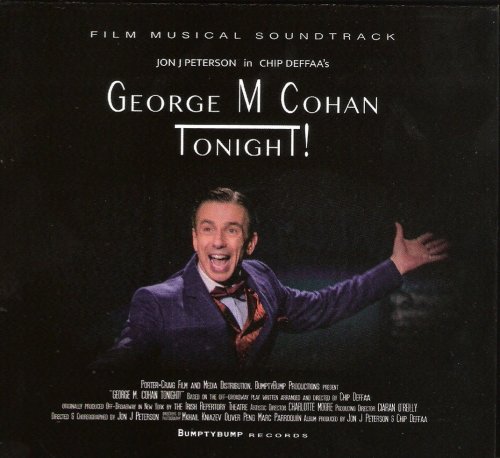
“George M. Cohan Tonight!’ soundtrack cover
Well, I’ve got to scoot now. I’ll be running recording sessions at our studio in Astoria on May 16th, May 22nd, May 29th, June 1st. With more to follow. And they’re always fun.
The 46th album that I’ve produced or co-produced–the “George M. Cohan Tonight!” motion-picture soundtrack album, starring Jon Peterson–comes out this Sunday. I’ve just been listening to an advance copy, and re-reading my liner notes for the album. And it’s prompting so many good memories. I got hooked on Cohan’s music when I was nine years old and first saw the film about his life, “Yankee Doodle Dandy,” on TV. I liked Cohan’s music so much, I began looking for other songs he’d created.
Over the years, I’ve assembled one of the two major private collections in the world of Cohan sheet music, recordings, and memorabilia. I’ve produced more recordings of Cohan’s music than anyone living—with more to come. Listening to our new soundtrack album, I’m also remembering Jon Peterson showing up at an open-call audition I held at Ripley-Grier Studios; he gave the best audition performance I’ve ever seen. I told him I wanted him to play Cohan in a show I’d write–persuading him to quit a Broadway production contract to take a chance with me instead. I began writing the script; we had the first tryout production up and running three weeks later. The script evolved into the show “George M. Cohan Tonight!” that we’ve presented in countless cities in the US and abroad. The motion picture adaptation is now playing on TubiTV.com. The soundtrack album comes out Sunday (available on Apple Music, Spotify, Ebay etc. in both physical CD and digital form). And I hope to do a couple more albums of rare—and in some cases, never-before-recorded–Cohan songs. I just found a copy, in Cohan’s own hand, of a never-published, never-recorded verse to one of his best songs. I can’t wait to record it!
The 47th album that I’ve produced or co-produced will be coming out June 1st. We’re working on the 48th album now. It should have a good mix of seasoned Broadway pros and—hopefully, if we can find ‘em—some promising younger artists-to-watch as well. Let’s see who chooses to audition! It’s always fascinating to see who will turn up at an in-person audition, or submit a self-tape via Email (Footloose518 @ aol.com).
And I’m excited that we’re starting to make podcast versions of my shows. This writer/director/producer is always happy to try new things. I feel very grateful—and very lucky—to be able to do work I love, with talented people I love.


Leave a comment