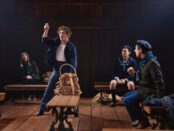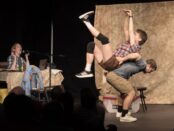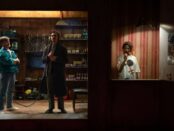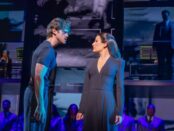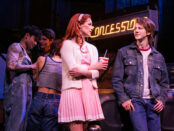
In the cavernous expanse of the Park Avenue Armory, where spectacle often arrives inflated to mythic proportions, "The Faggots and Their Friends Between Revolutions" materializes as a frequently mad, occasionally mystical, and resolutely LGBTQIA+ fantasia. Adapted from Larry Mitchell and Ned Asta’s 1977 queer fable-book—part manifesto, part utopian parable—this incarnation, shaped by composer Philip Venables and director Ted Huffman (who first unveiled it to British audiences in 2023), announces itself with a great deal of theatrical flourish. For all its conjurations and incantatory ambition, it is ultimately a work whose whimsy gleefully shines on the backs of this diamond’s many facets. [more]
The American Soldier, written and performed by Douglas Taurel, is a solid evening of theater with important messages about war and the soldiers who fight them. Taurel is an excellent actor and he has done a nice job adapting the show from actual soldier's letters and their accounts of their time in battle. [more]

This World of Tomorrow resembles the films "Back to the Future" (Bert cannot risk changing anything), "Groundhog Day" for its repetition of the same events, and "You’ve Got Mail" in which two undeclared lovers run the risk of missing each other. Both the message and the structure resemble those time travel movies of the 1940s like René Clair’s "It Happened Tomorrow" where the characters get to view a glimpse of the future only to end up back where they started. The problem with "This World of Tomorrow" is that the play attempts to do something that the movies do much better. While Derek McLane’s clever scenery making much use of projections on a series of square pillars which rearrange themselves for each scene as the projections change is appealing as well as eye-catching, it can only do so much to suggest the extensive and imposing World’s Fair, as well as other parts of New York City. All this will be more successful in a future film version in which CGI will allow us to really see the bygone fair and NYC in 1939. [more]
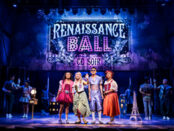
I come from a family of nurses, and apparently so does playwright Scott Organ whose play "Diversion" is set entirely in an ICU nurse’s breakroom. Organ has clearly done his homework, because he’s written an honest, intense, and yet often funny piece centering on a few days in the work life of six nurses under the pressure of a “diversion” investigation. For those unfamiliar with the word in a medical setting, “diversion” is the delicate term given to the illegal practice of diverting drugs away from their intended use, on patients, and instead toward personal use or sale. [more]

Talene Yeghisabet Monahon’s new play "Meet the Cartozians," being presented by The Second Stage at The Pershing Square Signature Center, is simply the best new American play in New York this fall. This riveting two-part play set in two time frames 100 years apart asks the questions what does it mean to be an American, what does it mean to be white in America, and what does it mean to be an Armenian American. The timeliness of these questions will not be lost on audiences well aware of the current administration’s views on immigration particularly of non-white applicants for asylum. The Armenian American playwright’s last three plays ("How to Load a Musket," "Jane Anger" and "The Good John Proctor") have all had historical backgrounds but this one is personal to Monahon as it deals with her own heritage. Director David Cromer who has proven himself to be a wizard with new plays as well as his brilliant reinvention of Thornton Wilder’s Our Town has chosen a superb cast led by two-time Tony Award-winner Andrea Martin and 2024 Tony Award-winner Will Brill who are all excellent playing two roles each. [more]

With a three-hour running time (the first act runs two hours straight without an intermission) the play is too long for its repetitiousness having the actors go over the same theater games and monologues over and over again. Of course, the play becomes an endurance test for the actors as well as viewers, whether it was intended to or not. Actors who have undergone this kind of training may be amused; those of us who have not may be bored or lose interest. Although the actors who make up the ten-member cast of "Practice" play very different personalities, we see so little of them individually that it is hard to keep them separate and they become a big blur. [more]
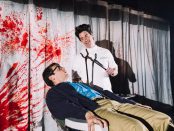
Harlem Holidays features Renée Elise Goldsberry in an intimate CTH celebration of music, storytelling, and community-driven artistry on Dec 15, 2025 [more]
If you know the play, you many have trouble following it as several actors double: Ron Canada plays both John of Gaunt, Duke of Lancaster (Richard’s uncle and Henry Bolingbroke’s father) and later the Bishop of Carlisle. Daniel Stewart Sherman doubles as both Sir Thomas Mowbray, Duke of Norfork and later as courtier Sir Stephen Scroop. Ryan Spahn is seen as Richard’s favorite Bagot, a Welsh Captain, and as a companion to the Queen. The ending has been changed as there is no Sir Piers Exton: another character comes to murder Richard in his cell, giving a different import to the scene. As there is no Duke and Duchess of York, the Duchess’ defense of her traitorous son after Bolingbroke becomes King Henry IV is given to the Queen instead. [more]
In Neil Pepe’s stark revival of Rajiv Joseph’s "Gruesome Playground Injuries," Nicholas Braun and Kara Young trace three decades of bruised connection. Childhood scars, teenage volatility, and a late-night reckoning unfold in jagged time jumps that reveal how two people can orbit each other without ever landing in the same emotional place. [more]
Strong’s book belies his name, its overlong (two hours, 40 minute) narrative, with all its scheming realpolitik, being more formulaic than authentic. Its points about the individual vs. the state, personal ambition vs. national loyalty, truth vs. propaganda, the pressures of celebrity, and so on, are clear, but Chess is too addicted to larger-than-life histrionics to make us more than cerebrally grateful or deeply invested in the choices the characters must face. [more]
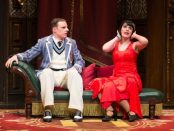
By the time the play reaches its understated yet piercing climax, the question is no longer whether ChiChi and Theodore are “right” for one another—though that question lingers—but rather what it means for any of us to seek connection in a world where desire is both compass and mirage. "HardLove" distills the fragile thrill of two strangers attempting to divine each other’s contours—emotional, physical, moral—and uses that single night’s encounter as a prism through which larger anxieties of belonging, expectation, and becoming refract. In the end, this bold, darkly funny, and unexpectedly tender work stands as a testament to the theater’s capacity to anatomize intimacy without anesthetizing it: a funny, poignant hour that leaves its audience pondering not only these two characters but the mysterious machinery of desire itself. [more]
With its big, if economical, imagination, "Two Strangers (Carry a Cake Across New York)" also seemingly contains a metropolis of non-digital humanity, thanks, in particular, to Tony Gayle's robust and amusingly familiar sound design ("stand clear of the closing doors, please"). But Robin and Dougal are the only people ever actually present onstage, which is enough. As they repeatedly scale the twin mounds of literal baggage on Soutra Gilmour's circular treadmill of a set--rotating away from and towards each other--the metaphoric intent is obvious. Still, it's the promptly endearing Pitts and Tutty who must translate that visual meaning into a palpable bond, so that the audience cares deeply when it is eventually threatened by both past and future complications. [more]
"Saturday Night Live" has made political satire look easy and has a lot to answer for. "44 – The Musical" written, composed and directed by Eli Bauman, who worked on the Obama campaign in Las Vegas in 2008, has created this slight parody of the 44th president’s first term. While the show is slickly produced, the writing is lazy using vulgar language – the f-word is sprinkled generously throughout the dialogue and repeated in its songs whose names are not spelled out in the program – and the satire only takes on the most clichéd items. As none of the talented cast looks or sounds like the real people they are playing, we need to keep reminding ourselves who they are. [more]
George Bernard Shaw — A salon-style evening at the American Irish Historical Society brought artists and educators together as David Staller led a candid, contemporary look at Shaw’s ideas in 2025. [more]
At Winter Rhythms, the lights warm, the lobby hums, and Sue Matsuki runs Urban Stages with the grace of a mentor and the stamina of a producer who loves every beat of the work. More than 150 artists gather for 11 nights of music, community, cookies, and the unmistakable generosity that defines this festival. [more]
Reunited with Chenoweth for the first time since "Wicked," Schwartz once again benefits tremendously from a genuine member of Broadway royalty who, roughly two decades ago, as the original Glinda, turned a bunch of prosaic songs into popular ones (critic takes ostentatious bow). While the score for "The Queen of Versailles" will not survive in our collective memory (please, no!), Chenoweth, as always, gives it her considerable best, particularly when showing off her coloratura soprano to Marie Antoinette (Cassondra James). That would be worth a severely reduced price of admission, if not for the frustrating inconsistencies of Schwartz's lyrics and Lindsey Ferrentino's book, which eventually turn unconscionable. [more]
Step inside the wild, razor-sharp world of VAPE! The Grease Parody, where creators Billy Recce and Danny Salles reveal how parody becomes true theatre — from the chaotic genius of “Green Lightning” to the meta-heart of “Look at Me in Agony.” A smart, funny, and surprisingly honest look at Off-Broadway’s boldest new spoof. [more]
However, like its characters in their narrow world, the play itself—which premiered last year at Chicago’s dynamic Steppenwolf Theatre—seems small and isolated on a Broadway stage, even at the relatively intimate Booth. Despite a typically sterling performance by Laurie Metcalf, whose presence in a part that fits her like a glove is the principal reason to make a visit worthwhile, Hunter’s dramatic tropes seem too familiar to generate the kind of breakthrough excitement warranted by the price of a Broadway ticket. [more]
"Reunion"'s lyricist Scharf and Composer Calire explore how two forgotten one-acts became a musical about second chances, memory, and the courage to reconnect. [more]
In their latest, Shaw’s ever-popular "Pygmalion," Staller has staged Shaw’s never-used prologue created for the 1938 film version which has the gods and goddesses on Mt. Olympus recount to the modern audience the myth of Pygmalion and Galatea which inspired Shaw’s Edwardian comedy. The set by Lindsay G. Fuori creates an Al Hirschfeld-inspired Greek temple used for all of the play’s five scenes. Four of the actors dressed in white Grecian robes (courtesy of designer Tracy Christensen) greet us and tell us the myth that we will see in Shaw’s updated 20th century comedy in which the sculptor becomes a professor of language and linguistics and the statue becomes a flower girl who wants to improve her speech well enough to get a job in a flower shop. However, Staller does not stop there but has created narrative introductions for each act which is rather intrusive though it may help some first-time viewers to understand the play. (Is there any theatergoer who has not seen the play’s musical version My Fair Lady on stage or screen?) [more]
"Reunions" is a charming new Edwardian musical made up of two classic one- act plays: James M. Barrie’s 1910 “The Twelve-Pound Look” and the Quintero Brothers’ 1901 “A Sunny Morning.” Using an ensemble of six main actors who rotate roles, these two one-act musicals have the same theme: former lovers meet years later by an accident that changes their lives. However, the Barrie play deals with a middle-aged couple in a London mansion while the Quintero play brings together two septuagenarians in a Madrid park. Beautifully directed by Gabriel Barre, this is an elegant evening worthy of its Edwardian ancestry. [more]
"The Yellow Wallpaper" is an enthralling new stage adaptation of Charlotte Perkins Gilman’s 1892 short story of the same name. Gilman’s original narrative is written as a series of diary entries by a woman who’s been confined to the upstairs room of a rented mansion by her husband, who is also her doctor. He prescribes her bed rest and little else, leading her to slowly losing her mind due to the stifling restrictions she is forced to exist under. Actress/choreographer Susannah Millonzi (Beldam's "Fall River Fishing," "Hedda Gabler," "The Crucible") and director Caitlin Morley ("Macbeth," "Twelfth Night") adapted the story together, taking a very direct approach. The diary entries become a series of monologues to be read by the nameless protagonist, the play’s only character. At the same time, the creative production and clever blocking adds significant depth to the narrative, introducing new ideas and exploring them wonderfully. [more]
Billy Recce and Danny Salles' lyrics are the secret engine of "Vape!"—clever, campy, and unexpectedly pointed. They skewers performative purity, influencer culture, and the desperate nostalgia of Gen Z’s retro revival, all while composing hooks catchy enough to survive outside satire. Under Jack Plotnick’s razor-sharp direction, "Vape!" turns vintage pink into neon green, and proves that a good parody doesn’t mock its source—it reinvents it. [more]
While Broadway was once filled with plays like this a generation or two ago, "Art of Leaving" now seems very dated. It would have been more believable set back in an earlier decade. Matt Gehring’s direction emphasizes the sit-com nature of the play which is a mistake as it makes the proceedings seem all that much more shallow. Both Aaron and Diana are very thinly written so we learn little about their 25 year marriage except that Diana has lived her life to please her unhappy and demanding husband. Jordan Lage’s Aaron is a total egoist who is lacking in sympathy, while Audrey Heffernan Meyer’s Diana seems unbelievably naïve as to what is available to women today. [more]
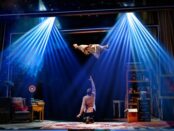
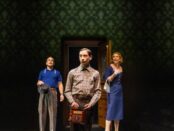
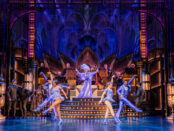
Superbly cast, superbly staged, and written by masters at the top of their game, “Ragtime,” at Lincoln Center, is the most potent and powerful production in town. [more]
Seriously, using a childhood favorite to throw existential dread into the increasingly lined faces of Gen-Xers isn't a bad idea. At times, it's even brilliant. By respectively casting the now 60-something Alex Winter and Keanu Reeves as Beckett's tragicomic vagabonds Vladimir (née Bill) and Estragon (née Ted), Lloyd creates an often giddily effective cross-decade continuum between highbrow and popular entertainment, which likely would have pleased the Irish playwright's vaudevillian sensibilities. Unfortunately, aside from all the usual Beckettian stuff about the futility of life, the real downer with this new production of Waiting for Godot is that Lloyd can't stop inserting himself into it, as if he's weirdly competing with Beckett for storytelling supremacy. Needless to note, that's a losing proposition. [more]
The style and tone of "re the Bennet Girls Ok?" has been updated to contemporary language with the women using “like” and multiple curse words including the F-bomb so that although we see women dressed in Mariah Anzaldo Hale’s clothing from 1811 what we hear is 2025 language. And while the jokes suggest this is now a farce, none of it is very funny, with the men getting the worst of it. Both Charles Bingley (nicknamed "Bing Bong" by the Bennet sisters) and Fitzwilliam Darcy are figures of fun so that we do not see what the women see in them. While the original novel was a social comedy, the serious problem that the Bennet women must marry as they will be evicted from their house on the death of their father is no longer a consideration today: entailment to the oldest male heir was discontinued in England in 1925. Also unlike in 1811, women can now work and earn their own money. [more]
"Nothing Like Broadway!" combines modern sensibilities with some old-fashioned influences into a unique and charming show. The narrative follows Milo, played by Tyler Tanner ("The Lightning Thief: The Percy Jackson Musical" national tour, "Shakespeare in Love"), who works the lights at a theater but dreams of singing on stage. That classic narrative of the unconfident protagonist looking to prove himself ends up crashing into a Cold-War-style spy thriller when Bixby, a debonair British spy played by Marek Zurowski ("West Side Story," "The Phantom of the Opera" world tour), has to hide out at the theater. Things spiral into delightful absurdity from there, culminating in a 20-minute continuous 11 o’clock number, which manages to be a total blast throughout. The show takes several big swings of this nature. Though not all of them pan out as well as that one, Rosie Corr’s ("Harmony," "Waitress") stellar choreography, David Rackoff’s ("I Am Bad," "The Chase Lounge") clever lyrics/book/music, and the pair’s co-directing decisions make "Nothing Like Broadway!" an infectiously fun show. [more]