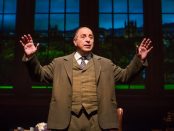
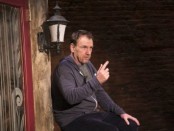
As he impersonates the British writer C.S. Lewis, Max McLean relies on little more than a pipe, a brown suit and tie, and a rather mellifluous voice to become the Anglican philosopher and noted atheist, who famously converted to Christianity in the mid-Twentieth Century. The script was cobbled together by McLean from Lewis’ memoir, letters and books, including other biographies of Lewis, a man who was “intoxicated” by words, which is primarily what this play is about--the mesmerizing effect that words can have, when uttered in an effective sequence. [more]
Speaking in an engaging Texas twang, the blonde Reeder recounts Ginnifer’s somber story with emotional straightforwardness and humor. Employing her expressive facial features, striking eyes and serene physicality, she delivers a performance of tremendous focus that hauntingly holds attention. [more]
Much is made of her numerous Oscar nominations, and this reaches a wonderfully presented climax. She finally wins the award for Best Actress on her eighth nomination for the 1985 screen adaptation of Horton Foote’s play, "The Trip to Bountiful." “Is that per week?” “No. That’s for the whole thing,” was Geraldine Page’s agent’s incredulous reaction to the low salary that was offered for it. [more]
With slicked back hair, a melodiously rough voice and a smooth physical presence, Timothy Simonson offers an accurate impression of Powell that captures his swagger. Mr. Simonson’s appealing performance forcefully recounts Powell’s rise and fall with histrionic relish. Simonson is particularly stirring when describing the hardscrabble life of Powell’s father from poverty in Virginia to prominence and wealth as a minister in New York City. [more]
Illusionist/actor Geoff Sobelle’s show is a combination of happening, art installation, and a meditation on the role objects have in our lives. Using audience participation, objects both hidden and seen, and magical illusion, Sobelle forces us to examine out relationship to the objects in our lives as well as how they ultimately define us when seen altogether as the detritus of a life. Performed in 11 segments with no intermission, "The Object Lesson" is not for everyone, but for those willing to go with the flow and give themselves up to Sobelle’s droll reflection, self-examination and visual theatrics, the evening is fascinating and rewarding. [more]
What truly distinguishes the show is Dixon’s fearless psychological focus on Rose and himself. The predominant theme is of hero worship and its bruising disappointments. It also attempts to explore the issue of the often-dark contrast between the on-stage and off-stage lives of great entertainers. In examining their involvement, Dixon doesn’t spare Rose or himself from honest scrutiny. [more]
Mr. Refael’s simple but well-crafted scenario takes place in a contemporary apartment in Israel, and has the elderly Salvado looking back at his past. This is theatrically achieved by having him directly addressing the audience. His best friend and fellow survivor is to be honored at the Holocaust memorial center Yad Vashem during a ceremony where he will light a torch. When he becomes incapacitated, that task falls to Salvado. This situation instigates a flood of painful reminiscences that explore his guilt at having survived. [more]
The concept of Love for Sale, though not particularly original, is not a bad one, except for one very important factor: Ms. Burke is not up to either the singing or acting demands of Love for Sale, a voyage from innocence to jaded sophistication as told in mostly dark, melodramatic songs, ironically influenced by the American films that flooded Europe in the twenties and thirties. It’s an extraordinarily difficult repertoire that constantly threatens to be silly expressions of impossibly colorful and desperate characters. [more]
What Evett delivers—using ample quotes from the poem and robust contributions from himself and Spangler—is a terrifying inside look of the Mariner’s experiences, beginning with being hijacked by a friend at a pub. He breathlessly illuminates what the day-to-day life was like with lurid descriptions of illnesses and exciting second-by-second reports of battles with other ships. [more]
O'Connell’s script is a well-structured series of confessional anecdotes interwoven with the lore of the movies. His performance is a riveting blend of stand-up comedy and grand stage acting with Shakespearean flourishes. The audience is on three sides of the very small theater. This intimate space at times feels too constrained for the unbridled emotionalism on display. [more]
The stories included are equal parts humorous, stirring or sobering but always meaningful and intimately personal. Deblinger is a natural storyteller, and every tale is polished and fully developed, and--more importantly--consistent with the show’s overall theme. Further, Deblinger is a fantastic impressionist, and the show contains no less than 15-20 fully realized character impersonations. The versatility he displays is a testament to both his natural abilities as well as his dedication to his craft. [more]
Raucous highlights include a jive reinterpretation of A Christmas Carol, “by Chazzie D, about a cat called Scrooge...who lives in Scrooge Tower.” There’s also Buckley’s irreverent take on The Gettysburg Address, “I’m a Lincoln cat.” Intertwined are Broder’s cool renditions of “On The Sunny Side of The Street” and “Georgia On My Mind.” He also demonstrates excellent saxophone and tambourine playing. [more]
Mr. Irving has an amazing singing voice that soars from octave to octave. His witty songs include a funny one about texting. He tells an epic story about his parents meeting. His musicianship is tremendous as he plays banjo, bouzouki, shruti box, mbira, jew's harps, whirly tube, scacciapensieri, and the ocean harp during the show. He does a wild dance to America’s “A Horse With No Name.” [more]
"Lavender Songs: A Queer Cabaret in Weimar Berlin" has the mature and slim Mr. Lawrence in drag virtually for the entire length of the performance. In a dirty-blonde curled wig, his face garishly made up, twirling a red and purple boa, and wearing a sleeveless sequined black dress, Lawrence is like an Otto Dix painting come to life. [more]
"All the Ways to Say I Love You" is refreshingly free of this formula. The incidents are straightforwardly depicted and the circular conclusion is simple. LaBute palatably sets up the situation by establishing that the male student is a senior who has had to repeat a year of school, so he is clearly a young adult. It is implied that he is African-American and it is stated that Mrs. Johnson’s emotionally distant husband is of mixed race. Despite these intriguing elements, the play narratively peaks halfway through and then grinds on. [more]
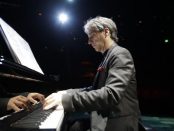
Felder’s play begins with a video of the actual Leonard Bernstein delivering a colorful, yet entertaining, illustrated lecture on music. When Felder sashays down the aisle, a cigarette in one hand and a drink in the other, the lack of resemblance is, at first, bothersome. But, somehow, sitting at a piano—which he plays impeccably—his monologue pulls you into Bernstein’s tumultuous life story. [more]
Writer Gustavo Pace is the handsome, youthful and animated performer of this autobiographical exploration. He loudly rattles on in Portuguese and English while adequately portraying himself and several characters. These include his father, brother, a female therapist working on turning him straight, and various others he encounters. It’s an amiable and passable performance that’s heavy on volume and shaky on intelligibility. [more]
“We’re actually going to be talking about 14th century Italian literature,” proclaims BenDeLaCreme near the start of his/her entertaining multimedia solo show" BenDeLaCreme’s Inferno A-Go-Go." It’s very loosely and irreverently based on Dante Alighieri’s The Divine Comedy. That literary classic describes a journey through hell including The Ninth Circle. Here it’s used as a clever pretext for an hour of inspired silliness with flashes of seriousness. [more]
In the course of 90 minutes, we follow the ups and downs of Strauss’ professional, mental health and romantic lives in great detail. To his credit, Strauss gives the impression of delivering these stories as if for the first time. He was fresh and very involved, yet sensitive to the audience’s reactions. He managed to make a tediously unattractive condition fascinating and also managed to make himself affecting and human, his disability notwithstanding. OCD has never been as attractively rendered. [more]
Part of the 2016 Brits Off Broadway lineup at 59E59 Theaters, James Fritz’s "Ross & Rachel" provides a more emotional, poignant and truthful story than what is expected when thinking of our favorite “friends” and their intense relationship. Molly Vevers takes on the role of both partners in a relationship plagued by different viewpoints and dealing with life’s hardships as a couple. This very talented actress relies on wit, candidness and sentiment to tell her story and doesn’t hold back when giving audiences the complete picture – in both the joyful and difficult times. While most people go in thinking that the show is going to be a comedic portrayal of the couple we know and love from television, Ross & Rachel flips the script and leaves you pondering the true meaning of life and one’s identity while in the confines of a relationship. [more]
She ran down the list of her Broadway co-stars: Ricardo Montalban, Donald O’Connor (the disastrous Bring Back Birdie), Antonio Banderas (upon whose shoulder she placed a shapely leg in Nine) and, her admitted favorite, Dick Van Dyke, with whom she co-starred in "Bye Bye Birdie" from which she sang “A Lot of Livin’ To Do” giving it a sassy, winking interpretation making it impossible to deny that the title is very on the mark. It wouldn’t be a Chita Rivera show without a mention of her iconic Anita in "West Side Story." A meeting with Leonard Bernstein to go over her songs just after she had been cast was nerve-wracking as she never had considered herself a singer. History has proved that her singing almost equals her dancing. “A Boy Like That” and “America,” complete with some mini-choreography were nothing short of electrifying. [more]
Many members of the American public and the journalism community continue to revere Edward R. Murrow as a paragon of integrity in the field of news reporting. Due to the skillfully writing of Joseph Vitale, Joseph Menino’s tremendous performance and its strong physical production, Murrow affirms his noble legacy. [more]
Meet Sam, a struggling New York actor whose day job is as the reservationist for a popular albeit fictional Manhattan restaurant. Seemingly surrounded by phones at every turn, Ferguson’s Sam has devices that connects him to the chef, the hostess, his manager, as well as to the outside World and those looking for a much sought after reservation. Demonstrating a full spectrum of physical and vocal capabilities, Ferguson manipulates his body and voice to bring to life the many characters that Sam interacts with over the phone. [more]
The cheery Mr. Bowers also explains that in the mime tradition only mimes in whiteface are silent. He simply but breathtakingly mimes a multitude of actions, objects and situations that precisely conjure up the intended imagery. Written by Bowers, the show is comprised of a series of stories of varying length that perfectly transition from one to the other. [more]
Ms. Duffin portrays the heroine as well as a multitude of characters using a strong Irish accent, expert physical transformations and her strong presence. Barefoot, wearing plaid lounge pants and a blue T-shirt Duffin holds forth on the black walled stage that has a few slits of lights and a floor strewn with earth. Though she is commanding, the nature of the material ultimately renders her performance and the overall experience of the play as wearying. [more]
Blizzard doesn’t miss a beat as she keeps the whole room in stitches during the course of this 80 minute performance. Her wit, charm, and wisdom are comedic gold and make for a flawless piece of entertainment. Hidden underneath the humor is the important theme of togetherness and female solidarity as she emphasizes needing your girls to get through life, as they understand many of the emotions/dilemmas that men aren’t able to understand. It is empowering to hear her truth about not trying to be perfect and admitting that sometimes the “crazy” is proof that you are doing this whole thing (“adulthood” and “parent thing”) correctly. [more]
On stage, Birbiglia’s presence differs significantly from that of his fellow comics. It is no exaggeration in referring to Birbiglia as a soft-spoken individual, a term not often associated with a stand-up comedian. Birbiglia embraces his subtlety as his calling card, and this unique quality is the trait that differentiates his style from that of others. Further, because of the way he controls his onstage presence, when he does raise his voice or get particularly physical, it is even more effective as a result. This style paves the way for many different forms of comedy and jokes along the way, thus keeping the show free of any break in pace or monotony. [more]
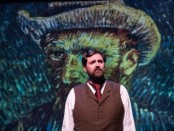
Leonard Nimoy intended "Vincent" as a vehicle for himself that would showcase his talents. In this Off-Broadway premiere presented by Starry Night Theater, "Vincent" is now such an outlet for Nimoy’s worthy successor James Briggs in this entertaining and insightful production. [more]
For his latest production, Brinkman has assembled over 20 songs which, cohesively, tackle every aspect of the climate crisis. Starting with a background of the physics and chemistry behind what’s happening in the world, he begins the show with a crash course in climate science. Brinkman’s clever lyrics are both informative and comical, and the unique way in which the information is presented to the audience makes learning fun and entertaining. Not only that, the conversational approach in his rapping also helps to make the information more easily digestible. [more]
At the top of the show Cariou tells us that he made his Broadway debut in the Stratford Connecticut Shakespeare Festival’s transfer of "Henry V" in 1969 and six months later in the spring of 1970 appeared at the Palace Theatre in the new musical" Applause." Ever since then, he has had the idea to combine Shakespeare and song with “tunes that either support the text or are the antithesis.” The evening proceeds to pair Shakespeare and song thematically, like the opening sequence which offers Orsino’s “If music be the food of love, play on” from "Twelfth Night," followed by Sondheim’s “Love, I Hear” from "A Funny Thing Happened on the Way to the Forum" and Rodgers and Hart’s “Falling in Love with Love,” from "The Boys from Syracuse," based on Shakespeare’s "The Comedy of Errors." [more]
Asner’s appearance in "A Man and His Prostate" is a delightfully thrilling opportunity to experience his considerable talents live. He vividly grouses, grimaces, and perfectly lands every joke with his monumental comic timing. The seriousness of the play is also conveyed when he skillfully tones his performance down to recite medical facts and to express the fears of the ramifications of the character’s condition and prognosis. Sitting raised above the audience at times he looks and sounds like a sage. [more]
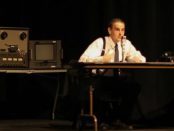
Victor Morales enters and introduces himself and notes that we are at Dixon Place. Mr. Morales who created this piece is stocky, bald, bespectacled, and possessed of a quirky everyman presence. For just under an hour, he delivers an amusing lecture with serious overtones enhanced by the illustrative projections. [more]