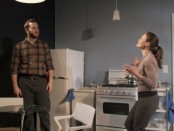
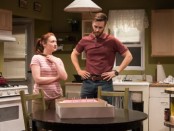
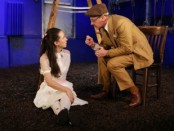
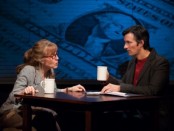
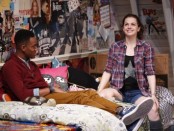
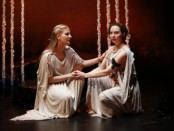
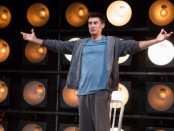
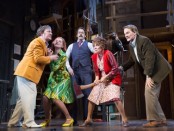
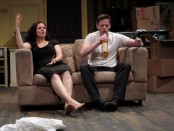
The satire begins early: it turns out that although the department likes having Brian doing his research proving that whites are genetically racist, they are not happy with his conclusions. Although Jackson may be the smartest doctor in the room, he has trouble working with others and bending to authority on the job. Although Valerie has a Harvard degree, she cleans houses to pay her rent which ticks off her upper middle-class mother. However, she is not pleased when she attends an audition for “Mary, the social worker” and is asked instead to read for the part of “Shlonda” from the ‘hood. Ginny finds that her therapy clients perceive her as white, but she knows that in the talk of race in America, she is invisible as race is defined as between blacks and whites in modern discourse. [more]
The chemistry between Gabriel and Baessato is fierce and electrifying as they get to know each other, and intensifies as Van begins to observe the human-like behavior of the robot and is determined to find out more. Anjali is hesitant to let him in on the secret, but reveals that the robot has developed an emotional bond to her, and sometimes responds to certain feelings such as loneliness and separation – often uttering the words, "don't leave me" through the door. Van is fascinated at what he finds out and the two join forces to figure out how best to capitalize on the service of the sex robot and how she can accommodate a greater (and richer) clientele by playing into their fantasy of the obedient housewife. [more]
An element of "The White Stag Quadrilogy" which cannot go overlooked is the amount of dancing incorporated into the production. In lieu of proper production techniques, Wolfert and company instead choose to depict stags parading across the desert, or eagles flying through the sky, by way of “interpretive” dancing. Enlisting the staff of the Plaza Michelle for this purpose, the dancing trio of Derek Smith, Michelle Uranowitz, and Jaime Wright are together a band of merry misfits who revel in their undulating, gyrating, style of dance (choreographed in hilariously gratuitous fashion by Chloe Kernaghan). Referred to on multiple occasions by Wolfert as “trained professionals,” the self-aware ensemble is a recurring aspect of the play which is, time and time again—and again, hilarious. [more]
Television and film actor Timothée Chalamet (Showtime’s "Homeland" and Christopher Nolan’s "Interstellar") makes an impressive New York stage debut as the play’s young protagonist. The role is almost too small to contain his bigger-than-life portrayal: kinetic, animated, provoking, questioning, vital, dynamic. His moods turn on a dime and he can shift from being a sophisticated adult back to being a little boy in a moment. Tall and lanky, he suggests the author but as he must have looked back in 1965. Also making his Manhattan Theatre Club debut, David Potters as his roommate Austin is tremendously sympathetic as a young man afraid of breaking the rules who has led a very sheltered life up until now. [more]
The forest setting by Ortiz seems to envelop the audience as does the sound design which is created by the actors in tandem with violinist Naomi Florin who plays Edward W. Hardy’s melancholy original score throughout the evening. The impressive Bunraku-style puppets are the work of Ortiz who seems to be a one-man theater corporation able to do everything required himself including his co-direction with Claire Karpen. The only wrinkle is that at times it is a bit confusing as to what is happening since after the opening prologue there is no dialogue and some of the mime is ambiguous. However, the show with folk-style backwoods costumes by Molly Seidel and atmospheric lighting by Catherine Clark & Jamie Roderick is always theatrical, always hypnotic. [more]
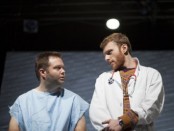
Directed by Alex Correia, the seven different plays presented each serve a purpose. "The Heart Attack," which opens the show, is solemn yet silly. Taking place in a hospital, Nate Rollins is a patient who thinks he is having a heart attack, and Shane Allen is the Doctor assigned to his case. The premise is initially that of just a hypochondriac in action, but once the check-up has been completed, the tone changes to that of a more poignant and meaningful exchange between two grown men. While not all the plays are equally as funny, humor is present throughout the entire evening to keep the overall tone on the lighter side. [more]
His great grandnephew, the French-born and raised Alexis Chevalier has written this well researched play with music that is based in part on Maurice Chevalier’s memoirs. It is structurally problematic with fantasy episodes, extraneous musical and dance sequences, and numerous often-lengthy scenes that don’t cohere. The dialogue is straightforwardly purposeful imparting historical facts and details with occasional bursts of poetic qualities. [more]
At the top of the show Cariou tells us that he made his Broadway debut in the Stratford Connecticut Shakespeare Festival’s transfer of "Henry V" in 1969 and six months later in the spring of 1970 appeared at the Palace Theatre in the new musical" Applause." Ever since then, he has had the idea to combine Shakespeare and song with “tunes that either support the text or are the antithesis.” The evening proceeds to pair Shakespeare and song thematically, like the opening sequence which offers Orsino’s “If music be the food of love, play on” from "Twelfth Night," followed by Sondheim’s “Love, I Hear” from "A Funny Thing Happened on the Way to the Forum" and Rodgers and Hart’s “Falling in Love with Love,” from "The Boys from Syracuse," based on Shakespeare’s "The Comedy of Errors." [more]
Schwend’s dialogue is realistic, believable, and true to life, as are the characters. As a play, however, it is a bit of a downer as we watch Amber become wearier without any relief in sight. Aside from Chris who is always putting everything off until tomorrow, Amber’s mother (who has been conned into liking him as a good father) is always begrudging about helping out though she lives down the block and doesn’t have anything else to do. The atmosphere and the characters are real, but each scene is just more and more of the same which becomes depressing and tiresome – just like Amber’s life. There is also the question of where the money comes from to buy all of the items that are carried in the door – unless the family is living on credit card debt which is never mentioned. This is also the sort of play where we hear a get deal about the children Janie, Max and Sammy, but the author manages to keep them off stage all evening. [more]
Nevertheless, Wills’ production is continually taking us by surprise both by his casting and his choices. His transgendered characters are played by transgendered actors. Moran’s Wilder and Angelos’ Ellen look a great deal like their counterparts, while Blankson-Wood and Heleringer as Spencer and Duncan, respectively, are a hoot as young entitled gay men who have totally bought into the capitalist system. “Mizz June” and Gentili, who are themselves transgendered icons, bring an air of authenticity to their roles as the colorful and outspoken Marsha and Sylvia. [more]
Cast as the curious playwright Rich, actor Jeffrey C. Wolf is the central focus of the evening. Wolf narrates the play by way of a series of monologues, which preface interviews with various members of the Tea Party or other pertinent political figures. Carrying the show on his back, Wolf is an agreeable narrator with an infectious curiosity. At times the play navigates deeply into American History, and when he dives into a fact or number heavy-preamble, his pace is cognizant of the fact that the audience is best assumed unfamiliar with it. Thanks to this, exposition regarding past political events is well-received and easily digestible. [more]
So begins a remarkable comedy-drama of two very opposite teenagers who shouldn’t have met and wouldn’t have if Anthony had not chosen the reclusive, mysterious Caroline for his partner. The play makes use of opposites, beginning with the theme of the poem, love and death, and in Whitman’s typical fashion, everything in between. But Caroline and Anthony are also opposites in every possible way: pessimistic/optimistic, sedentary/athletic, closed minded/open minded, white/black, friendless/popular, careless student/straight A student. They appear to have nothing in common, but by the end of the play they are drawn to each other through the magical words of Whitman and Leaves of Grass. Ultimately, Caroline and Anthony have revealed their dreams, fears and true selves to each other and to us. [more]
Ms. Udofia’s dialogue is richly expressive and she renders the four characters with depth and detail. The relationships between the characters are fully explored and their interactions where they voice their hopes and desires are often poignant. This is most particularly felt in the growing camaraderie between Abasiama and Moxie. [more]
Robert Langdon Lloyd’s eloquent performance as the blind prophet Tiresias energizes what had been a stilted presentation of this small-scale production of "The Burial at Thebes." Before Mr. Lloyd’s commanding midway appearance there had been a good deal of static expositional recitation and declaiming with only slight dramatic sparks. [more]
Both teenagers are desperate for our approval and understanding of their lives and what they did, unlike the tabloids which have apparently had headlines branding them as monsters. Listening to their sides of their stories, we are initially conned into a false sense of security – always a dangerous thing to do in a Philip Ridley play. By the end, we discover these are damaged youth we would not want to know personally, but we understand their motives entirely from their point of view. [more]
While Frayn’s roles are juicy parodies of very specific kinds of people, for the laughs to roll in one on top of the other, the play must be performed fast enough that we don’t have time to think about it or what we are laughing at. Consequently, though the production is entertaining for its comic portrayals, it fails to trigger all the laughs inherent in the script or become the laugh riot it is intended to be. Possibly, as the actors have more performances under their belts, the play may pick up speed and more laughs along the way. [more]
A Dream of Red Pavilions is set in 18th century China during the reign of Emperor Qianlong. The framing story which gives the plot its mythic quality involves a stone and a flower that are reborn as cousins, the rich scion Baoyu and sickly Daiyu, who fall in eternal love. Like" The Forsyte Saga" or "Downton Abbey," the social context depicted is the rise and fall of an aristocratic family. Beginning with the birth of Baoyu, the oldest son on whom the Jia family’s future fortunes rest, the play which takes place in 30 short scenes follows the affairs of these nobles and their servants over 20 years until Baoyu’s young adulthood. [more]
Director Lordi-Kirkham has unaccountable staged the play as though it were a radio play or a reading, making it more talky and static than it needs to be. While the text is faithful to the Russian novella with some trimming to reduce the number of characters, the use of both a narrator and much of the narration from the novel makes this seem like an interior monologue rather than a play. Unfortunately, the actors playing the twenty somethings who are given the most stage time do not have the technique necessary to bring off this psychological drama. At two hours and 10 minutes with no intermission, this is a long evening in the theater. [more]
Linda Lavin wears Anna in Richard Greenberg’s "Our Mother’s Brief Affair" like a chic couture outfit with many layers each of which reveals layers of colorful, woven cloth. There is a constant glow about her as she relates, mostly in flashbacks, the story of an illicit, but exciting affair with a stranger she met many years ago while waiting for her son, Seth (a bemused, but effective Greg Keller) to emerge from his Juilliard viola lessons. [more]
Brendan (NBC’s "Blindspot") Gall’s sexy and seductive new thriller, "Wide Awake Hearts," thrusts audiences into a challenging game of cat and mouse, as they are left to decipher the story of four friends in a case of art imitating life. An actor, director, writer and actress are faced with the intricacies of dealing with relationships, infused with passion and threats of infidelity, as they are in the process of creating a movie dealing with these very themes. [more]
The collaborative script is by the One Idiot troupe’s writers that include Jon Bershad, Aaron Burdette, Allie Kokesh, Kristy Lopez-Bernal, Nathan Min and Katelyn Trela. It’s a smart mash-up of plot points and characters that those familiar with Williams’ play will recognize and those who aren’t would still find funny due to the franticly goofy presentation. The writing is also characterized by an abundance of vulgarity and scatological humor that is relatively tame rather then being offensive. [more]
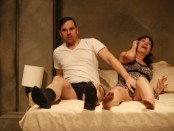
Joe Casey is a charming actor. He exudes a “playboy” vibe which goes hand-in-hand with the character of Michael whose vices range from women to booze and back again. Casey shows an understanding of a man who is largely misunderstood and actually well-intentioned. Steph Van Vlack plays the role of Donna. Nearing 50 and a divorcée with a child, Donna is conflicted in light of the fact that she—a woman of her age—is engaging in an apparent “one night stand.” Among other things, this is also a character deeply disturbed that she’s actually considering sleeping with the child she used to babysit for all those years ago. Van Vlack brings a necessary uncertainty to the character. Playing a woman of certain age, Van Vlack’s performance indicates that Donna still has deep insecurities and still has quite a bit to learn about relationships. [more]
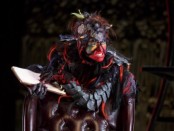
This Grand Guignol concept is sensationally realized by the striking physical production. John Gromada’s chilling sound design configures his spooky original score with its dominant organ along with bomb blasts and other sound effects for very effective results. Cameron Anderson’s scenic design is a dazzling haunted house affair with the stage wall covered in tiny bones and skulls, a ladder and ramp for the creature to scamper on, and manor-style furnishings. Hellish red hues are prominent features of Jesse Klug’s eerie lighting design. [more]
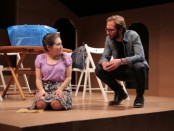
The opening one is British author Lexi Wolfe’s delightfully wistful "Stand Up for Oneself." It’s a Chekhovian romantic comedy with clipped Noel Coward-style dialogue taking place in the room of a house where a party is going on. Lucas, a 42-year-old morose music professor sits alone drinking with his cane nearby when the free-spirited 26-year-old Lila enters. There is flirtation and revelations. Sensitively directed by John Pierson, the play’s very fine writing is boosted by the wonderfully detailed and effecting performances of Alicia Smith and Mark Ryan Anderson. [more]
Asner’s appearance in "A Man and His Prostate" is a delightfully thrilling opportunity to experience his considerable talents live. He vividly grouses, grimaces, and perfectly lands every joke with his monumental comic timing. The seriousness of the play is also conveyed when he skillfully tones his performance down to recite medical facts and to express the fears of the ramifications of the character’s condition and prognosis. Sitting raised above the audience at times he looks and sounds like a sage. [more]
Directed by Danya Taymor, 'In Quietness" excels in its exploration of intimacy. When dialogue is being spoken between two actors at a time, there are moments of silence that are loaded with implication. It is a credit to the director that more character development happens with nothing being said at all rather than when a character is speaking. Kristen Robinson’s set design is efficient enough—the whole stage is made to look like the inside of a chapel—though it is made much more effective by intelligent lighting design by Masha Tsimring and Caitlyn Rappaport. [more]
Director Laura Lindow’s staging is a thrilling exhibition of pure stagecraft using very simple elements. The expressive actors are choreographed at times often in arresting tableaux especially a scene depicting drug addiction. There are powerful sequences visualizing violent clashes, flashbacks, fast-forwards and fantasies. A quite poignant one involves the complications of using the telephone in prison to keep in touch with loved ones. The pace is fast and vibrantly conveys the emotions of the characters’ situations. [more]
The interpretations are also open to question. Although she should be demure before her sexual awakening, Sara Topham plays Beatrice as experienced and sophisticated which allows her nowhere to take her character. While the beauty and the beast theme is much in evidence, Manoel Felciano’s make-up as the ugly De Flores fails to make him the monstrous embodiment of the play’s description. Christian Coulson’s Alsemero is described by his friend Jasperino as asexual and he seems to have taken this as the basis for his character. As a result he is extremely bland, as is John Skelley’s Alonzo, so that we never see what Beatrice is supposed to see in these men. [more]
The title is never explained and remains a cryptic point of thought. Is it the name of the jet that the plot revolves around? Is it a reference to a woman? What could it mean? Knowing the work and personality of David Mamet, perhaps it’s a "House of Games" con device that has no significance at all just like the play itself. Muddled and rambling it comes across as an arrogantly tossed off minor exercise by an eminently established author solely for profit. The dialogue is a grating rehash of his patented style of staccato vulgarisms and explosive tirades interspersed with pauses that result in self-parody. If "Glengarry Glen Ross" was his zenith, "China Doll" is his nadir. [more]
The personable Mr. Mitchell is the evening’s host and starts off the show by explaining the format. The six performers then go through the theater asking audience members for missing words that they then write in their scripts. After obtaining this material they then go onstage to sit in chairs with music stands on which they place their scripts and read from. For just over thirty minutes, they enact this silly and entertaining murder investigation with often funny results. [more]
Jerry Mayer’s "2 Across" will remind of a great many other romantic comedies but in the hands of Andrea McArdle and Kip Gilman, it is a charming light-hearted evening in the theater. At least half way through the 90 minute encounter you will be rooting for this seemingly mismatched couple to get together – if not long before. Brought together by a love of the daily crossword puzzle, this warm and wise comedy covers a great many topics that engage couples to day. [more]
Directed by Daisy Walker, "How Alfo Learned to Love" is chock full of Italian-American stereotypes. The characters are just heightened enough that the gimmick works, but there is also a lot of heart behind this story. Walker has brought to life a group of characters who are quirky and lovable, and in the end it really feels like a family affair. All of this is contingent on Thom’s performance as Alfo whose character arc is fleshed out and brimming with variety. This redemption story about learning to love is a rollicking good time. Backed by strong performances and direction, a slick and consistent pace, and an entertaining script which sticks to a winning formula, nary a soul is likely to leave this theater without a smile. [more]