News Ticker

Plays

And Miss Reardon Drinks a Little

May 10, 2017

Retro Productions’  50th anniversary revival of Paul Zindel’s "And Miss Reardon Drinks a Little" put the spotlight on an almost forgotten play that is worthy of revival. Shay Gines’ production with a game cast of seven is absorbing and compelling theater with characters that are bigger than life. Paul Zindel’s semi-autobiographical play comes alive in their hands. There may be more theatrical treasures to be mined from his collected plays. [more]

Six Degrees of Separation

May 9, 2017

All the acting is sharp, from the upper-crusters taken in by Paul (Lisa Emery, Michael Countryman and Ned Eisenberg) to their kids (Colby Minifie, Keenan Jolliff, Ned Riseley, and Cody Kostro), Chris Perfetti as Trent who, sexually intoxicated by Paul, fills him in on the ways and means of all the people he will eventually swindle, and finally, to the young lovers (Peter Mark Kendall and Sarah Mezzanotte) whose fate reveals just how psychologically damaging Paul can be. [more]

Fossils

May 9, 2017

Though the printed script, such as it is, is credited to Nel Crouch, Crouch is listed in the program as only the director, and "Fossils" is rather “By” Bucket Club, described as an “associate company.” Such confusion is perpetrated throughout the production: it’s hard to say if, in the end of this extremely low-tech presentation, Vanessa has actually encountered the Monster--and/or her father--or not. "Fossils" is apparently more about what doesn’t happen than what does. [more]

Entertaining Mr. Sloane

May 8, 2017

That this production has such an ideal Sloane puts it into the stratosphere.  With his sculpted physique, prevalent musculature and chiseled features that recall the young Malcolm MacDowell (who played the role in a 1975 London revival), Matt Baguth is mesmerizing.  Speaking in a whispery, low, lightly accented voice, Mr. Baguth commands attention.  Whether wearing Mod clothing or encased in black leather, and a tight white T-shirt, Baguth vividly captures the predatory nature of this youthful interloper with sly conviction. [more]

The Roundabout

May 5, 2017

Although the play seems to have something to say about economics and political systems, it is simply a very light romantic comedy making use of elements of change during the Great Depression. Ross’ production is quite proficient and fast-paced, but the characters are generic and we don’t learn much about them. As Lord Kettlewell, Brian Protheroe is the typical crotchety but wise aristocrat, Richenda Carey is most eccentric as the impoverished Lady Knightsbridge, and Lisa Bowerman is level-headed as the previously estranged Lady Kettlewell. Carol Starks’ Mrs. Lancicourt is the manipulative upper-class woman who attempts to dominate all situations. Hugh Sachs is a raisonneur straight out of classic drawing room comedy and would have been as at home in a play by Wilde, Shaw, Pinero or Galsworthy. [more]

Oslo

May 4, 2017

The clarity of this new play by J.T. Rogers does not only rely on the smart yet surefire way it’s written, but also on the masterful staging by Bartlett Sher, who, after recent productions of both "South Pacific" and "The King and I," is no stranger to directing gargantuan shows at Lincoln Center. Given its subject--the Oslo Accord or peace treaty between Israel and the Palestine Liberation Organization (P.L.O.) in 1993--Oslo is ultimately, an enormous play. But it is told in intimate terms. [more]

Her Opponent

April 29, 2017

Provocative, startling, and theatrical, "Her Opponent" is a recreation of the 2016 U.S. presidential debates between Hillary Clinton and Donald Trump. The twist is that actors of reverse genders portray them. [more]

The Antipodes

April 28, 2017

Every new play by Annie Baker is a marvel over the play before. It’s been nothing less than a privilege to accompany her on her journey, as she has been joining ranks with the best American playwrights. Part of what makes Baker the “best,” is that she has her own voice. Whether with "Circle-Mirror Transformation," the marvelous "The Flick," or her latest and current, "The Antipodes," Baker seems to devote a certain amount of attention to group dynamics, which is, after all, the basis of any drama. And how can I have left out reference to John, Baker’s play from last year, which was her first as part of her enrollment with the Signature Theater, and arguably the best of all? [more]

Hamlet. A Version

April 28, 2017

The dialogue of Ileana Alexandra Orlic’s English translation is problematic. Floating around are a few Shakespearean snippets, but otherwise it’s rather stilted. Without much verbal grandeur there’s a prevalent flatness. There’s not a compelling momentum, and so it never really rises above being a curiosity. However, overall this play does somewhat succeed as a spirited condensation, especially for those familiar with the original work. [more]

Indecent

April 25, 2017

"Indecent" is, on the surface, the history of Yiddish writer Sholem Asch’s brave Yiddish play "God of Vengeance" which was—incredibly, considering its wise understanding of the Jewish demimonde—written in 1906 during the height of anti-Jewish pogroms. (Asch actually witnessed a pogrom and its ugliness tainted his life thereafter.) It is far more, though. The play is a look at the sweep of Jewish life in the twentieth century using Asch’s creation as the hook. [more]

Lone Star

April 25, 2017

Alternating between flavorfully humorous and darkly revealing dialogue, Mr. McLure vibrantly renders his characters’ personalities and motivations. There’s a hilarious analysis of the incompatibility of eating a Baby Ruth candy bar while drinking beer. With this sociological slice of life, McLure has created three strong roles for actors, and this production’s cast plays them with assurance. [more]

Present Laughter

April 23, 2017

As the ageing matinee idol who never forgets to check his appearance in the mirror, Kline plays a man who is always acting, both on stage and off. His animated physicality in his roles has always been in evidence but here he outdoes himself. Using his arms, hands, head, face and body as his canvas, he is almost never still showing us what can be done on each and every line. He makes even an ordinary line into a witticism and his comebacks wither with every additional jibe. He cajoles, seduces, emotes, wheedles and at the same time suggests he pities himself. He creates a bigger than life character (is John Barrymore his model?) and watching him is a lesson in consummate acting. So completely does he make Garry Essendine his own, you cannot imagine anyone else in the role – although among other New York revivals he has been played by such stars as George C. Scott, Frank Langella, Victor Garber and Coward himself. [more]

Rebel in the Soul

April 23, 2017

If this all sounds a bit over-intellectual, well, so is the play. Though the intelligent script may be based on real people, they are forever describing themselves--and each other--in ways that real people never do. Think about practically any play by George Bernard Shaw, and you begin to get the picture. (Archbishop McQuaid even says, “I do find political theory most compelling.”) And although Moore, as director, has done much to compensate for the tiny stage space on which the expansive story unfolds--particularly with helpful projections by Chris Kateff and a cramped but effective set by John McDermott--she isn’t abetted very much by her actors. [more]

Daniel’s Husband

April 20, 2017

Matthew Montelongo is particularly effective in conveying Mitchell’s anti-marriage convictions, only to make us feel Mitchell’s subsequent anguish. Anna Holbrook is also outstanding as the self-centered Lydia, smartly dressed in Jennifer Caprio’s always dead-on costumes. But it would be an oversight not to also applaud Ryan Spahn as Daniel, Lou Liberatore as Barry, and Leland Wheeler as Trip. If Montelongo and Holbrook somehow emerge as acting victors, it may be because they have, in some respects, the two richest roles. (Mitchell and Lydia duke out their ultimate conflict offstage, in a court of a law.) In an odd way, "Daniel’s Husband" is ultimately the age-old story about THE mother-in-law, which may have given rise to many a comedian’s jokes, but, can often have lethal consequences for any married couple--whether they’ve literally tied the knot or not. [more]

Charleses

April 20, 2017

The dialogue is sparse as various mundane activities are depicted, such as learning to drive, shaving and ordering food from a deli. The infants are played by adult actors. The cast wears matching wigs. Andrea Hood’s authentically simple costume design is comprised of jeans, shorts, trousers, plaid shirts, and T-shirts. The production all has a Thornton Wilder-style quality. [more]

Samara

April 19, 2017

The play seems to be in the genre of the classic Western movie though highly poeticized and slow-paced. It resembles the 60’s films of Sergio Leone and Sam Peckinpah but with much less plot and without the scenic vistas. It follows the rules of the old West but creates a mysterious world of its own. Very little is revealed by the characters about themselves, most of whose names are generic (the Supervisor, the Messenger, the Drunk, the Cowboy, the Beast). Much could be read into the events but they remain opaque and obscure as do the characters who reveal little. This is a Samara of the imagination, not a real geographic place. [more]

Angel & Echoes

April 18, 2017

Presented together on the same bill, "Angel & Echoes" is part of the Brits Off Broadway Festival at 59E59 Theaters (where, it’s worth noting, "Echoes" originally played last year). As written by Naylor, enacted with ferocity and vitality by Avital Lvova, and directed with dispatch by Michael Cabot, "Angel" proves the far more effective (second) half of the evening. That may be because it’s told with an in-your-face immediacy and gumption that elude Echoes, which juxtaposes the lives of two different women, who lived in that region of the world at very different times. [more]

Gently Down the Stream

April 17, 2017

In between the scenes between the two men in Beau’s living room, Rufus records Beau’s reminiscences of his life and times. In this way, Sherman gives us a review of what things were like for gay men from 1940 up to the present, from the stories Beau had been told about the war years to his own personal and painful experiences from 1960 on. Beau’s memories include gay life in New Orleans, New York, San Francisco, Paris and London and cover police brutality and the rise of AIDS. Besides being flattered to be asked to tell his story, Beau also want to pass on his experiences to the next generation who have had its easier. While the play becomes schematic alternating scenes between the two, Fierstein is so convincing in these authentic but surprising tales of the past that it never becomes simply a device. [more]

Latin History for Morons

April 16, 2017

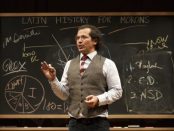
While setting out to “undo” our “whole, entire education” of Latin history--and to compensate for the textbook neglect of the impact of the Aztecs and the Incas on our culture and civilization--Leguizamo focuses on his son’s coming to terms with being the son of a Latino celebrity--namely, himself. Given that his wife is Jewish, and therefore, “very intolerant of intolerance,” Leguizamo never imagined that his “son was going to have to go through the same rite of passage that I did,” he says, at the beginning of this, his latest one-man show, which is filling the seats at The Public Theater. [more]

Mourning the Living

April 15, 2017

Ms. Hogan’s dialogue is well crafted and the structure is stageworthy, but it all comes across as a playwriting exercise rather than a full-fledged dramatic work. Medically, Hogan’s premise is extremely unlikely and adds to the off-kilter dimension. The plot points of the combination of someone in their 30’s being stricken with Alzheimer’s Disease, and then years later getting a respite from it, stretches credibility. [more]

A Gambler’s Guide to Dying

April 14, 2017

“To some he was dad, to some he was mate,” says McNair, at the top of his monologue, “to others he was liar, cheat, addict, hero, story teller.” Over the course of the next 70 minutes, McNair will also do, with modest effects and a modicum of success, other voices including his much younger self, a schoolteacher, mates of Archie’s, and even his own mother. Through it all, the one thing we never lose sight or sound of is his love for his grandfather. [more]

CasablancaBox

April 14, 2017

“The structure of 'CasablancaBox' is inspired by another filmmaker’s technique, Robert Altman’s roaming camera,” writes playwright Sara Farrington and director Reid Farrington in their program notes. This homage results in a collection of frantically staged vignettes that aren’t funny and don’t add up to much. [more]

Luft Gangster

April 13, 2017

It is fascinating to watch Lowell Byers face his unfounded, country boy optimism as he is confronted with the brutal realities of his situation. That Byers’ Lou never completely succumbs, despite having to perform several vile acts, makes him the moral center of the play that pushes the idea of morality to the extremes. In addition, his exacting research, based on his cousin’s travails, pays off in the complexity of his writing. [more]

The Play That Goes Wrong

April 12, 2017

While the non-stop buffoonery is reminiscent of Charles Ludlam and his Ridiculous Theatrical Company, this British import (produced by London’s Mischief Theater, no less) immediately evokes inevitable comparisons with "Noises Off," Michael Frayn’s divine and (admittedly, more) sophisticated farce about a community theater company putting on a play--perhaps the most hilarious, theatrical farce that has ever been devised by a playwright. But the present offering also has less of an agenda, settling for the sheer mayhem of putting together a group of people on a stage, during an ongoing performance, when absolutely everything that can possibly go wrong, does. It’s a surefire setup for the comic and rewarding chaos that ensues. In the end, and basically throughout, "The Play that Goes Wrong" has gone very right, indeed. [more]

“Rosalee Pritchett” & “The Perry’s Mission”: Two one-act plays

April 12, 2017

"Rosalee Pritchett" and "The Perry's Mission" are in the provocative tradition of such works of the period as Amiri Baraka’s 1964 play Dutchman and Melvin Van Peebles’ 1970 film "Watermelon Man." This exemplary production brings attention to these neglected playwrights, and is a welcome opportunity to experience their unsettling power. [more]

Vanity Fair

April 11, 2017

Tucker’s production uses seven actors playing 20 named characters plus members of the ensemble: the women (Joey Parsons and Hamill play one each, good girl Amelia Sedley and bad girl Becky Sharp, respectively) and the men play all the rest, including other female characters with the addition of wigs and slight costume changes. This allows the cast to demonstrate tremendous versatility in these juicy roles. [more]

The Profane

April 10, 2017

Playwright Zayd Dohrn has a facility for setups, punch lines and zingers that might play well as an HBO situation comedy attempting to mix humor with seriousness. As a theater piece, his premise has potential but his execution is deficient. [more]

Perversion

April 8, 2017

If only there were perversion in "Perversion." Instead, it’s a tedious, mélange of the absurdist styles of Jean Genet, Eugène Ionesco, Jules Feiffer and Dr. Seuss. There’s the eerie sensation of watching a satirical, counter-culture work that might have been exhumed from the archives of La MaMa, which was performed for three weeks in 1969, and then forgotten. [more]

Church & State

April 4, 2017

Rob Nagle (who created the role in the Los Angeles production) plays “compassionate conservative” North Carolina Senator Charles Whitmore who is up for reelection in a statistical dead heat in just three days’ time, running on a campaign slogan of “Jesus is my Running Mate” (chosen by his wife Sara). However, earlier that day he has been shaken by attending the funeral of 29 students shot by a lone gunman at the local elementary school which his sons attend. It could have been his sons who had been killed. [more]

Sweat

April 3, 2017

"Sweat" is a classic, “well-made”--or carefully constructed--play, with a focus on the dwindling work for people in the middle of the country, prompting them to install Trump in the White House--to the ongoing dismay of the rest of the world. It couldn’t be more topical even as it helps us understand just exactly what’s been happening to bring us all to this sorry state. It was also based on Nottage’s extensive interviews with many actual residents of Reading, fueling the drama’s impact. [more]

William Inge in Rep: Picnic & Come Back, Little Sheba

April 1, 2017

Though rather flawed in execution, there is much to enjoy in "Picnic" & "Come Back, Little Sheba": William Inge in Repertory. It is also revelatory in proving William Inge’s high ranking in the annals of dramatic literature. [more]

Growing Up Gonzalez

March 31, 2017

Mr. Rojas vividly creates an entertaining panorama of the Puerto Rican community in The Bronx of the 1960’s and 1970’s. A gallery of characters and numerous incidents are lovingly described. Orchard Beach, Roberto Clemente, various foods, the Catholic Church and a visit to Puerto Rico are among the cultural touchstones that are represented. [more]

How to Transcend a Happy Marriage

March 30, 2017

Marisa Tomei excels as George, the narrator of "How to Transcend…" --and of her own story. Thanks to Tomei’s vocal and visual expressions, we constantly share in George’s ongoing surprise, as she graduates from naivety to knowledge. In the end, it is George who has the most “transcendent,” and religious, experience. (It is not insignificant that we’re told George is the only Catholic in the group.)“It seems like you have omniscience,” says George, in her closing monologue, “when you can talk to the audience in a play.” And talk to us, she does, in the playwright’s smart, yet snappy language. Consider George also telling us that Jenna, “over time forgave us,” after walking in on her parent’s participating in a sex orgy. And “the trauma of seeing her parents’ aberrant sex lives up close--it became an anecdote in a college application.” Or consider David’s saying: “I’m from everywhere. And nowhere. I moved constantly as a child…. as a result, I don’t really believe in nationality.” [more]

The Emperor Jones

March 28, 2017

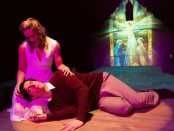
Directed by Ciarán O’Reilly as a feverish nightmare, this "Emperor," in just over an hour, exposes the inner reaches of the mind of the title character, Brutus Jones (played with a booming voice and a larger-than-life charisma by Obi Abili) leaving tedious reality behind. [more]

Beneath the Gavel

March 28, 2017

Bated Breath Theatre Company specializes in original works inspired by and in partnership with museum collections and exhibitions. However, this show about the fate of the “Haddie Weisenberg Collection” painted by artist Daniel Zeigler appears to be entirely fictional. Written and directed by Mara Lieberman, executive artistic director of the company since 2012, the play uses six actors in 43 different roles from artists both famous and imaginary, to auction house sales personnel and staff, to collectors to dancers, as well as having actors impersonate free standing sculptures. Ironically, 59E59 Theaters was at one time part of Christie’s Auction House and Theatre B was actually one of the firm’s galleries. [more]

The Price

March 27, 2017

Maybe “fireworks” is too strong a word for a production that is more of a slow burn. The play begins when Mark Ruffalo, as Victor, walks up, into the top floor of the home his family was consigned to, when the Great Depression of 1929 hit and their father lost his fortune. The essence of the conflict between Victor (a policeman) and Walter (a doctor) boils down to economic inequality. (As Walter says to Victor, “It’s very complicated between us.”) Though they both grew up with a chauffeur, the older Walter went on to a successful career while Victor stayed behind to care for their father when everything was lost during the Depression. [more]

Who Would Be King

March 25, 2017

Jason Slavick’s direction keeps the cast rollicking along, taking advantage of every inch of Ars Nova. He is helped by an energetic cast, all on the same wavelength, giving their physical and emotional all. Silly at times, yes; but ultimately dark and meaningful. [more]

Angry Young Man

March 24, 2017

The confusion and the rapid pace of the production pretty much engulf--and finally overwhelm--the extremely complicated story of"Angry Young Man." The performers, on the other hand, make this something of a gem of a small, Off Broadway offering, from Urban Stages. The wayward plot eventually takes Youssef to a disco with Patrick, and with Patrick’s girlfriend Alison, where Youssef is confronted by a skin-head, Terry, whom he accidentally kills. “The other customers were almost exclusively male,” says Youssef. “They seemed for the most part to be dressed as Patrick: long-hair, T-shirts, scruffy blue jeans.” [more]

Jack Charles V The Crown

March 23, 2017

His innate charm, joy of performing and theatrical grandeur is always on display in this show. All of those qualities combined with his resonant, Australian accented vocal delivery makes it easy to imagine him being commanding in Shakespearean and any number of roles in the classics of dramatic literature, as well as a screen actor. Sadly, environmental circumstances did not as of yet make this possible. [more]

The Last Days of Judas Iscariot

March 21, 2017

And what of the play which had its world premiere at the Public Theater in 2005? Parsons’ uneven production cannot keep this long play from seeming unwieldy. In fact, using so many actors is almost distracting as some of them are simply walk-ons, and disappear almost immediately. The new production seems less trenchant and more like a vaudeville with its set pieces than Philip Seymour Hoffman’s original staging. Nevertheless, the play still retains a cumulative effect and is ultimately compelling. [more]

C.S. Lewis On Stage: The Most Reluctant Convert

March 21, 2017

As he impersonates the British writer C.S. Lewis, Max McLean relies on little more than a pipe, a brown suit and tie, and a rather mellifluous voice to become the Anglican philosopher and noted atheist, who famously converted to Christianity in the mid-Twentieth Century. The script was cobbled together by McLean from Lewis’ memoir, letters and books, including other biographies of Lewis, a man who was “intoxicated” by words, which is primarily what this play is about--the mesmerizing effect that words can have, when uttered in an effective sequence. [more]

When It’s You

March 20, 2017

Speaking in an engaging Texas twang, the blonde Reeder recounts Ginnifer’s somber story with emotional straightforwardness and humor. Employing her expressive facial features, striking eyes and serene physicality, she delivers a performance of tremendous focus that hauntingly holds attention. [more]

Sam & Dede, or My Dinner with Andre the Giant

March 19, 2017

Beckett lived in rural France, and his nearby neighbor, Boris Roussimoff, helped him build a cottage on his property in 1953. Beckett grew close to the family, and offered to drive Andre to school, as the boy was reluctant to take the bus. This was because he suffered from gigantism and was self-conscious about his appearance and his difficulty in fitting into the bus. By the age of 12, he was 6’ 3” tall and weighed 208 lb. [more]

White Guy on the Bus

March 18, 2017

Musical star Robert Cuccioli has to call upon his experience playing both Dr. Jekyll and Mr. Hyde to become Ray in "White Guy on the Bus," a first-rate, new play by Bruce Graham, that has more than a stunning surprise or two, as it spreads out the story like a wild brush-fire burning out of control. His complicated and duplicitous “numbers man” character wants, from the beginning, to quit his high-paying job, and, like the French painter Gauguin, escape from the workaday world of banking and finance. “I don’t want to sell the house,” he tells his wife Roz in the opening scene. “I want to sell everything.” [more]

The Moors

March 18, 2017

Although the play demonstrates a surface knowledge of the genre and the period, it wants to have it both ways: it takes place in 1840 in a desolate mansion on the Yorkshire Moors but the characters talk and behave as though it is the present. It appears to be making a feminist statement by making all the members of the household female but has nothing new to say on the subject other than as a variation on these famous novels. And it attempts to be funny but isn’t clever or surprising enough to trigger much laughter. [more]

Significant Other

March 17, 2017

It’s well constructed, the dialogue is snappy and filled with some funny one-liners. The milieu is that of upper middle class Manhattan white-collar workers. Moderately entertaining, it attempts to explore a prevalent societal issue, but is undermined by its off-putting main character and its rarified sensibility. There is minimal sex talk and that is mostly cute, rather then revelatory. Jordan rhapsodizes about a male co-worker’s body, but doesn’t extoll anything much below the waist. [more]

The Light Years

March 16, 2017

Playwrights Hannah Bos and Paul Thureen with developer Oliver Butler, creatively evoke the tragic, nostalgic spirit of Booth Tarkington’s "The Magnificent Ambersons" and the wonderment of the works of humorist Jean Shepherd. The scenario is engaging and the characters are lovingly rendered. [more]

If I Forget

March 15, 2017

Steven Levenson’s "If I Forget" is the kind of family drama that doesn’t get written much anymore: one that has something to say other than just depicting a dysfunctional situation. Not only are we pulled into the family wrangling, the issues under debate are major ones and their outcome is serious business. Director Daniel Sullivan and a splendid cast of seven make this one of the most compelling plays of the season. This is a play you won’t soon forget and its provocative nature should trigger much discussion. [more]

Wakey, Wakey

March 14, 2017

"Wakey, Wakey" is Will Eno at his surreal, troubling, beautiful best, a play both challenging and easily absorbed. He truly approaches the unapproachable: the meaning of life. [more]
The Glass Menagerie

March 14, 2017

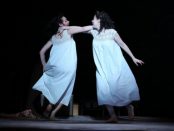
Sam Gold’s revival of "The Glass Menagerie," the fifth major production of the play in New York since 2005, is such a one. He has decided to remove all of the historical relevance as well as the scenery from this classic Tennessee Williams’ memory play. What he has also done is remove all of the poetry and all of the emotion in a play that on the surface would seem director proof. Ultimately, the production is more a director’s exercise in seeing how much he can cut from a play that tells a realistic story in a lyrical manner. A pity as his cast has two-time Academy Award winner Sally Field returning to Broadway after an absence of 15 years, two-time Tony Award winner Joe Mantello, Finn Wittrock (Theatre World Award and Clarence Derwent Award for "Death of a Salesman"), and debuting actress Madison Ferris. [more]

Deconstruction

March 14, 2017

The acting isn’t detailed or expansive enough to make Leaf’s words come alive or give the slightest notion of the intelligence of these three. Ms. Dobbins’ McCarthy is far too girlish. Yes, the playwright’s point is to show how even an intellectual can be seduced by a good-looking person, but she never boils over. The closest to anger she achieves is petulance. [more]

Linda

March 13, 2017

A revolving stage permits set designer Walt Spangler to depict, with dead-on realism and dispatch, not only Linda’s home--including an upstairs bedroom, which her daughters share--but also various offices at Swan Corporation, among numerous other sites. After a certain point, the dizzying, rotating stage becomes akin to a swirling merry-go-round, as director Lynne Meadow has it turning and turning, with different characters walking on and off, and through different doors, without any dialogue whatsoever, in subdued but effective lighting by Jason Lyons. It all becomes part of the accelerating gallop of the play itself, which ultimately spins out of control, as Linda learns that she’s lost her--well, let’s just say, in the end, everything. [more]

The Gravedigger’s Lullaby

March 13, 2017

Playwright Jeff Talbott offers an overall well-written and plotted social drama that detours into a strident political battle over capitalism. The sympathetic characters are trapped by their circumstances, as well as by Mr. Talbott’s rudimentary scenario. [more]

Villa

March 13, 2017

Chilean playwright Guillermo Calderón constructs a simple, engrossing and often funny scenario. Three women, all named Alejandra, have been selected as members of a deliberative, special committee from a larger body who could not reach a decision over a searing national issue. There’s suspense, shocking revelations and Survivor-like machinations. [more]

The Penitent

March 10, 2017

Perhaps because Mamet-regular Jordan Lage is so effective as Richard, the scenes between Charles and his own attorney prove the most effective. While Laura Bauer’s sensible costumes do all they can to make her seem real, Rebecca Pidgeon proves robotic as Kath, detracting from her character’s constant bewilderment. (Come to think of it, maybe it was a stylized choice for playing the part, because of Kath’s befuddlement and uncertainty, at every turn.) The last scene is set in a rehab room, where Kath has been confined, following a mental collapse or nervous breakdown. [more]

The Skin of Our Teeth

March 8, 2017

Thornton Wilder’s "The Skin of Our Teeth" with its benign belief in the resilience of the human condition is unlike any other American play you are likely to see. Both heavily influenced by earlier European experiments in theater, it is also influential in itself. While Arin Arbus’ production for Theatre for a New Audience at times seems as though it need tighting up, it is a play that must be experienced in the theater which is why it has never been turned into a Hollywood movie. Go and see for yourself what only the live theater can do to expand your imagination. [more]

Nibbler

March 6, 2017

Urban may have an admirable mission, in attempting to document the customary passage from youth to adulthood--or high-school to college, to be more precise--as he focuses on five graduating seniors in a middle-class suburb, in 1992, when one of them, Adam, remains behind, without any prospects for a glorious future. But the otherwise realistic play that unfolds quickly veers into surreal territory, as an alien from another planet enters their midst, and the eponymous “Nibbler” becomes ever more real a presence on stage, via a puppet, manipulated by several of the quite visible cast-members. [more]

Messenger #1, A New Ancient Greek Tragedy

March 6, 2017

In addition to the swiftness of the storytelling and the use of contemporary language, Jackson uses a sort of upstairs-downstairs approach. Aside from what is happening to the royals, we also see everything from the point of view of the three messengers. The messengers deliver their reports to us the populace, interact with each other, and interpret for us how the events of their world affect them. They also work as the chorus but each has something different to reveal rather than speaking in unison as in ancient Greek drama. Jackson has tweaked the legend somewhat which makes his version all the more surprising and absorbing. [more]

All the Fine Boys

March 5, 2017

Playwright Erica Schmidt has a minor aptitude for believably snappy dialogue, but not much else. Her tired scenario is astonishingly familiar and offers no fresh insights. That adolescence is tough is about all there is. That territory has been mined in John Hughes’ films and numerous television shows. There was also the 1985 movie "Smooth Talk," starring Laura Dern and Treat Williams that was based on a Joyce Carol Oates short story. [more]

Everybody

March 3, 2017

The original was aimed at an audience that most certainly was illiterate, so that the clever creators used cartoonish, unsubtle characters who spoke in popular jargon, even spouting profanity, which must have tickled the medieval audiences’ sensibilities and kept them following the actors in their juicy parts. Jacobs-Jenkins follows suit, but with his tongue firmly in his cheek, writing his characters, particularly Stuff (played with a no-nonsense, “from the block” insouciance by Lakisha Michelle May), as immediately recognizable twenty-first century caricatures. When cutie pie child Lilyana Tiare Cornell, playing the character Time, spouts the word “shitty,” the audience at the Diamond Stage giggles nervously. [more]
1 26 27 28 29 30 39