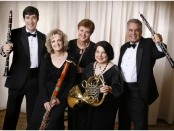
Joined by percussionist John Ferrari and conductor Jeffrey Means, the five members of the Da Capo Chamber Players – Curtis Macomber/violin, Chris Gross/cello, Patricia Spencer/flute, Meighan Stoops/clarinet and Steven Beck/piano – recently presented a concert inspired by the vibrant, important music of Milton Babbitt (1916-2011) on the occasion of the centennial of his birth. One piece was written by Babbitt himself, but all the other pieces, ranging in date from 1981 to 2013, were written by contemporary composers who at one point or another had studied with Babbitt at either Princeton or Juilliard. [more]
Performed the evening before the American election, the theme and purpose of the concert – remembrance of John F. Kennedy and Martin Luther King, Jr., two “outstanding stewards of humanity,” in Merriweather's words, whose lives were cut short by violence – embodied for musicians and audience alike art's core purposes. Art locates, grounds and inspires us; it gives us vocabularies for understanding ourselves. In the case of the works on this program, the American music of remembrance, contained in pieces by Steven Stucky and David Hurd, reminds us that moral and political conscience transcends individual lives and is strong within us all, even when our heroes are slain; and Mozart's "Requiem" calls up the universality of hope for salvation and pleadings for peace. [more]
Music director Steven Reineke led a perfectly respectable concert with the help of The Soldiers’ Chorus of The U.S. Army Field Band (First Lieutenant Alexandra Borza, Associate Bandmaster), a robust ensemble that proved itself song after song, including several songs in which soloists emerged to sing as in Barry Manilow’s “Let Freedom Ring” and the Toby Keith/Chuck Cannon “American Soldier.” [more]
From the very first opening bars of the "Chaos" overture, Hyde set the tone for the evening: conducting with gentlemanly authoritativeness, Hyde led the Orchestra of St. Luke's – who were all in exceptionally fine form – in a performance of expansive energy and optimism. Theologically, God's working material for his creation may have been unfathomably chaotic and formless, but in this particular artistic account of creation, Haydn's description of chaos is so informed by elegance, wit and bravura that the primordial chaos seems to have been imbued with goodness. [more]
Gordon created the role of Gertrude Stein with mezzo-soprano Stephanie Blythe in mind. Blythe’s monumental presence, thanks to a towering, charismatic, forceful voice, is meant to arrest and command attention. Blythe captures Stein’s complicated personality – her genius, her stalwartness, her humor and her occasional, brutal judgments about the artistic quality of her bon mots. [more]
"Lavender Songs: A Queer Cabaret in Weimar Berlin" has the mature and slim Mr. Lawrence in drag virtually for the entire length of the performance. In a dirty-blonde curled wig, his face garishly made up, twirling a red and purple boa, and wearing a sleeveless sequined black dress, Lawrence is like an Otto Dix painting come to life. [more]
In the first concert of the 2016-2017 Composer Portraits season at Columbia University School of the Arts' Miller Theatre, current music of American composer John Zorn (b. 1953), including five premieres, was presented and enthusiastically received. More accurately: Zorn's music-making – his understanding of individual composing and collegial collaborating as interconnected projects – was exuberantly celebrated. [more]
Introducing what he dubbed a pair of “Comedies of Crime,” NYGASP’s artistic director Albert Bergeret offered what he said was a first of a new series for the company: intimate performances of works by Sir Arthur Sullivan in the jewel box Marjorie S. Deane Little Theater performed to one piano, rather than to the usual full orchestra. In addition, the cast of "Trial by Jury" was comprised of the NYGASP’s Wand’ring Minstrels, a quintet of singers made up from the company, rather than using the full chorus, while the production of "Cox and Box" featured a newly edited version by singer/director David Macaluso. The new format for these delightfully entertaining productions had their advantages and disadvantages. [more]
Music Director/Conductor Steven Reineke chose three fine singers, Colin Donnell, Laura Osnes and Nathan Gunn, to animate the Lerner and Loewe songbook, along with the terrific choir, Essential Voices USA (Judith Clurman, Music Director). They, plus the lusty sounding New York Pops, brought songs from "Camelot," "Paint Your Wagon," "Gigi," "Brigadoon" and, the biggest hit, "My Fair Lady" to life. [more]
Hosted by the always charming Steven Reineke, the fundraising event, New York Pops Underground, featured two terrific Broadway stars, Montego Glover and Tony Yazbeck, whose performances clearly loosened the purse strings of a standing-room-only Feinstein’s/54 Below crowd. [more]
The performance of Verdi's "La Traviata" featuring Bonnie Frauenthal as Violetta and Jose Heredia as Alfredo Germont was wonderful in many ways. Frauenthal sang and acted her complex role compellingly: she is a confident singer, capable of both womanly sturdiness and subtle virtuosity, and she inhabited the dense narrative of Violetta's story credibly and compellingly. Heredia's youthful and earnest Alfredo was also convincing; his deep love of Violetta and grief at her death were poignantly believable. Interestingly, as an actor, Heredia stuck so literally to the movement of Alfredo's character in Piave's libretto that Alfredo's subservience to his father was maddening: the son's filial weakness undercut the manliness of his love for Violetta. Both Frauenthal and Heredia sang with integrity; they held nothing back from full commitment to either their roles or their audience. [more]
While the New York City Opera’s staging of "Aleko" could not be called a major rediscovery, it was an admirable attempt to offer a non-standard repertory work that had probably not been seen by any of its New York audience. The real surprise was the thrilling and commanding performance of "Pagliacci" which bodes well for NYCO’s future life and health at Lincoln Center. In addition, the New York City Opera Chorus, under the direction of William Hobbs, gave persuasive performances in both operas, another feather in the City Opera’s cap. [more]
Over the last several years, PRISM and two colleague chamber groups, Sō Percussion on the one hand and PARTCH on the other, have been engaged in the “Color Theory” project, and presented two separate concerts. Taking as their model early modern visual artists' examination of pigment mixes through the insights of Isaac Newton's discovery of color theory and prisms, the four saxophonists and composers with whom they collaborate have been using “color theory as a framework to explore the spectra that make up instrumental sound.” The results were exhilarating. [more]
This production had two brilliant design/directoral conceits that worked hand in glove with the musical elements to tell the story. The first involved twelve dancers from Ballet Hispanico’s BHdos all in white body suits from head to toe, undulating virtually continuously down stage in front of the ship, representing the river and its secrets. With indefatigably choreographed by Nicholas Villeneuve and breathtakingly lit by Barry Steele, they, indeed, became a living part of the scenery, even interacting with the characters on the ship. [more]
C4 has always been driven by certain core values and goals; the particular repertoire “cornerstones” being emphasized this season, as indicated in the concert's program notes, were important but infrequently performed works, beauty, and the nurturing of new composers' voices. This concert contained all these features in both recent works and four premieres. [more]
In the program notes and in informal remarks to the audience, Ochsner encouraged the audience to listen to all the works as music inspired by nature; this theme proved to be a useful organizing device for the concert. It was both literal – stars, storms, forest transformations and water events – and allusive: the vocabulary of nature works as well for human psychology as for meteorology. The size and composition of the 36-member chamber orchestra made both intimacy and grandeur possible. [more]
Such feast days deserve magnificent music; Bach and Handel created it. And the Saint Thomas Choir of Men and Boys, the first rate period-instruments Concert Royal, and five marvelous soloists gave splendid performances of two Bach cantatas and a Handel psalm-setting that did both the feast days and the music proud. The first-rate concert was a particularly fine accomplishment for St. Thomas Church: rocked by the sudden death last summer of John Scott, choral director and organist, the school and the church had to both manage a top-knotch concert season without their director and perform the “director-less” concerts as suitable memorials to Scott. [more]
Completing New York Gilbert & Sullivan Players’ 40th Season was a rare revival of 1884 "Princess Ida," the team’s eighth operetta and the only one in which the dialogue is in blank verse, it is presented in three acts, and it is based on a previous play by Gilbert. In the playwright/librettist’s second parody of Tennyson’s book-length poem "The Princess," the themes include feminism, education for women, Darwinism and the Battle of the Sexes. While the operetta still displays its relevance and timeliness, the NYG&SP production proved to be uneven in several categories. [more]
Above the stage on a screen throughout the presentation were projected photographs illustrating Rodgers’ career and appropriate backdrops for the locales of the shows. Brief insightful video interviews with Rodgers’ daughter Linda, lyricists Sheldon Harnick and Martin Charnin, playwright Sherman Yellen, historian Ken Bloom, Rodgers grandson Peter Melnick, record producer Thomas Z. Shepard, and the actor John Cullum were shown. A 1974 Public Television interview conducted by James Day showed the aged Rodgers ravaged by strokes and throat cancer but still vital and articulate. [more]
Price, Bottoms, Richardson and Courville are all strong, clear singers; they were well matched in this performance, alert to each other's pacing and responsive to each other's sensibilities. Although any one of the four could have grabbed a center spotlight, they were unified – probably by a combination of their own individual understandings of Beethoven's purposes and by Shapiro's direction – in graceful collaborative cohesion in their singing. [more]
She ran down the list of her Broadway co-stars: Ricardo Montalban, Donald O’Connor (the disastrous Bring Back Birdie), Antonio Banderas (upon whose shoulder she placed a shapely leg in Nine) and, her admitted favorite, Dick Van Dyke, with whom she co-starred in "Bye Bye Birdie" from which she sang “A Lot of Livin’ To Do” giving it a sassy, winking interpretation making it impossible to deny that the title is very on the mark. It wouldn’t be a Chita Rivera show without a mention of her iconic Anita in "West Side Story." A meeting with Leonard Bernstein to go over her songs just after she had been cast was nerve-wracking as she never had considered herself a singer. History has proved that her singing almost equals her dancing. “A Boy Like That” and “America,” complete with some mini-choreography were nothing short of electrifying. [more]
In the hands of less virtuosic musicians, Ligeti's material can spin out of control. Kigawa, Choi and Drehmann, however, from the very opening, invited the audience into an experience of listening based on complete trust. The work's elegant, almost wistful conclusion – a distillation of harmonic lines into quiet, unresolved ambiguities – was compelling. [more]
Staged by director/choreographer Doug Varone, "Dido and Aeneas" was amusingly presented in modern dress with Varone’s dancers playing the ensemble in both operas and pantomiming unseen props and scenery. As the original Purcell music to the surviving Nahum Tate 1689 prologue has been lost, LaChiusa has created a witty new one entitled" The Daughters of Necessity: A Prologue," and lasting 15 minutes. After the Chorus (men in bleachers on stage left, women on stage right) welcomed us, they recounted the myth of the Fates: Nono (Sarah Mesko) who spins the thread of life, Decima (Anna Christy) measures it, and Morta (Clark) snips the thread with her scissors. [more]
Inspired by the musical Olivier! was "La Révolution Française" that was Mr. Boublil Mr. Schönberg’s first collaboration. Created in 1973, this was the first French rock opera and dealt with The French Revolution. The rousing “Parisians, Awake and Rise/ Français, Français” was performed by Ms. Glover, Mr. Jordan, Mr. Scatliffe and Essential Voices USA. The original French Cossette from "Les Misérables," Marie Zamora, was a marvelous Marie Antoinette for the wistful song “Au petit matin/In the early morning.” [more]
Dynamic performer Migguel Anggelo exhilaratingly recalls the showmanship of Desi Arnaz and the performance art of Klaus Nomi in his terrific autobiographical cabaret act, "Another Son of Venezuela," that has the razzle dazzle of a Bob Fosse production. [more]
At turns beautifully silly, dreamy, exquisitely moving and always delightful, "Fêtes" is a sweeping, if daffy, look at life in eighteenth century Venice. Christie and his director Robert Carsen, framed the opera ingeniously by beginning the work in modern day Saint Mark’s Square complete with modern day tourists—mostly members of Ed Wubbe’s Scapino Ballet—with their cellphones, backpacks and obnoxious behavior. [more]
Since the 1670’s, the Choir has consisted of voices ranging from bass to treble, all students at St. John's College or the College School. There are currently six basses, five tenors, four counter-tenors and seventeen trebles; of the trebles – two or three of whom are no bigger than buttons – there currently appear to be thirteen families represented. In some senses, the trebles are the stars of the show: that such young boys should demonstrate such consistently high levels of both innate musicianship and disciplined formal training is remarkable. The sweetness of tone inherent to boys' soprano voices is not like anything else: its combined ethereality of the moment and promise of future sturdiness make it a perfect instrument for the invocation of angels, heavenly beauty and divine wisdom. [more]
“Our goal is not to impersonate her but to channel her,” said Mr. Sperling, the artistic director, writer and director of this entertaining event. In addition to these tasks, he also sang, played piano and as the genial host effortlessly delivered his authoritative biographical statements. A fan of Merman’s since childhood, Sperling’s conception and execution of this show was a very well done labor of love. His patter skillfully documented her renowned charisma, saltiness and, most importantly, her unique vocal abilities. [more]
Though the evening was studded with some of the more famous and mainstream orchestral pieces of William’s career—namely the March from "Raiders of the Lost Ark" or the Theme from "Jurassic Park," the evening also highlighted some of the more experimental pieces that came with Spielberg’s influential works of science fiction. A series of excerpts from "Close Encounters of the Third Kind," as well as a suite from "E.T. the Extra-Terrestrial," shed light on the fact that, though Williams is gifted at the art of creating a catchy melody, he is also an expert at concocting complex, ethereal music that makes the world of science fiction seem wholly believable. [more]
The Douglas-Westerlies music, whether its subject is lament or celebration, protest or affirmation, is artistically coherent: testing and stretching traditional genres, the music is about forward movement, about the exploration of “Great American Themes” as they end in felicitously determined encouragement and optimism. This music's informing energy and spirit shine and summon. Audience and listeners are invited into a musical experience in which history provides context, inspiration and goad; references to the political, musical and cultural past do not tether the music to old habits but liberate it for new conversations. Together, Douglas, Royston and the Westerlies generated a warm and rich brass-and-percussion sound; the Westerlies' happy virtuosity, discipline and irrepressible affection for the full range of their instruments' sounds make them a perfect collaborative partner for Douglas' genre mixing and generously imaginative expansion of the artistic possibilities of trumpet, trombone and drums. [more]
And Ensemble Pamplemousse, an exciting and distinctive six-member “composer performer collective” founded in 2003, and performing at Miller Theatre for the first time, had all sorts of fine surprises to offer. Each of the musicians composes and performs; each seems able to play several traditional and non-traditional instruments, though their publicity material identifies one primary instrument of each. All six, fresh off their extensive recent European tour – Natacha Diels/flutes, Jessie Marino/cello, Andrew Greenwald/drums, David Broome/keys, Bryan Jacobs/electronics and Ross Karre/miniature drumset – contributed equally to their recent Pop-Up performance. [more]
The last piece of the concert was James MacMillan's substantive and moving 1994 "Seven Last Words from the Cross," a 35 minute piece of seven different movements, varying in length from nine to one-and-a-half minutes each, for choir and orchestra. As the piece progresses through the final Passion drama, from Jesus' plea for forgiveness for his executioners to his exhausted last breath, MacMillan explores aspects of prayer and petition, anguish and fear – Jesus' and humanity's – in music that bears close allegiance to Romantic liturgies and Requiems. Here, the Choir and the orchestra were elegant, boys and men singing with superb control, lush expressivity … and their usual clear diction. [more]