Tony Marinelli is an actor, playwright, director, arts administrator, and now critic. He received his B.A. and almost finished an MFA from Brooklyn College in the golden era when Benito Ortolani, Howard Becknell, Rebecca Cunningham, Gordon Rogoff, Marge Linney, Bill Prosser, Sam Leiter, Elinor Renfield, and Glenn Loney numbered amongst his esteemed professors. His plays I find myself here, Be That Guy (A Cat and Two Men), and …and then I meowed have been produced by Ryan Repertory Company, one of Brooklyn’s few resident theatre companies.
That balance—between emotional vulnerability and razor-sharp humor—is what elevates "Hold Me in the Water" beyond the sea of solo shows that mine personal experience for applause. Haddad’s artistry lies in his fierce honesty and unsparing introspection. He examines his own longing, joy, and heartache with something approaching clinical precision, yet never loses the pulse of the deeply human. He never asks for pity, and when disappointment inevitably arrives, he extends surprising compassion—even to the one who’s let him down. [more]
The performers inhabit a shared space that hums with latent connectivity, even in the absence of direct dialogue. Their presence to and for one another—unspoken yet palpable—forms the quiet backbone of the piece. What unfolds is a relentless swirl of Marxist theory and grand philosophical overtures, repeated like mantras against a backdrop of absurdist physicality. Narrative cohesion is eschewed in favor of thematic resonance: a professor marks chalk outlines around a silent woman while students volley fervent monologues; later, those same students offer murmured asides as the professor ascends to a pulpit-like presence. Though no linear thread binds them, their trajectories intersect often and with theatrical charge, forming a constellation of meaning just out of reach. [more]
Bringley, making his theatrical debut as himself, delivers a performance marked by restraint and quiet intensity. His words, drawn largely from the memoir, reveal a man of thoughtfulness and delicacy—someone who seeks refuge not in action, but in observation, retreating to the hushed galleries of The Metropolitan Museum of Art, where he once worked as a guard. “You lose someone,” he tells us, simply, “and it puts a hole in your life—and for a time you huddle down in that hole.” It’s in that stillness, that huddling, that the piece finds its quiet power. [more]
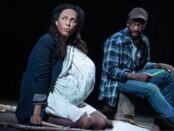
Before he was a Nobel laureate, before his name was canonized in the firmament of world literature, Wole Soyinka was a young playwright—barely in his mid-twenties—when he penned "The Swamp Dwellers" in 1958. And yet, this early work bears the unmistakable gravitas of myth: a compact, hour-long domestic drama that pulses with elemental force. In director Awoye Timpo’s hauntingly grounded revival, the piece reverberates with contemporary resonance. It is at once a family portrait and a parable, steeped in the muddy waters of postcolonial Nigeria and rippling outward into modern-day concerns—climate change, disillusionment with institutions, and the aching silence left by absent gods. [more]
The results of this updating are bold, and Andrews’ intellectual ambition is undeniable. At times, his revisions might seem questionable but when the production clicks, it strikes with a thrilling originality. The production pulses with an urgency often missing from more traditional revivals of "The Cherry Orchard," a play about people running out of time. The central conflict remains: Liubov, the bankrupt widow haunted by the ghosts of her past, returns to her family estate for the inevitable sale of the land that defines her family’s history. Practical solutions are needed, but neither she nor her hapless relatives can take decisive action. [more]
In "Amm(i)gone," Mansoor masterfully delves into the delicate nuances of cultural and personal differences, exploring the connections that bind us even in our diversity. Co-directed with Lyam B. Gabel, this meta-theatrical production—spanning a compact yet potent 80 minutes—recounts the journey of Mansoor and his mother as they embark on the project of translating "Antigone" into Urdu. Surrounded by designer Xotchil Musser’s evocative set of wooden cutouts and intricate mosaics, and serene candles for effect, Mansoor guides the audience through their creative process, blending dialogue, video and audio recordings, and projected imagery to weave a story that is both intimate and expansive. The production’s clever use of multimedia enhances the emotional weight of their shared task, inviting the audience to reflect on the complexities of language, family, and legacy. [more]
"The Trojans" effortlessly blends sharp, often hilarious high-school dialogue with an inventive and evocative score, creating a musical experience that feels both contemporary and nostalgic. The characters’ voices ring true to their age and environment, and their dialogue flows seamlessly into the show’s musical numbers. The soundtrack, crafted from cassette tape loops and vintage analog synths, infuses the production with an infectious energy, while also echoing the show's 1980s-inspired aesthetics. There are exceptional songs throughout the score but "Boys are Bad," a standout solo for Lucas (Daphne Always), not only delivers a memorable melody but also weaves in pointed commentary on masculinity—a theme that reverberates throughout the production. [more]
Peter Danish’s "Last Call" is a 90-minute confection of speculative daydreaming, inspired by a brief meeting between two of the most legendary conductors of the last century, Herbert von Karajan and Leonard Bernstein. Set in Vienna in 1988, in the sumptuous Blaue Bar of the Hotel Sacher, just before both men passed away, the play imagines a moment when the two giants of classical music, though not close friends, exchanged words. [more]
While the conversation may not always captivate, its premise—one that hinges on the unpredictability of human connection—remains intriguing. However, it’s hard to ignore the tension between the initial promise of a quick fling and the long, drawn-out conversation that ultimately defines their encounter. The result is a work that wrestles with the idea of how we fill the spaces between moments of intimacy—and whether we even have the language to fully express what it means to truly connect. [more]
While there are plenty of laughs in "The Great Privation," we never lose sight of the fact the subject matter has roots in the history of medical exploitation. Previous mainstream pieces have appeared in recent years: Rebecca Skloot’s #1 New York Times bestseller, "The Immortal Life of Henrietta Lacks," about a black woman whose cells were taken without her consent and unbeknownst to her contributed to numerous medical breakthroughs, and "Behind The Sheet," Charly Evon Simpson’s 2019 play presented by Ensemble Studio Theatre, loosely based on the story of J. Marion Simms, a gynecology pioneer whose progress (and success) was built on the suffering of enslaved women. [more]
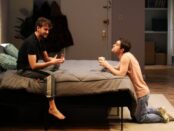
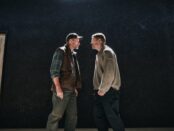
"Grangeville" ultimately revolves around the fragile, strained bond of brotherhood—or, more accurately, half-brotherhood—and both actors excel in capturing the tender nuances of this dynamic. Their performances resonate with a delicate authenticity, portraying two damaged individuals tentatively reaching toward one another, aware that reconciliation may or may not be in their future. The emotional pull of their evolving connection is subtle, yet profoundly moving. [more]
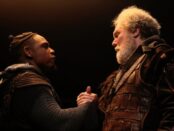
Dakin Matthews’ "Henry IV" is a consistently engaging gift to the theater season. Shakespeare scholars may quibble about the extent of the cuts from "Henry IV, Part II," but the reality is the original in its entirety can be a bit of a slog. Eric Tucker’s company treats us to the sheer thrill of witnessing a rarity executed to perfection, its invigorating energy palpable in every precise detail. [more]
Foreman's dramatic structure feels like an audacious attempt to stage the tumultuous workings of the mind itself. Neurons ignite, voices both internal and external whisper, scream, and echo through the chaos. Like a pinball careening through an ever-shifting machine, the sensory overload flashes, buzzes, and swirls, pulling you in with distractions that both enthrall and devastate. Yet, amidst it all, you may find yourself trying to self-convince that it somehow all makes sense…not perfect sense, but even nonsense has a layer of sense. [more]
Playwright/actor Braulio Basilio may appear prophetic when we sit in horror today watching the news as a returning president maps out how he plans to deprive immigrants of any and all freedoms in this new administration. Created and conceived by actors Basilio, Ursula Tinoco, Gilberto Gabriel, and their fellow Teatro 220 colleague Andrés López-Alicea, "Building My Casa" is a timely piece of theater that desperately needs a wider audience. In "Building My Casa," they do not give us any surprises nor are we ever expecting any; they give us a tale of three endearing individuals who each in their own way are strangers in a strange land. [more]
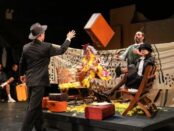
While they credit the eight puppeteers textually, “with help from the ensemble,” Warnock and Waage are also credited as executive producers along with set and costume design. Mr. Waage is given solo credit for the sublime puppet design and construction. All in all, the parts make for a rather resplendent whole. Starting with the puppeteers dressed in sparkly black fabric that bring a deserved attention to the constant manipulation of the puppets and a set that constantly morphs between scenes. The initial “lights-up” has a large chunk of sparkly “glitter basalt” that dissolves into the individual puppeteers. The look is reminiscent of Adrian’s classic sequined pantsuits for Judy Garland in concert. Kudos to lighting designer Daphne Agosin for capturing every sparkle in those costumes as well as to the projection designer Erato Tzavara for creating surreal space within the confines of the Baruch’s venue. Thor Gunnar Thorvaldsson’s original music and sound design underscore the fantastical display on stage. [more]
Girelli’s lyrics provide wonderful support to Willett’s choreography. A motif for the song “Valentine” has the dancers in tango movements covering their hearts with their palms. The playfulness of musical chairs takes over another song where chairs are left empty so prospective partners can sit in each other’s laps. The song “Tonight You’re Mine” provides for a very athletic, relentlessly physical duet danced by Marissa Nielsen-Pincus and the bare-chested Ryan Wuestewald. A passionate duet for Devika Chandnani and Noah LaPook is performed to “King of Tears,” a song that confronts the deep emotional pain from heartbreak, emotional vulnerability, and personal struggle to recover from a relationship that has ended. [more]
Walking into the Peter Sharp Theater we have no hint of what is behind what look like opaque vinyl shower curtains from one end of the stage to the other. Within moments of her appearance, decked out in a black suit and tie like the kid who hates to dress up to go to Grandma’s for Sunday dinner, we know Francesca D’Uva just doesn’t want to be here. At the end of 80 minutes, we are so glad she came. She breaks the ice by letting us know how sensitive she is to mouth sounds telling us about a high school teacher who smiled so hard you could hear it. On the count of three, we all try to copy the smile noise. “I love bringing people together like that. That will be the only piece of crowd work I do tonight. So hope you enjoyed it. You’re done.” [more]
The success of this play and our ability to navigate the ride relies heavily on the flawless cast led by Troyano herself. She shepherds us through every turn of the script and we willingly follow her everywhere she takes us. One of the standout moments is when Branden is whisked away to the Havana nightclub El Pescadito in Phantasmagoria. Alina as Carmelita entertains at the piano dressed as Bola de Nieve, a legendary Afro-Cuban cabaret artist. “Bola” performs a song “Messie Julian” containing lyrics “Yo soy negro social, soy intellectual, y chic” with modified references to Branden. When he asks what the song is about, Carmelita reveals herself to be half-bear ready to attack him. [more]
While the musicians are exemplary, it is Lipton who does the heavy lifting in the show. With what amounts to a very witty hosting duty, his singing voice is one that is rich and quite comfortable in various genres. Director Leigh Silverman keeps him moving and talking at all times, always engaging the audience even when he is being upstaged by his “Grandpa Morrie,” a Roomba that speaks (and sings) in Roomba-ese. Morrie has the audience wrapped around his finger, rather circuitry, when Lipton asks him to wait backstage and Morrie can’t make it back up the ramp without help. Morrie later duets with Lipton and at one moment stops cold. Lipton’s attempts at restarting Morrie fail (is this what Roomba death looks like?) until bass player Riggs offers a battery from his own mouth to recharge Morrie. The whole audience goes “Awww” and applauds. [more]
Director Scott Ebersold works wonders with the double-edged sword of the audience knowing full well these performances are colored by the play taking place close to 20 years ago when girls this age didn’t have the benefit of understanding their gender identity as girls do in 2024. Social media and sexual education have made great strides in these decades yet we don’t for even a moment feel that Mr. Ebersold’s concept gives us a museum piece. Ebersold gets vibrant heartfelt performances from each of the three actresses. [more]
As long as you come to John Yearley’s "Triptych" with the understanding that grief is a deeply personal and complex emotion and that just because two people are married doesn’t mean they will experience a traumatic event exactly the same way, then you will understand the plight of Joe and Blanche. It goes without saying, although it’s always said, nothing is sadder than the loss of a child; the parent is “supposed to go first” and the children are expected to grow older and have children of their own but life and unexpected tragedies have a way of getting in the way. [more]
As both playwright Harry Teinowitz and his co-author Spike Manton spent time in rehab, they carry us through the epiphanies as well as the relapses by injecting humor in every “shot glass” of this play. This is most evident when George returns from a drinking binge with the front wheel of his bicycle mangled into a pretzel. The roommates focus on the “falling off the wagon” rather than the falling off the bicycle. The highlight of their days (and nights) is getting together to watch reruns of "Cheers," with the episode where Sam Malone relapses being one they can probably chant verbatim the way other people can act out all the parts of "The Rocky Horror Picture Show." [more]
"Bad Kreyòl" is gifted with a pre-show voiceover from the playwright herself: “To love a people is to learn their language.” This speaks volumes for two women who know what they know, aren’t keen on changing it up any, and are inherently both generous givers and caretakers in every aspect of their lives. And yes, sometimes you need to butt heads. [more]
This stunning theatrical work is a creation of the two-member On The Rocks Theatre Co. (Christopher Ford and Dakota Rose), two ingenious artists who have been at work on "The Beastiary" since they were selected as Ars Nova’s fifth Company in Residence in 2019. Commissioned to create a new show from scratch, a first Ars Nova-produced reading came to fruition in 2021. Adding composer Dorit Chrysler to the team, later 2022 workshops added the theremin score and the puppets to the play. More behind the scenes development, a puppet build residency, and a two-week production workshop built the show that is now at Greenwich House. Ford and Rose have co-written and co-designed the scenic elements. Ford designed the glorious costumes and hand-made puppets and Rose directed the entire production. [more]
Director Jared Mezzocchi uses the proximity of the actors to the audience to its best advantage. We don’t even question when one of our ranks is pulled out to play Young Sunny. It adds to the sense of community that is the cornerstone of this production. Kudos to Mezzocchi and the four actors in intuitively divining who in the audience is most right for participation. As the play dashes back and forth in time, the actors are kept moving, narrating as they go along. Again physical life clearly dictates whether they are in character or in narration mode. Mezzocchi incorporates projection design to complement the telling of the history of the ever-changing neighborhood. It provides a welcome steady stream of point-of-reference when one considers the land was once dry tundra in the shadow of a glacier twice the height of the Empire State Building. [more]
Gabriel Kahane’s pair of song cycles are a welcome throwback to when lyrics were poetry and told great stories. Think of the 70's when the airwaves were blessed with the voices and songwriting of Harry Chapin, Joni Mitchell and Cat Stevens and you will have a basic understanding of what Kahane has successfully put together here. [more]
Four hardened male plainclothes police officers are being coached for a “suppression hearing” – that is a court proceeding prior to trial to challenge the legality of the evidence taken from the crime, whether it be drugs, statements, or identification. In "The Witness Room," there are two bags of cocaine that were removed from the crime scene, but the sloppiness of the affidavits filed by the four police officers means some “rehearsal” is necessary for all four men to be in agreement on what actually happened months earlier when a man was arrested. This is not as dense as "Rashomon." In place of the exquisite storytelling that offered subjective, alternative and somewhat contradictory versions of the same incident, "The Witness Room" gives us a very real situation where the slightest discrepancy either frees a criminal or sends an innocent person to jail. [more]
In this return engagement of the site-specific "The Voices in Your Head" we are often asked to give pause in order to consider how differently we all process our grief. Earlier this summer another play, someone spectacular, tackled the same subject matter but in a more predictable way. With that play, we never forgot we were in a theater watching a support group navigating their weekly session (but for that evening without the benefit of their group leader). While that was presented in thrust staging (the audience surrounding the actors on three sides), The Voices in Your Head created by Grier Mathiot and Billy McEntee welcomes us as new members to the group. [more]
Tarlton’s work is not without promise. As a social critique of people who are surgically attached to their smartphones, it is somewhat spot-on. (Heaven forbid we miss that recent post documenting what was ordered in the latest restaurant!) At points when actors were immersed in their phones rather than looking at or speaking to each other, the silence of audience realization, or rather revelation, was deafening. [more]
Ehrenpreis’ "Clowns Like Me" is sad, but true, and with the help of writer and director Jason Cannon, the brutally honest tale finds all the humor that’s possible. Within a very few minutes we are introduced to all the tools to discuss an obvious manifestation of his obsessive-compulsive disorder: cleanliness. Out come the goggles, gloves, cleaning rag, spray bottle and his co-stars Swiffer and Dirt Devil in this elaborate Ginger and Fred dance to clean where the average person would see no dirt. [more]
Perhaps "Midnight Coleslaw’s Tales from Beyond The Closet!!!" ’s tagline “an evening of boner-chilling terror” was not meant to be a typo. The premise of an evening of one-act plays that explore queer culture and perspective through (low) comedy and the macabre could be entertaining, if only the end result had enough macabre to fill out the evening. One act gives a truly creepy story of a young couple falling for a chair that appears to be made of human skin with a gender all its own that pleases both members of the heterosexual couple. The second act finds a lesbian couple on the eve of one of them turning her mother over to an assisted living facility. She in turn is haunted by the ghost of her long deceased father as the couple ready the mother’s house for sale. The last act is for the most part a monologue of a gay man that may or may not be celebrating his last birthday on earth. [more]
Raja Feather Kelly, an award-winning choreographer of recent Broadway musicals "A Strange Loop" and "Lempicka," as well as "Teeth," the recent Playwrights Horizons success imminently getting a commercial Off-Broadway run, makes his debut as a playwright with "The Fires," a work drenched in sorrow. The play examines three, actually four, Black men who inhabit the same third floor South Brooklyn railroad apartment in vastly different eras: 1974, 1998 and 2021. [more]
Someone once coined the adage, “Write what you know.” For the past few seasons, we have seen many writers have a lot to say about surviving the Covid lockdown, but none so eloquently as Dave Malloy in "Three Houses." Where there is often the sameness in the stories we’ve heard thus far, Malloy chooses to give us three not so disparate individuals each with a particular heartbreaking loneliness. All three tales are prefaced “so this is the story of how i went a little bit crazy living alone in the pandemic.” Where aloneness is ripe for scenes that are maudlin, Malloy setting these tales to music is rapture. [more]
Koogler began writing "Staff Meal" in January 2020 and completed the first draft in April 2020…well, he certainly had time on his hands, but so did a lot of people. It’s a wonder we didn’t have a great outpouring of “the great American novels” during Covid, or at least as we were being released from our lockdowns so we’d have something to read as we made our way back into the subway. What is striking about "Staff Meal" is that we begin with what passes for so much normalcy – two people begin conversation, even if it’s minimal Millennial-bleats, and graduate towards commiserating about the coffee in this particular café finally leading up to finding lunch somewhere…but this won’t be a quick run into a (low-end) McDonald’s or (slightly better than low end) Pret a Manger…this will be a foray into Ruth Reichl territory. They land in a high-end perhaps Michelin-starred restaurant where the staff gathers to eat gourmet cuisine before the dinner crowd comes in. [more]
As we are instructed early on, the meal and the service are divided into 15 sections. The Seder is held in the midst, or as a significant part, of the whole of the play. It is then complemented by the opera portions. Einhorn gets a big assist from composer Avner Finberg’s exotic score and musical director Mila Henry as she leads the chamber sextet from the piano. Tenor James Benjamin Rodgers as Moses, soprano Tharanga Goonetilleke as Tzippora, one of the God voices, and a messenger, and lyric bass Matthew Curran as the Pharaoh, Reuel, and the other God voice are exemplary. [more]
While the ensemble cast is excellent throughout, we do feel Taylor Mac’s absence when he goes offstage to change costumes (and that is quite a few times, one more sumptuous than the other – though not rivalling what goes on at a Cher concert). Most importantly the “new gender reveal” in Constantinople also occurs offstage. Inhabiting Orlando as a woman, Mac gives us one of the most heartfelt realizations, “How odd. When I was a young man, I insisted that women be obedient, chaste and scented. Now I shall have to pay in my own person for those desires. For women are not…obedient, chaste and scented by nature. They can only attain these graces by tedious discipline. There’s the hairdressing…that alone will take at least an hour of my morning…there’s looking in the looking glass…there’s being chaste year in and year out…Christ Jesus.” [more]
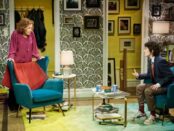
The performances are quite stellar. Jayne Atkinson’s Helen is simply gorgeous. We do see that woman who 30 years ago wore a red dress to a party…and that was enough for Mark and Lorraine to have a fight, as Mark “not to hurt Lorraine” had described Helen as plain. Thirty years later she is still anything but plain. Atkinson is that woman who could have broken up a marriage if Mark and Helen continued communicating over those 30 years. She is vibrant, earthy and quick-witted, all the things Lorraine may not have been. Tim Daly finds that illusive charm in Mark that may or may not allow the audience to forgive that this meeting reeks of the premeditated. He too provides us with an easy glance at what it must have been like for them to be together. He is more prepared for this meeting…the stops and starts and even Helen’s unintentional changes of subject. Daly, despite his character’s references to a heart attack and arthritis, gives us that glimpse of the youthful Mark that Helen fell in love with years ago, and could fall in love with once again. [more]
Playwright Kairos Looney has given us a gift in these painfully beautiful moments. We explore a family’s various ways of approaching love for and duty to each other with the result that we are all human coming as no surprise. Where sometimes there are breaks in communication, it is not about who gets “to be the better person,” but more about how we find that way to erect that bridge that brings us all together again. [more]
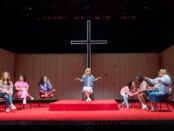
Sarah Benson’s direction is spot-on, but we find ourselves wishing the closing scene was more than just a plethora of bloody penises. This is where the creatives needed to say, “Okay, this is probably not what we wanted to say”. Adam Rigg’s scenic design though spare, is perfect for a mid-America room that can pass as a small church, or AA meeting. The neon cross is a great touch and Jane Cox and Stacey Derosier’s changing colors do not go unnoticed…particularly when the cross is pink amidst a lavender wash when Ryan is in the scene. Enver Chakartash’s costume design is appropriate across the board, although the women’s outfits in the closing scene are a mélange of Tina Turner’s castoffs from "Mad Max Beyond the Thunderdome." Choreographer Raja Feather Kelly provides fine ensemble suites for the Promise Keeper Girls. [more]
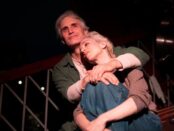
Enter young baritone Edwin Joseph. He has that dark curly hair and handsome face, yes, and the crucial understanding of the necessary swagger and selfishness that carries this character through the opera, yes. Mr. Joseph brings to mind the earthy and always sexy television star Shemar Moore, someone who has the confidence without even trying; it’s just there, and in spades. Joseph is helped with Mr. Wills’ ingenious staging. Tatyana’s letter scene is performed with Onegin perched on the top stairs of a stage ladder in full view just stage left of her bedroom space. The implication that he is well aware he is desired by Tatyana is there long before he reads the letter. He doesn’t need to read her outpouring of her soul to know he has that effect on her. In the birthday party scene, it’s not the flaunting of Onegin’s flirtations with Olga that sets the tone for Lensky’s challenge to a duel, it is a brazen handjob administered by Onegin to an already emasculated Lensky off in a corner where Lensky hopes no one sees that is the trigger for everything that follows. And throughout, particularly in his closing aria in Gremin’s palace, Joseph with his rich resonant baritone has this score in the palm of his hand. [more]
The text created by Bogart in collaboration with Maddow and Zimet is a collage of assembled passages from the works of Sartre and de Beauvoir, amongst others. Maddow and Zimet don’t often speak to each other in the piece, yet they are still very much “in dialogue.” The piece is designed as to keep them separate, though inseparable. The moments where they share stage action: putting away groceries, having sex (brief, then on to the next thought), and dancing is charming as comic relief in contrast to all the other serious content of the piece. One tongue-in-cheek moment that sheds light on how much history they share is their little jazz dance routine abruptly segueing into the Jim Carroll Band’s New Wave classic, “People Who Died.” The change is as abrupt as it is disconcerting, but it is seamlessly incorporated into the stage business. [more]
It is a rare author indeed that can take uncomfortable material, and by uncomfortable that is, to hear, digest, and process a subject no one likes as a subject of conversation, and then give an audience the opportunity to take away from the experience a profound enlightenment. But when that author is Dael Orlandersmith we have come to expect nothing else. The playwright’s new work, "Spiritus/Virgil’s Dance," is a contemplative meditation on mortality as much as it is an examination of how we choose to pass and live out our days until our own “conclusion.” [more]
While we are presented with characters who are doing a noble thing and can be touched by what they go through to accomplish their task, Brian Belding’s book and lyrics repeatedly take us out of 1942. In breaking up a fight between her brother and her old flame, Sophie blurts, “Are we seriously doing this?!”…Seriously? The tone is not “then” in 1942, it’s a university student of present day. When Willi walks in on the scene, he asks “What the f*@k is going on?!” We don’t doubt the impulse behind it, but was that really the vernacular in 1942? Natalie Brice’s score has its moments with some of the solos, but the full company songs sound like retreads of "Les Miserables" chorus numbers. “Munich” sounds like “Blind Eye” sounds like “Why Are You Here?” sounds like “The Mess They Made” sounds like “We Will Not Be Silent.” All are full throttle songs with the same sentiment, so why are there so many? [more]
Jes succeeds where some other bio-storytellers fail. Jes’ secret is being comfortable in their own skin to relate intensely personal experiences yet create a sense of universality, or community, that envelops the entire audience. You may not always agree, but chances are good you will be laughing with Jes, and not at Jes. As Jes puts it, “Most of my material takes at least two semesters of gender studies to truly understand.” As with most other autobiographical journeys, we get a heavy dose of self-deprecating humor, “I like when people call me 'they,' it makes me feel less lonely. Like someone can be like, 'That’s Jes, they’re gonna go smoke a spliff' and it sounds like I had a friend.” Reflecting on early career choices, “I was doing non-binary comedy in straight bars and clubs that were ten straight guys and one woman, and the woman was me. And I was like 'I’m not sure I’m the guy for the job but I’ll do my best for the culture. ' ” [more]
Probably only David Rabe’s "Sticks and Bones" (part of his Vietnam trilogy that included "The Basic Training of Pavlo Hummel" and "Streamers") is as demonstrative as "Lone Star" in its depiction of a soldier’s inability to easily pick up from where he left off upon returning from a tour of duty. For this production, Ruth Stage, in an adaptation by director Joe Rosario and actor Matt de Rogatis, has been given the rights to append the character of Elizabeth to the original "Lone Star" cast. Her character is from a companion McLure play, "Laundry and Bourbon," which has a history of being performed in repertory with "Lone Star." Elizabeth is Roy’s wife, therefore Ray’s sister-in-law. [more]
There are frequent breaks in thought such as “I forgot to mention at the top that I will be injecting my jokes with a bit of humor tonight as a way to keep them both engaging and fun.” Thanks for clarifying the job description. This is just one of many exclamations to the obvious. Director Nemuna Ceesay keeps us guessing. Are we watching an actor portraying a comedian/lounge performer? Does the comedian/lounge performer think he’s funny? What if no one laughs? A bit later there’s a recitation that goes on longer than it needs to. We start waiting for a punchline that never comes. And then it does…As it was introduced as a voice-over, “That was the opening paragraph of Moby Dick by Herman Melville, sold wherever Moby Dick by Herman Melville is sold. [more]
Tatarsky uses language in a fresh way, ultimately giving the sensation of having created her own. There are so many thoughts overlapping, and there are accompanying unintelligible sounds and gurgling (some of that happens during her coffee “breaks” and those coffee cups seem to be hidden absolutely everywhere), yet we follow her. When she references a new text, she will nonchalantly drop “I assume everyone here has read the book, yah? Great.” Of course, hasn’t everyone read "Die Ausbildung und Reisen von Wilhelm Meister"??? Her spontaneous body language may very well be choreographed but even there we have a very approachable and comforting whimsy throughout. [more]
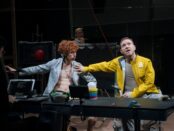
Not since Stephen Sondheim’s "Sunday in the Park with George" have “civilians” gotten so close to the creative individual’s “process” when attending a theater piece. David Adjmi’s "Stereophonic" is an intensely personal work that examines the creation of a rock album, a group’s follow-up to a late-blooming debut, in the very competitive music scene of the 1970’s. As the characters in the play have been compared to the celebrated Fleetwood Mac members in many articles appearing before the opening of this production, it’s safe to say this is an exquisite fantasia on the creation of the now-legendary rock masterpiece known as "Rumours," an album firmly in Rolling Stone Magazine’s Top 10 of “The 500 Greatest Albums of All Time.” [more]
If an audience can willingly get past the contrivance that the distant relative Stevie meets over coffee, a young white man whose family generations ago once owned (and fathered!) slaves in Stevie’s family, and who just so happens to be the live-in boyfriend of Stevie’s niece Meg, then the audience will have a good time. The four leads of Meg, her boyfriend Drew, her mom Beverly, and Beverly’s twin brother Stevie are written so well. We care so much about each of them that the revelation that they are intertwined by the horrific tale of a plantation owner that loved his slave but was not above slashing her tendons when she tried to run away sets a tone that should be devoid of all humor. [more]
Nathan Alan Davis’ "The Refuge Plays," if one pays attention, is exactly about refuge: growing up with it (because someone else has lovingly created it for you), seeking it (if you feel you must create your own), and coming back to the refuge you have always known (once you come to terms with the realization you’ve had no success trying to create it somewhere else). Davis, for the most part, has given us characters that we can easily fall in love with, each with their own path to refuge. [more]
To say that Krymov works like no other director is an understatement not to be taken lightly. He is known for his inventive Russian adaptations, but he has also been earning a reputation for tackling American literature with the same whimsical and sometimes fourth wall-smashing approach that emphasizes the pure act of theater making. It is at first quite disarming in its playfulness, yet never loses sight of sincere treatment of works of literature. Here we find two Ernest Hemingway short stories, "Hills Like White Elephants" and "A Canary for One," both written in the late 1920’s, matched with two scenes that serve as dense character portraits from Eugene O’Neill’s "Desire Under the Elms," circa 1924. They are not your normal fare when you consider the expectations of the term “love story.” [more]
nicHi douglas’ vision is one of evocative beauty, one that gives us stage pictures to treasure for some time. The seated women fanning themselves with beautiful white fans as they watch one of their own reading a passage or singing is a natural touch. Even the graphic for the show gives us pause – the word “pray” surrounded by two hands creating the parentheses denotes how personal the power of an individual’s prayer is. douglas’ church is almost utopian in its design in that it welcomes all with no judgment…even the “mixed company” of whites present at the service who might be startled by how genuinely euphoric the service is. Her choreography, like her direction, is empowered by a true spirit of celebration, reminiscent of the great Alvin Ailey masterwork, "Revelations." [more]
LaBanca’s performance in his own play defies superlatives. Including us in his choir at the beginning of the show says it all. We are relieved that he still finds joy in teaching. As he puts it, “I packed up my classroom and as God would have it, I was invited to move everything to a public school. Also in my neighborhood.” He takes comfort in an accidental meeting with a priest who was asked to step down and move to another parish. “It’s ok. Matthew, just remember. The church isn’t God.” [more]
Krymov’s production is a rapturous love letter to the making of theater. He unearths how we really tell our stories by our emotions, what we hide, as much as what we reveal. He uses his stagecraft to develop new work from what has existed for decades but now through what must be the most meticulous, yet fresh, improvisatory stage vocabulary. His new company’s forthcoming seasons will be must-see events of the highest order. [more]
Sweitzer inhabits over a dozen characters in this play entitled "20 Seconds: A Play with Music," albeit two of them are him when young and him telling us the story now…two people he knows intimately. He is never so broad as to suggest caricature. His female characters are vibrant and flesh-and-blood enough for you to suspend disbelief that you aren’t actually seeing his mom Kathy, and Erdean, and Ms. Ruth, the fleabag hotel manager, and Denise, the girl next door, and finally his creation, Vivian Delgrosso, a drag homage to the Italian women his mom’s age. He brings the same depth to his male characters, with the masterpiece being his sadistic, yet eventually repentant father Tom. [more]
Somewhere there are rules for what theatre is supposed to do: it should entertain, it should instruct, it should provoke. To say that Annie Dorsen’s "Prometheus Firebringer" checks all the boxes is an understatement of what she has done here. It is a brilliant reactionary, and yes, even cautionary, piece that takes a 2,500-year- old play that doesn’t really exist anymore (what is left of it is the title and a fragment or two – the rest has been lost over time) and thrusts it into an exercise for the unwitting specter of Artificial Intelligence. The results are fascinating, yet unremarkable; provocative, yet giddy. [more]
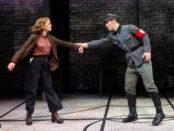
Director Rick Hamilton effectively steers the sad tale away from an endless maudlin saga. After all, the “spoiler” is in the program. Helena Weinrauch is alive and well and in her late 90’s, living in New York City. She attended the opening night of this production. We are carried by Helena’s travails – some are ultimately uplifting, like her about-face on her relationship with Wladek, a Jewish guard. She takes him to task for his participation in the black market, but he steps in to save her from death more than once. Earlier, she leaves the safe haven of living with a German couple who think Helena is married to a German officer on the front so not to put them in harm’s way when she knows she will ultimately be found out to be a Jew masquerading as a young German bride. Hamilton is conscious of needing every scene to be driven by intense depictions of rapid change in what was once a beautiful place to live. [more]
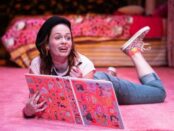
Playwright Samantha Hurley does beautiful justice to the life and times (and the inner workings of the mind) of this early teen with not a lot going on but for her own fantasy world and self-importance in the face of neglect, emptiness and lack of love. Shelby kidnaps Tobey Maguire because she has figured out how to get it done. Trapped inside her house with the object of her affection she realizes “Be careful what you wish for” only too well. We watch her growing pains as we see the actor she traps come to terms with his own failure to make success bring him happiness. In the end, they leave us with our own hearts full. [more]