News Ticker

Articles by Joel Benjamin

About Joel Benjamin (600 Articles)
JOEL BENJAMIN was a child performer on Broadway and danced with leading modern dance and ballet companies. Joel has been attending theater, ballet and opera performances ever since childhood, becoming quite opinionated over the years. He was the founder and artistic director of the American Chamber Ballet and subsequently was massage therapist to the stars before becoming a reviewer and memoirist. He is a member of the Outer Critics Circle.

The New York Pops: “Concert for Courage”
November 15, 2016

Music director Steven Reineke led a perfectly respectable concert with the help of The Soldiers’ Chorus of The U.S. Army Field Band (First Lieutenant Alexandra Borza, Associate Bandmaster), a robust ensemble that proved itself song after song, including several songs in which soloists emerged to sing as in Barry Manilow’s “Let Freedom Ring” and the Toby Keith/Chuck Cannon “American Soldier.” [more]

Falsettos

November 14, 2016

Throughout it all, Finn’s songs illuminate the joys, loves, hates, passions and complaints of this delightful cast of characters. From the opening “Four Jews in a Room Bitching” to the exquisitely moving final song, “What Would I Do?,” the score is full of melody and witty wordplay. There are songs about Mendel’s sessions (“Marvin at the Psychiatrist, a Three Part Mini-Opera” and “Jason’s Therapy”), a marriage proposal, a nervous breakdown song (“Trina’s Song”), a hilarious song about Jason’s little league (“The Baseball Game”), an ominous song (“Something Bad is Happening”) and several love songs (“I Never Wanted to Love You,” “Making a Home,” “Unlikely Lovers,” “The Games I Play” and the previously mentioned “What Would I Do?”). [more]

Coriolanus (Red Bull Theater)

November 9, 2016

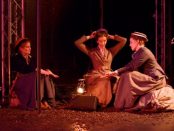
Just as Ulysses S. Grant and Dwight D. Eisenhower did centuries later, Coriolanus, urged on by his powerful mother, Volumnia (a startling, stinging Lisa Harrow), uses his military success as a springboard for a high political office, Consul, which he easily wins with help of two Tribunes of Rome, Sicinius Velutus (a wily Stephen Spinella) and Junius Brutus (Merritt Janson, playing cross gender to perfection) and a friend, Menenius Agrippa (Patrick Page, using his weighty voice and commanding eyes brilliantly). [more]

Love, Love, Love

November 5, 2016

British actor Richard Armitage making his New York stage debut and Tony and Academy Award nominee Amy Ryan work hard to make Kenneth and Sandra three-dimensional, likeable people, but, as written by Mr. Bartlett, their crassness is the fatal flaw in "Love, Love, Love." Why should we enjoy spending so much time with two people who so adroitly care only for themselves? [more]

Heisenberg

October 22, 2016

Simon Stephens, whose Tony Award winning "The Curious Incident of the Dog in the Night-Time" recently amazed audiences with its razor-sharp take on the inner workings of an autistic boy, is back with "Heisenberg," a two-hander that examines the relationship between a forty-something woman and a seventy-something man, written with the same consummate insight into the foibles of human beings, minus that play’s technical wizardry, here replaced by a sharp ear and eye for the nuances of neediness. [more]

Oh, Hello on Broadway

October 20, 2016

In the guise of two old Upper West Side bachelor geezers, Kroll as failed actor, Gil Faizon, and Mulaney as failed writer, George St. Geegland, wander about Pask’s brilliant combination apartment/beauty salon/TV studio/street set, musing out loud about their lives, wearing dreadful wigs (credit Leah Loukas) and speaking in a bizarre accent which, for example, turns “Broadway” into “broodway,” “an” into “en” and “homage” into “home page.” [more]
Inner Voices

October 17, 2016

Paulette Haupt, producing artistic director of Premieres, should be very proud of herself. Her "Inner Voices" program at the TBG Theatre managed to shock, move and entertain. The three short one-act musical monologues, each with a distinctive voice and each performed by an expert singer/actor were sweetly bizarre ("Just One 'Q' "), shattering ("The Pen") and heartwarming ("The Booty Call"). [more]

The Trial of an American President

October 10, 2016

Trial is stacked against Bush from the get-go. The torrent of facts alone convicts him. The director, Stephen Eich, the author and probably the actor, Mr. Carlin, seem to have decided to make Bush weak-voiced, full of twitches, nervous eye movements and religious fervor. Had Bush been portrayed as a stronger man who truly believed in what he did, the play might have had a dramatic spine. The very fact that after being convicted by a jury of audience members Bush’s last word is a tearful outcry (“Laura”) serves to induce not empathy, but pity. [more]

“Misty Copeland” by Gregg Delman

October 6, 2016

"Misty Copeland" is not just the celebration of Misty Copeland the feisty, young classical ballet dancer, but of Misty Copeland the young, nubile, well-proportioned young woman. She looks great wearing next to nothing, her exposed skin gleaming under Mr. Delman’s expertly subtle lighting. She is able to achieve all sorts of hyper-stretched positions on all sorts of furniture, her expressions ranging from distracted to come hither. [more]

The Black Crook

September 25, 2016

The creators of this version combined songs from the period—several probably used in the original production—with a pared-down version of the second-rate melodrama written with by Charles Barras (portrayed as always rattled and put upon by Steven Rattazzi), who tells his side of the story while also playing the romantic lead, Roldolphe, in the actual "Black Crook." [more]

New York Pops Underground (Feinstein’s/54 Below)

September 25, 2016

Hosted by the always charming Steven Reineke, the fundraising event, New York Pops Underground, featured two terrific Broadway stars, Montego Glover and Tony Yazbeck, whose performances clearly loosened the purse strings of a standing-room-only Feinstein’s/54 Below crowd. [more]

A Corona Works: Thorns of the Crown

September 20, 2016

Two queen-like figures, Ms. Corona and Maricarmen Garcia, dressed in a parade of Aviad Arik Herman’s sumptuous costumes, reigned over four young men—Nick Burrage, Alexandre Barranco, Nicholas Montero and Michael Bishop (dressed in Herman’s tight, revealing shorts). The men morphed into the roles of consorts and warriors, manipulated by the two royal ladies into confrontations involving vividly acrobatic ballet steps and quotes from Shakespeare. [more]

Phaedra(s)

September 17, 2016

During the three and a half hours of "Phaedra(s)," Huppert masturbates, menstruates, throws up, fellates several versions of Hippolytus, flails about with masochistic glee, and screams so loudly and continuously as to cause fears for her vocal health, all in the service of getting to the core of the title character as imagined by Sarah Kane, Wajdi Mouawad and J.M. Coetzee (with dramaturgy by Piotr Gruszczynski.) Director Krzysztof Warlikowski did little more than keep the over-the-top emoting and sexuality from exploding out to Fulton Street. [more]

Maestro

September 16, 2016

Felder’s play begins with a video of the actual Leonard Bernstein delivering a colorful, yet entertaining, illustrated lecture on music. When Felder sashays down the aisle, a cigarette in one hand and a drink in the other, the lack of resemblance is, at first, bothersome. But, somehow, sitting at a piano—which he plays impeccably—his monologue pulls you into Bernstein’s tumultuous life story. [more]

BalaSole Dance Company: Mixtus

August 22, 2016

The ten solos proceeded efficiently and smoothly with certain similarities becoming apparent: black was the color of all but one of the costumes and black was the mood of most the works. Crouches were the preferred opening poses, beginning with “Convergent Unease” by Alexis Julian to music by Max Richter, and the movement palettes were not particularly original, even when well danced, as were most of the solos. [more]

Sarasota Ballet: A Knight of the British Ballet

August 15, 2016

A few months ago we saw the sensational Miami troupe featuring the works of George Balanchine. Now we have just had a fascinating week-long season by the Sarasota Ballet troupe, directed by Iain Webb, at the Joyce Theater in Chelsea, in a program called "A Knight of the British Ballet" focusing on the brilliant work of Sir Frederick Ashton. Ashton was for decades synonymous with The Royal Ballet. His ballets were the artistic backbone of that troupe. It’s odd—yet wonderful—that Florida has become a stronghold for the repertories of two of the twentieth century’s most important choreographers. [more]

Cats

August 9, 2016

The debonair resident of posh St. James, and Gus, the theatre cat, are both played with finesse by Christopher Gurr, whose “Gus the Theatre Cat” who nearly steals the show away from the more famous “Memory,” here sung by an underwhelming, but pretty-voiced Leona Lewis, the British three-time Grammy Award nominee, as the bedraggled, superannuated beauty, Grizabella. Mr. Gurr’s wistful singing and great acting movingly communicate his tale of theatrical greatness and all the actors he had known (most completely forgotten by contemporary audiences). [more]

Takarazuka in “Chicago”

July 30, 2016

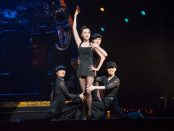
This Japanese version lacks the passion and darkness necessary to make this morality tale pop. The two leading ladies, Wataru Kozuki as Velma and Hikaru Asami as Roxie looked too wide-eyed and innocent to portray such trampy characters, but they moved and sang well. Keaki Mori as Matron “Mama” Morton, in her high, curly wig, totally missed the seamier sexual ambiguity of the character while Chihiro Isono as the put-upon Amos was a tad too low key. Asato Shizuki was slick, but not seamy or sexually provocative as the lawyer, Billy Flynn. [more]

The Mushroom Cure

July 29, 2016

In the course of 90 minutes, we follow the ups and downs of Strauss’ professional, mental health and romantic lives in great detail. To his credit, Strauss gives the impression of delivering these stories as if for the first time. He was fresh and very involved, yet sensitive to the audience’s reactions. He managed to make a tediously unattractive condition fascinating and also managed to make himself affecting and human, his disability notwithstanding. OCD has never been as attractively rendered. [more]

Bridgman|Packer Dance

July 20, 2016

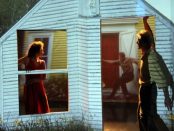
At times, Hopper’s paintings—mostly the moody ones—were inhabited by the dancers who took on the iconic, emotionally laden poses so brilliantly painted by Hopper, helped by Frank DenDanto III’s fine lighting. Outdoor scenes, images of isolated houses and rows of urban buildings added to the complexity. Endlessly long corridors, down which the dancers wandered, appeared as the soundtrack (by Scott Lehrer and Leon Rothenberg) alluded to city sounds, distant trains, conversations and nature. The two dancers were never eclipsed by the set and projections, their emotional states always in flux and always crystal clear. The effect was often breathtakingly and movingly beautiful. [more]

Twyla Tharp and Three Dances

July 13, 2016

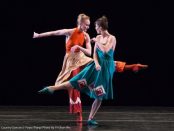
From 1976, “Country Dances” represented the post-experimental avant-garde phase after breakout success with her ballets for major dance companies. From 1980, there was “Brahms Paganini,” her entrée into her hybrid style combining her eccentric, seemingly casual movements with the classical ballet vocabulary and from 2016, “Beethoven Opus 130,” virtually a classical ballet with quirky touches. [more]

DELIRIOUS Dances: To Begin the World Over Again

July 9, 2016

Edisa Weeks’ DELIRIOUS Dances company presented "To Begin the World Over Again," an ultimately hopeful, informal look at American values filtered through the words of Thomas Paine, the Revolutionary War era philosopher and rebel-rouser—sort of an informal, easy-to-get-into Hamilton. [more]

On the Verge

July 6, 2016

As the women find themselves further and further in the future, it is how each reacts and is forever changed that give the play its emotional weight. Two manage to adjust quite well; one not so much. The whirlwind of mid-twentieth century America takes its toll on these intelligent travelers, outwardly in their clothing and inwardly on their attitudes toward life. The paths each takes at the end of "On the Verge"aren’t just theatrically satisfying—having been telegraphed subtly in many ways—but actually quite moving. Suddenly Overmyer, with the decided support of three fine actresses, ably directed by the astute Laura Braza, turns these silly, living cartoons into flesh and blood. And, that is the real journey of On the Verge. [more]

RIOULT Dance New York 2016

June 30, 2016

The New York City premiere of “Polymorphous” to Bach was a coolly elegant work that featured ever shifting black and white projections (by Brian Clifford Beasley) matched by the witty leotards by Karen Young which were white in front and black on the back. The video also featured reverse shadow images surreally mirroring the dancers as they plied the light jumps, gentle partnering and beautifully arching steps. The most balletic work on the program, “Polymorphous” used one of Rioult’s frequently used technique of working one pair of dancers in contrast to the other. In this case, the four dancers—Brian Flynn, Ms. Haines, Jere Hunt and Sara Elizabeth Seger—created two different pools of emotions—one quietly amorous, the other darker. “Polymorphous,” with its careful, quiet craftsmanship, was a kind of choreographic palate cleanser between the heated “Dream Suite” and the four “Duets Sacred & Profane” which followed. [more]

Florencia en el Amazonas

June 29, 2016

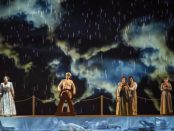
This production had two brilliant design/directoral conceits that worked hand in glove with the musical elements to tell the story. The first involved twelve dancers from Ballet Hispanico’s BHdos all in white body suits from head to toe, undulating virtually continuously down stage in front of the ship, representing the river and its secrets. With indefatigably choreographed by Nicholas Villeneuve and breathtakingly lit by Barry Steele, they, indeed, became a living part of the scenery, even interacting with the characters on the ship. [more]

Othello (American Sephardi Federation)

June 27, 2016

The American Sephardi Federation’s production of a greatly compressed "Othello" at the beautiful Center for Jewish History. This was the third of a series of three shows staged to showcase the talents of David Serero. He’s a Moroccan Sephardic Jewish performer who has charm and charisma. [more]

Shuffle Along, or the Making of the Musical Sensation of 1921 and All that Followed

June 27, 2016

"Shuffle Along..." follows the travails and triumphs of the creators of the 1921 David that fought what was at first a losing battle against the Goliath of the Broadway powers-that-be. The quartet that put the show together on a long road tour were libretto creators F.E. Miller (Brian Stokes Mitchell whose charisma and mind-boggling professionalism makes his character the safe harbor) and his partner, Aubrey Lyles (Arbender Robinson, brilliantly taking on the part usually played by Billy Porter); composer, Noble Sissle (Joshua Henry, giving a quietly dignified performance as an artist whose disappointment in America takes him to Africa) and lyricist, Eubie Blake (Brandon Victor Dixon, the more effervescent and demanding of the two songwriters). [more]

Ballet Tech presents Kids Dance

June 17, 2016

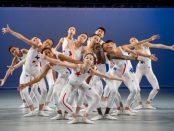
However, the main thrust of this troupe is to stimulate a gentle discipline and the ability to work effectively with others. It’s clear that these youngsters who range from seven or eight years old to teenagers enjoy their time on the stage and have been rehearsed to perfection. Occasionally a look of concerted concentration replaced smiles but this experience—whether any of these kids will go on to careers in the performing arts—is priceless and will have positive repercussions throughout their lives. [more]

Indian Summer

June 14, 2016

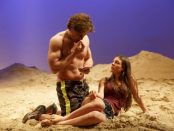
Gregory S. Moss’ "Indian Summer" at Playwrights Horizons is an uneasy mix of two stories, the first about the doomed romantic encounter between two teens and the second concerning the quiet existential suffering of an elderly man. Despite sudden shifts of tone, Moss manages to leave the audience feeling deeply for each of these characters. [more]

Paramour (Cirque du Soleil)

June 9, 2016

"Paramour," the Cirque du Soleil’s stab at producing a Broadway style musical at the Lyric Theatre, is the circus equivalent of a jukebox musical. Instead of songbook—Beach Boys, Four Seasons, Carole King, etc.—this show is a panoply of circus shtick: juggling acts, trampoline chases, trapeze acts, contortionists, teeter board high fliers, etc. Although the circus bits aren’t truly integrated into the overblown plot—a rather silly "42nd Street"/"A Star is Born"/"Red Shoes" mash-up—it’s great to see the Cirque du Soleil performers in any context, but why the creators couldn’t dovetail the wonderful circus bits with an intelligent plot, is a mystery considering all the money that clearly went into "Paramour." [more]

The Total Bent

June 6, 2016

Stew and Ms. Rodewald’s command of the musical genres of the 1960’s and 1970’s—gospel, Motown, soul, glam-rock, funk, R&B, blues, etc.—is astounding. The songs are organic extensions of the dialogue. In fact, this show could easily have been a straight drama or a sung-through opera. [more]

American Ballet Theatre: La Fille mal gardée

June 1, 2016

Leading this bucolic tale of amor interruptus were Gillian Murphy (her usual strong technique subsumed in girlish sweetness) as the farm girl, Lise, the “badly guarded girl” of the title, and Cory Stearns (at his lyrical best) as Colas, her young farmer swain. In the drag role of Lise’s mother, Widow Simone, was Marcelo Gomes, the still vibrant classicist perhaps just having a bit of fun in a character role, or keeping an eye on the future—distant future!—when character roles will be the natural progression for this great artist. [more]

Signature Plays

May 30, 2016

It’s clear why Edward Albee’s "The Sandbox" (1959), María Irene Fornés’ "Drowning" (1986) and Adrienne Kennedy’s "Funnyhouse of a Negro" (1964) are considered modern absurdist classics. They hew to the territory the truly greats like Samuel Beckett, Eugene Ionesco, the Dadas and Alfred Jarry explored, with Beckett the most influential, particularly in the first two plays, interpreting them with an American spin. If they are not as effective—if they seem somehow clichéd—the playwrights cannot be faulted. The Art World simply moves on. [more]
1 13 14 15 16 17 19