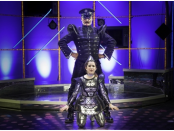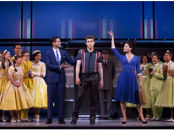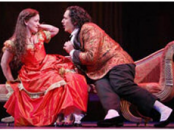
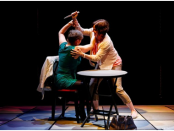
The artistic team responsible for this "Butterfly" made radical decisions and changes. Puccini’s original three acts of linear story – love and “wedding,” waiting, betrayal and death – are reorganized and abbreviated into three scenes of waiting, remembered love, and then betrayal. Some minor characters in the original opera are eliminated to create a caste of just five singing characters. The entire orchestra is reduced to a chamber orchestra of just six musicians, the Cantata Profana. The adaptation of Puccini’s orchestral score for this small chamber group by Daniel Schlosberg is remarkable: unexpectedly, its absolute faithfulness to Puccini’s musical intent at almost every turn made up for the diminished number of musicians. [more]
The show’s writer and host, Rob Berman, introduced many of the songs and, essentially, gave us the story of Lerner and Loewe’s difficult, on-again, off-again partnership. Referring to them, at one point, as an “odd couple,” Berman explained that the composer Frederick (or “Fritz”) Loewe was an “old world” European, and lyricist Alan Jay Lerner a “New York sophisticate,” who was educated in England. Berman also claimed that the common denominator for all of their musicals was a kind of “idealism,” making the pair “dreamers.” [more]
The goal of their three week Women in Theatre Festival is “a direct response to gender disparity in theatre leadership, casting, and production, the objective of WIT is to broaden the opportunities for women artists, engage with an audience who seek an indie theatre experience, and add to the canon of women playwrights writing roles for women actors.” "Great Again" quite successfully fulfills these commendable aspirations. [more]
Mr. Perry has certainly followed the maxim, “write what you know.” We follow the romantic and personal travails of four stereotypical, contemporary Los Angles types who have the financial resources for incessant self-examination. It’s a universe of meet cutes, overwrought emotional exchanges and happy endings. [more]
While most of the audience remained stony-faced, my companion and I were laughing hysterically throughout much of "Can You Forgive Her?", a black comedy if ever there was one, by Gina Gionfriddo at the Vineyard Theatre. It may be that many in the audience failed to recognize it was a comedy, and took it far too seriously, which is somewhat understandable, given the seemingly earnest yet cockamamie story--or rather stories--that unfold. [more]
Director Jesse Berger’s fast-paced staging is an exuberant amalgam of physical and verbal virtuosity combined with visual flair. A highlight is a crowd of characters hurrying into a closet and popping out one by one that’s out of a Marx Brothers movie. There’s also the spectacle of a group of bearded, shabby villagers of various heights storming The Mayor’s house in their flowing garments. [more]
Mr. Grandbois’ engrossing scenario is in the vein of such feminist fantastical works as "Diary of a Mad Housewife" and "Up the Sandbox." An expedition to a salsa dance club, buying a puppy from gypsies behind a Home Depot, watching Clash of The Titans on television with her son and a trip to the zoo are rendered with exquisite literary detail that’s simultaneously comic and moving. Looking into an old mirror becomes a Proustian reverie of Lanie’s recollections of her dead grandmother. [more]
It's Ella Fitgerald's centennial. She influenced more than a generation of singers and musicians. The lady called the “Queen of Jazz” or “The First Lady of Song” would have turned 100 this year. Her bounty is unmatched. Among her musical gifts, Ella was an exceptionally well-rounded musician, a pristine vocalist and impeccable improviser. She was jazz. There have been many first ladies of this or that but Ella was an original, clarion-voiced swing singer in a league of her own. [more]
From the beginning, one core component of Rosenbaum’s mission has been the cultivation of a contemporary American repertoire and the regular commission of new works. Rosenbaum is, in fact, an enthusiastic champion of young composers. This May concert, consisting of ten new works, reflected this focus … and was a wonderful celebration of young talent and achievement. [more]
An import from the United Kingdom, as part of the 2017 Brits Off Broadway Festival at 59E59 Theaters, Jon Brittain’s "Rotterdam" is not based on a true story relating to events in the eponymous Dutch city. It rather focuses on a British lesbian couple, one of whom decides at the beginning of the play that she’s really a man and really wants to become transgender. The crux of the drama is between Alice and her lover Fiona, who, in the course of the play, becomes Adrian. But why the two of them moved to Rotterdam seven years ago, is never really answered in the play--rather posed as a recurring question--along with the question of whether or not they’re going to remain there. [more]
It is set in present-day rural Afghanistan. Several years earlier, Paiman as a child was sold by his father to the well to do Jahandar. The two have an intense emotional and physical involvement that must soon cease, as Paiman is soon to marry because he is approaching manhood. Feda, Zemar, the dancing boy of Zemar, Jahandar’s droll, and mean cousin, is also aging out. Paiman and Feda fall in love and that instigates several conflicts. [more]
Amidst Mr. Maierson’s barrage of mechanical set-ups and punch lines, there are a few amusing jokes and insightful observations. Reprise is in the tradition of substantive romantic comedies such as several of the works of Neil Simon and Bernard Slade’s Same Time, Next Year. However, it lacks the polish and depth of those perennials, and is also mired in bathos. [more]

It quickly becomes apparent that Brown is a master at reading body language--no less than facial and vocal expressions--to manipulate the many audience-members who participate and to read their inner thoughts. Brown’s patter is also built on an almost glib sort of false modesty, such as his saying, near the end, “This only works because we are story-focusing creatures.” Any given interaction doesn’t “work” because we’re focusing on the “story,” but because he knows just exactly how to get us all to see only what he wants us to. [more]

But the concert didn’t have the satisfaction of a big blockbuster – such as Haydn’s Creation, with which the season began – or of two or three masterworks. Music of the Anglican tradition is the bone and blood of St. Thomas’ work: it’s the music in which the choir excels. The formal musical curriculum in which St. Thomas students are immersed serves them well in any musical endeavor or style, but the Anglican vocabulary is the one these young musicians are most comfortable with. In this particular concert, the music of non-Anglican-tradition composers was well presented, demonstrating the skills of the singers, both young and old, but wasn’t thrilling. [more]

In the ambitious T"hey Promised Her the Moon," playwright Laurel Ollstein explores a relatively untold chapter of American history. Solidly written but unsatisfyingly structured as a clunky series of flashbacks, confrontations and historical exposition, the play snaps to life in its final scenes. There the Salieri versus Mozart-style rivalry of Peter Shaffer’s "Amadeus" that has developed between the two antagonistic central figures is heightened. [more]

On the fourth anniversary of the Stonewall uprising in 1973, an arsonist set fire to a gay bar in New Orleans, killing 32 people. This tragic yet forgotten episode in gay history is not only part of a Harvey Fierstein monologue in "Gently Down the Stream"—currently playing at the Public Theater--but also the subject of "The View UpStairs," a new Off Broadway musical that has a lot of spark, but ultimately not enough fire. [more]

The writing is poetically descriptive and moderately engrossing with plentiful profanity. It is, however, a decidedly grim scenario despite abundant humor. The conclusion is a rhetorical and optimistic rallying cry for social justice. The themes and message are all very well realized in this production. [more]

Director Weyni Mengesha’s physical staging is proficient since for 80 minutes the actors are competently placed throughout for a fluid presentation. Unfortunately, Ms. Mengesha has the sound at full blast and that’s distracting. Just as egregiously, Mengesha has the talented cast performing at full throttle, resulting in overwrought and collectively overall ineffective characterizations. [more]

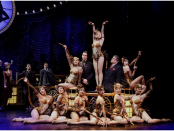
Handsome musical theater leading man Ryan Silverman is a commanding Ulysses with his operatic singing. Jeff Blumenkrantz is marvelously humorous and pitiful as Menelaus, Helen’s jilted husband. N’Kenge is fierce and bewitching as Mother Hare, a soothsayer-like figure. Ashley Brown is wonderfully comic as the mayor’s wife. Though silent as Paris, the youthful Barton Cowperthwaite’s superior ballet skills make a great impression. [more]
Though the printed script, such as it is, is credited to Nel Crouch, Crouch is listed in the program as only the director, and "Fossils" is rather “By” Bucket Club, described as an “associate company.” Such confusion is perpetrated throughout the production: it’s hard to say if, in the end of this extremely low-tech presentation, Vanessa has actually encountered the Monster--and/or her father--or not. "Fossils" is apparently more about what doesn’t happen than what does. [more]
That this production has such an ideal Sloane puts it into the stratosphere. With his sculpted physique, prevalent musculature and chiseled features that recall the young Malcolm MacDowell (who played the role in a 1975 London revival), Matt Baguth is mesmerizing. Speaking in a whispery, low, lightly accented voice, Mr. Baguth commands attention. Whether wearing Mod clothing or encased in black leather, and a tight white T-shirt, Baguth vividly captures the predatory nature of this youthful interloper with sly conviction. [more]
"Elliott loves bebop" is a much more satisfying piece than either "Sonerna" or "No slash" on their own. It would be no matter what. But the experience of having listened to the two quartets one after the other immediately before the octet immeasurably enriched the experience of hearing the octet: the octet’s complexities were more intelligible and the patterns of their interconnections were more clear. Without compromising or simplifying the work’s density, its meanings were more accessible. [more]
Mr. Karl gives a captivating performance that’s a whirlwind of energy, charisma and exceptional singing and dancing. It’s a commanding star turn that cannot quite compensate for the show’s hollowness. When getting dressed in the mornings, Karl’s leg brace was visible at the performance attended. This was the result of an injury that he had on April 14, 2017, while performing, near the end of the show. [more]
The clarity of this new play by J.T. Rogers does not only rely on the smart yet surefire way it’s written, but also on the masterful staging by Bartlett Sher, who, after recent productions of both "South Pacific" and "The King and I," is no stranger to directing gargantuan shows at Lincoln Center. Given its subject--the Oslo Accord or peace treaty between Israel and the Palestine Liberation Organization (P.L.O.) in 1993--Oslo is ultimately, an enormous play. But it is told in intimate terms. [more]
The sensational highlight of the concert was a medley from "South Pacific." “I’m Gonna Wash That Man Right out of My Hair” had the luminous Ashley Park euphorically performing that showstopper. Ms. Park was filling in for the previously announced and indisposed Laura Osnes. Female members of The Camp Broadway Kids Ensemble, who were dressed in colorful outfits and sailor caps, wonderfully joined Park. This thrilling production number was representative of Cynthia Thole’s vigorous direction and choreography. [more]
But the Broadway version of Charlie doesn’t really come alive until we’re introduced to Augustus Gloop (F. Michael Hayne), the fat little German boy who finds the first of the five gold tickets, and whose mother (Kathy Fitzgerald) sings along with him--as wurst links burst forth from his pockets, and the almost always, lively choreography by Joshua Bergasse, suddenly features clogging steps, with dirndls and lederhosen. [more]
Victor Herbert’s 1903 operetta "Babes in Toyland" was presented by MasterVoices (formerly The Collegiate Chorale), in a splendid concert production, to celebrate its 75th anniversary. Music director and artistic director, Ted Sperling superbly conducted the dynamic Orchestra of St. Luke's, and the terrific MasterVoices choral group, that appeared onstage with them. [more]
Provocative, startling, and theatrical, "Her Opponent" is a recreation of the 2016 U.S. presidential debates between Hillary Clinton and Donald Trump. The twist is that actors of reverse genders portray them. [more]
New York City based actress Catherine Russell, has much to celebrate this spring, as she reaches an important milestone in her career – being the first actress in theater history to perform 30 years in the same role. Ms. Russell has played leading lady Margaret Throne Brent in NY’s longest running play, "Perfect Crime," a thrilling murder mystery that leaves audiences on the edge of their seats as they work to piece the clues together. Additionally, this extraordinary actress has expanded her love and knowledge of the industry by taking on many other roles throughout her career -- including general manager, producer, teacher, builder, etc. -- and receives pleasure in a job well done. In fact, it’s key to her success as Ms. Russell credits happiness and fulfillment in your work being the main contributors to good health and well-being. [more]
Every new play by Annie Baker is a marvel over the play before. It’s been nothing less than a privilege to accompany her on her journey, as she has been joining ranks with the best American playwrights. Part of what makes Baker the “best,” is that she has her own voice. Whether with "Circle-Mirror Transformation," the marvelous "The Flick," or her latest and current, "The Antipodes," Baker seems to devote a certain amount of attention to group dynamics, which is, after all, the basis of any drama. And how can I have left out reference to John, Baker’s play from last year, which was her first as part of her enrollment with the Signature Theater, and arguably the best of all? [more]
The dialogue of Ileana Alexandra Orlic’s English translation is problematic. Floating around are a few Shakespearean snippets, but otherwise it’s rather stilted. Without much verbal grandeur there’s a prevalent flatness. There’s not a compelling momentum, and so it never really rises above being a curiosity. However, overall this play does somewhat succeed as a spirited condensation, especially for those familiar with the original work. [more]
Alternating between flavorfully humorous and darkly revealing dialogue, Mr. McLure vibrantly renders his characters’ personalities and motivations. There’s a hilarious analysis of the incompatibility of eating a Baby Ruth candy bar while drinking beer. With this sociological slice of life, McLure has created three strong roles for actors, and this production’s cast plays them with assurance. [more]