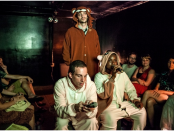
n light-hearted Rationalize (concert 27), composer Cody Brookshire combined found and manipulated sounds created by the audience with live music on bass clarinet and marimba. Brookshire created SynkroTakt, an audio streaming technology. Before the piece began, the composer instructed the audience on the seven-step procedure required to enable their devices to create sounds streamed into synchronous audio tracks; the audience, in this way, became the collective ‘artist/musician’ and provided one half of the ‘duet’ of electronic sounds and live instruments. The result was an unexpectedly sweet and pretty piece, a bauble in which sounds produced by an unusually concocted combination of chance and intention became a contemporaneous agent of creativity. [more]
In spite of the Festival’s lengthy booklet and daily concert updates, the rich creative vitality of the electroacoustic musical community remains only tangentially documented: composers and performers clearly work in close collaboration. Internationally recognized cellist Madeleine Shapiro, for instance, director of the important NewMusicMannes ensemble at the New School’s Mannes College of Music, is on the NYCEMF 2017 Steering Committee, and performed in several of the 2017 Festival’s concerts. She is clearly the sort of artist who can turn her instrument into both the composers’ muse and their servant. Shaprio’s ability to incorporate the cello’s entire history into its creative use in contemporary classical and experimental music suggests expanded incorporations of cello sounds in new music to contemporary composers. [more]
Stephen Kaplan’s "A Real Boy" is about a pair of puppets, named Peter and Mary Ann Myers, who adopt the eponymous child named Max, and it proves about as preposterous as such a premise suggests. It isn’t helped by director Audrey Alford’s often awkward staging, or by a muddled and confusing conclusion. [more]
In the seven concerts of the second half of the 2017 New York City Electroacoustic Music Festival held this month at National Sawdust in Brooklyn, New York, the full diversity and eclectic versatility of electroacoustic music was on vibrant, energetic display; the densely packed weekend of music was exciting, sometimes disconcerting and sometimes thrilling, and always fascinating. Sixty-six works by sixty-six composers were performed … a dizzying array of instruments, equipment, performers, sensibilities and effects! [more]
While the dialogue offers some stabs at humor and Opel--a first-rate comedienne of the old school--usually excels at comic timing, much of it falls flat here. Most of the 90-minute, intermission-less piece focuses, naturally enough, on Bobby’s attempts to create a new life for herself, ultimately meaning a new relationship. It’s during her second visit with the shrink that he says, “I’m making getting laid a medical directive”-- to which Bobby replies, “Can you do that?” effectively ending the scene. [more]
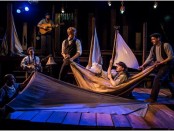
Book writers West Hyler and Matt Schatz have taken these facts and woven a charming piece of Americana that explores idealism coming up against cynicism. It’s very well structured, amusing and thoughtful. There are a few zingers that could be interpreted as referring to President Trump. Their chief conceit is having Banvard’s early associate Taylor, later become Barnum, and their rivalry becomes a focal point of the show. [more]
Matthew McElligott, Larry Tuxbury and Brian Sheldon’s book is a witty, smart and sharp take on pirate lore laced with a child’s sense of individuality, tolerance and inclusivity. It’s adapted from Mr. McElligott’s acclaimed series of children’s books. McElligott, Mr. Tuxbury and Michael Musial’s lyrics are quite accomplished and chock of full of crafty rhymes such as scarf with barf. Mr. Musial’s euphorically tuneful music completes the marvelous score, that’s perfectly rendered by Barbara Musial’s skillful music direction. [more]
Writer and co-creator Chesney Snow is also the performer. Mr. Snow appeared in the Off-Broadway and Broadway productions of the a capella musical "In Transit" as the narrator. Snow is also a prominent beatboxer. That’s an art form that replicates the sound of percussion by using one's mouth, lips, tongue, and voice. In The Unwritten Law, the African-American Snow mines the tragic circumstances of his life and those close to him. [more]
"I wanted the audience to see 'Places,' not as a ‘museum’ piece, but a piece that was relevant TODAY. Nazimova was fighting the things in the 19th century and early 20th century that we are still fighting…," explains Nordlinger, who also wrote the show, in publicity materials for the production. Her conceit is that Nazimova exists as a ghost and cheekily addresses the audience directly. Her skillful, well-researched and assembled biographical facts are laced with feminist slanted commentary, and knowledge of events that occurred after Nazimova’s death. [more]
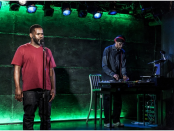
The genial Ralph Byers’ performance as Franklin is heroic as he is onstage for virtually the entire length of the show. Mr. Byers marvelously sings, dances and cracks wise, while channeling the familiar Franklin persona with his wry vocal delivery. Byers exudes dignity, serenity and focus despite the deficient material. [more]
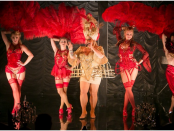
Mora works as a mermaid in a tank at the sideshow owned by the crusty, old Captain Murdock who rescued and raised her. As her romance with Johnny blossoms, there are complications. Her previous two boyfriends died under mysterious circumstances. An ominous woman in black mills about and there’s a fortuneteller looming over the action, as the plot builds to a tragic finale. There is also the possibility that Mora is a real mermaid. [more]
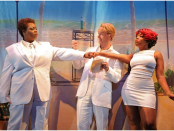
"Pity in History" was a teleplay commissioned by the BBC, and was broadcast on July 4, 1985. In the cast were Alan Rickman as the chaplain, Ian McDiarmid as the cook, and Anna Massey as the widow. Significantly, the era depicted was that of when it took place, reflected by period costumes and décor. Clips of it are on YouTube. [more]
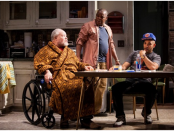
If you saw the original New York production of "Marvin’s Room," you may find yourself feeling that the play was more effective when it was presented in the far more intimate environment of Playwrights Horizons. The otherwise fine cast--which also includes Luca Padovan as Charlie and Carmen Lacivita and Nedra McClyde in various roles-- simply gets lost in the expansive space of the American Airlines Theatre. [more]

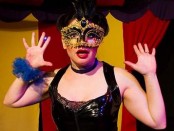
Vamping and slinking around in a bright, red tunic laden with rhinestones and wearing black tights, the vivacious Lesli Margherita steals and salvages the show as Mephistopheles. With the physical allure of the young Gina Gershon and the musical comedy talents of the young Donna Murphy, and her own quirky persona, Ms. Margherita is commanding. It’s a proverbial case of “I couldn’t take my eyes off her,” and “everything she said and did got a laugh.” [more]
Conveying the premature decrepitness of Errol Flynn with flair is Jonathan Stewart. His hair styled and with a thin mustache, the charming Mr. Stewart resembles Flynn and channels his dissolute persona and good humor with a melodious, slight Australian accent. The bearded and youthful George Psomas totally captures the look and essence of the early Fidel Castro with his edgy bearing. Combining sensuality, a lush singing voice and superior comic timing, Mr. Psomas is delightful. He and Stewart’s scenes together energize the show, particularly their clash near the end. [more]
Physically lean, with gaunt but animated features, the immensely charming David M. Lutken plays the narrator and sings many of the numbers. Mr. Lutken magnificently captures the essence of Guthrie with his wry twang, beaming smile and dramatic presence. This dimension is complete when he puts on a blue cap like Guthrie’s iconic one. That image is on display onstage, with a cigarette dangling from the side of Guthrie’s mouth. [more]
In the spirit of being a critic, the play is always describing and commenting on itself, in other words, even as it unfolds--a kind of meta-theater experience that may not be to everyone’s liking; but it surely replicates much of the Off and Off-Off Broadway theater and performance art to which Denton devoted so much of his energies. It’s also prone to overly precious lines, such as, “So I look in a thing called the newspaper,” underscoring the degree to which Denton grew to rely on his computer skills. “I’m good with software and hardware,” he tells us. [more]
While wearing an all black ensemble of a cap, T-shirt, shorts and sneakers, D’Lo commandingly holds forth with plentiful pop culture references in 70 minutes. Possessing the powers of an accomplished stand-up comedian he expresses the searing and hilarious details of his transgender journey in an often rapid, hip-hop style alternating with a measured pace. Audience members are occasionally addressed directly with riotous results. [more]
After fifteen years of formal study, Shyu incorporates five distinct music traditions in her newest work: “epic storytelling (Pansori), East Coast shaman music (DongHaeAhnByeolShinGut), and Binari, usually performed as a blessing for an audience, all from Korea; music from sub-districts Aileu and Atauro ferom East Timor; Hengchung Folk Song with moon lute from Taiwan; Ledhekan, which combines Javanese dance with improvisational singing (Sindehenan) from Indonesia; and the ‘speaking-the-song’ or ‘katari’ with Japanese bias, the rare 4-stringed instrument originally used by monks and priests.” [more]
"The Enchanter” is Alland, a magnetic and noted sculptor in Paris, in 1888, who has been through many women. He has become the object of desire for Louise. She is a 32-year-old, free-spirited, unmarried Swedish woman. Living off her deceased, pastor father’s inheritance and has come to Paris for spiritual fulfillment and enlightenment. She has scorned a suitable bank clerk suitor in her native land, opting instead for adventure. [more]
In 85 minutes, playwright Ins Choi achieves the supreme goal of The Theater, making an audience laugh while engaging their emotions. The dialogue is flavorful and richly comical with exposition expertly integrated. Though the setting is specific, the themes are universal. Its Arthur Miller crossed with Norman Lear. [more]
The animated and charismatic Mr. Spitaletta is the standout of the cast, vibrantly appearing in numerous roles. Highlights of his portrayals are a commanding Russian agent spoofing Danny Kaye’s tongue-twisting patter number "Tschaikowsky (and Other Russians)" from Kurt Weil’s "Lady in The Dark," and a rollicking caricature of Richard Nixon. Mr. Spitaletta is an ever-present delight. [more]
The show also explores Lamarr’s improbable career as an inventor. She and composer George Antheil held a patent for a miniaturized player-piano mechanism that was synchronized with radio signals. They donated it to the U.S. Navy who neglected it. This technology was instrumental to the U.S. Defense Department in dealing with The Cuban Missile Crisis in 1962. Their invention is used today in cell phones, WiFi, CDMA, GPS, Bluetooth and military satellites. [more]
Ms. Bentley has vibrantly coordinated all of the presentational elements into an intriguing 75-minute production with her commanding staging. The present, the past, and inner lives all converge through the flawless unison of movement, dance and stage effects. [more]
C4’s last concert of the season was a typical C4 concert. The concert had one intermission; in both halves of the concert, there were one or two pieces that were new to C4 and one or two that they’d performed before. In this concert, there were also three premieres. Some pieces were a cappella; some were accompanied by a somewhat unexpected set of instruments, in this case, electronic … hence this concert’s name, “Electric: Choral works with electrified ensemble.” Almost all of the composers featured were either current or former C4 members; singers conducted each others’ works. Individual singers moved easily between solo parts and “just” being a section member. The extensive program notes were, as always, extremely useful. [more]
The Pulitzer Prize-winning Foote (1916-2009) was acclaimed for his cycle of plays that celebrated his native, rural Texas that included "The Trip to Bountiful." In "The Traveling Lady," he characteristically depicts the human condition with everyday conflicts, regional dialogue, and richly delineated and lovingly rendered characters. Those qualities make these vivid roles for actors. [more]
Ms. Donovan’s enthralling opening sequence sets the tone for the production. Behind the curtains are actors in silhouette with their shadows on view. Other cast members appear to the side of the auditorium and proceed on to the stage. There are numerous gorgeous stage pictures and compelling movement and dance numbers. The play’s infamous violent set pieces are boldly realized. [more]
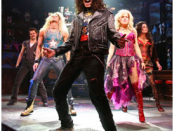
Lazarus’ score is an entertaining blend of rock, pop and show tunes. None of Elvis Presley’s actual songs are heard, but there are a number of clever takeoffs such as “Viva Milwaukee!” and “Spread the Word of Hound Dog.” His good-natured book is a shambles. The serious, campy and satirical elements don’t connect. The plot is crammed and wayward. It recalls the 1960’s "Batman" television show as well as counterculture fantasies such as the 1968 film "Wild in The Streets" and Brian De Palma’s movie, "The Phantom of The Paradise." [more]
In the play which is billed as “a dramatic verse tapestry,” playwright Joseph Pearce ably weaves together poems and diary entries by Sassoon and Owen with extracts of other writers of the era. Though Mr. Pearce identifies the characters as the English Sassoon and Owen, he provides scant biographical details about them. From this treatment, they could be any British young men of that time. [more]
Bearded, stocky and with that distinctive, wild comb-over of salt and pepper hair and wearing an artist’s smock, Brochu vividly conveys the visual, vocal and personality characteristics of the Broadway legend. For 90 enthralling minutes, he dramatizes and enacts the remarkable life and career of that unforgettable performer. [more]
Created by the documentarian theatre company Sister Sylvester, "Maps for a War Tourist" was intended to be a biographical exploration of the life of Deniz Karacagil. A former Turkish art student, Ms. Karacagil was arrested three years ago for wearing a red scarf outside. That was interpreted by the authorities as a provocative gesture in support of socialism. [more]
Ludlam also starred in "Artificial Jungle," his last of 29 plays, which he also directed. It took its inspiration from Emile Zola’s "Therese Raquin," which had already inspired James M. Cain to write "The Postman Always Rings Twice" and "Double Indemnity," each of which became a hit film. Ludlam also set out, with Jungle, to write a crowd-pleaser, and he succeeded with critics and theatergoers alike. [more]
Carlo Adinolfi plays John, the performance artist. With his British accent and wiry physicality he has an intense presence but possesses limited charisma. Mr. Adinolfi’s simple but inspired scenic design with its aesthetically arranged white sheets and white bench and white cabinet with wigs provides a compelling landscape for the actions. [more]