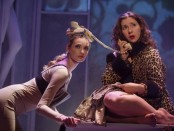
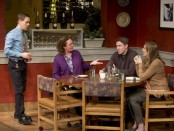
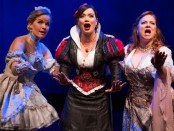
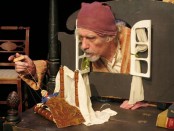
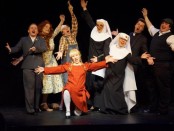
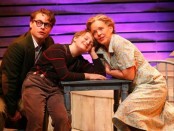
"A la Carte: A Feast of New Plays" is a presentation of The Workshop Theater’s leading playwrights that consists of six short plays, all with the theme of food. Most of the works are comic though some are very moving. The styles all vary but the level of writing of each is solid, and contains interesting situations and characters. Cumulatively it’s an entertaining program that gives a wonderful showcase to the excellent cast of actors that have been assembled to portray these often rich roles. [more]
The Handel and Haydn Society – sometimes called the H + H Society, for contemporaneity's sake – is celebrating its Bicentennial with a number of special short-term and long-term events and programs. One of these, most recently, was the sponsorship of a Music Critics Association of North America Institute, a two-day long immersion for eleven MCANA members in the current life of the H + H Society. The informative, intelligent and extremely well-organized Institute was conceived primarily by Marie-Helene Bernard, H + H's Executive Director since 2007, and administered with graceful, quietly effective attention to detail by Matthew Erikson, H + H's Public Relations and Communications Manager. The MCANA Institute provided opportunities for learning and robust exchanges of insights and ideas; it was an affirmation of the H + H Society's place in the contemporary world of classical music. Though the purposes of the MCANA Institute were primarily musical, it also provided access to information about the Society's positive, effective engagement in the cultural life of Boston as a whole. [more]
December 12, 2015 marks the 100th birthday of Frank Sinatra. Sinatra’s singing career spanned seven decades starting in the 30’s until shortly before his death in 1998, winning him eleven Grammy Awards. Even those born after his death know his iconic songs such as “Love and Marriage,” which was used as the theme song of the TV sitcom Married with Children. Sinatra is one of the best-selling artists of all time, having sold more than 150 million records worldwide. He is considered by many to be "the greatest singer of the 20th century.” Led by the energetic and creative Music Director Steven Reineke, The New York Pops Presents "Let’s Be Frank" affectionately and admirably paid tribute to the prolific and unique singing career of Frank Sinatra with the help of four robust and polished guest singers, Storm Large, Tony DeSare, Frankie Moreno and Ryan Silverman. [more]
With its ravishing, precise dialogue, very fine structure, and expertly imparted exposition, Skylight, is a model of accomplished playwriting. Mr. Hare is known for his Leftist political beliefs with which he infuses his plays. Here, in early post-Thatcher Britain, he has his characters eloquently debate their clashing world views, along with differing personal takes on their relationship. [more]
As part of their splendid yearlong Bicentennial Celebrations, the Handel and Haydn Society of Boston have been presenting major choral works that have figured prominently in the Society's long distinguished history. In March 2015, in the very depths of Lent, the featured work was Bach's extraordinary "St. Matthew Passion." Any successful performance of this monumental work demands elegant artistic discipline and a coherent intellectual and creative vision; the Handel + Haydn Society's Artistic Director and Conductor, Harry Christophers, the Handel + Haydn Society Period Instrument Orchestra and Chorus, the six wonderful soloists, and the Vocal Arts Program Young Women's Chamber Choir and Young Men's Chorus all effectively brought the necessary rigorous musicianship and artistic clarity to this performance. The result was indeed wonderful. [more]
Director Paul Dobie’s staging gives the show a fast pace and well utilizes the small playing area, which is the upstairs cabaret theater of The Stonewall Inn, the historic gay bar on Christopher Street, where it is performed once a week on Thursday nights. It premiered there in October 2014 and ran through December 2014. It has returned to New York following engagements in Los Angeles and San Francisco. [more]
In the course of Mr. Siegel’s erudite remarks, the work of key figures responsible for these often classic musicals recurred. Composer and lyricist Cole Porter was represented by four shows, composer Richard Rodgers and lyricist Oscar Hammerstein II by three shows, as was composer Jule Styne. Most monumental was the achievement of legendary producer David Merrick who was responsible for bringing five of the shows to Broadway. [more]
Shulman is a skilled story teller, creating characters that are real and complex: honorable people that make mistakes, some misguided, some well-intentioned or ruthless. People we all know, maybe even in our own families. Shulman makes the head of each household, two women, the focal point of the play. Noor, which means light in Arabic, is a widowed professor at the university with a 16-year-old daughter, Aisha, and a son, Nimer. She doesn’t wear a headscarf, and spends time alone with her late husband’s friend Salim (Alok Tewari), which is frowned upon in the community. Noor received an order from the Israeli government that her house is going to be taken down in 30 days. [more]
“Who Are You,” recorded by The Who, starts off "The Book of Moron." It’s a well-crafted 80-minute theater piece of observational stand up comedy written and performed by Robert Dubac. The title is a pun on the musical, The Book of Mormon and is representative of Mr. Dubac’s comic sensibility. Those who find him funny will have a great time at this show, and those who don’t, will have a tough time. [more]
Eleonor Sandresky is not the first composer to be attracted to Parthenia's affinity for collaboration with contemporary music-writers. Her new piece, “John Donne Songs Without Words,” was written for and with Parthenia and Patton, as Sandresky herself explained in her brief introduction of the piece to the March 22 audience. Sandresky builds on these musicians' ability to make their instruments accomplish everything that Baroque composers expected them to as well as much that their seventeenth century sensibilities would never have imagined. Sandresky assumes, as well, these musicians' wide-ranging intellectual literacy, their willing ability to stretch their performance skills and purposes, and their exceptionally good-willed, down-to-earth lack of pretense. [more]
Lyrics & Lyricists artistic director Deborah Grace Winer was the show’s host. Charming, and with dry humor and passion, Ms. Winer delivered informative and entertaining commentary between songs. Her funny material included riffs on Seinfeld, the high cost of pastrami, and King Kong climbing The Empire State Building: “Not everyone makes it in New York.” [more]
The pieces chosen by Crawford for this concert represented the very best of the Viennese Classical period: each piece in the evening's repertoire was a unique marriage of deep drama and expansive beauty. On this evening, the particular mission of the American Classical Orchestra – to play European masterpieces of orchestral music on period instruments – was brilliantly clear in both purpose and effect. Designed to enable audiences to hear what composers, their musicians and their audiences actually heard two or three centuries ago, this orchestra transported contemporary audiences back in time, revealing what the edginess and innovation of the past first sounded like. [more]
The concert series Encores! “celebrates the rarely heard works of America’s most important composers and lyricists.” With "Paint Your Wagon," they have selected a perfect candidate to demonstrate their mission. Until now, it hasn’t been revived in New York City, and though some of the songs have remained familiar, the show itself has faded into relative obscurity. Artistic Director Jack Viertel and playwright Marc Acito are credited with this concert adaptation of the original book. [more]
As principal narrator, Justin Flagg is charismatic and easily engages the audience in a sing along. He is impressive playing a number of instruments and wearing several different hats. The talented ensemble cast does a superb job playing a colorful array of roles and instruments, singing a cappella, harmony, and full out concert style. The costumes by Pamela Shaw astutely help tell the story. Several scenes revealed behind the scrim call to mind a Norman Rockwell painting. And you could be fooled by the sight of Peter, Paul and Mary. Marty Kopulsky (hair and wig design) deserves accolades for the many characters and eras to reflect. [more]
Dream sequences, fantasies, and confessional monologues add to the play’s eclectic form. There’s a rapid montage portion with racing NYC denizens including business workers, homeless people, drunks, and cutthroat landlords. The plot turns are often typical for this genre, but there are enough new ones that make it all seem fresh. Playwright Albarrán, who is in his 20’s, also plays the leading part. [more]
Whether or not I am convinced that Hillary Clinton needs to take a lover, and indeed how confident I am in Meek’s sexual aptitude for the task, the presentation was a great success triggering booming laughter thanks to a wit wholly unaccounted for in this age in America, a repartee most welcome to this writer. [more]
The play’s scenes alternate between the scientific research institute and the couple’s apartment. The theatrical device of having one set representing both places is well rendered by scenic designer David Zinn’s realistic and well-appointed set. Matt Frey’s lighting design and Ryan Rumery’s sound design contribute requisite razzle dazzle effects for the transitions from one setting to another. Mr Zinn also designed the purposeful costumes.
[more]
Recently, as part of the Miller Theatre at Columbia University's Composer Portrait series, Augusta Read Thomas was briefly interviewed between performances of recent and new works for string quartet and percussion. The first half of the program featured the world premiere of Capricci for violin and viola (2014) and of Selene for percussion quartet and string quartet (2015) as well as “Invocations” from Sun Threads for string quartet (1999). The second half of the program began with an informal interview between Thomas and percussionist David Skidmore and then concluded with the New York premiere of Resounding Earth. [more]
This play was originally produced in London’s West End in 2013. Ms. Mirren was awarded The Olivier and Evening Standard Award as best actress. She is repeating this acclaimed performance on Broadway with a cast made up of actors from the London production and newly selected Americans. With star quality, crisp authority and sheer talent, she compellingly portrays Elizabeth II from her ascension to the throne at the age of 25, to the very present with references to President Obama.
[more]
This hasn’t played London’s West End, and has not been performed in the United States until now. The Fifth Avenue Presbyterian Church’s Theatre Fellowship has presented this premiere. The cast of this Actor’s Equity showcase production is made up of polished professional and engaging non-professional performers, many of who are Fellowship members. The overall results for this light-hearted fare are that of high-level community theater. [more]
Stile Antico's February 28 concert, part of the Miller Theatre at Columbia University's Early Music series, at the Times Square Episcopal Church of St. Mary the Virgin, was marvelous. Stile Antico sang thrillingly; their choice of repertoire – sixteenth century Renaissance a cappella music associated with the Hapsburg imperial court … the core content of the 2014 CD – was artistically exciting and intellectually rewarding. [more]
Does love provide the strength that keeps a marriage bound, or is love fragile and, when it wanes, the cause of the failures in a partnership? Maybe it’s both? The new musical "Long Story Short," written and composed by Brendan Milburn and Valerie Vigoda, adapted from David Schulner's play An Infinite Ache, explores this quandary artfully. Skillfully directed by Kent Nicholson, this imaginative and fresh musical chronicles the ups and downs of a 50-year relationship between an Asian American woman and a Jewish American man. This aptly named 95-minute production poetically exposes the wonder and misery of a lifetime together. [more]
Beaming Broadway musical comedy veteran, Lee Roy Reams presented the final honor, the ASCAP Major Engagement Award to Lillias White. “My grandmother’s table was my cabaret,” she recalled about the beginning of her long and successful career. In a full-out performance, she then recreated her Tony Award-winning role as an aging prostitute, from the 1997 Broadway musical The Life, with her signature song, “The Oldest Profession.” It was a commanding and fitting finale to this exuberant event. [more]
The structure of the early evening concert was simple, sensible, intimate … and exhilarating. The JACK Quartet was seated on the stage, as were several rows of spectators; more spectators were in the auditorium proper. The concert consisted of three parts: first came the world premiere of the new twenty-minute quartet, then an informal discussion by the composer, then the second performance of the new quartet. What a treat, to hear a new work … twice! [more]
The Peccadillo Theater Company has finely and faithfully revived this rarely seen Odets play, the 6th of his plays to be produced in the late thirties. They are, “dedicated to the rediscovery of classic American theater, particularly those works which, despite their obvious literary and theatrical value, are not regularly revived.” [more]
Inspired by real life events of the 1860's and concerned with telling the relatively unknown stories of women pioneers, "Abundance" is highly engrossing, steeped in historical details, and a poignant examination of relationships and friendships. Each of the four main characters is precisely detailed. The complexity of their virtues and flaws are examined with great clarity. The good and bad sides of everyone are shown realistically. [more]
"Sisyphus" played at the Abrons Arts Center this February, the newest avant-garde production from Experiments In Opera. Composers Jason Cady, Aaron Siegel, and Matthew Welch (acting as their own librettists) created a promising concept for an opera, with a cultural abundance of Greek myth at their disposal to create a beautiful libretto. However, this world premiere was a case of more tragedy, full of missed opportunities, rather than inspiring. [more]
Director Mindy Cooper’s very well executed transitions between the show’s 27 numbers, the personable Scott Siegel’s erudite remarks, and the variety of gifted performers who participated made "Broadway by the Year: The Broadway Musicals of 1916-1940" a brisk and very enjoyable event. [more]
"Fabulous!," which returns to Off-Broadway after a successful run last fall, is an unabashed gay mash-up of "Anything Goes" and "Some Like it Hot," where two best-friend drag queens, Laura Lee Handle (Tobias Young) and Jane Mann (DaWoyne A. Hill), working in Paris in a cheesy musical revue, witness the shooting of the star of the show. As everyone scurries frantically to get away, a priceless necklace falls off the victim and is retrieved by Laura Lee. The best friends flee the crime scene. [more]
The fabric of the community of a small Jersey shore town is torn apart in the wake of the mysterious disappearance of young Leonard Pelkey. At first this one-man show, written and performed by James Lecesne, follows the lines of every crime drama you have seen. Yet, "The Absolute Brightness of Leonard Pelkey" proves to be much more than superficial intrigue and ends up challenging the very conscience of society. The standing ovation and second curtain calls this show has been receiving in previews are already setting this piece of theater apart. [more]
The eclectic world of cabaret is unique in the entertainment industry. It allows artists' to connect with an audience in an intimate setting. Today, the clubs are ripe with new, rising and mature talents and the beginners who want to make it. But, who are today's torchbearers? Who will make their mark? And, who will take cabaret into its next phase? Time will tell. [more]
Premiering in 1982 as a one-act play with music, author Eduardo Machado, has now revised and expanded it into a full length musical. The first act is a decent all around effort, but the second act is leaden. Taking place 10 years after the first, it’s an interminable update of the character’s lives with numerous flamboyant plot twists. [more]
Leading The New York Virtuoso Singers with characteristic wit, panache and artistic integrity, Harold Rosenbaum presented an a cappella evening of a songs about love – from its first beginnings to its very end, with every bit of flirtation, fun, fornication, fancy and foolishness in-between – at Merkin Concert Hall, bringing considerable warmth to a happy audience on a cold, cold February night. [more]
The second half of the concert consisted of Fauré's Requiem. This familiar, deeply loved work – an examination of requiem themes that is more about interior considerations of mortality than about cosmic confrontations with hell or pleas for salvation – depends for its success on clear, clean musicianship. The shimmery delicacy and complex harmonic richness of Fauré's music were brilliantly served on this evening by the Voices of Ascension … as they always have been: the Fauré Requiem has been a signature piece of this chorus since its creation twenty-five years ago. In this performance, soprano Sarah Shafer and bass-baritone Evan Hughes both brought a deeply personal sense of prayer to their singing. Shafer's “Pie Jesu” was intimate without being sentimental, and ethereally beautiful. Hughes sang with unrestrained and eloquent passion. [more]
Venerable and accomplished fixture of the theater, Austin Pendleton has perfectly directed the play. The characters and their relationships have all been minutely realized and the action well staged.
Scenic designer Walt Spangler’s turntable set brilliantly renders the various rooms in Pops’ apartment as well as the building’s rooftop. Among the authentic looking details and props is a mournful Christmas tree with lights that subtly comments on the passage of time. [more]
Pintauro’s play about a tragic American family is highly dramatic but lacks nuance. The four main characters are clearly defined in the first fifteen minutes of the play and remain static throughout. The dialogue is unnatural at times and makes for awkward lulls and pauses. As a result, the action becomes monotonous. [more]
It’s a stylized “family secrets” drama, presented with a broad comedic tone. Heightened and arch (often including lengthy florid speeches) the dialogue has shades of "The Devil Wears Prada." Though mostly dense and opaque, there are emotionally involving sequences, particularly as the play reaches its conclusion. Ms. Callaghan also explores the theme of women’s self-image and how that issue clashes with society’s idealized view and the resulting conflicts. Bordering on the didactic, this nevertheless does yield moments of poignancy. [more]
With only a few days until Valentine’s Day we are surrounded by constant reminders of humanities obsession with being loved and understood. Quite timely, and unapologetically, YOLO! Productions has brought us a piece of theater concerning the affairs of the heart. You won’t be able to help but fall in love with the revival of Rajiv Joseph’s 'Animals Out of Paper" as directed by Merri Milwe. Trust us you’ll love the writer for the corny folding analogies and forgive him for the unsubtle appearance of an origami heart in this quirky tale of humanity’s capacity for love. [more]
Mr. Busch, known as a playwright of campy homages to old movies in which he often plays female roles, was an appropriate and authoritative host. For most of the proceedings, he sat off to the side wearing male attire wryly reading the often affectionate commentary. He chronicled the history of the Hollywood musical, its stars, its songwriters and its studios. This background material described the distinctive cinematic styles of the major studios, and the idiosyncratic moguls who ruled them. The musical movie histories of Warner Brothers, MGM, Universal, Paramount, 20th Century Fox and Columbia were detailed. Well-selected illustrative slides and film clips were projected above the orchestra. [more]
Though Lhamo has absorbed all sorts of Western musical idioms and made them her own, her voice is distinct in its range of octaves and volumes and in its gorgeous ability to make both human and nature sounds that Western singers wouldn't permit themselves to attempt. Lhamo's musical origins are identifiably Tibetan, but the accumulation of her human and artistic experience has made of both her voice and her intentions something entirely her own. [more]
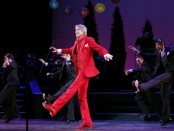
One of the chief pleasures here is the first appearance in more than 30 years by the legendary Tommy Tune in a New York City musical. Since his Tony Award-winning leading role in the Broadway Gershwin revisal, "My One and Only" in 1983, he’s directed, choreographed, made special appearances, toured in musicals and periodically performs a nightclub act. He plays an entertainer at the garden party and at the hotel. In a three-piece red neon suit, he sings and taps “Fascinating Rhythm” solo and then with the ensemble. In the second act, he’s in a blue neon suit and a straw boater with a blue bird on top to sing and tap “Little Jazz Bird.” After leaving the stage, he pops out from the wings, doffs the hat, revealing a gold star inside. It’s symbolic as he embodies the old time, unique star quality Broadway is known for. [more]
Led by David Hayes, Music Director, the New York Choral Society and Orchestra, together with first rate soloists and the Princeton Girlchoir, presented a magnificent performance of Felix Mendelssohn's magisterial 1836 oratorio "St. Paul" on January 25, 2015 in Carnegie Hall. Mendelssohn's oratorio is a huge work; on this afternoon, the work's sweeping monumentality was fully realized without any loss of musical subtlety, nuance or detail. From beginning to end, chorus and orchestra alike presented the music they cleared loved with unflagging energy and endlessly renewed, fresh passion. [more]
Theatergoers knowledgeable with "Death and the Maiden" will find "Shesh Yak" very familiar territory. Those who aren’t will still find this play tediously predictable as this scenario has been played out in a number of other dramatic works. The writing is flat, formulaic and rudimentary. [more]
Theatergoers familiar with Richard Foreman’s work with the Ontological Theater will be especially receptive to this frenetic production. There are also traces of Monty Python. Those open to a experiencing a collection of an hour of seemingly plotless, frantic, very well performed vignettes, might find it an entertainingly provocative time. It’s a barrage of colorful imagery composed of heightened sights and sounds. The loud tone of a ringing telephone is prominently featured. [more]
This finely constructed memory piece is characterized by comedy and melancholy. Overcoming parental dysfunction is it’s universal theme. It’s rendered with complexity, as the characters are often shown at their most vindictive but also with their good qualities that they often repress. The dialogue is crisp and filled with mordant Irish wit. [more]
With "Constellations," Nick Payne has deftly created a unique and very moving romantic work in the tradition of modern British playwrights that is universally appealing. [more]
Hearing these Sondheim classic songs well performed and seeing them vibrantly staged was reason enough for this concert to be considered a success. That it also paid tribute to the artistry of Harold Prince with its revelatory documentary presentation made it an even more glorious event. [more]
The drawn-out finale is a fiercely acrimonious type of Edward Albee's "Who’s Afraid of Virginia Woolf?" style confrontation dealing with class warfare. Here the dispute is over the duo’s given circumstances in life. One is from wealth and the other is from painful dysfunction. Supposedly it’s all true (based upon reading the cast’s biographies) which adds a layer of heightened reality to the proceedings. [more]
An American Worker is an agitprop musical in the spirit and tradition of social consciousness American theater such as the works of Sidney Kingsley, Clifford Odets, and Marc Blitzstein’s The Cradle Will Rock. Though well intentioned, it is deficient on all crucial levels. [more]
Singing to a happily packed Carnegie Hall, the Cecilia Chorus of New York, led by music director and conductor Mark Shapiro, presented two masterpieces of mid-twentieth century choral music. Francis Poulenc's "Gloria" (1960), though not written explicitly for the Christmas season, is a perfect celebration of it. Ralph Vaughan Williams' "Hodie, A Christmas Cantata" (1954), in contrast, is an anthology-style oratorio about Christmas itself, the very day of Jesus' birth. Different in style and national origin, the two works nonetheless complement each other, presenting Christmas joy from a variety of perspectives. [more]
The mastermind behind this enchanting show is Brenda Bell. Besides writing the well-crafted lyrics for the new songs, she also wrote the clever book that faithfully embodies Dickens’ sensibility with numerous offbeat touches. She has made it fresh for those familiar with the story, and a great introduction for those who might be experiencing it for the first time. As the director. she has superbly coordinated all of the production elements, staging, and performances into a beautiful event. [more]
The enduring power of the Harlem Renaissance songs comes from their truth telling and historical testimony. Their accessibility and quality of invitation, their universality of human experiences of love, family, hope and loss, and their indomitability all make us adore these songs, and forget that they were initially the products of a devalued and segregated community. [more]
The Merkin Concert Hall of the Kaufman Music Center was packed on a recent cold December evening; the audience, happily anticipating two hours of fabulous music, was not disappointed. Five musicians – pianists Steven Blier and Michael Barrett, soprano Julia Bullock, tenor Darius de Haas and baritone James Martin – presented 24 carefully chosen pieces of music from the Harlem Renaissance in a concert of marvelous music-making. The singers inhabited their songs so completely that their singing was not about interpretation, but identity. The pianists were equal partners in the music, not mere accompanists. The audience applause, together with their Ohhs and Ahhs and slowly expelled breaths of marveling gratitude, created an atmosphere of receptivity that greeted and thanked the musicians before and after every song. [more]
This brilliant production of Samuel D. Hunter’s "Pocatello" is characterized by tremendous depth in characterization and engaging simplicity in presentation. Leo Tolstoy famously observed, “All happy families are alike; each unhappy family is unhappy in its own way.” Here, a clash over gluten-free pasta becomes a memorably chilling pretext for psychological warfare. [more]
“Happ’ly ever after…can be a royal pain in the ass!” sings Snow White in Disenchanted!, a pleasant musical spoof of iconic Disney princesses, that depicts them after their classic stories have ended. She, Cinderella, Sleeping Beauty, and a number of other heroines comically complain during ninety minutes that are bright, and often entertaining, but that somewhat drag. [more]
As a director, Horejš has a great command of the visual. The puppets perform in various parts of the stage and fly around and enter from windows and trapdoors. The compelling stagecraft is aided immensely by Federico Restrepo's skillful lighting design that very finely captures the moods and era of the story. These enchanting effects are all heightened by the old curiosity shop quality of the furnishings on stage, and the authentic looking garments the cast wears, by set and costume designer Michelle Beshaw. [more]
Director Lawrence Lesher and cast have hit the ground running Off-Broadway this Christmas season with the first revival of Todd Michael's The Asphalt Christmas. Theatre Row's Lion Theatre awaits those daring and looking for a Christmas story less caramel coated this year with an audacious play, both shocking and entertaining, as The Exorcist comes to St. Celestine's and their annual Christmas pageant. [more]
This musical theater version of "A Christmas Memory" has been performed around the United States in regional theaters, since 2010. This year, The Irish Repertory Theatre has selected it for its annual holiday production. Perhaps in a condensed version it would have provided the desired festive entertainment. [more]