Articles by archive
“A really fun mix-tape of some our favorite songs…with no through line,” was how Steven Reineke, the exuberant music director and conductor of The New York Pops, described this delightful tribute to notable singer-songwriters from the past 60 years. [more]
Rebel in the Soul
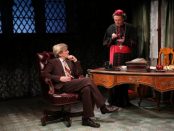
If this all sounds a bit over-intellectual, well, so is the play. Though the intelligent script may be based on real people, they are forever describing themselves--and each other--in ways that real people never do. Think about practically any play by George Bernard Shaw, and you begin to get the picture. (Archbishop McQuaid even says, “I do find political theory most compelling.”) And although Moore, as director, has done much to compensate for the tiny stage space on which the expansive story unfolds--particularly with helpful projections by Chris Kateff and a cramped but effective set by John McDermott--she isn’t abetted very much by her actors. [more]
Daniel’s Husband
Matthew Montelongo is particularly effective in conveying Mitchell’s anti-marriage convictions, only to make us feel Mitchell’s subsequent anguish. Anna Holbrook is also outstanding as the self-centered Lydia, smartly dressed in Jennifer Caprio’s always dead-on costumes. But it would be an oversight not to also applaud Ryan Spahn as Daniel, Lou Liberatore as Barry, and Leland Wheeler as Trip. If Montelongo and Holbrook somehow emerge as acting victors, it may be because they have, in some respects, the two richest roles. (Mitchell and Lydia duke out their ultimate conflict offstage, in a court of a law.) In an odd way, "Daniel’s Husband" is ultimately the age-old story about THE mother-in-law, which may have given rise to many a comedian’s jokes, but, can often have lethal consequences for any married couple--whether they’ve literally tied the knot or not. [more]
Charleses
The dialogue is sparse as various mundane activities are depicted, such as learning to drive, shaving and ordering food from a deli. The infants are played by adult actors. The cast wears matching wigs. Andrea Hood’s authentically simple costume design is comprised of jeans, shorts, trousers, plaid shirts, and T-shirts. The production all has a Thornton Wilder-style quality. [more]
Angel & Echoes
Presented together on the same bill, "Angel & Echoes" is part of the Brits Off Broadway Festival at 59E59 Theaters (where, it’s worth noting, "Echoes" originally played last year). As written by Naylor, enacted with ferocity and vitality by Avital Lvova, and directed with dispatch by Michael Cabot, "Angel" proves the far more effective (second) half of the evening. That may be because it’s told with an in-your-face immediacy and gumption that elude Echoes, which juxtaposes the lives of two different women, who lived in that region of the world at very different times. [more]
Alam Khan: Maestro Ali Akbar Khan Birthday Celebration
Thanking his packed audience at Le Poisson Rouge for coming to hear him play, Alam Khan described his music on this evening as a tribute to his father, Ali Akbar Khan, whose ninety-fifth birthday it would have been. But it was more than an ancestral honoring: it was a tribute to a rich centuries-old tradition of Hindustani classical music. [more]
Vespers of 1610 (Handel + Haydn Society Orchestra and Chorus)
"Vespers of 1610" is a big and oddly sprawling work. It makes no liturgical sense, and, in terms of texts, has little programmatic unity beyond a consistent Marian devotion. But it is a coherent whole of musical and spiritual experience. It gives the impression of limitlessness, as though there were no end to what Monteverdi could have kept on telling us, precisely because the sacredness and meaning of God’s sacred words are infinite. [more]
Latin History for Morons
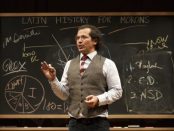
While setting out to “undo” our “whole, entire education” of Latin history--and to compensate for the textbook neglect of the impact of the Aztecs and the Incas on our culture and civilization--Leguizamo focuses on his son’s coming to terms with being the son of a Latino celebrity--namely, himself. Given that his wife is Jewish, and therefore, “very intolerant of intolerance,” Leguizamo never imagined that his “son was going to have to go through the same rite of passage that I did,” he says, at the beginning of this, his latest one-man show, which is filling the seats at The Public Theater. [more]
Mourning the Living
Ms. Hogan’s dialogue is well crafted and the structure is stageworthy, but it all comes across as a playwriting exercise rather than a full-fledged dramatic work. Medically, Hogan’s premise is extremely unlikely and adds to the off-kilter dimension. The plot points of the combination of someone in their 30’s being stricken with Alzheimer’s Disease, and then years later getting a respite from it, stretches credibility. [more]
A Gambler’s Guide to Dying
“To some he was dad, to some he was mate,” says McNair, at the top of his monologue, “to others he was liar, cheat, addict, hero, story teller.” Over the course of the next 70 minutes, McNair will also do, with modest effects and a modicum of success, other voices including his much younger self, a schoolteacher, mates of Archie’s, and even his own mother. Through it all, the one thing we never lose sight or sound of is his love for his grandfather. [more]
CasablancaBox
“The structure of 'CasablancaBox' is inspired by another filmmaker’s technique, Robert Altman’s roaming camera,” writes playwright Sara Farrington and director Reid Farrington in their program notes. This homage results in a collection of frantically staged vignettes that aren’t funny and don’t add up to much. [more]
The Play That Goes Wrong
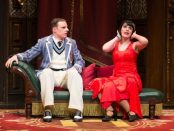
While the non-stop buffoonery is reminiscent of Charles Ludlam and his Ridiculous Theatrical Company, this British import (produced by London’s Mischief Theater, no less) immediately evokes inevitable comparisons with "Noises Off," Michael Frayn’s divine and (admittedly, more) sophisticated farce about a community theater company putting on a play--perhaps the most hilarious, theatrical farce that has ever been devised by a playwright. But the present offering also has less of an agenda, settling for the sheer mayhem of putting together a group of people on a stage, during an ongoing performance, when absolutely everything that can possibly go wrong, does. It’s a surefire setup for the comic and rewarding chaos that ensues. In the end, and basically throughout, "The Play that Goes Wrong" has gone very right, indeed. [more]
“Rosalee Pritchett” & “The Perry’s Mission”: Two one-act plays
"Rosalee Pritchett" and "The Perry's Mission" are in the provocative tradition of such works of the period as Amiri Baraka’s 1964 play Dutchman and Melvin Van Peebles’ 1970 film "Watermelon Man." This exemplary production brings attention to these neglected playwrights, and is a welcome opportunity to experience their unsettling power. [more]
The Profane
Playwright Zayd Dohrn has a facility for setups, punch lines and zingers that might play well as an HBO situation comedy attempting to mix humor with seriousness. As a theater piece, his premise has potential but his execution is deficient. [more]
World Music Institute: Salif Keita
Over the course of Salif Keita’s recent appearance at The Town Hall there was a story whose shape reflected both Keita’s identity and his music. At 7:00 p.m., there was a question-and-answer session with Keita, musician and writer Banning Eyre of www.afropop.org, and translator Isabelle Dupuis. By the end of the evening, audience and performers were inseparably merged; singing and dancing had become one, and Keita had made us all his own. Far from needing any explanation or translation, the music of Salif Keita is entirely universal. [more]
Perversion
If only there were perversion in "Perversion." Instead, it’s a tedious, mélange of the absurdist styles of Jean Genet, Eugène Ionesco, Jules Feiffer and Dr. Seuss. There’s the eerie sensation of watching a satirical, counter-culture work that might have been exhumed from the archives of La MaMa, which was performed for three weeks in 1969, and then forgotten. [more]
Writer Ron Fassler on His New Book and Theater Adventures
Actor, writer and director Ron Fassler [avatar user=”Courtney Marie” [more]
Sweat
"Sweat" is a classic, “well-made”--or carefully constructed--play, with a focus on the dwindling work for people in the middle of the country, prompting them to install Trump in the White House--to the ongoing dismay of the rest of the world. It couldn’t be more topical even as it helps us understand just exactly what’s been happening to bring us all to this sorry state. It was also based on Nottage’s extensive interviews with many actual residents of Reading, fueling the drama’s impact. [more]
William Inge in Rep: Picnic & Come Back, Little Sheba
Though rather flawed in execution, there is much to enjoy in "Picnic" & "Come Back, Little Sheba": William Inge in Repertory. It is also revelatory in proving William Inge’s high ranking in the annals of dramatic literature. [more]
Growing Up Gonzalez
Mr. Rojas vividly creates an entertaining panorama of the Puerto Rican community in The Bronx of the 1960’s and 1970’s. A gallery of characters and numerous incidents are lovingly described. Orchard Beach, Roberto Clemente, various foods, the Catholic Church and a visit to Puerto Rico are among the cultural touchstones that are represented. [more]
How to Transcend a Happy Marriage
Marisa Tomei excels as George, the narrator of "How to Transcend…" --and of her own story. Thanks to Tomei’s vocal and visual expressions, we constantly share in George’s ongoing surprise, as she graduates from naivety to knowledge. In the end, it is George who has the most “transcendent,” and religious, experience. (It is not insignificant that we’re told George is the only Catholic in the group.)“It seems like you have omniscience,” says George, in her closing monologue, “when you can talk to the audience in a play.” And talk to us, she does, in the playwright’s smart, yet snappy language. Consider George also telling us that Jenna, “over time forgave us,” after walking in on her parent’s participating in a sex orgy. And “the trauma of seeing her parents’ aberrant sex lives up close--it became an anecdote in a college application.” Or consider David’s saying: “I’m from everywhere. And nowhere. I moved constantly as a child…. as a result, I don’t really believe in nationality.” [more]
The New Yorkers: A Sociological Musical Satire
Herbert Fields’s book was based on a story by E. Ray Goetz and New Yorker cartoonist Peter Arno. This clunky concert adaptation by Jack Viertel is crammed with double entendres, puns, anachronisms, and contemporary inside jokes that mostly thud. [more]
The Price
Maybe “fireworks” is too strong a word for a production that is more of a slow burn. The play begins when Mark Ruffalo, as Victor, walks up, into the top floor of the home his family was consigned to, when the Great Depression of 1929 hit and their father lost his fortune. The essence of the conflict between Victor (a policeman) and Walter (a doctor) boils down to economic inequality. (As Walter says to Victor, “It’s very complicated between us.”) Though they both grew up with a chauffeur, the older Walter went on to a successful career while Victor stayed behind to care for their father when everything was lost during the Depression. [more]
Angry Young Man
The confusion and the rapid pace of the production pretty much engulf--and finally overwhelm--the extremely complicated story of"Angry Young Man." The performers, on the other hand, make this something of a gem of a small, Off Broadway offering, from Urban Stages. The wayward plot eventually takes Youssef to a disco with Patrick, and with Patrick’s girlfriend Alison, where Youssef is confronted by a skin-head, Terry, whom he accidentally kills. “The other customers were almost exclusively male,” says Youssef. “They seemed for the most part to be dressed as Patrick: long-hair, T-shirts, scruffy blue jeans.” [more]
Glass @ 80: Philip Glass & Foday Musa Suso
Beginning in the 1980s, Glass and Suso collaborated on several projects. Genet’s difficult, demanding, essentially un-actable and relentlessly fracturing play, "The Screens," elicited from Glass and Suso unexpectedly warm and affirming music. The setting for Genet’s play – the wretchedness of the French Algerian War – calls for music that is both European and African, but to imagine Glass’ contribution as “the European one” and Suso’s as its African opposite is to misunderstand the creative relationship. [more]
Jack Charles V The Crown
His innate charm, joy of performing and theatrical grandeur is always on display in this show. All of those qualities combined with his resonant, Australian accented vocal delivery makes it easy to imagine him being commanding in Shakespearean and any number of roles in the classics of dramatic literature, as well as a screen actor. Sadly, environmental circumstances did not as of yet make this possible. [more]
C.S. Lewis On Stage: The Most Reluctant Convert
As he impersonates the British writer C.S. Lewis, Max McLean relies on little more than a pipe, a brown suit and tie, and a rather mellifluous voice to become the Anglican philosopher and noted atheist, who famously converted to Christianity in the mid-Twentieth Century. The script was cobbled together by McLean from Lewis’ memoir, letters and books, including other biographies of Lewis, a man who was “intoxicated” by words, which is primarily what this play is about--the mesmerizing effect that words can have, when uttered in an effective sequence. [more]
Otello (LoftOpera)
LoftOpera is a feisty little company that operates around Brooklyn, especially Bushwick. They are giving" Otello" in LightSpace Studios, a disco on Flushing Avenue about the size of a high school gymnasium. There’s a small orchestra (27, about half the size Rossini wrote for), kept under tight but lyrical control by the company’s maestro, Sean Kelly. The singers do not appear to be looking at him for cues while they are enthusiastically playing out the story, but they only got lost once at Saturday night’s performance. [more]
When It’s You
Speaking in an engaging Texas twang, the blonde Reeder recounts Ginnifer’s somber story with emotional straightforwardness and humor. Employing her expressive facial features, striking eyes and serene physicality, she delivers a performance of tremendous focus that hauntingly holds attention. [more]
Sam & Dede, or My Dinner with Andre the Giant
Beckett lived in rural France, and his nearby neighbor, Boris Roussimoff, helped him build a cottage on his property in 1953. Beckett grew close to the family, and offered to drive Andre to school, as the boy was reluctant to take the bus. This was because he suffered from gigantism and was self-conscious about his appearance and his difficulty in fitting into the bus. By the age of 12, he was 6’ 3” tall and weighed 208 lb. [more]
White Guy on the Bus
Musical star Robert Cuccioli has to call upon his experience playing both Dr. Jekyll and Mr. Hyde to become Ray in "White Guy on the Bus," a first-rate, new play by Bruce Graham, that has more than a stunning surprise or two, as it spreads out the story like a wild brush-fire burning out of control. His complicated and duplicitous “numbers man” character wants, from the beginning, to quit his high-paying job, and, like the French painter Gauguin, escape from the workaday world of banking and finance. “I don’t want to sell the house,” he tells his wife Roz in the opening scene. “I want to sell everything.” [more]
Significant Other
It’s well constructed, the dialogue is snappy and filled with some funny one-liners. The milieu is that of upper middle class Manhattan white-collar workers. Moderately entertaining, it attempts to explore a prevalent societal issue, but is undermined by its off-putting main character and its rarified sensibility. There is minimal sex talk and that is mostly cute, rather then revelatory. Jordan rhapsodizes about a male co-worker’s body, but doesn’t extoll anything much below the waist. [more]
The Light Years
Playwrights Hannah Bos and Paul Thureen with developer Oliver Butler, creatively evoke the tragic, nostalgic spirit of Booth Tarkington’s "The Magnificent Ambersons" and the wonderment of the works of humorist Jean Shepherd. The scenario is engaging and the characters are lovingly rendered. [more]
The New York Pops: “Life is a Cabaret: The Songs of Kander and Ebb”
“It looks like when you got your Kennedy Center Honor!” exclaimed Mr. Reineke, as a spotlight shone on John Kander, who was attending the concert from a first tier box at Carnegie Hall. He grinned to a thunderous reaction. Sitting with him, was Susan Stroman, who has directed several Kander and Ebb productions. Near the end of the show, at Reineke’s instigation, the house lights went up, and the orchestra and the audience joined in for “Happy Birthday” to Kander. [more]
Linda
A revolving stage permits set designer Walt Spangler to depict, with dead-on realism and dispatch, not only Linda’s home--including an upstairs bedroom, which her daughters share--but also various offices at Swan Corporation, among numerous other sites. After a certain point, the dizzying, rotating stage becomes akin to a swirling merry-go-round, as director Lynne Meadow has it turning and turning, with different characters walking on and off, and through different doors, without any dialogue whatsoever, in subdued but effective lighting by Jason Lyons. It all becomes part of the accelerating gallop of the play itself, which ultimately spins out of control, as Linda learns that she’s lost her--well, let’s just say, in the end, everything. [more]

The Gravedigger’s Lullaby
Playwright Jeff Talbott offers an overall well-written and plotted social drama that detours into a strident political battle over capitalism. The sympathetic characters are trapped by their circumstances, as well as by Mr. Talbott’s rudimentary scenario. [more]
Villa
Chilean playwright Guillermo Calderón constructs a simple, engrossing and often funny scenario. Three women, all named Alejandra, have been selected as members of a deliberative, special committee from a larger body who could not reach a decision over a searing national issue. There’s suspense, shocking revelations and Survivor-like machinations. [more]
Composer Portraits Series: Misato Mochizuki
Neither a “Western composer” nor a “Japanese composer,” Mochizuki hasn’t sought to manufacture some sort of mix-and-match blend. She doesn’t borrow or build add-ons. Instead, seeking inspiration in nature on the one hand and in human projects as diverse as photography, genetics and cooking on the other, she produces music that is about both being and story. Embedded within every piece one beginning after another, her stories unfold from each; then she builds them into each other. Though she incorporates elements of theater in the use of lighting and musicians’ movements around the stage, her music is fundamentally unpretentious and unfussy; her writing is equally straight-forward and optimistically fresh. [more]
Book Review: “The Actor Uncovered: A Life in Acting” by Michael Howard
Mr. Howard is eminently qualified to hold forth on the subject, having been a prominent New York City acting teacher for over 60 years. Concurrently with an active theatrical career, he studied with Sanford Meisner at The Neighborhood Playhouse, and with Lee Strasberg as a member of the Actor’s Studio. In 1953, he founded The Michael Howard Studios. [more]
The Penitent
Perhaps because Mamet-regular Jordan Lage is so effective as Richard, the scenes between Charles and his own attorney prove the most effective. While Laura Bauer’s sensible costumes do all they can to make her seem real, Rebecca Pidgeon proves robotic as Kath, detracting from her character’s constant bewilderment. (Come to think of it, maybe it was a stylized choice for playing the part, because of Kath’s befuddlement and uncertainty, at every turn.) The last scene is set in a rehab room, where Kath has been confined, following a mental collapse or nervous breakdown. [more]
Nibbler
Urban may have an admirable mission, in attempting to document the customary passage from youth to adulthood--or high-school to college, to be more precise--as he focuses on five graduating seniors in a middle-class suburb, in 1992, when one of them, Adam, remains behind, without any prospects for a glorious future. But the otherwise realistic play that unfolds quickly veers into surreal territory, as an alien from another planet enters their midst, and the eponymous “Nibbler” becomes ever more real a presence on stage, via a puppet, manipulated by several of the quite visible cast-members. [more]
All the Fine Boys
Playwright Erica Schmidt has a minor aptitude for believably snappy dialogue, but not much else. Her tired scenario is astonishingly familiar and offers no fresh insights. That adolescence is tough is about all there is. That territory has been mined in John Hughes’ films and numerous television shows. There was also the 1985 movie "Smooth Talk," starring Laura Dern and Treat Williams that was based on a Joyce Carol Oates short story. [more]
Interview: A New Musical
Composer Soo Hyun Huh’s original music is a fine and eclectic assortment of modern melodies. The English lyrics are written by Bryan Michaels. The combined results are stilted and pedestrian. The score is primarily sung dialogue with some actual if indifferent songs. Mr. Michaels has also translated Jung Hwa Choo’s book into English. [more]
Turning Page
Much is made of her numerous Oscar nominations, and this reaches a wonderfully presented climax. She finally wins the award for Best Actress on her eighth nomination for the 1985 screen adaptation of Horton Foote’s play, "The Trip to Bountiful." “Is that per week?” “No. That’s for the whole thing,” was Geraldine Page’s agent’s incredulous reaction to the low salary that was offered for it. [more]
Kunstler
In "Kunstler," playwright Jeffrey Sweet recounts the defense attorney’s life and career in his well-written, comprehensively researched, and affectionate treatment. The conceit is that Kunstler is to address an audience of law school students at a university. Kerry is a young woman who is the vice-chair of the program committee attends him to him and becomes his foil, and is the play’s secondary character. This construction allows for a free wheeling manner of imparting the chronological details. It’s a solid take that could have certainly been at least a routine biographical exploration, but is undone here by the odd casting. [more]

Fish Men
Each character is conveniently a different, representative type of oppressed nationality. Though Tirado goes overboard in detailing these culturally diverse, downtrodden characters’ backstories with sociological overtones, and despite numerous tangents, there are very compelling portions, and the roles are rich opportunities for the talented cast. [more]
See Reverse
Presented by the acclaimed Broken Box Mime Theater, "See Reverse" consists of ten short pieces with some even shorter vignettes sometimes in between. Lasting close to two hours with an intermission, it’s a lot of mime. [more]

Cabaret Spotlight: Hey There, Good Times
The measure of a singer's worth is in the ear of the beholder. What is one person's Piaf is another person's Barbra. There's no magic formula to being one of the great ones. All one can do is be dedicated to the art and have a willingness to experiment and keep at it come rain or shine. The rest is a matter of luck and timing, talent and tenacity. For some, the call might come late. But when answered, there's no turning back. [more]
Sunset Boulevard
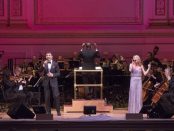
The score remains an uneven but catchy patchwork that has yielded several choice songs amidst the acceptable filler. Mr. Lloyd Webber’s music is a heady pastiche of old movie melodies with discernable portions of his" Evita" and "The Phantom of The Opera." Don Black and Christopher Hampton’s lyrics range from inspired to pedestrian. [more]
Adam
With slicked back hair, a melodiously rough voice and a smooth physical presence, Timothy Simonson offers an accurate impression of Powell that captures his swagger. Mr. Simonson’s appealing performance forcefully recounts Powell’s rise and fall with histrionic relish. Simonson is particularly stirring when describing the hardscrabble life of Powell’s father from poverty in Virginia to prominence and wealth as a minister in New York City. [more]
Composer Portraits Series: Beat Furrer featuring Either/Or
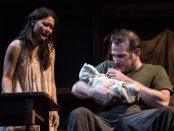
This is serious work. Without defiance of traditional or conservative contemporary classical music simply for mere defiance’s haughty sake, Furrer is developing his own particular vocabulary. And successful performance of Furrer’s music requires serious musicians. The musicians of Either/Or are a good match for this composer. Their technical skills are superb, marked by both muscular stamina and virtuosic creativity; equally important, their willingness to take performance risks is grounded in intellectual and artistic integrity. [more]
Big River: The Adventures of Huckleberry Finn
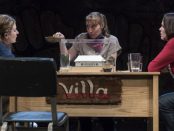
Red-haired, animated and engagingly boyish, 18-year-old Nicholas Barasch is sensational as Huckleberry Finn. Mr. Barasch is onstage virtually the entire time and winningly carries the show. As Jim, the runaway slave, Kyle Scatliffe brings dignity, forcefulness and powerful vocal ability during his commanding performance. [more]
Boys of a Certain Age
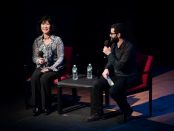
This volatile quartet battle over the personal and the political during a Scotch-fueled weekend at Ira’s Fire Island house. There’s not much in the way of plot, but secrets are revealed, scores are settled and life goes on with new insights. It’s reminiscent of a Terrence McNally play but lacking in polish. [more]

The Mother of Invention
Playwright James Lecesne has been acclaimed for his solo performance works, most recently "The Absolute Brightness of Leonard Pelkey." Here, he has written a traditional play employing theatrical devices that’s a mélange of David Sedaris, Charles Busch and Modern Family. There are one-liners galore, wacky situations and a decidedly campy sensibility. It’s a bunch of superficial antics that never really meaningfully connect. [more]
New York Polyphony: Palestrina’s “Marcellus Mass”
The second work of the evening was the world premiere of Ivan Moody’s Vespers Sequence. In careful, clear program notes, Moody described his goals in his compositions in general and in this new Vespers Sequence in particular: he seeks to “bring the concepts and principles underlying Orthodox spirituality … into dialogue with modernity” … in the “creation of a specifically Orthodox para-liturgical repertoire that brings together liturgy and concert.” Moody collaborated closely with New York Polyphony in conceiving and then finalizing this work; although the sacred texts and many of the originating aesthetic impulses of the work are ancient, the overall feel, in this premiere performance, was of something vital and contemporary. [more]
Drunkle Vanya
Periodically the cast calls for a “Family Meeting.” The theme from Jeopardy is played on a kazoo and three audience members are picked to come up. The one who is wearing the funniest nametag that relates to dialogue from the play is the winner, receiving a free vodka shot. Drinking games also take place. All of these festive tangents never sidetrack the plot of the play. Ms. Hudson is also the director, and her giddy, all-over-the-place staging in this large living room, enhances the exuberance of the piece. Improbably and cleverly, Chekov’s tone and intentions survive the mayhem. [more]
Georgie: My Adventures with George Rose
What truly distinguishes the show is Dixon’s fearless psychological focus on Rose and himself. The predominant theme is of hero worship and its bruising disappointments. It also attempts to explore the issue of the often-dark contrast between the on-stage and off-stage lives of great entertainers. In examining their involvement, Dixon doesn’t spare Rose or himself from honest scrutiny. [more]
Making Dreams a Reality: First Miss America’s Outstanding Teen Shares Her Journey to Off Broadway Musical
I’ve been watching Miss America since I was very little, and my sister and I would get dressed up every year in crowns and gowns and banners and I saw Miss Pennsylvania, Marla Wynne, in '92 or '93 and her talent was ventriloquism and I fell in love with it, and decided that I wanted to learn to make my Barbie’s talk. I went to my bedroom and sat in front of the mirror and figured out how to talk without moving my lips. I then got my first puppet at around age seven and started performing, but it all started watching Miss America. [more]
Golgotha
Mr. Refael’s simple but well-crafted scenario takes place in a contemporary apartment in Israel, and has the elderly Salvado looking back at his past. This is theatrically achieved by having him directly addressing the audience. His best friend and fellow survivor is to be honored at the Holocaust memorial center Yad Vashem during a ceremony where he will light a torch. When he becomes incapacitated, that task falls to Salvado. This situation instigates a flood of painful reminiscences that explore his guilt at having survived. [more]
PEER GYNT & the Norwegian Hapa Band
A major flaw is Peer Gynt. Personable, co-composer Park plays the title role. When we first see him, he’s wearing a hipster wool cap, plaid shirt and eyeglasses. Possessed of a good singing voice, his acting ranges from pleasantly monotonous to ineptly excessive. He strains to be charismatic especially in his dance moves and doesn’t succeed. Park’s performance has stamina but lacks grandeur to carry the leading role of this full-length musical. [more]