News Ticker
- December 13, 2025 in Off-Broadway // BUM BUM (or, this farce has Autism)
- December 12, 2025 in Musicals // The Faggots and Their Friends Between Revolutions
- December 12, 2025 in Cabaret // Mary Foster Conklin — Mirrors Revisited (50th Anniversary)
- December 11, 2025 in Cabaret // Kathy Kaefer — Kiss Me Once: Stories from the Homefront
- December 11, 2025 in Off-Broadway // The American Soldier
- December 9, 2025 in Off-Broadway // This World of Tomorrow
- December 9, 2025 in Cabaret // A Noel Coward Celebration — Steve Ross & Friends
- December 7, 2025 in Off-Broadway // Diversion
- December 5, 2025 in Off-Broadway // Meet the Cartozians
- December 5, 2025 in Features // Tom Stoppard: An Appreciation
- December 4, 2025 in Off-Broadway // Practice
- December 4, 2025 in Cabaret // Eddie Bruce — The Magic & Music of Tony Bennett
- December 3, 2025 in Interviews // Interview with Ty Jones, Classical Theater of Harlem
- December 2, 2025 in Features // Gingold Theatrical Group’s 20th Anniversary Gala at The Players
- December 2, 2025 in Interviews // The American Soldier – An Interview with Douglas Taurel
Archive
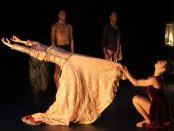
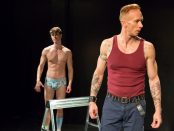
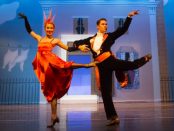
Two queen-like figures, Ms. Corona and Maricarmen Garcia, dressed in a parade of Aviad Arik Herman’s sumptuous costumes, reigned over four young men—Nick Burrage, Alexandre Barranco, Nicholas Montero and Michael Bishop (dressed in Herman’s tight, revealing shorts). The men morphed into the roles of consorts and warriors, manipulated by the two royal ladies into confrontations involving vividly acrobatic ballet steps and quotes from Shakespeare.
[more]
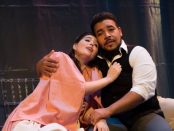
The performance of Verdi's "La Traviata" featuring Bonnie Frauenthal as Violetta and Jose Heredia as Alfredo Germont was wonderful in many ways. Frauenthal sang and acted her complex role compellingly: she is a confident singer, capable of both womanly sturdiness and subtle virtuosity, and she inhabited the dense narrative of Violetta's story credibly and compellingly. Heredia's youthful and earnest Alfredo was also convincing; his deep love of Violetta and grief at her death were poignantly believable. Interestingly, as an actor, Heredia stuck so literally to the movement of Alfredo's character in Piave's libretto that Alfredo's subservience to his father was maddening: the son's filial weakness undercut the manliness of his love for Violetta. Both Frauenthal and Heredia sang with integrity; they held nothing back from full commitment to either their roles or their audience.
[more]
Playwright Ana Nogueira has a facility for often arch dialogue but not much else. The play’s potentially promising sci-fi premise is undermined by its bizarre vagueness. Not only do the leading characters not have names, there is no biographical data about them imparted. Their professions and life details are never described. Most crucially HIM’s thesis is mentioned several times but what the subject of it was is not stated. Ms. Nogueira basically presents two ciphers that are difficult to truly care about. Ultimately, it’s all a hollow and smug exercise.
[more]
While proud of how she is portrayed in the press, as a woman who couldn’t be broken, McPhee delves beneath the surface to illustrate how Shanley really felt once she returned to an empty apartment at the end of the day -- with her beloved dog as her only real company. Like everyone else, she experiences confusion, loneliness, and pain and only can hope that her good choices and desire to help mankind outweigh the mistakes that she has made.
[more]
During the three and a half hours of "Phaedra(s)," Huppert masturbates, menstruates, throws up, fellates several versions of Hippolytus, flails about with masochistic glee, and screams so loudly and continuously as to cause fears for her vocal health, all in the service of getting to the core of the title character as imagined by Sarah Kane, Wajdi Mouawad and J.M. Coetzee (with dramaturgy by Piotr Gruszczynski.) Director Krzysztof Warlikowski did little more than keep the over-the-top emoting and sexuality from exploding out to Fulton Street.
[more]
Unlike the original short story which was set on a rural farm in Cornwall, England, and the film which was reset in Bodega Bay, California, the play takes place entirely in the main room of an isolated house in New England. Stefan Dzeparoski’s production which puts the audience in the same room with the characters has its strengths and weaknesses making this an evening of mixed success.
[more]
Felder’s play begins with a video of the actual Leonard Bernstein delivering a colorful, yet entertaining, illustrated lecture on music. When Felder sashays down the aisle, a cigarette in one hand and a drink in the other, the lack of resemblance is, at first, bothersome. But, somehow, sitting at a piano—which he plays impeccably—his monologue pulls you into Bernstein’s tumultuous life story.
[more]
Lott employs skillful puppetry, complementary video projections, innovative lighting and novel sound design to show the transitions between the present and make-believe. Five puppeteers (Robert Stevenson, Jamie Agnello, Rowan Magee, Chelsea Fryer, and Sam Jay Gold) carefully and exactingly portray the slow but sure disintegration of Blossom's mind. Real-time and imaginary time are each given their own set pieces through which Blossom explores memories and in-the-moment relationships.
[more]
This comedy revival of Leslye Headland’s 2010 play, that was adapted for the 2012 film of the same name, "Bachelorette," is as caustic and outrageous as ever. While looking ahead to a wedding day is supposed to generate feelings of excitement and bliss as women band together to stand by their girlfriend as she prepares to say “I Do,” this is often times not the case with several different personalities in the same room. It can be a very stressful time as emotions heighten and feelings get hurt, and "Bachelorette" humorously and dramatically represents this experience as three girls meet up to celebrate the night before their friend’s wedding in a swanky hotel suite.
[more]
Playwright Julia Cho has crafted an engaging and universal work that unevenly blends reality with mysticism. The characters are all very well delineated and the dialogue is flavorful and realistic. It’s structured as a series of short scenes that include monologues, flashbacks and fantasies. The play’s two-act form diminishes its momentum, running two hours and fifteen minutes with an intermission. Repetitiveness and a preoccupation with profundity sidetrack its effectiveness at times.
[more]
While the New York City Opera’s staging of "Aleko" could not be called a major rediscovery, it was an admirable attempt to offer a non-standard repertory work that had probably not been seen by any of its New York audience. The real surprise was the thrilling and commanding performance of "Pagliacci" which bodes well for NYCO’s future life and health at Lincoln Center. In addition, the New York City Opera Chorus, under the direction of William Hobbs, gave persuasive performances in both operas, another feather in the City Opera’s cap.
[more]
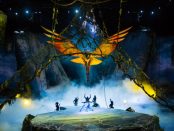
The show includes pole vaulting, giant flowers that rise up out of the ground, the building of the bone structure of the totemic Thanator, the high flying of the Toruk, a flock of birds played by kites, pulsating live drumming, two earthquakes, the lava flow, a three story water fall, and the rise of the river by which the Pandorans are saved. Along the way the questers are beset by various exotic animals played by 16 huge puppets (designed by Patrick Martel) which are manipulated from inside by the performers. As the trio travel from one clan to another, the environment before us morphs from one colorful place to another in Carl Fillion’s monumental set and prop design.
[more]
Director Kira Simring’s superior staging theatrically presents the play’s complicated situations with clarity and surrealistic flourishes. Characters often enter and exit through unlikely places such as through the audience or from a side door. Though the play lasts only 75 minutes, Ms. Simring’s physical realization of it makes it seem lengthier with the depth she has brought to it. Her results with the cast, some of who play dual roles is superb.
[more]
Following "Bachelorette" and "Assistance," Leslye Headland’s latest play, The Layover, is a taut psychological thriller told in an updated film noir style. Trip Cullman, who has directed all of her New York productions, has made the play a tour de force of tension and unease. As acted by Annie Parisse, Adam Rothenberg, Amelia Workman, John Procaccino and Quincy Dunn-Baker, the tone is marvelously sustained. The only fly in the ointment is the ending which will take you entirely by surprise and may feel unmotivated.
[more]
Taub’s eclectic score to original lyrics includes jazz, rhythm and blues, pop, Broadway and ragtime. Among Kwei-Armah’s ingenious touches were his use of a series of community cameo groups play back up for individual songs: the Jazz Procession for Countess Olivia’s father was played by the spirited Jambalaya Brass Band. Viola’s inner monologue was interpreted expressively in pantomime by New York Deaf Theatre. Malvolio’s solo Can-Can was performed by the nine energetic and enthusiastic dancers of The Love Show. The duel provoked by Sir Toby was backed up by the thrilling drummers of COBU while his duel masters were portrayed by the electrifying Ziranmen Kungfu Wushu Training Center. Throughout the evening, the Illyriettes made up of six ladies dressed identically in purple sequined sheaths played back up group for various singers and musical numbers.
[more]
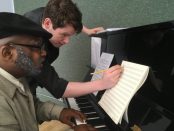
To call "About Clarence and Me" simply a play is misleading, as the project features an entirely original score by co-writer Scott Hiltzik. A classical musician, Hiltzik’s music is technically striking but carries a modern flare. In additional to their finely tuned performances, both DeMone and Roll impress as musicians as well. Roll proves himself to be quite the accomplished classical pianist, demonstrating mastery of the keys by way of precision and constraint. DeMone, ever his opposite, produces from the piano a sound descendent of a ragtime piano roll, at times accompanied by the veteran singer’s sonorous growl. Directed by Hiltzik’s co-writer Jones, the duo’s intimacy with the material is plain to see in the final product. Full of nuanced moments both thematically and in performance, the writing team’s hands-on approach is responsible for this well-rounded and solid production.
[more]
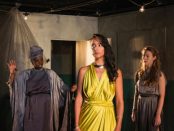
Written in 415 B.C. as a criticism of the Athenian capture of Melos and the subjugation of its population earlier that year, "The Trojan Women" has remained relevant throughout the last 2,500 years due to mankind’s penchant for war. Although Ellen McLaughlin’s new adaptation makes some changes to the Euripides original, it retains its power pertinent for our own time in the wake of the refugee crisis. While at times callow, Anne Cecelia Haney’s production for The Bats is persuasive, potent and poignant. It also provides an excellent introduction to the plays that make up Greek tragedy for those who have not experienced them on stage.
[more]
Besides achieving sensitive and strong performances from the cast, director David Drake masterfully fulfills the playwright’s intentions with his lively and brisk staging. The collaborative group UnkleDave's Fight-House’s fight direction is thrillingly realistic for several physical conflicts.
[more]
The beauty of Chen’s technique lies in engaging the audience in a guessing game that they don’t immediately know they are a part of – presenting them with certain messages that appear to be true, but challenge them to think about it from a different perception. One of the main themes is examining the different viewpoints between the Chinese and American cultures and how perceptions can be skewed. The result is a clever and eye-opening puzzle that teaches important lessons around the human experience in a shocking way by offering extremes.
[more]
Now that we have been through all the angry play movements, literate writers like N.C. Hunter and Terence Rattigan are once again ripe for revival. While in his own time, Hunter was criticized for being too much like Chekhov that now seems a plus in the days of sloppy craftsmanship and plays that are really movie scenarios staged in the theater. "A Picture of Autumn" was obviously a post-war British variation on Chekhov’s "The Cherry Orchard," while Waters of the Moon resembles "The Sea Gull." "A Day by the Sea" owes a great deal to Chekhov’s "Uncle Vanya" and includes the same basic cast of characters.
[more]
Gwenllian Higginson and Michael Humphrey in a scene from “The Good Earth” (Photo credit: Tom
[more]
"Crashlight" is a musical that is so inept that the recurring age-old mental question while watching it is, “What were they thinking?” The "King Lear"-style eye gouging sequence in the second act pushes it into the realm of the totally ludicrous.
[more]
Toni Press-Coffman’s "Touch" is a rather challenging play both in that a great deal of it is narrated in recollection and also that it deals with much naked emotion. The cast led by Peter McElligott who is onstage almost throughout the evening could not be bettered. Director Nathaniel Shaw has made this under-dramatized play into a more theatrical experience. While Touch will not be for everyone, it is an impressive document of the workings of the human heart.
[more]
Vegas still maintains its status as a hotspot for Broadway musicals, theatrical plays, and live entertainment. Although Performing Arts doesn’t appeal as largely to today’s youth in relation to other forms of entertainment, the city hopes to draw in more young performers to the arts by creating public and supporting personal programs
[more]
The dynamic cast is made up of Marquis Gibson, Lauren Shaye, Nicole Stacie and Christian Lee Branch. These four very talented performers all portray numerous characters during this 75-minute work. President Barack Obama is depicted as well.
[more]
The ten solos proceeded efficiently and smoothly with certain similarities becoming apparent: black was the color of all but one of the costumes and black was the mood of most the works. Crouches were the preferred opening poses, beginning with “Convergent Unease” by Alexis Julian to music by Max Richter, and the movement palettes were not particularly original, even when well danced, as were most of the solos.
[more]
"To Protect the Poets" shows how readily lines can be crossed when “street justice” is employed, instead of the judicial system. This first-rate, timely and intelligent play is a just representation of how two people who love each other deal with violent crimes against women and police brutality.
[more]
While "LUNT AND FONTANNE: The Celestials of Broadway" is a fine and concise review of their careers for people who have never heard of them, Murphy and Lang make them seem more superficial than necessary. It is true that Fontanne was born in England, but Murphy and Lang play both of them as very English and exceedingly refined and proper, not backed up by their performances as themselves in "Stage Door Canteen." The Lunts’ famous use of overlapping dialogue which was years ahead of its time can be seen in the video of their film of "The Guardsman." Murphy and Lang often use it to talk over each other’s lines making them unintelligible, while the Lunts came in on the last syllable of their cues which is much more realistic. The Lunts may have appeared in many light drawing room comedies, but to portray them as delivering their lines on the same level all time would not have made them as famous as they were.
[more]
Laden with jokes, sight gags and flamboyant characters, Mr. Free’s well-constructed and startling work combines the outrageous sensibilities of John Waters’ films with the social consciousness of Norman Lear’s television sitcoms. Free’s giddily convoluted scenario is dense with flashbacks, fantasies and surprises. Just when a thread is exhausted he is seamlessly on to another. The classic horror film "Night of the Living Dead" is emulated for the deadly serious dénouement.
[more]
Directed by Leni Mendez, "Implications of Cohabitation" is a smooth running machine, albeit some undeveloped moments in the script. The staging is fluid and the story is clear, but some exchanges between characters are borderline inauthentic. The set design by Anna Grigo is effective, but slightly repetitive. The main set piece is an empty apartment, and the decorum of the apartment is changed to reflect the change in location. Unfortunately, these changes are minimal and don’t do much to enhance or differentiate one scene from the next.
[more]
Richard Alfredo’s 'The Dark Clothes of Night," a brilliant parody/homage to film noir and hardboiled fiction, the third play of Summer Shorts – Series B, is so good it alone is worth the price of admission. The other two plays which precede it in this year’s 10th Festival of New American Short Plays have interesting but undeveloped premises. But "The Dark Clothes of Night" is an instant classic, a humorous satire that is also a brilliantly theatrical study in paranoia, fear and evil and the elements that made film noir irresistible. Directed by playwright Alexander Dinelaris, the three actors in this memorable short work play multiple roles with assurance and aplomb.
[more]
Writer Gustavo Pace is the handsome, youthful and animated performer of this autobiographical exploration. He loudly rattles on in Portuguese and English while adequately portraying himself and several characters. These include his father, brother, a female therapist working on turning him straight, and various others he encounters. It’s an amiable and passable performance that’s heavy on volume and shaky on intelligibility.
[more]
A few months ago we saw the sensational Miami troupe featuring the works of George Balanchine. Now we have just had a fascinating week-long season by the Sarasota Ballet troupe, directed by Iain Webb, at the Joyce Theater in Chelsea, in a program called "A Knight of the British Ballet" focusing on the brilliant work of Sir Frederick Ashton. Ashton was for decades synonymous with The Royal Ballet. His ballets were the artistic backbone of that troupe. It’s odd—yet wonderful—that Florida has become a stronghold for the repertories of two of the twentieth century’s most important choreographers.
[more]
«
1
…
82
83
84
85
86
…
114
»
Copyright Jack Quinn, 2001-2023