News Ticker
- April 8, 2026 in Off-Broadway // Public Charge
- April 8, 2026 in Off-Broadway // Desi SNL
- April 7, 2026 in Musicals // No Singing in the Navy
- April 7, 2026 in Off-Broadway // Uncle Vanya, scenes from country life
- April 7, 2026 in Off-Broadway // The Last Audition
- April 2, 2026 in Columns // THE EXPLOSIVE GROWTH OF FILM AND TV PRODUCTION FACILITIES IN THE NEW YORK / NEW JERSEY AREA
- April 1, 2026 in Musicals // Gotta Dance!
- March 31, 2026 in Off-Broadway // Jesa
- March 30, 2026 in Musicals // Monte Cristo
- March 30, 2026 in Off-Broadway // The Unknown
- March 30, 2026 in Off-Broadway // Antigone (This Play I Read in High School)
- March 30, 2026 in Off-Broadway // Antigone in Analysis
- March 29, 2026 in Off-Broadway // Bughouse
- March 28, 2026 in Musicals // The Paparazzi
- March 27, 2026 in Broadway // Giant
- March 26, 2026 in Off-Broadway // Ivanov
- March 25, 2026 in Musicals // Blood/Love
- March 24, 2026 in Off-Broadway // Touch
- March 24, 2026 in Music // The Silent Serenade
- March 23, 2026 in Musicals // The Wild Party (New York City Center Encores!)
- March 22, 2026 in Broadway // Every Brilliant Thing
- March 22, 2026 in Multimedia // Burnout Paradise
- March 20, 2026 in Musicals // Chasing Grace
- March 20, 2026 in Off-Broadway // Entangled: 12 Scenes in a Circle K off the I-40 in New Mexico
- March 19, 2026 in Off-Broadway // Trash
- March 17, 2026 in Concerts // The New York Pops: “United in Sound: America at 250”
- March 17, 2026 in Musicals // Bigfoot! A New Musical
- March 14, 2026 in Off-Broadway // Spare Parts
- March 14, 2026 in Off-Broadway // Zack
- March 13, 2026 in Off-Broadway // Dear John
- March 10, 2026 in Off-Broadway // Our House
- March 10, 2026 in Off-Broadway // Body Count
- March 8, 2026 in Off-Broadway // Chinese Republicans
- March 7, 2026 in Off-Broadway // The Mall The Mall The Mall
Archive
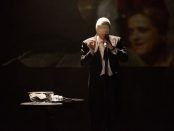
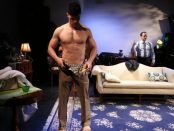
Carlo Adinolfi plays John, the performance artist. With his British accent and wiry physicality he has an intense presence but possesses limited charisma. Mr. Adinolfi’s simple but inspired scenic design with its aesthetically arranged white sheets and white bench and white cabinet with wigs provides a compelling landscape for the actions.
[more]
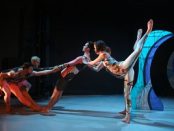
Wearing pale, simple but elegant costumes with small colorful patches around the hips (designed by Sue Julien and Brenner) the dancers in “Soul River/Blues” entered singly at first up a diagonal, almost as if sneaking on. As the dance unfolded they rolled and paused, looking over their shoulders to a score by Ry Cooder and V.M. Bhatt which was a hybrid of Indian classical and bluesy American guitar styles. One man (Aaron Selissen) and four women (Kara Chan, Ruth Howard, Sumaya Jackson and Kristi Ann Schopfer) interacted in slow lifts and groupings that became ever more complex in their angles and internal relationships.
[more]
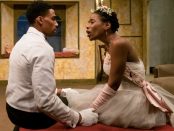
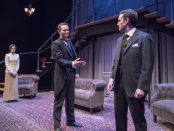
Like in a Noel Coward comedy, the witty zingers come fast and furious: “That her big white Cadillac looks like a pregnant Frigidaire,” “Did you say she was from Newark or Noah’s Ark?”, “Harlem has gotten to be such a cesspool of nobodies,” “You can’t raise a rose in a junkyard,” “The ribbon around your neck is loose. Tighten it.” It also offers some very wise statements on the relationships between men and women: “women grow old from neglect and not from age,” “Regardless of how bad we women look in the morning, Oscar, we never wake up needing a shave,” “She loves the ground he staggers on.” However, the play also makes clear the rivalry between various Black enclaves: Harlem, Brooklyn and Washington, D.C. Dolly, Tillie and Mrs. Pace make pronouncements on the classiness of each.
[more]
The artistic team responsible for this "Butterfly" made radical decisions and changes. Puccini’s original three acts of linear story – love and “wedding,” waiting, betrayal and death – are reorganized and abbreviated into three scenes of waiting, remembered love, and then betrayal. Some minor characters in the original opera are eliminated to create a caste of just five singing characters. The entire orchestra is reduced to a chamber orchestra of just six musicians, the Cantata Profana. The adaptation of Puccini’s orchestral score for this small chamber group by Daniel Schlosberg is remarkable: unexpectedly, its absolute faithfulness to Puccini’s musical intent at almost every turn made up for the diminished number of musicians.
[more]
The show’s writer and host, Rob Berman, introduced many of the songs and, essentially, gave us the story of Lerner and Loewe’s difficult, on-again, off-again partnership. Referring to them, at one point, as an “odd couple,” Berman explained that the composer Frederick (or “Fritz”) Loewe was an “old world” European, and lyricist Alan Jay Lerner a “New York sophisticate,” who was educated in England. Berman also claimed that the common denominator for all of their musicals was a kind of “idealism,” making the pair “dreamers.”
[more]
The goal of their three week Women in Theatre Festival is “a direct response to gender disparity in theatre leadership, casting, and production, the objective of WIT is to broaden the opportunities for women artists, engage with an audience who seek an indie theatre experience, and add to the canon of women playwrights writing roles for women actors.” "Great Again" quite successfully fulfills these commendable aspirations.
[more]
Mr. Perry has certainly followed the maxim, “write what you know.” We follow the romantic and personal travails of four stereotypical, contemporary Los Angles types who have the financial resources for incessant self-examination. It’s a universe of meet cutes, overwrought emotional exchanges and happy endings.
[more]
Say this for actor Hamish Linklater: he writes juicy parts for his fellow actors. He also knows how to set up a sense of community. The New Group production directed by its artistic director Scott Elliott has a fine cast led by two-time Tony Award winner Norbert Leo Butz and Zosia Mamet, just off six seasons of the recently ended HBO television series, Girls.
[more]
While most of the audience remained stony-faced, my companion and I were laughing hysterically throughout much of "Can You Forgive Her?", a black comedy if ever there was one, by Gina Gionfriddo at the Vineyard Theatre. It may be that many in the audience failed to recognize it was a comedy, and took it far too seriously, which is somewhat understandable, given the seemingly earnest yet cockamamie story--or rather stories--that unfold.
[more]
Director Jesse Berger’s fast-paced staging is an exuberant amalgam of physical and verbal virtuosity combined with visual flair. A highlight is a crowd of characters hurrying into a closet and popping out one by one that’s out of a Marx Brothers movie. There’s also the spectacle of a group of bearded, shabby villagers of various heights storming The Mayor’s house in their flowing garments.
[more]
Company member, Omar Román De Jesús choreographed the third world premiere, “Daniel,” to a multiple-sourced score. He took his eight dancers through a dramatic visit to those on the autism behavior spectrum, finding beauty, sadness and even some humor. The emphasis was definitely on the darker elements with angular knee and elbow jutting movements repeated over and over again. Unlike his mentor, David Parsons, De Jesús dared to end his work with two sections that each used two dancers.
[more]

Unlike such political plays as Arthur Miller’s "The Crucible," David Hare’s "Stuff Happens" and the current "Oslo" by J.T. Rogers, Building the Wall is speculative political fiction. Projected into the not-so-distant future, it takes place after a terrorist attack has released a dirty bomb in Times Square irradiating two square blocks. As a result, President Trump has declared Martial Law and begun rounding up millions of immigrants for deportation. This extraordinary move which had gotten out hand has led to his impeachment and exile to Palm Springs. "Building the Wall" takes place in 2019 in a prison meeting room in a federal lock-up in El Paso, Texas. Gloria, an African American historian and college professor, has come to interview Rick, a white man, who is awaiting sentencing for his role as the former warden of a new Magnum Security private prison facility outside of El Paso for illegal immigrants awaiting deportation. It is Rick’s role in the disposal of bodies after a cholera epidemic in the overcrowded facility which has landed him in prison.
[more]
Expect great things from Udofia in the future. Both plays demonstrate that she writes full-bodied, three-dimensional characters, while "Her Portmanteau" reveals that she can also write a play from the heart whose emotions will pull you in and stay with you long after the final curtain. Also keep your eye on Chinasa Ogbuagu: playing two different women 36 years apart she is totally unrecognizable, you have to read the program to discover that it is the same actress, an extraordinary feat.
[more]
The opening scenes augurs well, hinting at the deeper emotional motivation for Salome’s future behavior, her decision to avoid romantic involvement. As the lights gradually rise to reveal Salome, seated at her desk, her back to the audience, she is described by disembodied voices as a contradictory figure who is loved and respected in equal measure. Then Salome, the product of a respectable, well-to-do upbringing, tells a tale of being duped by the kitchen help when she was a child. The look on Mieko Gavia’s face as Lou Salome after revealing this traumatic event makes it clear that she will never be duped again. Ms. Gavia skillfully portrays Lou Salome as a stalwart anti-romantic who, nevertheless, knows that friendships with the influential males of her time were a necessary evil.
[more]
Mr. Grandbois’ engrossing scenario is in the vein of such feminist fantastical works as "Diary of a Mad Housewife" and "Up the Sandbox." An expedition to a salsa dance club, buying a puppy from gypsies behind a Home Depot, watching Clash of The Titans on television with her son and a trip to the zoo are rendered with exquisite literary detail that’s simultaneously comic and moving. Looking into an old mirror becomes a Proustian reverie of Lanie’s recollections of her dead grandmother.
[more]
It's Ella Fitgerald's centennial. She influenced more than a generation of singers and musicians. The lady called the “Queen of Jazz” or “The First Lady of Song” would have turned 100 this year. Her bounty is unmatched. Among her musical gifts, Ella was an exceptionally well-rounded musician, a pristine vocalist and impeccable improviser. She was jazz. There have been many first ladies of this or that but Ella was an original, clarion-voiced swing singer in a league of her own.
[more]
From the beginning, one core component of Rosenbaum’s mission has been the cultivation of a contemporary American repertoire and the regular commission of new works. Rosenbaum is, in fact, an enthusiastic champion of young composers. This May concert, consisting of ten new works, reflected this focus … and was a wonderful celebration of young talent and achievement.
[more]
An import from the United Kingdom, as part of the 2017 Brits Off Broadway Festival at 59E59 Theaters, Jon Brittain’s "Rotterdam" is not based on a true story relating to events in the eponymous Dutch city. It rather focuses on a British lesbian couple, one of whom decides at the beginning of the play that she’s really a man and really wants to become transgender. The crux of the drama is between Alice and her lover Fiona, who, in the course of the play, becomes Adrian. But why the two of them moved to Rotterdam seven years ago, is never really answered in the play--rather posed as a recurring question--along with the question of whether or not they’re going to remain there.
[more]
It is set in present-day rural Afghanistan. Several years earlier, Paiman as a child was sold by his father to the well to do Jahandar. The two have an intense emotional and physical involvement that must soon cease, as Paiman is soon to marry because he is approaching manhood. Feda, Zemar, the dancing boy of Zemar, Jahandar’s droll, and mean cousin, is also aging out. Paiman and Feda fall in love and that instigates several conflicts.
[more]
Amidst Mr. Maierson’s barrage of mechanical set-ups and punch lines, there are a few amusing jokes and insightful observations. Reprise is in the tradition of substantive romantic comedies such as several of the works of Neil Simon and Bernard Slade’s Same Time, Next Year. However, it lacks the polish and depth of those perennials, and is also mired in bathos.
[more]
The adept cast is led by Zainab Jah in the title role. In the one detail in which Parks’ play matches "The Elephant Man," Ms. Jah, a shapely, lovely actress, transforms herself into Venus right in front of the audience, painfully pulling on a padded costume that leaves nothing to the imagination. Ms. Jah’s Venus is a strong figure who rolls with the punches but is no match for the hypocrisy of the powers that be. She is a strong enough actor to keep her head above the fray.
[more]
It quickly becomes apparent that Brown is a master at reading body language--no less than facial and vocal expressions--to manipulate the many audience-members who participate and to read their inner thoughts. Brown’s patter is also built on an almost glib sort of false modesty, such as his saying, near the end, “This only works because we are story-focusing creatures.” Any given interaction doesn’t “work” because we’re focusing on the “story,” but because he knows just exactly how to get us all to see only what he wants us to.
[more]
There was a mysterious coolness about “Close-Up” which, according to a program note by Ms. Cornfield, was meant to delve into the personalities of her five dancers, doing this by assigning very particular gestures—touching the face with a finger, holding a palm to the forehead, quivering hands, mimed pouring, nods—and facial expressions like appearing to laugh or shout to each dancer. She called these intimate, non-dance details, “zoom close-ups.” These quirky bits were additions to sleek, catlike movements that included lunges, low leg circling and the kind of balletic movements that were the centerpiece of Cunningham’s choreographic output.
[more]
The playing space designed by Doyle is a narrow white runway with a stool at one end and at the other, an archway created by continuing the flooring into the air on which Japanese writing appears as on a banner. The audience sits in stadium-type seating on either side of the playing space. Eschewing pageantry, the production puts the cast in very bland outfits of black, grey, white, blue or beige (costumes by Ann Hould-Ward), adding fabric or robes when absolutely necessary. The lighting by Jane Cox occasionally bathes the stage in either red or blue mood lights.
[more]
All but one of Zall’s works were solos and all were based on famous literary figures: “George Sand” (ruminating on her lost love, Chopin), “Mary Tyrone” (from "Long Day’s Journey Into Night" fighting her addiction while remembering her childhood), “Sonnet” (to an Edna St. Vincent Millay sonnet about obsessing over a lost love), “Amanda” (the mother in "A Glass Menagerie" sadly musing over her ball gown) and “Shadow of Her Sister” (two sisters from "The House of Bernarda Alba" battle to the death with dark Catholic imagery overlaying the internecine war).
[more]
But the concert didn’t have the satisfaction of a big blockbuster – such as Haydn’s Creation, with which the season began – or of two or three masterworks. Music of the Anglican tradition is the bone and blood of St. Thomas’ work: it’s the music in which the choir excels. The formal musical curriculum in which St. Thomas students are immersed serves them well in any musical endeavor or style, but the Anglican vocabulary is the one these young musicians are most comfortable with. In this particular concert, the music of non-Anglican-tradition composers was well presented, demonstrating the skills of the singers, both young and old, but wasn’t thrilling.
[more]
Director Jesse Marchese has cast the play very strangely. Ari Brand’s Bob is a good deal shorter than his younger brother so that one must continually remind one’s self which is which. As Pamela, Paton Ashbrook also is taller than Bob. Is this a subtle hint that she doesn’t belong with him? Gerald has three friends who are guests in his father’s house. Andrew Fallaize’s Tommy, an idle fellow mad about golf, and his girlfriend Letty, played by Mia Hutchinson-Shaw, seem so much younger than Gerald that it stretches the imagination that they are his close friends. Gerald’s friend Henry Wentworth, a successful barrister played by Michael Frederic, looks so much older that it also seems rather unbelievable that they are bosom buddies. A delightful Cynthia Harris plays wise, compassionate Great Aunt Harriet in such an astute manner that she highlights all the subtext of her lines, the only actor in the production to do so.
[more]
Chris Anthony Giles, Nicholas Edwards, Dan Rosales, Juwan Crawley and Nora Schell (original cast)
[more]
The opening resembles that of Mann’s novel: a horse and buggy deliver a visitor to a tuberculosis sanitarium on a mountain top overlooking a valley, suggesting that the unspecified time is 100 years ago, prior to W.W. I. Immediately, the doctor discovers that the newcomer has T.B. and needs weeks of rest. This One Who Has Come from the City to Heal meets and interacts with the other denizens, including a healer, a mother of a degenerate child, one who is building a space ship, and one who composes sounds and visions, as well as having the ability to see those who have passed away.
[more]
The final work, “On Foot” was choreographed by Hollander and seven company members. It featured a Middle East-tinged score by Kinan Azmeh and Anouar Brahem and sensational visual art, mostly created on the spot, by Kevork Mourad whose ancestors fled the Armenian genocide. Mourad created both beautiful and horrifying projections on the back screen of the stage and also sat at a computer projector producing fluidly morphing images on a scrim: people floated about; ancient buildings melted; and complex landscapes passed by capturing the mood of the choreography.
[more]
In the ambitious T"hey Promised Her the Moon," playwright Laurel Ollstein explores a relatively untold chapter of American history. Solidly written but unsatisfyingly structured as a clunky series of flashbacks, confrontations and historical exposition, the play snaps to life in its final scenes. There the Salieri versus Mozart-style rivalry of Peter Shaffer’s "Amadeus" that has developed between the two antagonistic central figures is heightened.
[more]
“Corvidae,” Colin Connor’s contribution to the program, was staged to the relentless first movement of a Philip Glass Violin Concerto. The title refers to the scientific name of the family of crows and ravens. The six dancers, stylishly dressed in all black outfits by Connor and Keiko Voltaire and moodily lit by DK Kroth, wandered about stylishly, but aimlessly, suddenly bursting into movement, softly leaping, arms held in wing-like positions. The heads of stationary dancers were held high in ornithological awareness as the rest of the cast softly cut through the air in balletic, sweeping steps. The overall mood was dark and sexy.
[more]
On the fourth anniversary of the Stonewall uprising in 1973, an arsonist set fire to a gay bar in New Orleans, killing 32 people. This tragic yet forgotten episode in gay history is not only part of a Harvey Fierstein monologue in "Gently Down the Stream"—currently playing at the Public Theater--but also the subject of "The View UpStairs," a new Off Broadway musical that has a lot of spark, but ultimately not enough fire.
[more]
The writing is poetically descriptive and moderately engrossing with plentiful profanity. It is, however, a decidedly grim scenario despite abundant humor. The conclusion is a rhetorical and optimistic rallying cry for social justice. The themes and message are all very well realized in this production.
[more]
Director Weyni Mengesha’s physical staging is proficient since for 80 minutes the actors are competently placed throughout for a fluid presentation. Unfortunately, Ms. Mengesha has the sound at full blast and that’s distracting. Just as egregiously, Mengesha has the talented cast performing at full throttle, resulting in overwrought and collectively overall ineffective characterizations.
[more]
At the end of this "Happy Days," it’s difficult not to be heartbroken by Ms. Wiest’s Winnie, particularly when she gets a rare glance at her significant other, Willie, who manages to crawl over the sand to serenade her with the “Merry Widow Waltz.” Jarlath Conroy playing Willie makes the most of his few scenes both behind and on top of the sandy mound. Somehow he even makes something of his slow crawl towards Winnie at the end. Seeing Ms. Wiest’s face at that moment is worth sitting through Beckett’s theatrical obfuscations.
[more]
Handsome musical theater leading man Ryan Silverman is a commanding Ulysses with his operatic singing. Jeff Blumenkrantz is marvelously humorous and pitiful as Menelaus, Helen’s jilted husband. N’Kenge is fierce and bewitching as Mother Hare, a soothsayer-like figure. Ashley Brown is wonderfully comic as the mayor’s wife. Though silent as Paris, the youthful Barton Cowperthwaite’s superior ballet skills make a great impression.
[more]
Hnath’s new story is absorbing and twisty, interestingly creating an entirely new set of ethical and social questions than was handled by Ibsen in 1879. He has handled it in a similar fashion to Bergman’s "Scenes from a Marriage" but without the painful emotional fireworks. It is 15 years since Nora had left her husband, stating he had no further claim on her. She has not been heard from since. Having become a famous feminist author with advanced ideas writing under a pseudonym, she has recently discovered due to a blackmail attempt that Torvald has never divorced her which she assumed he had done. Having lived as a single woman, signing contracts, controlling her own money, and having relationships with men not her husband, she is guilty of a criminal offense under Norway’s laws at the time and can be sent to jail. She arrives at his door to obtain her divorce to really be a free woman.
[more]
McCollum is both charming and charismatic playing among other characters the self-entitled and irresponsible Bruce, the hippie techie Sal, Kat’s spaced-out boss Madison, and the intrepid and heroic Shackleton, although at first it is not obvious that he is all of these characters. It is a bravura performance showing tremendous range as he makes each one entirely different. Vigoda is another story. Her Kat is plucky but is mainly a device to get Shackleton to tell his story. We never learn much about her and she never changes as the adventure unfolds. Her violin playing is excellent but it is a bit of a distraction from her other activities in the musical.
[more]
All the actors in the band play their instruments with panache and perfect period style, including Cott whose piano doodling is terrific. James Nathan Hopkins plays the cute, upbeat saxophonist, Jimmy Campbell; Brandon J. Ellis, the joking teddy bear of a guy, Davy Zlatic, the bassist; Alex Bender, the intensely dramatic trumpeter, Wayne Wright; Geoff Packard, the germ phobic trombonist, Wayne Wright; and Joe Carroll as Johnny Simpson, the percussionist who survived a scary accident during the War.
[more]
Retro Productions’ 50th anniversary revival of Paul Zindel’s "And Miss Reardon Drinks a Little" put the spotlight on an almost forgotten play that is worthy of revival. Shay Gines’ production with a game cast of seven is absorbing and compelling theater with characters that are bigger than life. Paul Zindel’s semi-autobiographical play comes alive in their hands. There may be more theatrical treasures to be mined from his collected plays.
[more]
All the acting is sharp, from the upper-crusters taken in by Paul (Lisa Emery, Michael Countryman and Ned Eisenberg) to their kids (Colby Minifie, Keenan Jolliff, Ned Riseley, and Cody Kostro), Chris Perfetti as Trent who, sexually intoxicated by Paul, fills him in on the ways and means of all the people he will eventually swindle, and finally, to the young lovers (Peter Mark Kendall and Sarah Mezzanotte) whose fate reveals just how psychologically damaging Paul can be.
[more]
Though the printed script, such as it is, is credited to Nel Crouch, Crouch is listed in the program as only the director, and "Fossils" is rather “By” Bucket Club, described as an “associate company.” Such confusion is perpetrated throughout the production: it’s hard to say if, in the end of this extremely low-tech presentation, Vanessa has actually encountered the Monster--and/or her father--or not. "Fossils" is apparently more about what doesn’t happen than what does.
[more]
The two leads David Spadora and Morgan Cowling are charming but that isn’t really enough to carry the show. The script isn’t too kind to their parents. As Big Harry, Lenny Wolpe is overbearing and possessive and as Sherri’s mom Francine, Robin Skye is controlling and possessive. Both are quite convincing and unpleasant – just as the script wants them to be. As the Village Voices, Chavez, Manocherian and Saunders demonstrate tremendous versatility playing all sorts of roles and are excellent singers.
[more]
That this production has such an ideal Sloane puts it into the stratosphere. With his sculpted physique, prevalent musculature and chiseled features that recall the young Malcolm MacDowell (who played the role in a 1975 London revival), Matt Baguth is mesmerizing. Speaking in a whispery, low, lightly accented voice, Mr. Baguth commands attention. Whether wearing Mod clothing or encased in black leather, and a tight white T-shirt, Baguth vividly captures the predatory nature of this youthful interloper with sly conviction.
[more]
"Elliott loves bebop" is a much more satisfying piece than either "Sonerna" or "No slash" on their own. It would be no matter what. But the experience of having listened to the two quartets one after the other immediately before the octet immeasurably enriched the experience of hearing the octet: the octet’s complexities were more intelligible and the patterns of their interconnections were more clear. Without compromising or simplifying the work’s density, its meanings were more accessible.
[more]
Mr. Karl gives a captivating performance that’s a whirlwind of energy, charisma and exceptional singing and dancing. It’s a commanding star turn that cannot quite compensate for the show’s hollowness. When getting dressed in the mornings, Karl’s leg brace was visible at the performance attended. This was the result of an injury that he had on April 14, 2017, while performing, near the end of the show.
[more]
Although the play seems to have something to say about economics and political systems, it is simply a very light romantic comedy making use of elements of change during the Great Depression. Ross’ production is quite proficient and fast-paced, but the characters are generic and we don’t learn much about them. As Lord Kettlewell, Brian Protheroe is the typical crotchety but wise aristocrat, Richenda Carey is most eccentric as the impoverished Lady Knightsbridge, and Lisa Bowerman is level-headed as the previously estranged Lady Kettlewell. Carol Starks’ Mrs. Lancicourt is the manipulative upper-class woman who attempts to dominate all situations. Hugh Sachs is a raisonneur straight out of classic drawing room comedy and would have been as at home in a play by Wilde, Shaw, Pinero or Galsworthy.
[more]
The clarity of this new play by J.T. Rogers does not only rely on the smart yet surefire way it’s written, but also on the masterful staging by Bartlett Sher, who, after recent productions of both "South Pacific" and "The King and I," is no stranger to directing gargantuan shows at Lincoln Center. Given its subject--the Oslo Accord or peace treaty between Israel and the Palestine Liberation Organization (P.L.O.) in 1993--Oslo is ultimately, an enormous play. But it is told in intimate terms.
[more]
The original film is brazen in its guerilla-style filmmaking, a good deal of which was surreptitiously produced right under the noses of the Institution’s officials. To anyone who knows or watched the original 1967 film, James Sewell’s choreographic rendition would seem tame, certainly lacking the shocking visions of naked men abused and humiliated by sadistic guards, ridiculously backward psychologists and a nutritional staff intent on starving the patients. (Images abound of skeletal men wandering aimlessly.) The film begins with the eponymous follies, the men singing and dancing to a bizarre version of “Strike Up the Band” and showing off their other talents, only to quickly descend into a vision of hell on earth.
[more]
The sensational highlight of the concert was a medley from "South Pacific." “I’m Gonna Wash That Man Right out of My Hair” had the luminous Ashley Park euphorically performing that showstopper. Ms. Park was filling in for the previously announced and indisposed Laura Osnes. Female members of The Camp Broadway Kids Ensemble, who were dressed in colorful outfits and sailor caps, wonderfully joined Park. This thrilling production number was representative of Cynthia Thole’s vigorous direction and choreography.
[more]
But the Broadway version of Charlie doesn’t really come alive until we’re introduced to Augustus Gloop (F. Michael Hayne), the fat little German boy who finds the first of the five gold tickets, and whose mother (Kathy Fitzgerald) sings along with him--as wurst links burst forth from his pockets, and the almost always, lively choreography by Joshua Bergasse, suddenly features clogging steps, with dirndls and lederhosen.
[more]
Victor Herbert’s 1903 operetta "Babes in Toyland" was presented by MasterVoices (formerly The Collegiate Chorale), in a splendid concert production, to celebrate its 75th anniversary. Music director and artistic director, Ted Sperling superbly conducted the dynamic Orchestra of St. Luke's, and the terrific MasterVoices choral group, that appeared onstage with them.
[more]
Provocative, startling, and theatrical, "Her Opponent" is a recreation of the 2016 U.S. presidential debates between Hillary Clinton and Donald Trump. The twist is that actors of reverse genders portray them.
[more]
New York City based actress Catherine Russell, has much to celebrate this spring, as she reaches an important milestone in her career – being the first actress in theater history to perform 30 years in the same role. Ms. Russell has played leading lady Margaret Throne Brent in NY’s longest running play, "Perfect Crime," a thrilling murder mystery that leaves audiences on the edge of their seats as they work to piece the clues together. Additionally, this extraordinary actress has expanded her love and knowledge of the industry by taking on many other roles throughout her career -- including general manager, producer, teacher, builder, etc. -- and receives pleasure in a job well done. In fact, it’s key to her success as Ms. Russell credits happiness and fulfillment in your work being the main contributors to good health and well-being.
[more]
Every new play by Annie Baker is a marvel over the play before. It’s been nothing less than a privilege to accompany her on her journey, as she has been joining ranks with the best American playwrights. Part of what makes Baker the “best,” is that she has her own voice. Whether with "Circle-Mirror Transformation," the marvelous "The Flick," or her latest and current, "The Antipodes," Baker seems to devote a certain amount of attention to group dynamics, which is, after all, the basis of any drama. And how can I have left out reference to John, Baker’s play from last year, which was her first as part of her enrollment with the Signature Theater, and arguably the best of all?
[more]
The dialogue of Ileana Alexandra Orlic’s English translation is problematic. Floating around are a few Shakespearean snippets, but otherwise it’s rather stilted. Without much verbal grandeur there’s a prevalent flatness. There’s not a compelling momentum, and so it never really rises above being a curiosity. However, overall this play does somewhat succeed as a spirited condensation, especially for those familiar with the original work.
[more]
The company is in great shape. It’s a difficult task to combine ethnic themes with ballet and modern dance, but somehow Eduardo Vilaro has been succeeding terrifically. His troupe entertains, titillates and even educates (if that isn’t a dirty word).
[more]
Written by the same team that created the musical version of "Grey Gardens" (Doug Wright, book, Scott Frankel, music, and Michael Korie, lyrics) which gave Ebersole the two best roles of her career, the new show is absorbing, elegant and urbane hewing closely to the facts while at times compressing time and offering a few composite characters. Suggested by the joint biography "War Paint" by Lindy Woodhead and the documentary film, "The Powder and the Glory," the musical tells the parallel stories of the rivalry and careers of these two remarkable women from the 1935 to 1964. As they are never reported to have met, Wright’s book for the musical either alternates their lives or uses a split stage effect to show us both at the same time in their own milieu. Occasionally, they lunch at the St. Regis at the same time but avoid meeting each other seated on their own banquettes.
[more]
"Indecent" is, on the surface, the history of Yiddish writer Sholem Asch’s brave Yiddish play "God of Vengeance" which was—incredibly, considering its wise understanding of the Jewish demimonde—written in 1906 during the height of anti-Jewish pogroms. (Asch actually witnessed a pogrom and its ugliness tainted his life thereafter.) It is far more, though. The play is a look at the sweep of Jewish life in the twentieth century using Asch’s creation as the hook.
[more]
«
1
…
41
42
43
44
45
…
64
»
Copyright Jack Quinn, 2001-2026