News Ticker
- April 8, 2026 in Off-Broadway // Public Charge
- April 8, 2026 in Off-Broadway // Desi SNL
- April 7, 2026 in Musicals // No Singing in the Navy
- April 7, 2026 in Off-Broadway // Uncle Vanya, scenes from country life
- April 7, 2026 in Off-Broadway // The Last Audition
- April 2, 2026 in Columns // THE EXPLOSIVE GROWTH OF FILM AND TV PRODUCTION FACILITIES IN THE NEW YORK / NEW JERSEY AREA
- April 1, 2026 in Musicals // Gotta Dance!
- March 31, 2026 in Off-Broadway // Jesa
- March 30, 2026 in Musicals // Monte Cristo
- March 30, 2026 in Off-Broadway // The Unknown
- March 30, 2026 in Off-Broadway // Antigone (This Play I Read in High School)
- March 30, 2026 in Off-Broadway // Antigone in Analysis
- March 29, 2026 in Off-Broadway // Bughouse
- March 28, 2026 in Musicals // The Paparazzi
- March 27, 2026 in Broadway // Giant
- March 26, 2026 in Off-Broadway // Ivanov
- March 25, 2026 in Musicals // Blood/Love
- March 24, 2026 in Off-Broadway // Touch
- March 24, 2026 in Music // The Silent Serenade
- March 23, 2026 in Musicals // The Wild Party (New York City Center Encores!)
- March 22, 2026 in Broadway // Every Brilliant Thing
- March 22, 2026 in Multimedia // Burnout Paradise
- March 20, 2026 in Musicals // Chasing Grace
- March 20, 2026 in Off-Broadway // Entangled: 12 Scenes in a Circle K off the I-40 in New Mexico
- March 19, 2026 in Off-Broadway // Trash
- March 17, 2026 in Concerts // The New York Pops: “United in Sound: America at 250”
- March 17, 2026 in Musicals // Bigfoot! A New Musical
- March 14, 2026 in Off-Broadway // Spare Parts
- March 14, 2026 in Off-Broadway // Zack
- March 13, 2026 in Off-Broadway // Dear John
- March 10, 2026 in Off-Broadway // Our House
- March 10, 2026 in Off-Broadway // Body Count
- March 8, 2026 in Off-Broadway // Chinese Republicans
- March 7, 2026 in Off-Broadway // The Mall The Mall The Mall
Archive
The new story concerns Wayne Hopkins, an American boy whose parents die tragically and his Uncle Dave informs him that he is a wizard and must attend a special school in England. Wayne is sorted into The Puffs which he discovers is the house for the losers, rejects and nerds who never win at anything. His one goal is to be a hero at something – eventually – while getting through magic school. There he meets the dashing older student Cedric (Andy Miller) several years ahead, as well as another American, the nerdy math prodigy Oliver Rivers (Langston Belton) who can’t seem to succeed at magic, and Megan Jones (Julie Ann Earls), who wears Goth make-up, all black clothing and resents being there. Megan is particularly angry because her mother is a prisoner and in thrall to the Dark Lord.
[more]
The ambiguities in Mary Jane’s character seem to stem more from the writing than the acting: though her behavior remains dubious or questionable, Mary Jane comes to real life as enacted by Carrie Coon, who was such a memorable Honey in the recent Broadway revival of "Who’s Afraid of Virginia Woolf?" She’s a solid Mary Jane as well, but then, the character and her motives prove harder to pin down. The stalwart New York actress Brenda Wehle is a perfectly believable and no-nonsense Ruthie. The always reliable Liza Colón-Zayas is Alex’s caregiver Sherry, and Danaya Esperanza and Susan Pourfar are persuasive as, respectively Sherry’s niece and another mother with similar challenges.
[more]
Twyla Tharp (Photo credit: Robert Whitman) [avatar user=”Joel Benjamin”
[more]
Known as the Shakespeare play with the most song lyrics, the production also includes a deliciously bouncy new score by Stephen Schwartz in different musical styles from the 1920’s – 1950’s, including setting some of Orlando’s mash notes to Rosalind which are usually spoken in verse. The musical numbers are mostly reassigned to the musical theater veterans like de Shields and Stillman who plays an onstage, upright piano, with Leenya Rideout on violin and double bass, and other members of the cast occasionally joining in on guitar and triangle. All of this adds to the festive, light-hearted atmosphere. Originally announced as a Jazz Age interpretation, that concept seems to have gone by the wayside.
[more]
Having spent nearly five hours in the company of Ms. Parks’ parade of these beautifully written characters I find myself conflicted about these plays. She is brilliant at generating fire with the source of the heat difficult to pinpoint. It’s her talent to write dramas which sizzle, constructed in her strange vernacular, yet somehow leave too many questions unanswered, the better to prove her one-sided stories.
[more]
Director Charles Weldon acted in the 1983, Mark Taper Forum’s Los Angeles production, and besides his meticulous casting he has perfectly rendered this revival. Mr. Weldon’s physical staging inventively, precisely and aesthetically utilizes the large stage to faithfully realize the material.
[more]
In terms of the atmospherically detailed writing and Mr. Moad’s enjoyably intense performance that recalls a Sam Shepard hero, “Quittin’ Meth” is the most powerful of the program and its concluding play. It’s a poetically expressed evening’s odyssey of a 27 year-old Iraq War veteran who has returned to his Illinois hometown in 2007. Set in a rundown bar in this depressed steel mill neighborhood, we follow his memories of the war that contrast with his present observations and glimpses of the pitiful bar denizens . He encounters a war buddy who lost a leg and has descended into drug addiction.
[more]
"In Search of Dinozord" is Linyekula’s futile, naive attempt to turn the devastating history of his homeland into art. There was choreography—simple, spasmodic, realistic, but ultimately falling short of expressing anything but physical tension. There was a wonderfully minimal stage setting—by Studios Kabako/Virginie Dupray—that turned the well-equipped NYU Skirball Center for the Performing Arts stage into a sleek black box, with colored lines intersecting, a large red vertical structure and a back wall consisting of joined sheets of wood that served as a screen. Costumes—not specifically credited—were worn-looking casual street wear in faded colors. Lighting was exquisitely expressive.
[more]
Chicago playwright Philip Dawkins makes a memorable New York debut with an involving and engrossing play which at the performance under review you could have heard a pin drop, so rapt was the audience. The play is, indeed, flawed by its avoiding real confrontations time and again, always stopping short of out and out war. Inspired by the true story of Miss Gloria Allen who volunteered to teach a class in etiquette at Chicago’s Center on Halsted, "Charm" is both a fascinating story and it covers unexplored territory on our stages. As Mama Andrews, the elegant Sandra Caldwell is both charismatic and compelling, never fazed by the behavior of the class even when they pay her no mind or reject her teachings.
[more]
There are plentiful comic one-liners and also sharp observations in Mr. Giles’ well-crafted dialogue. Giles perfectly renders all four characters with personality details and traits. The tensions, concerns and sensibilities of the long-term gay couple all ring true, but interspersing these with the mildly entertaining hamster story feels like a strategic theatrical device that undercuts the main plot to no great effect.
[more]
The only color in the predominantly black-and-white show is orange, which appears as a pair of high heels, a hat and a cape, an apron, books, and various other odd items. There’s also a large bowl of oranges, hanging high up on the black, back wall of the set. (Though Jennifer A. Jacob is credited as “Costume Coordinator” in the program, no one is listed for scenery.) Though it may not add up to much of a story or make much sense, the highly stylized presentation of "A Clockwork Orange" makes it well worth-while as an evening out at the theater.
[more]
With her slim physique, flawless diction, melodiously husky voice and imperious bearing, Dunagan is commanding. She conveys the character’s arrogance, selfishness and harrowing mental decline due to dementia with steely flair. She forcefully embodies the archetypal distant mother who damages her children.
[more]
Besides harboring a dwindling dream to become a dancer, thanks to a leg injury, Halliday’s dramatic stand-in, Jack (Tyler Jones), an adoptee, also has to contend with the overwhelming repercussions of having tracked down his biological family, which includes an adult half-brother (Andrew Glaszek) with his own substance-abuse demons. That’s a lot for 90 minutes, and Halliday, despite a valiant effort, can’t keep his play from sinking under the weight of it all.
[more]
This was a man who loved words, the exact turn of the phrase, its cadence and where the stress falls, whether in Shakespeare or Pinter, Beckett or Stoppard, and his commitment to the nuance of language lay at the heart of everything he did. He used to tell a story about working with Dustin Hoffman on The Merchant of Venice and being delighted when Dustin turned up to rehearsal one morning declaring that ‘you can’t improvise this shit’. For Peter, the detail of the language was everything. A young director mocked him as an ‘iambic fundamentalist’: Peter was thrilled. Words, words, words were everything.
[more]
Both as written by Stroppel and portrayed by Stephen D’Ambrose (Stravinsky) and Mark Shanahan (Disney), it also becomes clear that they are equally imperious--at first. Though they’re both monomaniacs, its Disney who proves more like a Trumpian narcissist. While Stravinsky says early on, “Everything I say is entirely true,” Disney, a bit later, claims, “I’m never wrong.” The fireworks begin as soon as they start to interact when Disney describes how the music evokes for him the birth of the universe and “earth--in its infancy,” not to mention dinosaurs, which remain the most memorable part of the "Fantasia" segment or sequence
[more]
The play isn’t just about social climbers but those who want to game the system and live beyond their income, and their sense of entitlement rivals that of the 1990’s. However, this is 1901 and there is also a social hierarchy of who is in and who hasn’t made it yet. And these aren’t the robber barons with unlimited incomes, but people further down the economic scale hoping to make a killing by speculating on the market. Like a novel by Henry James or Edith Wharton, this turn of the century social drama encompasses a good many characters and events and includes both comedy and tragedy. The current almost three hour time length would have been longer at the beginning of the last century as there would have been more intermissions in this four act play, but in those days playgoers liked getting their money’s worth.
[more]
Neil Pepe’s production of Simon Stephens’ "On the Shore of the Wide World" will not please all. The pace is consciously slow – like the life lived by these characters. However, the wait is worth the effort. By the end when the family reunites for Sunday dinner, the play has become both powerful and poignant. The title, incidentally, comes from the next to the last line of John Keats’ sonnet, “When I have fears that I may cease to be” in which the speaker worries about missing out on love, fulfillment, fame and success, apt summation of Simon Stephens' play.
[more]
Barnes’ choreography is a delightful blend of ballet, modern dance and stylized movement. She and Bass are highly skilled and have a great chemistry together that recalls that of an accomplished comedy team with flashes of dramatic depth.
[more]
In fact, Harry Feiner’s marvelous, you-are-there set design for "The Violin" made me think of 'American Buffalo" (set in a shabby pawn shop) before the first words of the play were even uttered or its three cast-members (Robert LuPone, Peter Bradbury and Kevin Isola) even appeared on the stage. But whether or not playwright McCormick had that early Mamet work in mind, the main idea behind "The Violin" was probably inspired by a real event, when celebrated cellist Yo-Yo Ma left his prized cello in the trunk of a New York taxi some years ago, and paid a handsome reward for its return.
[more]
Disguised as a snazzy cabaret act, set against constantly projected images from a sleazy Eighties public access talent show—from which the show’s title is derived—the short, intense performance is delivered without a single intake of breath it seems, an energy level that makes it difficult to actually hear—rather than merely listen to—the women’s histories of how they were forced into jobs and professions they found irritating or shallow by pressures applied by loved ones and even themselves.
[more]
The affable Gerardo Rodriguez is hilarious as José and brings great dramatic depth to the role. As Joe, the personable Andrew Blair utilizes his geeky but appealing persona to humanize the stock character of the corporate manipulator. Mr. Rodriguez and Mr. Blair have a tremendous and palpable chemistry that’s instrumental to the play’s success.
[more]
This 1877 operetta, now celebrating its 140th anniversary, has been reduced to the nine major roles and the chorus has been eliminated. The result is a streamlined version that moves along at a steady pace under Albert Bergeret’s music and stage direction. The problem with the production is that although this is listed as a comedy, the new NYGASP revival wasn’t very funny except for several contemporary references such as “Amazon Prime” and the “changes at the White House.”
[more]
Although the plot has been reset in Loveless, Texas and New Orleans, Louisiana, circa 1929, it is an improvement over the original story as a romantic comedy: Shakespeare’s version ends with a death and four pairs of lovers departing and agreeing to meet in a year’s time. Loveless, Texas puts the funeral at the end of the first act, and brings all four couples, plus two more, together by the final curtain, which is much more satisfying. (No spoiler this as it is obvious what will happen – just not so obvious how they will get there.)
[more]
The awkwardly titled "The Rape of the Sabine Women, by Grace B. Matthias" has problems beyond its nomenclature. What, if anything, is it ultimately about? Though it claims to be a “satirical” look at the subject of rape, any satire is lost in the mixed results of the presentation. If anything, the play seems too subtle and nuanced for its own good.
[more]
Apart from two years ago, when personal developments required me to cancel my scheduled trip at the last minute, the present summer marked my 18th consecutive year at the Shaw Festival at Niagara-on-the-Lake and my 12th at the Stratford Festival--both in Canada. (Stratford is about a 90-minute drive from the Toronto airport, and Niagara-on-the-Lake is an hour or so from Buffalo.) What any theatergoer who’s never been to either Festival doesn’t know is that each is the best-kept theatergoing secret in North America. That’s because they are true repertory theaters, and there’s nothing to compare with seeing the same actor in one play in the afternoon and then in a very different production in the evening. And for the most part, every actor in each company is doing just that: there are matinees and evening performances every day of the week, except for Monday, when both Festivals are dark. (Each Festival also has four different theaters.)
[more]
Dazzling hand puppets, stick puppets, marionettes and shadow puppets that are projected onto screens, which were all created by Godwin, depict this gallery of archetypal characters. These are all fantastically employed by him and are on display for the show’s 80 minutes.
[more]
In interviews, Ruhl says she intends this play as a gift to her mother who played Peter Pan in Iowa as a teenager. As noble as this goal is, "For Peter Pan on her 70th birthday" never coheres into a compelling experience. The character of Ann is fascinating but is embedded in an uninvolving scenario that is perhaps a mediation on aging, death and disillusionment.
[more]
As Blixen, Pelletier is riveting as she wraps her cocoon around the unsuspecting but susceptible young man. Catlike and sinuous as she stalks him and the stage, she is cajoling, seductive, mysterious, wise all at the same time, as they discuss writing, poetry, philosophy, beliefs, memories, desire, and how to live one’s life. Impeccably dressed by Stine Martinsen, she exudes glamour as well as baring her soul. She inhabits the role making us think that we have met the real Karen Blixen.
[more]
Sigourney Weaver, who acted in Gurney’s plays Mrs. Farnsworth and Crazy Mary, periodically appeared onstage with her husband Jim Simpson. Mr. Simpson was the former Artistic Director of The Flea Theater which presented 15 of Gurney’s works. Throughout the celebration the couple reminisced about the writer and recited biographical details about him, while illustrative slides depicting his life were projected. At the conclusion of this portion, in white lettering on a black background, were projected the titles of Gurney’s 48 plays. It was a stark testament to his achievements.
[more]
With his breezy delivery, terrific comic timing and everyman persona, Jeb Kreager is highly engaging as Manning. The animated, wiry and bearded Luis-Daniel Morales is soulful and at times wildly funny as Charlie. Mr. Kreager and Mr. Morales have a marvelous chemistry together which energizes the play.
[more]
On a multi-tiered set that takes advantage of every square inch of the tiny Medicine Show Theatre—designed by the authors—Ms. Kostek narrated Dietrich’s life story, from middle class childhood in Berlin to theater and cabaret actress to Hollywood star and on to her virulent anti-Nazi activities and beyond, clearly telescoping some of the events for convenience. (Did Dietrich’s audition for the great director Max Reinhardt really lead to performing at his cabaret the very next day?)
[more]
Ms. Grossman tended toward overuse repetition of movements and arm gestures. Emotional states were supported by little else than the titles and her husband’s gemlike scores. “No Words,” to a score composed and played by Mr. Homan, opened the program. His music sounded like an anguished string quartet to which she made an honest stab at using gesture and arrangement of the eight dancers to express the anger and loss in a poem, “Fury: In Praise of Stone,” by Janet R. Kirchheimer and Jaclyn Piudik, which was printed in the program.
[more]
The newly reconstituted New York City Opera opened its second full season with a shared production of Puccini’s rarely performed "La Fanciulla del West" created in collaboration with the Teatro di Giglio di Lucca, Italy; Teatro Lirico di Cagliari, Sardinia; and Opera Carolina of Charlotte, North Carolina. Ivan Stefanutti’s production is solid but old-fashioned and traditional except for huge projections that fill the back wall of the three sets, some which work and some which don’t. Conducted by James Meena, Opera Carolina’s general director and principal conductor, with a cast led by soprano Kristin Sampson in the title role, both the orchestra and cast gave sturdy though only intermittently exciting performances in this unusual Italian opera.
[more]
In the first half of her career, Barbara Cook was a top leading lady in musical theater, famously originating roles in such Broadway shows as “The Music Man” and “She Loves Me.” (Decades later, she could still sing for me at her home lines of “My White Knight” that had been cut from the score of “The Music Man” before it opened on Broadway in 1957.)
[more]
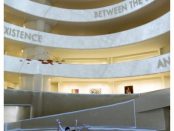
The title comes from T.S. Eliot’s "The Hollow Men," the one that famously includes the line: “This is the way the world ends/Not with a bang but a whimper” - which is exactly how Falls the Shadow ended, the dancers swirling off to the borders of the Rotunda performing space after a series of meetings and partings that too often found them lying in geometric patterns on the floor, their arms spread out in cross forms or moving their limbs in unison to produce a Busby Berkeley effect. (The audience stood above the action on the ramps, looking down.) The two couples rarely mixed and matched, but did occasionally form lineups that wound up dragging the unlucky fourth dancer who was face down on the stage. The actual movement palette was limited to walking, soft arabesques, rolling on the floor and some hip-level lifts, all repeated too many times.
[more]
Ms. Zelman-Doring’s cryptic scenario of deeply close twin siblings (Ana offers to masturbate Simon when he is tied up in a chair) is out of Sam Shepard and her dialogue is a pleasing cross between Harold Pinter’s spare eloquence with flourishes of Christopher Durang’s silliness. The abrupt and inconclusive conclusion is in keeping with what went before it.
[more]
Performed by The Bats, the resident company of The Flea Theater, the world premiere of "Inanimate" is the inaugural production in their new home on Thomas Street, between Church and Broadway, several blocks south of their original premises. Performed in The Siggy, named after founder and patron Sigourney Weaver, a house with 46 permanent seats, it is the first of the three new theaters to open prior to the complex’s grand opening on September 28. It has been given a sharp, assured staging by director Courtney Ulrich with engrossing performances by its cast of seven.
[more]
As in one of Alan Bennett’s "Talking Heads" monologues, Stapleton offers a richly detailed portrait of an ordinary person that revels in the mundane. She also adds the arresting device of having the inner life of the cow depicted in fantasy sequences.
[more]
Mr. Klingenstein beautifully and simply renders his fictional account with exquisite detail and emotion. Klingenstein’s dialogue is precise and filled with sharp epigrams. It’s all a genteel and moving exploration of the human condition. A lovely highlight is Ann and Samuel recreating portions of the Lincoln-Douglas Debates of 1858.
[more]
Exquisitely produced by the Mint Theater, Jonathan Bank’s direction is leisurely and slow, which undercuts the theatricality of all but the last and the most satisfying one, 'The King of Spain’s Daughter," originally given four separate stage productions at the Abbey from 1935-1939 and two in London in 1939. Using a company of seven, the actors appear in varying combinations while all appear in the third play, "Holiday House. " Two of the plays end too abruptly calling out for a more substantial length, while one of the plays seems to go on too long.
[more]
Billed as a “bio-epic,” playwright Zachary Desmond emphasizes the epic in his uneven though compelling approach. Mr. Desmond affectionately imparts biographical details of Einstein’s life from youth to old age. Particularly captivating are the sequences depicting his courtship and marriage to his first wife, mathematician Mileva Marić.
[more]
Nora Sørena Casey’s "False Stars," part of this year’s Corkscrew Festival at the Paradise Factory, starts slowly but gradually grows more involving as all the interconnections between the characters slowly reveal themselves.
[more]
Much of the play is like an odd synthesis of 1960’s theatrical satires. There are absurdist shades of Murray Schisgal, Elaine May, and particularly of Jules Feiffer's "Little Murders," laced with Paddy Chayefsky’s lacerating tirades. It eventually becomes clear that it’s meant to be overblown and not at all realistic, and at times is hilarious. A zany Reform rabbi’s irreverent diatribe on faith, and a Darth Vader sight gag are hysterical highlights. Then there’s the girlfriend’s unsettling, casual disclosure that she’s had a double mastectomy. It all recalls the provocatively dark humor of Larry David.
[more]
Projected titles indicate place and year—beginning with Arles, 1888 and progressing until van Gogh’s suicide—which we hear as an offstage gunshot—in July of 1890. The audience is treated to Vincent’s thoughts on his painting technique, his poverty, his mental health, his fellow artists, stars, sunflowers, all interrupted by chamber music by Debussy, Fauré, Chausson and Franck played—in various combinations—by Henry Wang (violin), Yuval Herz (violin), Chich-Fan Yiu (viola), Timotheos Petrin (cello), Max Barros (piano) and Renana Gutman (piano).
[more]
But Cohen the composer is another matter entirely--his jazz-inflected songs make "Come Light My Cigarette" a gem of a chamber musical. As more and more of the songs are revealed, time and again one is reminded of "Trouble in Tahiti." And like that classic Leonard Bernstein opera, "Come Light My Cigarette" appears to be set in the 1950’s, which the music evokes. So do the busy but impressive set and costumes, both designed by Craig Napoliello.
[more]
The songs never come up to the title song made famous by Marlene Dietrich who’s mentioned several times during the play. Antin’s attempt at playful seduction, “Take Me Home Tonight,” sung by the half-dressed cabaret girls and his German-style drinking song, “Fill My Stein with Beer” are pleasant pastiche, but “How Can Germany Survive?” (sung by the beleaguered Willi) and “Time to Stand Up” (sung by Josef) are heavy-handed and obvious. The lyrics throughout, even in the love songs are of the “moon-June” variety, but, as mentioned, are sung with great feeling.
[more]
Watching Evans being bossed around by the tall beanpole Russel Norris, whether in an office job, cleaning a park or waiting on tables, was to watch classic comedy performed with brilliant, but invisible timing. (Credit choreographer Tyler Holobaski for his seamless contributions.)
[more]
Having a background in dance accounts for Gelman’s mesmerizing staging that is filled with finely choreographed sequences. Characters take showers onstage with actual water cascading on their nude bodies and there are stylized, brief simulations of sex that are suggestively erotic. Numerous, arresting tableaus silently emit significance. The actors all give bold, brave and intense performances that transcend stereotypes.
[more]
Antyon LeMonte, Honey Davenport, Jay Knowles and Kevin Aviance in a scene from “Trinkets”
[more]
While the three plays in Summer Shorts 2017: Festival of New American Short Plays – Series B have been given proficient productions each seems ultimately unsatisfactory. All seem like first drafts rather than completely fulfilling their potential. The three authors could learn a lesson from the three plays in Series A which all hit their marks. Interesting experiments but failures nevertheless.
[more]
Set in a California, Bay Area high school, there we meet the four students who prattle on in contemporary lingo. Gradually, and without any explanation we learn that they are witches. An episode of Bewitched has more background information. After 30 minutes, a semblance of a plot emerges, a run for class office. Eventually it is revealed that the candidate running was raped over the previous summer at an off campus party where alcohol was consumed by her male opponent. This past event becomes the play’s main focus.
[more]
Bruce Norris’ "A Parallelogram" endeavors to explore some sobering facts about the effect of the future on the present and responsibility to others. Unfortunately, the play ends up being laborious and tiresome - without being revealing or challenging. Too many of the fantasy elements have not been worked out so that much must be taken on faith or not considered. Norris wants to say something deep but this 2010 play having its belated New York premiere is more confused than meaningful.
[more]
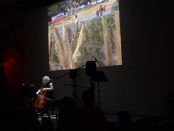
Interestingly, some of the most raucously explicit material of protest came not from the Peace and Social Justice Concert 24 but from the Wil(helms/liams)burg Concert 26, a collaboration of musicians and performing artists from Brooklyn and Hamburg, Germany. In the opening work, "Trumpen," for clarinet, piano, cello and laptop performers, Georg Hajdu created a piece based on the destructive and fracturing words of Donald J. Trump. This piece introduced the Unheard-of//Ensemble – Ford Fourqurean/clarinet, Daniel Anastasio/piano and Thea Mesirow/cello – who played throughout the concert, demonstrating remarkable technical control and versatility; this group “is a contemporary chamber ensemble dedicated to the development and performance of new music by living composers.” In "Trumpen," Trump’s words are altered and devolved into an ever-increasing intensity of chaos; the audience is witness to the mess – and is part of it as well – as this replicates political protest at its best, at once ancient and contemporary.
[more]
n light-hearted Rationalize (concert 27), composer Cody Brookshire combined found and manipulated sounds created by the audience with live music on bass clarinet and marimba. Brookshire created SynkroTakt, an audio streaming technology. Before the piece began, the composer instructed the audience on the seven-step procedure required to enable their devices to create sounds streamed into synchronous audio tracks; the audience, in this way, became the collective ‘artist/musician’ and provided one half of the ‘duet’ of electronic sounds and live instruments. The result was an unexpectedly sweet and pretty piece, a bauble in which sounds produced by an unusually concocted combination of chance and intention became a contemporaneous agent of creativity.
[more]
In spite of the Festival’s lengthy booklet and daily concert updates, the rich creative vitality of the electroacoustic musical community remains only tangentially documented: composers and performers clearly work in close collaboration. Internationally recognized cellist Madeleine Shapiro, for instance, director of the important NewMusicMannes ensemble at the New School’s Mannes College of Music, is on the NYCEMF 2017 Steering Committee, and performed in several of the 2017 Festival’s concerts. She is clearly the sort of artist who can turn her instrument into both the composers’ muse and their servant. Shaprio’s ability to incorporate the cello’s entire history into its creative use in contemporary classical and experimental music suggests expanded incorporations of cello sounds in new music to contemporary composers.
[more]
Stephen Kaplan’s "A Real Boy" is about a pair of puppets, named Peter and Mary Ann Myers, who adopt the eponymous child named Max, and it proves about as preposterous as such a premise suggests. It isn’t helped by director Audrey Alford’s often awkward staging, or by a muddled and confusing conclusion.
[more]
Mark Finley, the director, knew enough to keep the play charmingly low-key with just enough animated physicality to illustrate the story. Finley clearly understood all of Strothmann’s best qualities as a storyteller and how to keep him on his toes as an actor and memoirist.
[more]
The revival at the York is being seen in yet a new version of the show that began as a cabaret in 1981 and went to Broadway in 1985. Created by director Larry Alford, choreographer Wayne Alford and composer Herman, the original show included new songs written especially for the show, only one of which remains in the revival. However, as directed by Pamela Hunt ("The Musical of Musicals"), this version of "Jerry’s Girls" organizes the songs more faithfully by around each show and includes the greatest hits from "Hello, Dolly!," "Mack and Mabel," "Milk and Honey," "Mame," two numbers from "Dear World," and ending with a medley from "La Cage aux Folles." Along the way are also two unfamiliar numbers from Herman’s 1960’s revue "Parade."
[more]
In the seven concerts of the second half of the 2017 New York City Electroacoustic Music Festival held this month at National Sawdust in Brooklyn, New York, the full diversity and eclectic versatility of electroacoustic music was on vibrant, energetic display; the densely packed weekend of music was exciting, sometimes disconcerting and sometimes thrilling, and always fascinating. Sixty-six works by sixty-six composers were performed … a dizzying array of instruments, equipment, performers, sensibilities and effects!
[more]
While the dialogue offers some stabs at humor and Opel--a first-rate comedienne of the old school--usually excels at comic timing, much of it falls flat here. Most of the 90-minute, intermission-less piece focuses, naturally enough, on Bobby’s attempts to create a new life for herself, ultimately meaning a new relationship. It’s during her second visit with the shrink that he says, “I’m making getting laid a medical directive”-- to which Bobby replies, “Can you do that?” effectively ending the scene.
[more]
«
1
…
39
40
41
42
43
…
64
»
Copyright Jack Quinn, 2001-2026