News Ticker
- April 7, 2026 in Musicals // No Singing in the Navy
- April 7, 2026 in Off-Broadway // Uncle Vanya, scenes from country life
- April 7, 2026 in Off-Broadway // The Last Audition
- April 2, 2026 in Columns // THE EXPLOSIVE GROWTH OF FILM AND TV PRODUCTION FACILITIES IN THE NEW YORK / NEW JERSEY AREA
- April 1, 2026 in Musicals // Gotta Dance!
- March 31, 2026 in Off-Broadway // Jesa
- March 30, 2026 in Musicals // Monte Cristo
- March 30, 2026 in Off-Broadway // The Unknown
- March 30, 2026 in Off-Broadway // Antigone (This Play I Read in High School)
- March 30, 2026 in Off-Broadway // Antigone in Analysis
- March 29, 2026 in Off-Broadway // Bughouse
- March 28, 2026 in Musicals // The Paparazzi
- March 27, 2026 in Broadway // Giant
- March 26, 2026 in Off-Broadway // Ivanov
- March 25, 2026 in Musicals // Blood/Love
- March 24, 2026 in Off-Broadway // Touch
- March 24, 2026 in Music // The Silent Serenade
- March 23, 2026 in Musicals // The Wild Party (New York City Center Encores!)
- March 22, 2026 in Broadway // Every Brilliant Thing
- March 22, 2026 in Multimedia // Burnout Paradise
- March 20, 2026 in Musicals // Chasing Grace
- March 20, 2026 in Off-Broadway // Entangled: 12 Scenes in a Circle K off the I-40 in New Mexico
- March 19, 2026 in Off-Broadway // Trash
- March 17, 2026 in Concerts // The New York Pops: “United in Sound: America at 250”
- March 17, 2026 in Musicals // Bigfoot! A New Musical
- March 14, 2026 in Off-Broadway // Spare Parts
- March 14, 2026 in Off-Broadway // Zack
- March 13, 2026 in Off-Broadway // Dear John
- March 10, 2026 in Off-Broadway // Our House
- March 10, 2026 in Off-Broadway // Body Count
- March 8, 2026 in Off-Broadway // Chinese Republicans
- March 7, 2026 in Off-Broadway // The Mall The Mall The Mall
- March 7, 2026 in Off-Broadway // The Reservoir
- March 1, 2026 in Off-Broadway // Marcel on the Train
Archive
Filichia has had a long and storied career as a theater critic and author of several books on the topic. His having witnessed a multitude of productions, this immersion informs "God Shows Up"’s fine structure and technical command of playwrighting. The bouncy dialogue has Shavian passages and the expertly defined characters make terrific roles for actors to play.
[more]
The play is a thoughtful and illuminating look at the attractions and perils of a career in adult entertainment. Lauren’s story is a cautionary tale, yes, but the underlying attitude of the play is “sex positive.” Heckler and her associates do not shame Lauren/Scarlett for choosing to be open and unashamed about her sexuality. Yes, they show that a life in porn can be a dicey and occasionally harrowing proposition, brimming with a high quotient of misogynistic and generally creepy behavior. However, the focus is more on Lauren’s naivete about just how closed minded and judgmental the people around her will be about her decision—even when they are themselves avid porn consumers.
[more]
In recent years the play has not fared with such acclaim. A 2008 Broadway revival starring Frank Langella eliminated the narrator character of The Common Man, the play’s cleverest device, and was not well received. Now Fellowship for the Performing Arts has brought the play to the Theater Row’s Acorn Theatre directed by Christa Scott-Reed, who also staged FPA’s revival of Shadowlands last season. Unfortunately, the academic and unimaginative production fails to bring the ideas and the tensions in the play to a boil.
[more]
The two directors/founders of BalletBoyz, Michael Nunn and William Trevitt, directed and photographed the film which also included Pérez’s choreography. Although the movie certainly illuminated the dark themes for a screen-crazy audience, it too often was a distraction when the dancers were performing in front of the screen, spread out across the Joyce stage. Having to choose between the live and the filmed action became a problem even though both were of equal technical merit.
[more]
Part of the tradition is the audience’s response. There was hooting and hollering from the audience, sounding like they were at a rock concert, but it was impossible not to get caught up in the enthusiasm. The general raucousness was a display of the clear delight that the audience enjoyed. It created an atmosphere of unbridled joy and who could resist? Everyone was smiling and laughing and clapping.
[more]
Having seen it at least four times before, I can say with certainty that Sam Shepard’s "True West" (1980) is a firm and solid play: a play to be pondered both while you’re watching it and afterwards, when you consider what you saw. But the current Roundabout production leaves more than just a little to be desired: it’s slow and plodding and contemplative, instead of explosive, which is what it’s designed to be.
[more]
Comprised of 27 short scenes in two parts that are each designated as being two acts and ranging from 1945 to 1954, "The Glen" is a stewpot of a play inspired by a real person’s life. Glenn Loney (1928-2018) was a drama critic, college professor and author. Mr. Loney’s friend, the play’s author Peter B. Hodges, states in his program note:
[more]
Directed with touching simplicity by Henry and choreographed with a lyrical flow by Lorna Ventura, this Anne tells the well-known story utilizing a combination of voiceover readings, projections, dance, mime and fine acting. Henry has turned Anne into a dance play with an original take on this oft-told tale of a spunky, intelligent and witty young lady guarded by a mute Greek chorus of four who reflect and illuminate her inner thoughts and feelings.
[more]
In three acts, we get idealized Norman Rockwell-style Americana. As in his dramas, O’Neill’s sense of structure is totally idiosyncratic. Ah, Wilderness! is shorter than his dramas but still feels long at two hours and 40 minutes with an intermission but it is absorbing nonetheless. That’s due to its novel perspective. Instead of the cheapskate father and drug addict mother in Long Day’s Journey into Night, we get idealized perfect parents. The young hero here is set on a path of moral rectitude rather than dissolution. O’Neill offers an uplifting fantastical reworking of his well-documented grim upbringing where everything for a change is happily resolved.
[more]
Director John Collins made the more than seven hour running time a breeze with his attention to detail, moving his cast of office workers/Gatsby characters with such naturalness that, as each denizen of this weird space was drawn into a speaking part, it seemed organic and smooth, as well as quite amusing, beginning with Scott Shepherd who, as the first person to pick up the book, took on the character of its narrator Nick Carraway who tells the story, which takes place in 1922, from a future vantage point. Shepherd, who was in it from first to last, deserves the biggest kudos for keeping Gatz afloat with his calm demeanor and quietly stylized readings.
[more]
"We’ll Have Manhattan: Rodgers & Hart in New York," created and narrated by the soon-to-become Broadway’s Tootsie (in the new Broadway musical), Santino Fontana found most of its emotional heft in the sad story of the partnership of the efficient Richard Rodgers and the foot-dragging Lorenz Hart who found himself, a not handsome gay man, in the wrong time and place. Hart had little personal happiness, it seems, but his songs were certainly full of gaiety and wit.
[more]
These two mild points aside, Jaffee’s script is nevertheless hugely successful in conveying this man-vs-nature clash; his use of clever dialogue and idiosyncratic characters keep the topic in the forefront with much humor and without any preachy heavy-handedness.
[more]
Though not in the same class with Alan Jay Lerner’s masterpiece, "My Fair Lady," "Carmelina" has a similar theme: how a young woman reinvents herself. While the three soldiers are under the impression that they invented Carmelina Campbell in the classic Pygmalion and Galatea fashion, in fact Carmelina has reinvented herself, also a major theme in the Lerner canon, along with "Coco" and "Dance a Little Closer." This charming musical comedy also features a Tony Award nominated score which deserves a second and a third hearing.
[more]
There are many dimensions to Ray Yamanouchi’s "The American Tradition," directed by Axel Avin, Jr. for the New Light Theater Project. On one level, it’s an adventure story about a daring attempt to escape from American slavery. Eleanor (Sydney Cole Alexander) and Bill (Martin K. Lewis) are an enslaved married couple in the antebellum South. When they learn that he is about to be sold and separated from her, they seek a way to escape to the North. Eleanor proposes a wild scheme: A relatively light-skinned woman, she will disguise herself as Evander, a white male slaver. And Bill will pretend to be Evander’s slave and traveling companion.
[more]
The Brooklyn-born Quinn has been performing stand-up since the 1980’s and his seasoned wise guy New Yorker persona was once showcased on Saturday Night Live and in recent years in several theater pieces. Clad in a plaid shirt, black jeans and sneakers, this show business veteran uses his tuneful gravelly voice with its cadences of the streets to optimum effect. His material is a model example of superior comic writing. Bursts of perfectly crafted one-liners constructed in the classic form of set ups and punchlines, skillfully composed observational riffs and occasionally addressing audience members directly, all sustain "Red State Blue State"’s 75 minutes.
[more]
While Jessica Dickey’s "The Convent" may not have any new answers and may cover familiar material, it does so with such vitality and theatricality, that it becomes a memorable experience. Under the direction of Daniel Talbott, the seven actresses led by Samantha Soule and Wendy vanden Heuvel are compelling and expressive. By the time the play is over, the audience have experienced much that the inmates of the retreat have gone through.
[more]
Playwright Stephen Belber offers an intricate character study comprised of a barrage of brief nonlinear scenes chronicling the eventful existence of a woman from childhood to the age of 62. With the craft and depth of a fine novelist, Mr. Belber creates a mosaic of pointed incidents imparting vital information. These pass by rapidly with no discernable shape but then at the conclusion everything majestically falls into place.
[more]
Casual strolling was suddenly punctuated by dancers bumping and grinding at each other, these full-bodied movements resonating in slightly different ways in each dancer, sometimes leading to entwining, slithering, sweaty duets. Faces displayed over-the-top grimaces and uneasy forced smiles which led to desperate, phony-sounding laughing. Arms were swung or used to produce angular silhouettes with studied nonchalance. Bodies twitched and twisted to staccato beats—music composed and arranged by Ori Lichtik whose score for “Love Chapter II” began with barely audible electronic beats which grew in volume and speed until the score suddenly became a Latino Cha-Cha to which the dancers seemed to glory.
[more]
Similar to a flatly serious youth exploitation flick circa 1970, playwright Phoebe Nir’s utopia-in-the-wilderness yarn "Eco Village," is likeably inept. There’s a hallucinogenic drug dinner party sequence that’s out of late Otto Preminger when he was painfully trying to be with-it that has bursting strobe lights and a female dominatrix in full regalia. The whole thing has a trippy "Gilligan’s Island" vibe combined with turgid writing and overacting. The elaborate rustic set is spectacular which helps.
[more]
At the center of "Secret Identity" is Keith Weiss who plays JT. The proverbially baby-faced Mr. Weiss is physically, emotionally and vocally entrancing. With his rumbling low voice and expressive imposing physical presence, Weiss truly takes on the character exhibiting the pathos of the outsider. He casts off sullenness to deliver some amusing Robin Williams-style antic riffs while doing impersonations of teachers. His contorted manner when observing Trey disrobe speaks volumes about how JT feels. Weiss is onstage virtually the entire time and his performance is a chief measure of the play’s success.
[more]
Adapting Broadway shows for "live" TV is never easy. And this production was hampered by some extraordinary bad luck. One of the stars, Brennin Hunt, ("Roger") broke his foot at the last minute, and they wound up broadcasting a tape of the dress rehearsal--instead of televising a "live" performance--for much of the night, Only the final portion--which hit home hardest-was actually airing "live." And that may well account for some of the muted energy that bothered me--the fact that we were watching a videotaped dress rehearsal. Some actors may well have been "saving something" for the anticipated live broadcast, It felt like that to me, anyway.
[more]
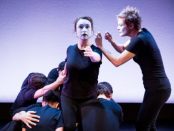
Broken Box Mime Theater’s SKIN is a collection of short plays loosely centered around its one-word title. The pieces run the gamut in terms of subject matter, approach and tone. Or course, many theatergoers may have an implicit bias against the very idea of mime. This is understandable if unfair. Mime has long been viewed by many, in the U.S. anyway, as little more than pretentious preening and outsized gesturing by grimacing folks in clown makeup. More often than not, it’s seen as a joke. But this show has a fun, cool, buoyant vibe that reminds audiences that the genre needn’t be just a punchline, but something that can actually pack a punch.
[more]
Amidst the flamboyance, Mr. Calderon significantly explores topical issues. The depiction of post-traumatic stress disorder, the eternal dramatic clash between brothers and the plight of the underclass are all vividly realized through his markedly delineated characters. His heady dialogue laces the vernacular with shrewd insights. The final scene arguably gets carried away with symbolism and luridness but what came before has been quite stimulating.
[more]
Six actors, three men and three women, in a company of seven, play many roles in this fluid production designed by Anna Driftmier that uses several different doorways, on-stage props and furniture that is rolled out swiftly to tell Ann’s story from age 16 in 1828 to her untimely death at 66 in 1878. Jessica O’Hara-Baker is a towering Ann Lohman, aka Madame Restell, level-headed, goal-directed yet humorless as she sees a need and methodically goes about taking care of it, caring little for the mores of times or proscribed women’s roles. Narrated by Ann and including newspaper headlines read by the other cast members as well as period songs of 19th century ballads sung and played by the company, "Wickedest Woman" begins with her 1848 trial which is interrupted repeatedly in order to tell the story in chronological order.
[more]
Manning’s direction and script are both expertly crafted. The play’s moral questions are cleverly woven into each of its fully-dimensioned characters’ words, and their tales are often presented without bias, leaving the audience to draw its own conclusions. The actors find their full potential in this play, each one as compelling as the next, filling their portrayals with humor, earnestness and passion; they listen to each other in every moment and are a joy to watch.
[more]
Humorist and journalist Calvin Trillin has made his wife Alice Stewart Trillin, educator, writer, mother and muse, famous from such books as "Alice, Let’s Eat," "Travels with Alice" and "Family Man." When she passed away in 2001, many readers felt they knew her well enough to send Trillin condolence notes. His acclaimed 2006 memoir, "About Alice," introduced her to a wider audience. Now Theatre for a New Audience has commissioned Trillin to dramatize the book as a two hander under the direction of Leonard Foglia. The play with Jeffrey Bean as Calvin and Carrie Paff as Alice is quite charming but Alice herself remains elusive.
[more]
The lit pumpkin on a ledge in the living room aptly suits the title of "Trick or Treat," a new play by Jack Neary. But despite the skeleton positioned on yet another shelf, the play’s title refers to more than just Halloween, as the plot that unfolds is full of reversals and shocking developments that keep tricking you into thinking that you know what’s going on, and treating you to some characters who don’t. It isn’t until the very end that you apprehend a story you thought you were following all along. There are startling surprises all along the way.
[more]
Conceived and directed by Coral Cohen, along with musician/composer Zoë Aqua and the cast, Threads illuminates the experiences of a large swath of the Jewish population, beginning with a warmly related litany of genealogy delivered by the five fine performers: Hannah Goldman, Lea Kalisch, Luisa Muhr, Daniella Seidl and Laura Lassy Townsend. In turn, each tells of her background, the individual stories adding up to a portrait of the extent that Jews were forced to travel the world to find homes, particularly before, during and after World War II.
[more]
Obviously, this is a play for which any sort of a happy ending will be deeply compromised, but what Simpson does so beautifully is show us how these women overcome their suspicions and envy to find support in one another. It’s tempting for playwrights to work toward such an end by wallowing in sentimentality. However, it never seems that Simpson, Robert or the talented women portraying these characters are pulling frantically at our heartstrings. The plot unfolds simply and satisfyingly, with the characters’ behavior always plausible and unforced. Surprising moments of humor serve as grace notes to an otherwise somber story.
[more]
Though exhibiting its source material’s young adult sensibility, Ally Sheedy’s highly effective stage adaption is totally absorbing for adults as well. Ms. Sheedy shrewdly captures the sense of an adolescent’s voice and structures the presentation as a collection of pointed vignettes flowing from one to another, skillfully imparting personal and historical details.
[more]
All four works—particularly the first three—had a certain offhanded similarity, a lack of formal movement ideas and construction, but all four choreographers are clearly students of the school of Jiři Kylián, the most famous director of the NDT whose incredibly musical, minutely detailed choreography has influenced many both in Europe and here in the United States. Kylián’s works have a touching humanity to them, while these four works tended more to movement for its own sake and arbitrary expression of emotions.
[more]
Irish actors Niall Buggy and David Ganly returning to their original roles play two murderers sharing a cell in Dublin’s Montjoy Jail. The fiftyish PJ (Ganly) and the sixtyish Christy (Buggy) alternate in their tales, eventually becoming one story. One has committed a crime on impulse and can’t even explain why he did it. The other committed a revenge killing, just like one that killed his father when he was a child watching through the front window. Growing up in a suburb of Dublin, PJ tells us he was an only child with a much loved mother. At seminary, he becomes hopelessly infatuated with a younger fellow seminarian “shining with beauty.”
[more]
Ireland gives a big performance that is almost larger than life. From the moment we meet her, she commands the stage. Watch how intently she listens to the others or how you can hear her thoughts clicking away as to how to avoid the rules she doesn’t like. It is almost exhausting following her as she is always doing something with her hands, her body, her voice, her total instrument. This is the sort of complete theatrical commitment that makes legends and would be dangerous for an unstable performer. Try taking your eyes off her while she is on stage – you simply can’t do it. However, unlike her Alma Winemuller in last season’s "Summer and Smoke" where she made all of the other characters disappear, her Alison is held in check by the other actors who have their own axes to grind, pun intended.
[more]
“Emmenez Moi” was the stirring opening number performed by the French Ms. Constant as she majestically strode through Don’t Tell Mama’s cabaret room and onto the small stage. With her expressive enchanting singing, engaging playful presence, upswept flowing blonde hair and clad in a slinky glittering black sequined dress, Ms. Constant was a vision of star quality.
[more]
This setting and premise alone might suggest quite a dull evening of theater, except for the fact that from the moment these actresses converge on the stage, the subtle energies of their characters begin to intertwine and negotiate for space and position, piquing the interest of the audience.
[more]
Breen's script, a succession of rapid-fire vignettes divided in half by an unnecessary intermission, tries to compensate for its lack of depth with imagined multitudes. According to a promotional flyer, the production's six actors portray a total of sixty-two characters. While I feel confident enough in my counting abilities to verify the former, I'll leave the latter to someone whose obsessiveness exceeds my own. That person might also have to be a little generous in regards to defining what constitutes a character.
[more]
Of Passloff’s eight works, the newest, “Frolic,” (2018) to music by Erik Satlie (“Trois morceau en la forme de poire”) came closest in spirit to her classical ballet origins, utilizing whimsical characters to tell a gentle daydream. To the calm music played live by pianists Michael Cherry and Douglas Schultz, a gentle Ballerina (Esmé Boyce), a boisterous, muscular Joker (Aviles), a sassy Horse Trainer (Pam Wess), two cavorting Horses (S. Asher Gelman and Mati Gelman) and a caring Mother (Charlotte Hendrickson)—all costumed in appropriate, colorful outfits—danced solos and duets, finally uniting for what—in minimalist terms—was a grand finale complete with cartwheels, simple ballet steps, horsey prancing, and the entire cast competing for attention from the rapt audience.
[more]
An exhilarating trio of short plays by that noted cultural provocateur Neil LaBute make their New York City premieres in this edition of the LaBute New Theatre Festival 2019. Since 2013, the St. Louis Actors’ Studio with the support of Mr. LaBute who is an acclaimed film director, screenwriter and playwright has held an annual festival of one-act plays. This incarnation is unique as it is comprised solely of works of his which is probably why it is so potent.
[more]
Eve Wolf’s play is essentially a monodrama, with John Noble portraying the title character. The production is a rich one, both visually and aurally. It features an abundance of live music, performed by a vivacious string quartet (violinists Mari Lee and Henry Wang, violist Matthew Cohen, and cellist Ari Evan), along with a pianist (Zhenni Li) and a trumpeter (Maximilian Morel). In addition, excerpts from historical recordings are heard. Meanwhile, extensive animated projections from designer David Bengali become central to the overall effect. The play is a kaleidoscopic, sense-stimulating experience that seems at times just to avoid becoming a three-ring circus.
[more]
She encouraged me to dream big, grab opportunities when they came, and work full steam--and not to wait, because none of us know how much time we have. (I thought she'd live forever.) When she decided it was time to write her memoirs, she asked if I could meet with her. She told me she wasn't a writer, she couldn't possibly write a book by herself, and asked if we could do an "as told to" book together, with her telling me stories which I could put into book form.
[more]
A spirited cast and a talented director do their best to bring playwright Katelynn Kenney’s heartfelt but leaden "Wendell & Pan" to the stage. It’s an unsatisfying family secrets drama laden with allusions to "Peter Pan." The mystical revelatory sequence near the end and the protracted coda magnify the previously flawed writing. Tinkerbelle is represented by a flickering firefly in a glass jar and when released does cause a lovely effect.
[more]
Now playing at the MTC’s Samuel J. Friedman Theatre on Broadway, "Choir Boy" is set at The Charles R Drew Preparatory School for Boys, a Catholic academy for young men of color. Written by Tarell Alvin McCraney (who shared the 2017 Academy Award for Best Adapted Screenplay for Moonlight), the problem with the play is that Pharus’ colleagues and choir mates prove as generic as the student uniforms they all wear: blue blazers, white shirts, striped ties, and beige trousers. (The costume designer is David Zinn, who also did the scenery.)
[more]
Theaterscene.net is deeply saddened to report the passing of the legendary Carol Channing. Channing died at 12:31am on Tuesday, January 15th, 2019, at home in Rancho Mirage, CA of natural causes.
[more]
Whether being pushed in a wheelchair or hobbling around on a cane, Mark Peters is an excellent Lear. Mr. Peters forcefully captures all of the character’s pathos, humor and despair with his mature presence and rich vocal delivery. As The Fool, Judy Krause’s clowning and feistiness is delightful. Ms. Krause and Mr. Peters’ marvelous rapport energize the production, hinting at the tantalizing possibilities of an even further stripped down treatment focusing more on these two characters.
[more]
Do you have any objection to being touched?” asks the theater representative of audience members when they check in at the Brooklyn basement where British playwright Dan Ireland-Reeves’ "Bleach" is performed. That question is crucial as one attendee is called upon to silently portray a flashback character who has slight physical contact with the actor, and another gets a brief grinding lap dance. Those who state a negative preference are left alone.
[more]
The four choreographers whose three works were represented at the Japan Society’s Contemporary Dance Festival: Japan + East Asia flung themselves headlong into the modern world of dance with only occasional glances over their shoulders at their ancestors-in-art, preferring what often appeared to be an arbitrary approach to choreography uneasily alternating between coy, fey bits of choreographic fluff and sudden primal screams. Only the final work on this occasionally interesting, but flawed program displayed some understanding of this concept of the inexorable march of time and its effects.
[more]
We felt like we toured the world this past weekend without ever leaving New York. It was a
[more]
Mr. Brader’s writing on this fascinating subject is sharp, insightful and well-observed. As a performer, Brader’s breezy personability endows his personal odyssey with an appealing everyman quality as he appears as himself and impersonates various other characters. At 80 minutes, the show is overall compelling. Cold turkey, gradual cessation, hypnosis and bicycle spinning are all attempted to stop with varying results.
[more]
The supernatural scenario is a little like something one might find on an eerie episode of Alfred Hitchcock’s old TV anthology. Unfortunately, it all comes off as fairly stilted and heavy-handed. This is due in part to some of the flowery language that Nogueira uses (“I have the strength of a river to drown my sobbing heart with a loving rage”). But it also has to do with Ortman’s direction, which eschews realism in favor of a highly self-conscious theatricality.
[more]
Translator Shane Baker has found excellent Yiddish equivalents for Beckett’s language. He understands that Yiddish is a minor key tongue full of sadness, quicksilver tone changes, perfect for expressing the constant complaints that fill the libretto of Godot. Of course, it is Beckett’s language that passes the time with its casually tossed off deep observations of the human condition in the guise of flippant or quasi-philosophical comments.
[more]
No one loves Berlin's music more than I do. But the creators of this stage adaptation have tried to jam too many well-known songs into the show. I think that cutting a couple of the songs, and letting characters talk a bit more would give the show a more natural feel, and give it some needed moments to breathe. And help us bond more with characters. And if you want to add a song to express the characters' feelings, pick the very best songs for the scene--not just the best-known songs.
[more]
Mr. Brader is an engaging and soulful performer with a smooth and pleasing vocal delivery. Brader is an admirer of Spalding Gray and channels that monumental artist’s impassioned sense of storytelling. As a writer, he offers a vividly candid but somewhat flawed treatment of his explosive autobiographical material. Arguably a tauter and more focused scenario would flow more effectively. Still, Spitting in the Face of the Devil ultimately achieves redemptive impact.
[more]
Employing humor, documentary detail and suspense, Bachner offers an emotional detective story. Wit and whimsy meld with poignancy as the picaresque quest begins in present day New York City. It involves a gallery of characters, flashbacks. and often frustrating twists and turns, several of which are legal obstacles that impede such searches. Bureaucrats, a celebrated “adoption hunter,” the adopted parents and other key figures are all imaginatively incorporated into the narrative. Bridgforth is vocally and physically titanic as she switches back and forth between being Susan and playing the other characters with grandly distinctive characterizations.
[more]
In the plus column, it was easy on the eyes. Scenic designer Lou Anne Gilleland created agreeable though not particularly elaborate sets: a rocky stretch of seashore for the first act and a gloomy ruined chapel for the second. Lighting designer Benjamin Weill gave us a kaleidoscope sky that turned lavender or red or some other dramatic shade, according to the changing moods of the story. And Gail J. Wofford and Quinto Ott’s costumes were bright and playful, especially the flouncy sleepwear (Queen Victoria’s Secret?) worn by the female wards of Major General Stanley, the operetta’s famed “Modern Major General.”
[more]
Our TheaterScene.net staff was very prolific in 2018. I'm proud of all their efforts and our site in it's 18th year as a home for long form independent arts journalism.
[more]
Brock’s work once prized effect over substance, but years of choreographing situation and character-based musicals ("Be More Chill," "Spiderman: Turn Off the Dark") have sharpened his artistic vision; or, perhaps, he has matured as he’s gained experience—and years.
[more]
While "Clueless, The Musical" is never less than slick and professional in the best possible way, for those who know the iconic film it offers no surprises so slavishly does it follow the original storyline. What was charming in the 1995 movie about Cher’s sense of superiority and wishing to help others less fortunate is no longer as acceptable. What was amusing in the era of excess now seems selfish, elitist, and an example of extravagant wastefulness. Alicia Silverstone’s appeal in the film doesn’t carry over to the musical where Dove Cameron, Disney star of Liv and Maddie, comes across as spoiled rotten by her wealthy single parent father who has given her pretty much everything she wants.
[more]
Nothing is what it seems in Jeremy 0. Harris’ startling and explosive "Slave Play" which investigates where race and sexual relationships intersect. What we have been watching in the play’s opening scenes is role playing on Day Four for Antebellum Sexual Performance Therapy, “designed to help black partners re-engage intimately with white partners from whom they no longer receive sexual pleasure.” These three couples have chosen to spend a week in this new treatment in order to deal with their "anhedonia" or inability to feel pleasure which has been a problem for them for some time.
[more]
"The Prom" is giving Broadway something it’s been lacking for years, which is a high-spirited, old-fashioned musical comedy, where the cast’s energy spills out over the footlights, and is then reflected in all the smiling faces you encounter as you leave the theater. It’s the equivalent of a standing ovation that moves out into the streets.
[more]
A five-day journey to Bear’s Ears National Monument in Utah in the company of other dancers, choreographers and Native Americans turned Gotheiner’s mind to more serious pursuits resulting in “Bear’s Ears” and “Detour,” two of his best works. Both display some influence of Native American dance forms, but only to focus Gotheiner’s creative energies on the emotional journeys of his dancers. Bear’s Ears is a national monument under attack by this government’s forces which want to open this area to mining and natural gas exploration, completely ignoring the deep spiritual associations with the Native Americans.
[more]
«
1
…
29
30
31
32
33
…
64
»
Copyright Jack Quinn, 2001-2026