News Ticker
- April 8, 2026 in Off-Broadway // Desi SNL
- April 7, 2026 in Musicals // No Singing in the Navy
- April 7, 2026 in Off-Broadway // Uncle Vanya, scenes from country life
- April 7, 2026 in Off-Broadway // The Last Audition
- April 2, 2026 in Columns // THE EXPLOSIVE GROWTH OF FILM AND TV PRODUCTION FACILITIES IN THE NEW YORK / NEW JERSEY AREA
- April 1, 2026 in Musicals // Gotta Dance!
- March 31, 2026 in Off-Broadway // Jesa
- March 30, 2026 in Musicals // Monte Cristo
- March 30, 2026 in Off-Broadway // The Unknown
- March 30, 2026 in Off-Broadway // Antigone (This Play I Read in High School)
- March 30, 2026 in Off-Broadway // Antigone in Analysis
- March 29, 2026 in Off-Broadway // Bughouse
- March 28, 2026 in Musicals // The Paparazzi
- March 27, 2026 in Broadway // Giant
- March 26, 2026 in Off-Broadway // Ivanov
- March 25, 2026 in Musicals // Blood/Love
- March 24, 2026 in Off-Broadway // Touch
- March 24, 2026 in Music // The Silent Serenade
- March 23, 2026 in Musicals // The Wild Party (New York City Center Encores!)
- March 22, 2026 in Broadway // Every Brilliant Thing
- March 22, 2026 in Multimedia // Burnout Paradise
- March 20, 2026 in Musicals // Chasing Grace
- March 20, 2026 in Off-Broadway // Entangled: 12 Scenes in a Circle K off the I-40 in New Mexico
- March 19, 2026 in Off-Broadway // Trash
- March 17, 2026 in Concerts // The New York Pops: “United in Sound: America at 250”
- March 17, 2026 in Musicals // Bigfoot! A New Musical
- March 14, 2026 in Off-Broadway // Spare Parts
- March 14, 2026 in Off-Broadway // Zack
- March 13, 2026 in Off-Broadway // Dear John
- March 10, 2026 in Off-Broadway // Our House
- March 10, 2026 in Off-Broadway // Body Count
- March 8, 2026 in Off-Broadway // Chinese Republicans
- March 7, 2026 in Off-Broadway // The Mall The Mall The Mall
- March 7, 2026 in Off-Broadway // The Reservoir
Archive
"The Rise and Fall, then Brief and Modest Rise Followed by a Relative Fall of…Jean Claude Van Damme as Gleaned by a Single Reading of His Wikipedia Page Months Earlier" is the brobdinagian title of a tongue-in-cheek, hour-long comic riff on the life of a faded movie star. The title is almost as long as the play. Timothy Haskell has written what is actually an extended elaborate skit brought to life by Joe Cordaro (perfect as a clueless Van Damme and other characters) and John Harlacher (hilarious as the all-knowing narrator) using puppets designed by co-director Aaron Haskell. The other director is Paul Smithyman who also designed the efficient conglomeration of a set which includes two podiums for the actors and a screen for the snippets of films and slides used to illustrate the story. In front of the screen is a slotted board into which the actors insert funny two-dimensional stick puppets.
[more]
Four appealingly performed single Manhattan roommates’ tangled romantic lives are depicted in the pleasant contemporary Off-Broadway musical, "Love Quirks," which has a rapturous score. Composer and lyricist Seth Bisen-Hersh’s striking melodies and literately crafted lyrics render the variety of songs with the polish of accomplished cabaret numbers. A standout is a gay male schoolteacher wryly ruminating while on a date.
[more]
The Mint Theater Company continues its three play mini-festival of the forgotten plays of Elizabeth Baker with "Chains." Given a polished – maybe too polished – production like the earlier "The Price of Thomas Scott," this play is also problematic, but in another way. Unlike her contemporaries John Galsworthy, George Bernard Shaw and Harley Granville-Barker, Baker’s "Chains" has a very narrow focus: the discontents of the lower middle-class white collar folk. All of the characters in the play’s first half (the script’s Act I and II) do nothing but either complain about the grind of their daily six-days-a-week jobs (half-holiday on Saturday) or laugh at those who would give up a steady employment. You would think that back in 1909 when the play was written there wasn’t anything else to talk about. Jenn Thompson’s direction is conventional and sedate where something more animated might have been more to the point.
[more]
Such an event is the high-tech adaptation at the Baryshnikov Arts Center calling itself "The Orchard," conceived and directed by Igor Golyak, described as based on "The Cherry Orchard" by Anton Chekhov as translated by Carol Rocamora. If you don’t know the play, you will be entirely at sea. If you know the play, you will marvel at all the totally unnecessary tricks used by the director that do nothing to help with understanding the play or ferreting out its meaning. Although the production has a fine cast headed by Mikhail Baryshnikov and Jessica Hecht, the actors are swamped by all the unnecessary trappings around them.
[more]
Originally broadcast on "Soul!," an early PBS program dedicated to showcasing Black arts and politics, Baldwin and Giovanni's one-on-one echoes contemporary concerns while also remaining decidedly of its era. Unearthed by a theater collective and other trapped-at-home artists during the pandemic for an online recreation, it has now been transformed again, this time into a staged adaptation titled "Lessons in Survival: 1971." In truth, "googled" is likely the more appropriate verb for how someone found the Baldwin-and-Giovanni conservation, since it is entirely available on YouTube, where, to be honest, it is best experienced, not least because in that digital form it can be rewound for another listen, which a few of Baldwin and Giovanni's complex, unannotated arguments definitely require.
[more]
For the company’s director, Peter Boal, this short season was a homecoming of sorts. He was a principal dancer in the New York City Ballet which calls the David H. Koch its artistic home. He left seventeen years ago and, since 2005, has been the PNB’s artistic director. Boal should have put more thought into the ballets he brought, at least those on Program A. Only one of three had heart and emotional depth and was gimmick-free. All three works by established choreographers showed off different facets of the skilled dancers.
[more]
In 'Circle Jerk," this cocky duo confidently preen, bray and cavort while donning various wigs and flamboyant costumes as multiple fey stock characters for over two numbing hours of their self-congratulatory twaddle. Their grating characterizations are achieved by intently staring into the camera, making faces, raising eyebrows and doing voices. It’s not "Your Show of Shows," but a niche audience of friends, relatives and trustafarians who could be amused by their antics. Cat Rodríguez appears in several female roles with campy flair.
[more]
Romy Nordlinger has written and is performing the monodrama, "Garden of Alla: The Alla Nazimova Story," at the TheaterLab. Directed by Lorca Peress, "Garden of Alla" gives us this eccentrically talented artist up close and personal. Nordlinger has a history of portraying Nazimova and has honed her interpretation to the point that it fits her like a second skin, helped by Peress’ sense of pacing and stagecraft.
[more]
Shekar’s script is extremely smart, funny at just the right moments, and morally gripping. Her characterizations of Ariel and Sanam are fully formed, uniquely individual and carefully complementary: Ariel is a crunchy-granola, bee-loving, single mom who’s desperate to prove Monsanto’s guilt, and Sanam is intense, strong-minded and honest to a fault. Through the character of Arvind, Shekar introduces the notion to Sanam that she and Ariel are looking at their study through the impartial lens of confirmation bias. The character of Dr. Hayes adds just the right amount of antagonism, almost sinister. Although there’s lots of statistics jargon in the script, it never impedes the progress of the story, thanks to the actors and director Aneesha Kudtarkar, who skillfully shapes the piece, finely intertwining the performances to maximum impact.
[more]

The new work on the program, a world premiere, was “Hope Is the Thing with Feathers” by Michelle Manzanales, choreographed to John Lennon & Paul McCartney, Bob Marley, Harry Woods and several others. Using ten of the Taylor dancers, Manzanales produced a work that was charming if a tad repetitious. Santo Loquasto’s pale costumes had an elegantly informal look. The dancers trooped on in a long line performing unison steps, lunges, leans and twists until movements moved sequentially down the line, mostly soft falls to the stage. In between these unison sections there were jaunty solos and quick duets that segued into group dances. The pop song soundtrack underlined the work’s informal feel. Manzanales certainly put the dancers through their paces. There’s nothing more appealing to an audience than a line of performers dancing their hearts out in unison! Her work shows promise but also is clearly the work of a novice. What the ballet had to do with the Emily Dickinson poem it came from wasn’t clear.
[more]
Comedian Sarah Silverman has turned her bestselling memoir, "The Bedwetter: Stories of Courage, Redemption and Pee," into a musical with the help of co-book writer Joshua Harmon, author of this year’s award-winning "Prayer for the French Republic," and composer Adam Schlesinger ("Cry-Baby"), who passed away in 2020 just as the show was about to go into rehearsal prior to the pandemic. The new musical, simply called "The Bedwetter," like the book is by turns amusing, first hilarious and later serious. Anne Kauffman’s production has a top-notch cast headed by Bebe Neuwirth, Caissie Levy, Darren Goldstein and Rick Crom.
[more]
Kaliski attempts a clever conceit marrying "The Oresteia" characters to the modern tragic story of the homeless hordes. Does "The Oresteia" provide an effective jumping off point to explore this timely and heartbreaking issue? Sadly, the answer is no. Kaliski has written a play whose subject matter is only tangentially connected to the characters Orestes, Electra and Clytemnestra who, in Greek mythology, lived in ancient Argos. Their stories of patricide and matricide and other ‘cides have no connection—emotional or situational—to the problem at hand and Kaliski doesn’t try very hard to splice the two subject matters together.
[more]
Tennessee Williams’ full-length play’s titles, characters and dialogue have been part of the consciousness since "The Glass Menagerie"’s 1944 premiere. During his peak years of the 1940’s and 1950’s, he also wrote many one-acts, exploring his familiar concerns, chiefly the naïve preyed upon by the worldly. "Five By Tenn" is an enchanting program drawn from these, which are uniformly satisfying. This modest Off-Off-Broadway production is presented by the Out of the Box Theatre Company, whose members are artists mostly over the age of 50. The show serves as an introduction to rarely performed obscure Williams works, all of which take place in drab bedrooms, and as a showcase for the talented mature cast.
[more]
The animated Aline Salloum fearlessly embraces all of Najaf’s unsettling complexities, delivering a riveting performance. In the early sexually frank verbal exchanges, Ms. Salloum marvelously recalls Elaine May’s matter of fact comedic brilliance. With his captivating boy next door presence, Erik Larsson as Drew offers a smashing characterization combining naiveté and Machiavellianism. As Josh and Ben, the equally commanding and personable Jalen Ford and Jake Bryan Guthrie wonderfully evoke boyish randiness and adolescent confusion. Though clearly not teens, this youthful quartet are totally and effortlessly believable in their roles.
[more]
"Mr. Parker," the latest play by Michael McKeever whose "Daniel’s Husband" has been produced twice Off Broadway, has been given a stylish production by director Joe Brancato who also directed the earlier play. David Goldstein’s one-room studio set situated in the East Village is elegant and cozy. The costumes by Myra Oney are chic. The acting by its trio of actors is polished and urbane. Even its premise of a gay man dealing with the sudden death of a long-time partner and husband is up-to-date and timely However, as written the play seems superficial and slight. Dramatically it avoids all the big scenes that might have been included. It remains entertaining but without the payoff one wants in such a drama.
[more]
Diriwachter is particularly skilled in writing working class vernacular. The Father and Tim speak the same language and he catches all the subtleties of decades of ups and downs. He also is wonderful with the two salesmen, cleverly finding the rhythm of their spiels that build up to the final pitches. His salespeople are written as clever but not unfeeling so that the audience never totally believes that the Father and son are being betrayed and cheated.
[more]
An import from the Edinburgh Fringe Festival, "Islander" embraces that renowned international jamboree's artistry and experimentalism, most notably by forgoing musicians for sound looping machines operated by Findlay and Tennick themselves. Especially for the technophobic (cough, cough), it's an extraordinary feat to witness actors become part of the production crew without the conceit ever feeling gimmicky or compromising the flow of the storytelling. That's no doubt due mostly to Findlay and Tennick's on-the-spot sound engineering abilities, which, to be sure, still take a backseat to their even more remarkable singing and acting.
[more]
Can a 27-year-old Black gay professional journalist and a 21-year-old Blatino bicycle messenger with an out of wedlock son find love and happiness together in Brooklyn? That is the crux of author James Earl Hardy’s compelling class-conscious drama "B-Boy Blues The Play," where all of its characters are confident of their varied sexuality. Mr. Hardy, an accomplished entertainment reporter, published his novel, "B-Boy Blues: A Seriously Sexy, Fiercely Funny, Black-on-Black Love Story," in 1994. It led to five sequels, a short story and an upcoming film version. Hardy’s stage adaptation premiered at New York City’s 2013 Downtown Urban Arts Festival (DUAF), which is also presenting this production.
[more]
I’ve often told friends what an impact "Funny Girl" had on me. That was the show that made me fall completely, utterly, and permanently in love with Broadway. I was a teenager when I saw it—not quite 15. I started taking odd jobs to make some extra money; I stopped buying comic books; I began skipping school lunches, too—I was trying to save every possible penny so I could buy Broadway theater tickets. Theater became my top priority. And as often as possible, I would go to see another Broadway show. (Broadway was far more affordable then than it is now, and I was eager to check out everything—musicals, comedies, dramas. I could often get tickets to shows—up in the balcony--that didn’t cost much more than tickets to movies.) "Funny Girl"—more than "My Fair Lady" or any other show I appreciated—was what got me really hooked on theater. And I’m still grateful for that.
[more]
Following the lead of Francis Ford Coppola’s "Apocalypse Now," Siting Yang has updated Conrad’s "Heart of Darkness" to the present but left the story mainly set in Africa. In "Sky of Darkness" as the narrator Ma Luo (Yang’s new Marlow) is Chinese, the tale is now an exposé of Chinese interference in African affairs both financial and military. However, Yang complicates the story by having it periodically interrupted by The Ghost of Nigerian novelist Chinua Achebe who famously gave a lecture criticizing Conrad’s novella in 1975 from an African point of view as racist and stereotyped. But this Achebe doesn’t object to the story as a xenophobic work of post-colonialism but criticizes Conrad for what he says he did not see. He doesn’t take into consideration that Conrad’s story is told by a series of narrators and that Captain Marlow is horrified by the repression he does see by the European rulers (in his time the brutal Belgian occupation).
[more]
Origin Theatre Company’s stark production of Kees Roorda’s A Kid Like Rishi is a totally involving Rashomon-like take on a real-life tragedy: In November of 2012, 17-year-old Rishi Chandrikasing, a young man of Indian descent, was shot and killed at a train station in the Hague by a policeman. Was it a case of racial profiling? A justified shooting? Accidental? In the English translation by Tom Johnston, Roorda thoroughly examines the event through the testimony of twenty or so witnesses all played by three disparate, but complementary actors: Sung Yun Cho, Atandwa Kani and Kaili Vernoff, all three quietly intense. The cell theatre’s well-known flexibility was put to good use by the scenic designer Guy de Lancey who placed the audience on four sides of a long wooden table around and upon which the actors performed Koorda’s sad docudrama.
[more]

In four scenes spanning a few months, Ra renders his gay family trio’s life events, medical situations, numerous clashes and resolutions with pungent topicality. The pandemic is referenced, gender and pronouns are discussed, and cultural bromides are stated: “Black people can’t be racist. I read that on the Facebook.” Ra’s characters are given rich portrayals by the splendid cast. With his melodious voice, priceless facial expressions and stage presence, veteran actor Keith Randolph Smith grounds the production with his towering performance as Bartholomew. As Maxwell, the fiery Emerson Brooks supremely conveys the character’s bottled-up emotions, offering a moving psychological portrait. The personable Gerald Caesar’s Tony is a vivid take on adolescent struggle. Randy Harrison as Charles offers a winning take on the supportive spouse with his straightforward vocal delivery and calm manner. Lithe, animated and spunky Ryan Jamaal Swain hilariously and poignantly tranmits all of Antoine’s facets. The radiant Tiffany Villarin combines levity and warmth as the noble Chloe.
[more]
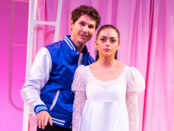
"Romeo & Bernadette" is a musical comedy worthy of the name that delivers on all counts. Mark Saltzman’s spoofing of the old story is great fun and his lines are very clever. The score with its famous melodies transformed in new ways is a lush feast for the each particularly as sung by this excellent cast. Under Justin Ross Cohen’s direction the cast brings this far-fetched story to brilliant life. One only hopes that the threat of the real story of Hamlet comes as a follow-up.
[more]
James Ijames’ "Fat Ham" (all puns intended) is the latest and most successful modern riff on the Bard turning Hamlet into an expression of the Black experience while at the same time having much fun at Hamlet’s expense. As one of the few comedies to ever win the Pulitzer Prize, we should be hearing more soon from this talented playwright whose "Kill Move Paradise" in 2017 appears to be his only other New York credit, also directed by Saheem Ali. Already an associate artistic director/resident director with The Public Theater, Ali has previously worked wonders with "Merry Wives," "Nollywood Dreams," "Shipwreck," "Fires in the Mirror," "The Rolling Stone," "Passage," and "Fireflies," among others at various theaters around town. As usual his casting choices are perfect to the nth degree.
[more]
Written by Renee Philippi, this witty mockery of authoritarianism is derived from Friedrich Schiller’s play "The Robbers" and the Korean novel "The Story of Hong Gildong." Composer and lyricist Lewis Flinn’s smart original score joyously recall’s Kurt Weil’s galvanizing melodies and Bertolt Brecht’s biting lyrics. It’s rousingly rendered by musical directors Jacob Kerzner and Hee Eun Kim.
[more]
Takiff is a skilled performer who never loses the audience no matter how angry or sardonic he gets. He is helped by the mood setting lighting of Elizabeth M. Stewart and the sound and video contributions of Matthew Chilton. Mark Mindek provides some minor, but effective, dance bits. Brian Lane Green’s direction made all of pieces fit together into a cogent whole. As difficult as the subject matter is, "Jews, God, and History (Not Necessarily in That Order)" should be seen as a fresh, in depth consideration of the subject matter.
[more]
Although playwright Anchuli Felicia King’s plays have been performed in London, Washington, D.C., Staunton (Virginia), Melbourne, and Sydney, her Susan Smith Blackburn Prize-nominated "Golden Shield" appears to be her first New York main stage production. Ostensibly about a young, idealistic lawyer’s attempt to bring her sister on board as a translator in a risky legal battle with a multinational tech corporation, the play is about half a dozen other things as well: sibling rivalry, child abuse, ethical turpitude, human rights issues, governmental suppression of the internet, legal loopholes, and corporate greed. The play actually conflates two different very real lawsuits (against internet giants Yahoo and Cisco) which may explain why it is initially so complicated.
[more]
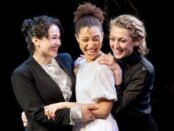
While this is not an in-depth interpretation and at times seems a bit superficial, Will Pomerantz’s production of "Three Sisters" is a true ensemble making it appear that these people have lived together for years. His new adaptation in contemporary idiom is easy on the ears and easy to comprehend. The pacing of the production is always on the move which is saying a good deal when it comes to Three Sisters which is often performed in a glacial style to mirror the characters’ boredom and disappointments. Here the characters complain about their fate but get on with their lives.
[more]
This premiere five-performance Off-Off-Broadway showcase run of "The Oracle" is best viewed as a tryout, and the production’s presentational flaws are cited with that belief. Co-author Elliott also directed; while he’s assembled, well-positioned and guided the industrious cast to lively performances, his physical staging is variable. The play is structured as 34 brief scenes over two acts. Instead of rapid transitions, there’s a pause between each scene while recorded music plays as the actors get in place. This intrusive strategy slackens the pacing and adds to the running time.
[more]
Alison Leiby’s "Oh God, A Show About Abortion" is probably the most level-headed work about that much debated subject, perhaps too level-headed. While the United States is going through social and political paroxysms over a leaked Supreme Court argument that portends the overturn of Roe v. Wade, Leiby’s matter-of-fact attitude toward the subject is a balm.
[more]
Adam Kraar’s new drama, "The Karpovsky Variations," is a memory play about a dysfunctional family of driven people and the music that inspired them. Unfortunately, in its current form it is both confused and confusing. Without a family tree, it is difficult to keep straight all of the names of characters both seen and mentioned. Director Tasha Gordon-Solmon has eliminated almost all of the scenic elements described in the script which does not make it any easier to follow. There is a fascinating story hidden in this material but it hasn’t been allowed to surface yet.
[more]
This charming show comes from the acclaimed Spanish troupe, Kulunka Teatro. The ensemble of Jose Dault, Garbiñe Insausti and Edu Cárcamo all offer awesome physically commanding silent portrayals of a variety of types while encased in Ms. Insausti’s stupendously created caricaturist masks. Their handling of props is majestic. During the exhilarating curtain call, the cast appears without masks, and their magnetism is even more visible. André & Dorine’s engaging wry scenario was devised by Insausti, Mr. Dault, Iñaki Rikarte, Mr. Cárcamo and Rolando San Martín.
[more]
Tony Valdovinos who grew up in Phoenix, Arizona, was 18 before he found out that he was an undocumented immigrant. The new musical "¡Americano!" is based on the true story of his life and challenges. Impassioned and spirited with an animated cast that seems to be living their roles rather than acting them, the show is a superior musical entertainment. Staged with vigor and energy by Michael Barnard, artistic director of The Phoenix Theatre Company where the show premiered in 2020, and choreographer Sergio Mejia, ¡Americano! is both moving and entertaining, moving along with the speed of an express train with never a minute wasted in its urgent storytelling.
[more]
Based on historical facts, the new and exciting musical "Paradise Square" tells a story of fictional characters caught up in real events which lead up to the Draft Riots that occurred in Manhattan in July 1863. Set in the notorious neighborhood known as Five Points, renowned as the most dangerous place to live in the United States, it takes place mainly in the fictional Paradise Square Saloon in the real Paradise Square. Aside from the sensational dancing by choreographer Bill T. Jones and a rousing score by composer Jason Howland who also conducts, the show stars Joaquina Kalukango giving a show-stopping performance in the leading role. However, she is also surrounded by a great many leading characters played by actors at the top of their game. Like an epic adventure, Paradise Square will keep you engrossed until the very last moment.
[more]
Though there’s two well-delineated characters and a compelling plot, "A Case for the Existence of God" plays out like a 90-minute cerebral exercise, reaching an unsatisfying pseudo-fantastical conclusion. This is explained by Hunter’s stage directions which explicitly have the actors sitting for a good deal of the time. He has several dictates as to how his dialogue should be delivered, one example is “Dialogue written in italics is emphatic, deliberate; dialogue in ALL CAPS is impulsive, explosive. Dialogue in [brackets] is implied, not spoken.”
[more]
Alice Childress’ "Wedding Band," which is a difficult play to stage due to its shifts in tone, is a major rediscovery. However, it straddles a thin line between realism and romance and its poetry needs to be handled very carefully. Unlike the tamer "Trouble in Mind," "Wedding Band" has a very strong message and a good deal to say about racism in American in telling its sensitive interracial love story about a time when it was a love that dared not speak its name. While this production makes some problematic choices, the time has certainly arrived for this play to be returned to the American stage.
[more]
The 1975 play "American Buffalo," now onstage at the Circle in the Square Theatre in a crackling revival, remains the quintessential Mamet experience, the one that should be seen to fully appreciate what has been lost. Essentially a two-hander masquerading as a three-hander, it's a character study short on plot and long on self-delusion as a couple of small-time crooks imagine themselves as much more than they are while planning an ambitious heist. To say they're all talk gets to the satirical heart of Mamet's play.
[more]
In "POTUS," Selina Fillinger’s first Broadway comedy, all is revealed by its unwieldy subtitle (“Behind Every Great Dumbass Are Seven Women Trying to Keep Him Alive”) which leaves little room for development or surprise. The repeated statement “that’s the eternal question” in answer to why none of these women are President may be the real message behind this play. As staged by famed choreographer and director Susan Stroman, POTUS is frenzied rather than funny, a problem in farce. The seven famous actresses are undone by their one-note characters which give them little to play off of or expand on. A pity considering how few Broadway comedies there are these days and the quantity of talent on stage at the Shubert Theatre.
[more]
Freshman playwright Charles Gluck, a retired gastroenterologist who has finally followed his dream to write a play, has turned out one terrific piece of theater. There is virtually no superfluous dialogue in this script; almost every line serves a specific purpose, whether it’s to provide key exposition, continue to build the play’s fully three-dimensional characters or to accelerate and intensify the dramatic through point.
[more]
Anyone else may find this decent show to be a tired affair which just about sustains its two-and-half-hour running time. The memory-piece book by Crystal, Lowell Ganz and Babaloo Mandel is based on their screenplay which ranges from the 1950’s to the 1990’s. It intends to be a loving tribute to a bygone show business era and fitfully succeeds at that. The schmaltz-laden dramatic writing never really rises above the rudimentary, rendering the events and conflicts with patness and clichés. Still, it offers choice roles that are marvelously performed by the other cast members.
[more]
Deliriously and explicitly profane, Michael R. Jackson’s Pulitzer Prize winning musical, "A Strange Loop" has—unbelievably—made it to Broadway, produced by Playwrights Horizons, Page 73 and the Woolly Mammoth Theatre Company. Jackson’s explicit portrait of a lost soul’s salty journey is alternately stunning and amusing, appealing and appalling, told at a breakneck pace through his book, lyrics and music. It’s a rare, if dispiriting, portrait of a gay man who isn’t a paragon, a man who isn’t conventionally handsome, successful or rich.
[more]

You would think that at the tail end of a pandemic Thornton Wilder’s 1943 Pulitzer Prize-winning "The Skin of Our Teeth" would be the perfect play for our moment. This experimental play which pays tribute to the resilience of the human race offers hope in time of adversity. The experimental nature of the play uses techniques promulgated by James Joyce, Luigi Pirandello and Bertolt Brecht, none of which are so new or unfamiliar anymore: actors addressing the audience directly and stepping out of character, anachronistic events or references, etc. There are allusions to the Old and New Testament, Greek Mythology and Shakespeare. Writing in the middle of World War II, Wilder presciently made use of such themes as the problems of climate change, refugees, dysfunctional marriages, nepotism and political corruption, which remain at the forefront today. Even after 80 years, Wilder’s play seems eternally forward-looking, eternally novel, and continues to be an important piece of American theater.
[more]
In the 13 years that span this earnest, thought-provoking play, three weddings, fear, war, and death all serve to test the strength and sanctity of these women’s bonds. Toossi’s script is intimate, and searching, both funny and heartbreaking; "Wish You Were Here" is a beautiful testament to the strengths and allegiances women find with each other in times of turmoil and oppression.
[more]
This 2022 "Macbeth" appears to be entirely a director’s project, but Sam Gold has done his actors no service with the busy activity he has added to the play. Fine actors like Daniel Craig and Ruth Negga who have demonstrated their top-flight acting chops on stage elsewhere have not been aided by the bizarre direction. Ironically, Shakespeare’s name is nowhere to be seen in the ads for the production. If this was to rope in the fans of Craig’s James Bond, this production gives them no help in following the play, a story of ambition and revenge, which should have been the point of the updating. Even if you are well-versed in the play, you will find yourself adrift much of the time.
[more]
This Broadway production, a godchild of a recent 2019 production at The Public Theater (directed by Leah C. Gardiner), is directed and choreographed by modern dance luminary Camille A. Brown (who choreographed The Public Theater version, hence the pedigree). Her take on Shange’s work is more matter of fact and streetwise than previous productions, her choreographic vision adding depth to the playwright’s vernacular, profane expressions of the consciences of a community of hard-pressed women.
[more]
Unfortunately, while Wells (Nikki M. James) and Mary Church Terrell (Cassondra James), another renowned Black suffragist, occasionally pop up to offer intersectional insights, they mostly come across as an addendum to the all-female and nonbinary musical's Paul-centric narrative. Taub knows Wells and Terrell obviously belong in the story she's trying to tell, but she hasn't figured out how to dramatize their inclusion yet. Other suffragists whose names should be much more well known today also receive paper-thin characterizations: Lucy Burns (Ally Bonino); Doris Stevens (Nadia Dandashi); Ruza Wenclawska (Hannah Cruz); Inez Milholland (Phillippa Soo).
[more]
Taking the law into your own hands can be a risky business as Harry Wade and friends find out in Martin McDonagh’s hilarious dark comedy "Hangmen" which finally made its Broadway debut after being delayed two years by the pandemic. The cast of this Royal Court Theatre/Atlantic Theater Company production is somewhat different from the one that debuted Off Broadway in 2018 with four members of the original 11 person company remaining. British film star David Threlfall who made his New York stage debut in 1980 in his Tony Award nominated performance as “Smike” in "Nicholas Nickleby" returns to Broadway for the first time since 1997 in the leading role as Harry, the second most famous hangman in the United Kingdom.
[more]
Beanie Feldstein’s clunky rendition of “I'm the Greatest Star” crystalizes the absurdist dimension of this off-kilter first Broadway revival of the 1964 musical, "Funny Girl." With her nasal, often muffled singing, oddly emphatic line readings and smug mugging, in no way does she suggest a great star, yet this nearly three-hour show is centered around her. It instantly deflates with her wan introductory “Hello, gorgeous.” She does exhibit idiosyncratic pluck and stamina throughout.
[more]
Direction by Victoria Pérez could have better negotiated the script transitions and emotional shaping of the piece; however, script, director and actors, as well as lighting design by Miguel Valderrama and sound design by Michael Hernandez all come together to create a moving ending which comes with no answers but does provide a sense of closure. "Bloom" hasn’t fully flowered in this incarnation, but perhaps more will be revealed in future productions.
[more]
The final work was the world premiere of “Only One Will Rise,” a work by a new choreographer Olivier Tarpaga to a colorful score he co-wrote with Tim Motzer who was one of the three on stage musicians. Daniel Johnson and Saidou Sangare were the others.
“Only One Will Rise” used a large cast that Tarpaga handled adroitly, shooting groups across the stage in interesting patterns, eventually focusing on several soloists who appeared angst-ridden. His movement themes were decidedly Limón influenced with the addition of sensual twists and undulations taken from African ethnic folk dance, movements that the Limón troupe performed beautifully, wringing a myriad of emotions from these departures from their home base technique.
[more]
Tracy Letts’ "The Minutes" is both a fine political comedy as well as an indictment of how most Americans live today. It ultimately asks us to look at our values as well as our connection to the society around us. It will not make you so much as talk about it after you have seen it, but ask yourself if the indictment includes you. Continuing her connection to playwright Tracy Letts which began with "August: Osage County" in 2007, director Anna D. Shapiro adds another excellent contemporary play to her resumé.
[more]
He won a Tony Award starring in the Broadway masterwork "How to Succeed in Business Without Really Trying." And fortunately his performance was captured well in the film adaptation of that brilliant show. (Watch that film for a sample of his greatness.) And he won another Tony Award for "Tru,'his one-man show about Truman Capote (which was later successfully adapted for public television). He was simply compelling. And people who would never have watched the real Truman Capote speak for an evening were mesmerized by his theatrical version of Capote. I was impressed, too, by his ability to surrender himself entirely to the needs of the role; if he was portraying a real person, like Truman Capote (or, later, Dominick Dunne, for "American Crime Stories"), he could become the character so thoroughly, you almost forgot you were watching Robert Morse.
[more]
A lure of this Broadway premiere revival is 25 years later experiencing the acclaimed performances of much of its original cast. Being a memory play, their current ages are irrelevant, especially when their talents are impeccable. With her renowned charismatic stage presence, Mary-Louise Parker is monumental as Lil’ Bit. Ms. Parker’s drawling vocal delivery and magnetism fully and poignantly realizes the character from the perspective of an older woman looking back on her dysfunctional adolescence. The soft-spoken and shattering David Morse soulfully embodies Uncle Peck, a delusional W.W. II veteran who has descended into alcoholism and pedophilia.
[more]
Playwright Martin Crimp, an adherent of the ”in-yer-face” school of British playwriting, has taken Edmond Rostand’s turn-of-the-last century verse drama, Cyrano de Bergerac, and not only blown off the cobwebs but exploded it into an entirely new 21st century experience. Staged by innovative director Jamie Lloyd, it has become a showcase for titanic Scottish stage and screen actor James McAvoy making an unforgettable New York stage debut in the title role as the 17th century poet and soldier.
[more]
Essentially, Mouron boils the story down to a couple lines about love and beauty, while eliding any sense of the loss, isolation, and dread that the novella also poetically conveys. Her little prince is a man-child incapable of engaging with life's pain rather than Saint-Ex's courageously inquisitive child-man who can't help but look for happiness in sorrow and vice versa. In the absence of this existential heft, the production makes room for co-director Anne Tournié's, admittedly, often charming choreography. A pas de deux between Zalachas and Sulty is particularly lovely, thanks in part to the latter's stunning, and protean, red dress from costume designer Peggy Housset.
[more]
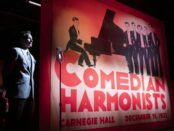
Although 25 years have gone by since "Harmony" first tried out at the La Jolla Playhouse in San Diego, the Barry Manilow/Bruce Sussman musical about the Comedian Harmonists is still relevant and timely. This historical musical based on true events which took place mainly in Germany from 1927- 1935 is a necessary reminder of the rise of Nazism and the naïve people who thought it would blow over. Produced by the National Yiddish Theatre Folksbiene at the Museum of Jewish Heritage, "Harmony" could not be in a more fitting setting to tell this story. Directed and choreographed by Warren Carlyle, the musical has been given a big Broadway-style production for its first New York appearance starring Chip Zien and Sierra Boggess as well as a cast of featured players.
[more]
As a piece of theater, "Songs About Trains" is earnest and unique. Lead author (and performer) Beto O’Byrne, along with contributing authors Eugenie Chan, Reginald Edmund, Jay B Muskett and Rebecca Martínez (who also co-directs) have constructed a work that’s not definitely a musical and not quite a play, but more of a performance piece which sews stories together with music, dance and songs.
[more]

"Birthday Candles" also has an unusual theatrical device: we follow Ernestine Ashford from 17 to 107 meeting her on her various birthdays that are depicted. The other characters come and go (by death, moving away, or dropping out of her life). Inspired by Thornton Wilder’s 1931 "The Long Christmas Dinner" which like "Birthday Candles" covers 90 years in one family, Wilder’s landmark play has also inspired Paul Vogel’s "The Long Christmas Ride Home" and Dan LeFranc’s "The Big Meal," as well as the breakfast table scene in Orson Welles’ "Citizen Kane." While Vivienne Benesch’s production for the Roundabout Theatre Company at the American Airlines Theatre is beautifully done giving Debra Messing a bravura role as Ernestine Ashworth in which she is onstage throughout, the play is devoid of surprises in covering 90 years in 90 minutes in the life of one woman, too predictable to feel fresh. And once the characters are introduced, they pretty much stay the same throughout the rest of the play.
[more]
Lee peppers his worn scenario with plenty of pop, cultural and political references, well-crafted zingers and familiar conflicts. Dating apps, "Dancer from the Dance," "Sex and the City" are among the totems cited and a Trump supporter is declared to be a “MAGA fag.” "To My Girls" succeeds as a rote genre-piece for a niche audience desiring a simplistic gay play where there’s laughter, tears and resolution in drag danced to The Pointer Sisters. Lee’s thinly drawn characters are highly playable.
[more]
The ubiquitous Billy Porter was given command of the most recent New York City Center Encores! presentation, the 1997 musical "The Life." His direction and re-interpretation of this tawdry portrait of 42nd Street left a great deal to be desired, but strong performances by the leading players made vivid impressions. Originally written by the estimable Cy Coleman (music/book), Ira Gasman (lyrics/book) and David Newman (book), "The Life" is set in the 1980’s as seen from the point of view of a narrator, Old JoJo (Destan Owens, fine in a thankless, add-on role) who observed and commented on his past which included watching himself, Young JoJo (Mykal Kilgore, fine singer, but looking nothing like his counterpart) behave badly. The concert adaptation was by Porter himself.
[more]
«
1
…
17
18
19
20
21
…
64
»
Copyright Jack Quinn, 2001-2026