Archive
What makes "Elyria" intriguing is how its American location affects the hidebound ritual social rules of its Southeast Asian characters. That all the characters emerged from an African diaspora that seemed to have little influence on their ingrained Indian culture only adds to the colorful rendition of an old-hat story. [more]
Crumbs from the Table of Joy
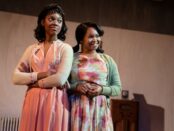
While this first New York revival of the 1995 "Crumbs from the Table of Joy" does not reach the heights of Nottage’s later Pulitzer Prize-winning plays, "Ruined" and "Sweat," it proves to be a very charming and competent look at growing up Black in Brooklyn during the McCarthy Era. Under the direction of Colette Robert, the fine cast holds our interest with this domestic comedy drama. Always engrossing, the play demonstrates Nottage’s ability to write about race, social change and economic deprivation in an engaging manner. Nottage proves to have been a very accomplished playwright from the outset of her career. [more]
Pericles (Target Margin Theater)
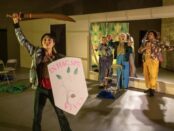
Director David Herskovits must have looked at this as a true labor of love, but not all of the touches support the hard work of the actors. In some of the early ensemble scenes, the actors put on exaggerated courtly poses. The poses do nothing to further what is going on dramatically;, they appear done just for the sake of being curious. But Mr. Herskovits succeeds with the handling of deeply humane and touching scenes. [more]
1+1
Eric Bogosian’s latest play to reach New York is his 2008 "1+1" which feels like a made for television movie written without taking into consideration the #MeToo movement that has occurred since then. While its Hollywood milieu of pornography, drugs, and easy money exists, this seems like a rather simplistic view of it all. Director Matt Okin, founder of The Black Box theater company of Englewood, N.J. which has coproduced the play now at the SoHo Playhouse, has done the actors no service allowing for a kind of soap opera acting. The minimalist production values undercut the discussion of the perks and glitz of the film world. [more]
War Dreamer
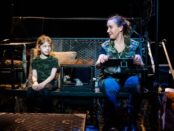
"War Dreamer" is a compelling exploration into the psychology of a female veteran who served in Iraq. It is a depiction of the struggles of a veteran to make sense of the memories, nightmares, paranormal events, and mental dislocations that intrude daily. Those experiences are more than a function of post-traumatic stress disorder. They result from a life lived in the alien world of war and all that is that experience. The play is a frighteningly accurate presentation of the process that some veterans must navigate as they try to return to a "normal" life. Written by Leegrid Stevens, "War Dreamer" has a storyline that is not straightforward in time and place. It is disconnected from a regular flow of action, with jumps in time, place and reality. However, he skillfully keeps the audience guessing what is real and what is not without losing the story's underlying thread. Stevens makes the audience both witness and participant as he brilliantly weaves his story of trauma and disassociation. [more]
Cat on a Hot Tin Roof
While it may have appeared a huge gamble to mount this 'Cat" again, the results are so well worth it. While other productions of "Cat on a Hot Tin Roof" have been mounted as star vehicles for actors whether they were right for the roles or not, this new Ruth Stage production brings it back to what the playwright originally intended – an incredibly solid ensemble piece. Here we see it as we’ve come to know it – one of the finest American plays of its generation. It is unequivocally a must-see! [more]
Public Obscenities
Shayok Misha Chowdhury’s "Public Obscenities" having its world premiere at the Soho Rep is an immersive story into Bengali culture in Kolkata, formerly known as Calcutta. Directed by the author in 12 episodes which are given chapter names, this two hour and 50 minute play is as much like a television mini-series as it is a family saga. The realistic production resembles a film as much as it is possible on a stage with our attention being guided to various alcoves as though they were film cuts on the remarkable setting by the collective dots. The play is challenging as the first long extended scene is mainly in Bangla, the language of Kolkata, without supertitles. While the rest of the play is translated when it is bilingual, the dialogue is studded with Bangla words which are left up to the audience to figure out. [more]
I Love My Family, But…
The show is billed as a musical, but it is more concert than play, strong in music and weak in the storyline. The songs cover a lot of emotional ground, many with a humorous edge, but the book only provides a slim dramatic structure for the characters' actions. What is missing is more detail about who the characters are and for what reason we should care about the events being depicted. The dialogue is more of an introduction to the songs than a dramatic link to the overall story. [more]
Fall River Fishing
Absurdist to an increasingly ho-hum degree, Szadkowski and Knox let their imaginations run amok with silly speculations about pre-double-homicide life in the Borden household that are punctuated by head-scratchingly anachronistic jokes involving Tinder, Cabbage Patch Kids, John Belushi, and whatever other free associative references apparently sprung to mind during their no-doubt personally enjoyable writing sessions together. The problem is that Szadkowski and Knox are incapable of bridging the gap between their evident fun and our actual entertainment, an obnoxious shortfall made cringe-worthy by the fact that they both star in "Fall River Fishing." For the charitable among us, I suppose, seeing Szadkowski and Knox delivering their own unfunny dialogue might compel a forced giggle, especially in such close downtown quarters. But theater is expensive and time is fleeting, so a lack of chortling generosity is also perfectly understandable. [more]
The Trees
Borinsky’s dialogue is filled with colorful, quirky lines which are often funny and entertaining, but the entire script borders on absurdity without a cohesive through point. There are a handful of lines which carry a promise of meaning, but most are tossed into the air like tweets, missing connections and lacking purpose. There’s a passage inspired from Deuteronomy 20:19, which, if it’s supposed to be the inspiration for the plot, stands alone as one of the few sage moments in the story. [more]
The Sign in Sidney Brustein’s Window
Unfortunately, the latest revival now at the BAM Harvey Theater cannot be counted as having reversed the play’s fortunes. It still seems vastly overwritten and verbose as it attempts to cover too many topics (political corruption, anti-Semitism, racism, artistic fulfillment, prostitution, drug addiction, marriage, homosexuality, etc.) Almost no social issue of the day except foreign politics has been left out. At a current running time of three hours and five minutes with one intermission, the play seems long and lugubrious though it has a great deal to say that is admirable and prescient. The script being used could see a judicious edit and a pruning of topics covered. [more]
The Best We Could (a family tragedy)
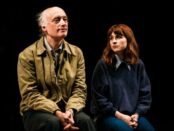
Hands down Emily Feldman’s "The Best We Could (a family tragedy)," at the Manhattan Theatre Club, wins the most ironic title of the year. Not one character does the best he or she could in this heart-twisting five-actor drama. The play details the long, slow descent of a family, cushioned only by an occasional jest and buoyed by the intensely moving acting by the ensemble with Frank Wood standing out in a superb demonstration of artistry. [more]
LOVE
Alexander Zeldin’s "LOVE" seems much longer than it actually is due to much silence and the reenactment of everyday tasks usually skipped onstage in plays. There is little dialogue and what there is tends to be rather ordinary talk about daily living. The play mainly works as a sort of experiment in the way that the Federal Theatre Project dramatized burning issues in the 1930’s. However, the play is a valuable record of life in a shelter using a documentary approach so real that it makes us feel like voyeurs. While the title remains unexplained, by the end each of the adult characters get to say it as a reminder that they have the backs of the others. [more]
Letters from Max, a ritual
When a tall, lanky Max Ritvo entered Sarah Ruhl’s playwrighting class at Yale, she knew this was no ordinary 20-year-old student. Self-described as a poet with a sense of humor, he managed to capture her heart, and she remained forever changed. "Letters from Max, a ritual," now being presented by Signature Theatre, is not just a collection of correspondence between the two, but a document of a deep emotional bond between two creative souls that can’t even be severed by the untimely death of one of them. [more]
The Seagull/Woodstock, NY
Aside from the problem of which translation from the Russian to use, the thorny problem with American productions of the plays of playwright Anton Chekhov is how to deal with the fact the author himself called them comedies but everyone from his early director Konstantin Stanislavski on has seen them as tragedies. Playwright Thomas Bradshaw has neatly solved both problems: in his new adaptation renamed "The Seagull/Woodstock, NY" which recasts the play as an updated modern comedy, he also made the play a very funny satire of today’s culture vultures, thespians and the literati. His version in which all of the names have been Anglicized makes Chekhov’s turn-of-the-last century play very accessible to contemporary audiences which is not often the case with Chekhov adaptations - without making drastic changes. In doing so, it makes whatever parody there was in the original of theater and literary icons of Chekhov’s time now understandable to today’s audiences due to updated references they can recognize. [more]
Becomes a Woman
Originally entitled "Francie Nolan," the same as the title character of her later "A Tree Grows in Brooklyn," but unrelated to that story except for sharing its Brooklyn setting, the play does incorporate anecdotes and scenes that would later appear in Smith’s novels. "Becomes a Woman" is uneven in tone, with a first act that is comedic, a second that is melodramatic, and a final act that is dramatic. On the one hand, the play is now a period piece depicting strict mores and values that have loosened up a great deal; on the other hand, much of its cavalier treatment of women is still unfortunately true today. While the first two acts resemble a great many films and plays of the 1930’s concerning fallen women, it is the third act which is progressive and ahead of its time, so much so that it may have scared off the all-male producing fraternity of those days. While the women are beautifully written, the male characters are undeveloped and not believable. As a result, the acting is the same with the best performances by the actresses and some unreal work by the men. [more]
A Bright New Boise
The second play of Samuel D. Hunter’s residency at Signature Theatre is the first New York revival of his 2011 Obie Award winning 'A Bright New Boise," not seen by too many people in its short schedule run at The Wild Project in the fall of 2010. Oliver Butler’s production is a taut drama with rising tensions throughout until the climax. At first appearing to be a workplace drama set in big box store breakroom, the play turns out to be a meditation on faith, relationships and expectations. The ensemble cast is excellent and makes this a riveting piece of theater. The title is ironic in that all of the characters are going through crises and do not see the promise of a new world, in fact, they are mostly pessimistic about the future. [more]
Eleanor’s Story: An American Girl in Hitler’s Germany
Garner is a wonderful actor, shifting easily and subtly from one character to another, her voice, posture and gestures are just right. She avoids being maudlin and thereby makes her narrative even more heartbreaking. Even when Eleanor is reunited with her favorite apple tree back in New Jersey, she hits just the right note of sweetness and hope. [more]
Conversations After Sex
Setting aside societal shame and judgment, anonymous sexual encounters have their benefits. If the chemistry works, then there’s the immediate gratification in the form of pleasure. If the connection isn’t perfect, then deciding to make a quick exit (either before or after the experience) can be awkward, as well as deciding whether a “repeat” is in order. A bigger question which might come to mind is why does a person choose an anonymous “quickie” over getting to know someone first? Are they looking for validation, or avoiding fears of loneliness, commitment, or rejection? Are they wearing anonymity like armor? Such thoughts come to mind as Mark O’Halloran’s swift and engaging play “Conversations After Sex” unfolds, a collection of scenes in which the unnamed character of “She” (played by Kate Stanley Brennan) engages in post-coital dialogues with several different men she has met on-line, in bars or in passing (all portrayed by Fionn Ó Loingsigh). [more]
Kissing the Floor
The ensemble in this show does an outstanding job. Christina Bennett Lind as Annie gives us a direct and well executed view of a frightened, emotionally conflicted woman amid a psychological breakdown. Wilson convincingly plays Izzy, showing us a character who appears balanced and somewhat detached from the emotional conflict but still leaves room for questions about what may be behind that stable, rational façade. Eckert, as the Warden, plays a crucial part as the bridge to the understanding of the show's central theme and later provides a path to the ending. Finally, Ingulsrud is both Paul and Eddie, presenting characters who, although growing up together, developed radically different reactions to the dysfunction that was and is their family. His embodiment of the disturbed mental state of Paul is exceptional, as is his detached, somewhat arrogant depiction of Eddie. [more]
Amani
Denise Manning as Amani is totally believable as a 9-year-old who has had to grow up quickly without parents and her naiveté about love as she maneuvers through growing pains is touching. Her scenes with her father move from precocious to acutely heartfelt to ultimately switching roles when she has to lay down tough love right back at him. It is a performance layered with so many emotions all at once. Although the play is performed without an intermission, it is clearly broken up into three acts, with the second act culminating in a “I deserve to live” soliloquy for Amani that, as performed by Ms. Manning, is breathtaking in its scope. [more]
Cornelia Street
Although British playwright Simon Stephens has written three musicals with composer/lyricist Mark Eitzel, formerly of the indie rock band American Music Club, Cornelia Street, set on a quiet back street in the West Village, is the first to arrive in New York where it is having its world premiere courtesy of Atlantic Theatre – Stage 2. Led by two-time Tony Award winner Norbert Leo Butz who is on stage almost throughout the show, "Cornelia Street," an elegy for a bygone age of unique Village restaurants and coffee houses, does not give its cast enough to do. The songs do not forward the plot but tell us what we already know, and the plot such as it is does not get going until the second half. An interesting attempt to create a place and its regular denizens on stage, "Cornelia Street" in this form does not make a satisfying statement. [more]
The Wanderers
The latest play to reach New York by Anna Ziegler, author of 'Photography 51," "Boy," "The Last Match" and "Actually," has a complicated structure she appears to have invented. "The Wanderers," her fascinating study of faith, love and fulfillment, parallels two Jewish couples a generation apart who appear to have been each other’s destiny (the Jewish concept of “bashert”) but who do not seem to be able to live together successfully. The play also has an email correspondence between a celebrated and controversial novelist and a Hollywood film star played by Katie Holmes, who really is a Hollywood film star. Barry Edelstein who also directed the play’s world premiere at The Old Globe theatre in San Diego keeps the separate parts bubbling along but without achieving the depth of character that the play implies. [more]
She’s Got Harlem on Her Mind: 3 Plays by Eulalie Spence
The problem with rediscovering lost plays from the past is that works that are 100 years old may have gotten dated or express views no longer held. Back in the 1920’s, Harlem Renaissance author Eulalie Spence wrote a great many prize-winning one acts for which she could not get full productions. Metropolitan Playhouse is correcting that oversight by offering an evening of three of these entitled "She's Got Harlem on Her Mind." Unfortunately, they play like short stories rather than fully formed plays. As the characters are mainly grifters and con-artists, they do not show African-American life in the 1920’s in a very good light. A great deal of care and thought has gone into Timothy Johnson’s production which is set in 1927 including period songs between the plays and before and after, but his direction is often too slow and much of the acting is too studied to be naturalistic. [more]
Kingfish
The set is a bare-bones representation of a boat with fishing gear, picnic coolers, and fish made from paper. The lighting is basic, given the nature of the venue, a small basement theater. It is the nature of Fringe Festival productions since it is a chance for playwrights and actors to showcase their work with very tight budgets. None of these things matter with Kingfish since the play and performances are strong enough to make the reality of the set of no great importance. If you like short, well-written, thought-provoking, dark comedy, Kingfish will be a good choice. And if this is representative of the plays in the festival, there should be more good work to be found. [more]
Pictures from Home
"Pictures from Home," a stark, but eventually moving vision of a family, is based on the photo memoir of the same name by Larry Sultan. Sharr White, the playwright, has taken Sultan’s expansive volume of family remembrances and reduced its literary and visual extravagances to the size of the stage of Studio 54. The director Bartlett Sher and his colleagues have fashioned a microcosmic look at a mother, father and son, all hiding behind façades carefully sculpted over decades. That they are played by three terrific theater veterans—Nathan Lane, Zoë Wanamaker and Danny Burstein—helps spin this play into theatrical gold, an intimate, human-scale work that stands out in a season of blaring musicals. [more]
Othello (New Place Players)
In the most elementary explanation of a play’s dramatic structure, the protagonist is the character who drives the action and is the emotional heart of the narrative. Everyone knows how the play "Othello" is going to end, so really the artistic and entertainment value hinges on whether an audience can sympathize with Othello as he is manipulated by the extent of Iago’s hatred for him. Unfortunately for Eliott Johnson as Othello, we meet him as the already heralded general of the Venetian army but witness nothing heroic about him. This monotone Othello doesn’t even raise his voice until Act 3, Scene 4, with “Zounds!,” an epithet meaning God’s wounds, and only upon his exit after confronting Desdemona about the missing heirloom handkerchief. [more]
Untitled Calamity Jane Play
"Untitled Calamity Jane Play" by Kati Frazier is a memory play attempting to make sense of all the different versions of the iconic woman, Calamity Jane. As directed by Akia Squitieri, the play is well-told from the perspective of different versions of Martha Jane Cannary. It leaves the viewer with an idea of who this person is without establishing a clear identity. It also shows that it is not so important to know the truth of her life as much as to revel in the wonder of it. [more]
Proud
This moment is where the message of the play becomes apparent. From this point on, the dialogue will be about the planet's condition and humankind's responsibility for that condition. Although there are moments when it seems "preachy," the discussion is handled well without distracting from the story's core. It is clear from the ensuing conversation that Tom's report will be a recommendation to destroy the planet. In terms of the report, Dick is a dissenter, Harry uncaring either way, and Pat struggling to understand the enormity of what is being discussed about the future of humankind and all the living creatures on the planet. [more]
Twelfth Night (The Classical Theatre of Harlem)
When the Countess Olivia played by glamorous Christina Sajous declares “How wonderful!” in the final scene of The Classical Theatre of Harlem’s return engagement of its production of William Shakespeare's "Twelfth Night," she most likely has the whole audience in agreement. Director Carl Cofield has created a colorful, imaginative and humorous staging of a romantic comedy classic that usually has two melancholy leading characters and is not very funny. Add music and dance to the talented cast led by the dynamic Kara Young as well as visual stage pictures which are very cinematic and you have a top-notch revival for audiences of all ages. [more]
Lucy
Writer/director Erica Schmidt's "Lucy" is a play struggling to find a point of view, or perhaps a point of view struggling to find a play. If the latter is true, then that narrative position seems to be "good help is hard to find," which generally only satisfies an audience, at least the "help" part of it, when there's a "My Man Godfrey," or even "Mary Poppins," spin attached. But Schmidt apparently has adopted her position sincerely, with some topical digressions into issues like healthcare coverage and paid sick leave. Or maybe Lucy is just an exceptionally slippery satire, and I failed to grasp its profundity while wondering why the play had to last more than one scene. [more]
One Night Only: An Evening with Heather Headley and The New York Pops
Pairing The New York Pops with Broadway star Heather Headley brought out the best in each. The energy zipping between the orchestra’s music director Steven Reinecke and Headley was palpable. The program was a wonderful musical portrait of Headley. Reinecke, and Headley’s accompanist and personal music director, Ron Colvard did not just support her but became “the wind beneath her wings.” [more]
On the Town with Chip Deffaa at Anthony Rapp’s “Without You”
Rapp’s show—directed by Steve Maler, with musical direction/orchestrations by Daniel A. Weiss (who was the associate conductor/second keyboards player of the original Broadway production of Rent)—is quite moving. I was held by it throughout. And it is extraordinarily rich with Jonathan Larson songs, including “No Day but Today,” “We’re Dying in America,” “Rent,” “La Vie Boheme,” “One Song Glory,” “Seasons of Love,” “Without You.” Hearing these familiar songs—which I’ve heard so many times in Rent, performed by multiple singers—in new contexts, now sung solo—gives me an even greater admiration for them. They are such well-crafted songs, and they have enormous impact here, just as they did in their original contexts. Rapp has an especial affinity for Larson’s work; no one performs Larson’s songs more compellingly. He has long been the foremost interpreter of Larson’s music. He “gets” the music completely. It resonates for him. No one interprets Larson’s work better. [more]
The Village! A Disco Daydream
Dixon Place, a mecca for LGBTQ culture in the quickly gentrifying Lower East Side, is offering a return of the campy play, "The Village! A Disco Daydream," written by Nora Burns, a dizzy, sometimes sad, revisit to the pre-AIDS seventies, an era of sexy go-go dancers, sugar daddies, hunky hustlers and eager newbies. First produced last fall, its popularity propelled this current revival. [more]
Who Murdered Love?
What is a mystery inside a riddle wrapped in an enigma? A Winston Churchill question from 1939 aptly fits a play with music set in 1924 that toys at being a murder mystery. As a play with music "Who Murdered Love?" doesn't work. As a play without music, it doesn't work as well. It is Dadaism with Surrealist overtones, and Surrealism with Dadaist overtones, if anyone in the audience knows what Dada or Surreal means. [more]
On Set with Theda Bara
David Greenspan, the shape-shifting thespian, has taken on yet another multi-character play, as if his one-man "Strange Interlude" and his more recent "Four Saints in Three Acts" whet his appetite for Joey Merlo’s "On Set with Theda Bara," a mysterious take on the life of the silent picture era vamp and her intrusion into a family whose lives become a film noir. Directed smartly by Jack Serio, the surreal play, just one hour long, took the audience on a colorful journey that included a truly spooky séance. [more]
Sugar Daddy
Sam Morrison’s poignant "Sugar Daddy" has been “on the boards” for just under a year, but first coming to prominence at last year’s East to Edinburgh presentations at 59 East 59th Street Theatres as the Brits say “with a proper sendoff” before he struck gold at the Edinburgh Festival in August. It was only a matter of time before this jewel of a show received a longer run here in New York. It is truly a comfortable fit at SoHo Playhouse, with the only pity being it doesn’t have an open-ended run. "Sugar Daddy" is so many things. It is an off-beat love story; it is an expression of love as much as it is an expression of grief. Most importantly, it is an intensely personal story that he has chosen to share with total strangers, yet we don’t feel like strangers when he’s done. [more]
Cullberg: “Horse, the Solos”
Though only an hour long, Deborah Hay’s Horse, the Solos (2021), set on the dancers of Cullberg (founded in 1967 as the Cullberg Ballet by the late, eminent Swedish choreographer Birgit Cullberg), was difficult to sit through, a meandering, shapeless work that provided few visual pleasures and even fewer moments of human interaction. Hay provided a Choreographer’s Note to explain how Horse was painstakingly produced during the recent Covid Pandemic, created on the dancers via instructions communicated by computer screens and a trusted rehearsal director. Hay stated, “Horse, the Solos" relies on two common attributes of survival, risk and efficiency.” Her opaque, overly intellectual analysis is a product of her years in the world of avant-garde dance, the Judson Dance Theater and the Merce Cunningham Dance Company. The dry, boring dance on Te Joyce Theater stage was a reflection of her experimental past, the influential lessons of which have long been absorbed into the greater dance world. [more]

Between Riverside and Crazy
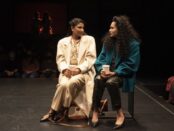
Living in his "palatial" rent-controlled apartment on one of Manhattan's most stunning architectural stretches, Walter "Pops'' Washington (Stephen McKinley Henderson) is an aging man of aging principles. A Black ex-cop, he presides over a crumbling kingdom from the figurative throne of his dead wife's wheelchair in Stephen Adly Guirgis' Pulitzer-Prize-winning "Between Riverside and Crazy." The gruffly engaging Henderson, along with the rest of the heady ensemble, feast on Guirgis' piquant dialogue that blends the sacred with the profane, the comic with the tragic, and earnest social commentary with intense silliness. It's just unfortunate that Guirgis' shaggily constructed plot inspires doubts about whether a brilliant cast and brilliant writing necessarily equate to a brilliant play. [more]
Lady in the Dark
Unfortunately, this is musical comedy and does not need operatic voices, Lawrence being famously a singer with a very small range, while Kaye came from cabaret and night club. With all of the leads double cast, Sunday matinee’s singers seemed either miscast or poorly directed by Eric Lamp and Benjamin Spierman. Matthew Imhoff’s sets which are carried on and off by the singers took an inordinately long time and there were moments of dead time during office scenes which also seemed underpopulated. While conductor and artistic director Michael Spierman gave a creditable performance of the complete score, it did not seem to hang together but felt like individual numbers, unlike many other Weill scores which feel integrated and whole. [more]
Asi Wind’s Inner Circle
"Ari Wind’s Inner Circle" is so incredible that it defies the imagination. Can these be called sleights of hand when we see everything that happens at all times? It is the sort of show that you just have to see for yourself and experience firsthand to believe. Not even magicians have been able to explain many - or all - of the tricks. It would be unfair to describe the tricks more completely – though how they are handled will completely amaze and dazzle you. [more]
F*ck7thGrade
Singer/songwriter Jill Sobule’s life story is on display in the charming cabaret musical "F*ck7thGrade" – with a difference. Sobule, the original “I Kissed a Girl” composer/lyricist, plays herself in this one-woman musical which features a band of three voicing other roles. The score is made up of her greatest hits plus four new songs. Since so many of her songs are autobiographical, they segue beautifully into the story of an unhappy childhood and later success as a performer and writer. Liza Birkenmeier’s book is based on months of interviews with some of the names changed while others are left intact. [more]
tanzmainz: “Soul Chain”
Three solos were stunning in their display of physical endurance. One woman moved forward, repeatedly kicking one leg behind her nearly touching her head with her foot. Another, tall and lithe, stood at the foot of the stage and began writhing, wiggling and shaking in a very disturbing way, for a very long time. And, a young bearded man stood dead center nearly surrounded by the group and began gyrating his head—forward, right, back, left—for more than fifteen minutes at an ever-increasing pace! All three solos were attempts at exhibitionism amidst the tedium. All three solos were both horrifying and exhausting to watch, yet eerily fascinating. [more]
Without You
And that's the agonizing tension in "Without You;" in his lyrical responses to Larson, Rapp is well aware that it's not a back-and-forth, that Larson can't say anything more than he has already. But, just as with "Rent," there is still solace, because I'm sure Rapp, the show's impressive five-member band cozily tucked into Southern's set, and the production crew could hear what I did in the audience: lots of crying. It came with a palpable feeling of not being alone in your thoughts for the dearly departed, especially those taken much too soon. A generation or two removed from having attended "Rent," it was an unspoken bond not only worth revisiting but, if I'm being honest with myself, desperately needed. [more]

Field of Mars
The set by Sascha van Riel has the feel of an unfinished work, with minimal props and an amateurish feel. His lighting does help in moving the story along, but the play itself doesn’t rise above the blandness of the set. The eleven actors, most of whom are seasoned performers, give an almost affectless reading of the script as if they are working with no direction and no understanding of the characters or the intent of the play. [more]
Colin Quinn: Small Talk
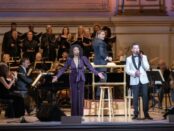
"Small Talk," like its title suggests, is less unified than Quinn’s earlier shows. He also uses its format to wander from topic to topic, seemingly randomly without much structure. It allows him to focus on his pet peeves which seem to be the real topic of the show. While some of his earlier shows were big on humor, this one is more interested in provoking thoughts than laughs. [more]
Natalia Osipova: Force of Nature
The ballerina Natalia Osipova easily transformed herself from spectral to sensuous to eerie in just the first half of her 'Force of Nature" program at the New York City Center. The show—presented sadly only once—was one of the best in the popular genre of ballet star-led gatherings. Osipova’s company members were all superb; it was a company of equals with little frivolous ego on display. Some came from her home troupe, the Royal Ballet; others from American Ballet Theatre and the rest from young ballet troupes. To display her classical bona fides, she opened the program with the Act Two Pas de Deux from "Giselle," brilliantly partnered by the handsome, technically smooth Marcelino Sambé, a principal dancer from the Royal Ballet. In this duet, the spirit of the title character meets for the last time her royal suitor whose attentions in the first act resulted in her early death. She is now a Wili, a girl who has died before being wed, but she is forgiving. His character is Albrecht. He meets her and partners her in lovely poses and windblown lifts. Osipova’s light as air jumps and floating arms were marvelous. These two produced a masterful performance helped by a particularly fine recording of Adolph Adam’s famous score. [more]
Memorial
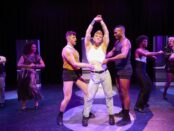
Not only is Livian Yeh’s "Memorial" revealing in its historic depiction of a recent piece of American history, it is additionally a very satisfying dramatic work. It is also very pertinent now with its depiction of racism against Asians shown to have been just as prevalent 40 years ago, as well as how deeply ingrained our unexpressed prejudices go. Jeff Liu’s direction mines all of the play’s nuances, twists and turns. The superb design adds greatly to bringing the play to life, suggesting more than is actually on the stage. With this world premiere, the Pan Asian Repertory Theatre has a current winner as well as a play that should travel well to other theaters around the country. [more]
A Beautiful Noise: The Neil Diamond Musical
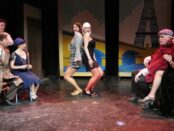
When the older Diamond reaches an existential breaking point, he finally stands up, stage center and takes command of his memories, experiences and his life with an intensely concentrated rendition of “I Am...I Said.” As sung by Mark Jacoby, it is the most poignant moment of the show, particularly when he confronts his younger self face-to-face. Will Swenson, the charismatic star of 'A Beautiful Noise," is hampered by the full-steam-ahead pacing of the show, leaving little time for introspection. He is a powerhouse, molding his voice to sound like the actual Neil Diamond as best he can, often missing the mark. But that’s okay because the majority of the audience came to feast on the songbook of a favorite performer and they are rewarded handily. [more]
Not About Me
Eduardo Machado’s 11th play to premiere at Theater for the New City is called "Not About Me" which is a complete misnomer as it is about his life for the last 40 years with his alter ego at its center. Marketed as a “memory play that takes audiences on a haunting journey through the mind of a playwright during Covid-19 lockdown,” in fact, it is about his friends who died during the last pandemic, the mysterious “gay disease” that came to be called AIDS. Other than as a tribute to those lost friends, it is difficult to see the message of the play as it depicts a great deal of risky behavior. [more]
Hong Kong Ballet: “Romeo + Juliet”
Webre went for acrobatics and precision rather than passion. Perhaps, the Chinese Communist regime frowns upon openly sexual expression in dance. Perhaps Webre can’t summon anything but pretty pictures, but his Romeo + Juliet was theatrically brilliant, but emotionally shallow. [more]
The Dog Show
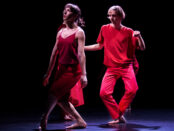
Ivan Faute’s "The Dog Show" is ambitious in trying to tell a story by holding back on the details. Unfortunately, the method has grave, unresolved problems. For most of the first act we have no idea why it has been given this title. Neither the direction nor the script allows the performers to develop their characters who remain at the end the same as at the beginning. There is a play buried in this material but as of now it has not surfaced. [more]
Offal Endings
"Offal Endings" is billed as "a dark comedy" but it is more of a drama with some comedic elements. It grapples with complicated subjects and is not always successful. It "reads" better than it plays, which is not to say that it is a bad play, just that it needs more structure in its story development and execution. The topics it touches on are important given the increased commercialization in the delivery of medical care and, more importantly, psychological care in the complex socio-political environment of the present and near future economy. It presents challenging ideas but doesn’t clarify the challenges those ideas represent. [more]
The Collaboration
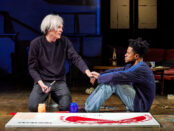
While Bettany and Pope are each very convincing as Warhol and Basquiat since they are made up to look exactly like they did in life, they seem to be in two different plays, using different acting styles. The other problem with "The Collaboration" is that it feels very superficial, like a laundry list of items for them to discuss, while at least several of the dramatic devices are taken out of context or are relocated in chronology. It is certainly a fascinating premise: an older famous and fabulously successful artist whose star is fading and a younger rising star who has taken the art world by storm and seems to be unstoppable, brought together by their shared dealer. [more]
H.M.S. Pinafore (NYGASP)
While Albert Bergeret’s old-fashioned production does not sparkle, it is a solid, steady ship that satisfies with all its jokes intact plus a few new ones like the hilarious drunken scene between the captain and the First Lord of the Admiralty. Associate conductor Joseph Rubin kept the orchestra in close harmony and gave an excellent account of Sullivan’s lilting score. Albère’s attractively realistic scenery looked brand new and created interesting stage pictures. The lovely late Victorian costumes by Gail Wofford helped complete the stage picture. Benjamin Weill’s lighting design bathed the stage in sunlight for the daytime scenes in the first act, and used blues and purples for the evening scenes of the second act. [more]
Truth’s a Dog Must to Kennel
Under the direction of Karl Janes and Andy Smith, Tim Crouch is a very commanding performer, using his resonant baritone to paint pictures with words, holding our attention at all times. Narrating alone he makes us see all he describes from the theater, to the audience, to the landscape on stage and the other unseen actors. However, the play is not for all theatergoers simply because the format is complex and hard to follow and knowledge of the plot of "King Lear" is mandatory. On the other hand, for those who are into experimental theater, this is an exemplary model of the genre boldly pushing the envelope to what is possible. [more]
On the Town with Chip Deffaa: From Anatevka to Wales
"Fiddler"--brilliantly directed by Joel Grey—is an unusually impactful production. It’s emotionally rich, moving, and timeless. And wholly believable. They had me from the first words of the opening number, “Tradition.” (And what a glorious ensemble sound they got!) Steven Skybell playing “Tevye” won the Lortel Award for Outstanding Lead Actor when this production was first presented in 2019. (And the production as a whole won Drama Desk, New York Drama Critics Circle and Outer Critics Circle awards that same season.) He is an excellent Tevye—earthy, naturalistic, struggling to deal with the hardships of life, and able to leaven the hardships with well-expressed humor. This is a big production for Off-Broadway, with some two dozen actors in the company, and Zalmen Mlotek conducting 10 musicians in the orchestra. I don’t speak Yiddish, but the English supertitles would make it easy for anyone to follow along. I’ve seen Fiddler, in various incarnations, enough times—and I’ve savored the original Broadway cast album since Fiddler first premiered back in the 1960’s—I didn’t really need to read all of the supertitles. I quickly got engrossed in the action. This is one of the greatest of all musicals—the book, music, and lyrics are so strong—it always has rewards to offer. [more]
Darkness After Night: Ukraine
"Darkness: unfolds in many very short scenes with some confusing transitions. Dubashin, the traitor to Russia, finally gets to confront Number One in a knock-down personal battle. The only thing that can be said for this denouement is that it is wishful thinking of the highest order. There is more than a whiff of a vanity production here, leavened by Morrow’s “good intentions.” Morrow is, perhaps, a tad self-indulgent to have put himself in the action hero part of a military do-gooder and he could use a dramaturg who could shape the disparate scenes into a well-oiled whole. [more]
Richard Holbrook: “Christmas Magic in the Big Apple”
"Christmas Magic in the Big Apple" continues Richard Holbrook's many years of presenting Christmas season shows. What sets his productions apart from many other performers is his view that this time of year is a time for celebrating family and friends. It is not simply a time of religious holidays but more of an all-encompassing recognition of the joyous spirit that moves people to engage with one another in a celebration of life. His shows are a creative mix of holiday songs with a universal theme. Holbrook commented, “Not everyone celebrates Christmas, and I don't want people coming to my show being made to feel uncomfortable." His playlists over the years have exemplified that view, with the current show being the latest in the series. [more]
Ohio State Murders
McDonald is mesmerizing as she speaks Kennedy’s strong, clear, poetic and evocative prose. We never forget that McDonald’s Suzanne Alexander is giving a lecture but she changes ages in an instant as she becomes the wide-eyed and innocent college student in love with learning and new ideas, and then return to being the mature author with a shocking story to tell. McDonald shifts beautifully between idyllic scenes of college life, the ugly face of racism in the dorm and on campus, and the off-stage violence that defines the murders. While the play is not told in strict chronological order there is no problem in following the story of these few years in the early 1950’s that shape Suzanne Alexander’s life. [more]