News Ticker
- December 12, 2025 in Musicals // The Faggots and Their Friends Between Revolutions
- December 12, 2025 in Cabaret // Mary Foster Conklin — Mirrors Revisited (50th Anniversary)
- December 11, 2025 in Cabaret // Kathy Kaefer — Kiss Me Once: Stories from the Homefront
- December 11, 2025 in Off-Broadway // The American Soldier
- December 9, 2025 in Off-Broadway // This World of Tomorrow
- December 9, 2025 in Cabaret // A Noel Coward Celebration — Steve Ross & Friends
- December 7, 2025 in Off-Broadway // Diversion
- December 5, 2025 in Off-Broadway // Meet the Cartozians
- December 5, 2025 in Features // Tom Stoppard: An Appreciation
- December 4, 2025 in Off-Broadway // Practice
- December 4, 2025 in Cabaret // Eddie Bruce — The Magic & Music of Tony Bennett
- December 3, 2025 in Interviews // Interview with Ty Jones, Classical Theater of Harlem
- December 2, 2025 in Features // Gingold Theatrical Group’s 20th Anniversary Gala at The Players
- December 2, 2025 in Interviews // The American Soldier – An Interview with Douglas Taurel
- December 2, 2025 in Off-Broadway // A Bodega Princess Remembers La Fiesta de los Reyes Magos, 1998
Archive
In the cavernous expanse of the Park Avenue Armory, where spectacle often arrives inflated to mythic proportions, "The Faggots and Their Friends Between Revolutions" materializes as a frequently mad, occasionally mystical, and resolutely LGBTQIA+ fantasia. Adapted from Larry Mitchell and Ned Asta’s 1977 queer fable-book—part manifesto, part utopian parable—this incarnation, shaped by composer Philip Venables and director Ted Huffman (who first unveiled it to British audiences in 2023), announces itself with a great deal of theatrical flourish. For all its conjurations and incantatory ambition, it is ultimately a work whose whimsy gleefully shines on the backs of this diamond’s many facets.
[more]
Mary Foster Conklin’s Mirrors Revisited stripped Peggy Lee’s 1975 art-album down to its core. With a tightly aligned ensemble led by John DiMartino, Yoshi Waki’s bass, Vince Cherico’s percussion and luminous violin from Sara Caswell, the performance revealed the cycle’s psychological through-lines and affirmed Sue Matsuki’s thoughtful curatorial vision for Winter Rhythms.
[more]
Kathy Kaefer’s Kiss Me Once: Stories from the Homefront transforms 1940s wartime songs into moving portraits of real families, lovers, and soldiers. Through tender storytelling and beautifully sung classics, she honors the Greatest Generation not with nostalgia, but with living, breathing remembrance.
[more]
The American Soldier, written and performed by Douglas Taurel, is a solid evening of theater with important messages about war and the soldiers who fight them. Taurel is an excellent actor and he has done a nice job adapting the show from actual soldier's letters and their accounts of their time in battle.
[more]
This World of Tomorrow resembles the films "Back to the Future" (Bert cannot risk changing anything), "Groundhog Day" for its repetition of the same events, and "You’ve Got Mail" in which two undeclared lovers run the risk of missing each other. Both the message and the structure resemble those time travel movies of the 1940s like René Clair’s "It Happened Tomorrow" where the characters get to view a glimpse of the future only to end up back where they started. The problem with "This World of Tomorrow" is that the play attempts to do something that the movies do much better. While Derek McLane’s clever scenery making much use of projections on a series of square pillars which rearrange themselves for each scene as the projections change is appealing as well as eye-catching, it can only do so much to suggest the extensive and imposing World’s Fair, as well as other parts of New York City. All this will be more successful in a future film version in which CGI will allow us to really see the bygone fair and NYC in 1939.
[more]
Steve Ross and a gifted ensemble brought Noël Coward’s world vividly to life at the Episcopal Actors’ Guild, blending wit, longing, and theatrical history. Highlights included Shana Farr’s luminous “Someday I’ll Find You,” young Austin Hardy’s charming poem, and a show-stopping turn from 100-year-old Dorothy. A night of artistry with purpose.
[more]
I come from a family of nurses, and apparently so does playwright Scott Organ whose play "Diversion" is set entirely in an ICU nurse’s breakroom. Organ has clearly done his homework, because he’s written an honest, intense, and yet often funny piece centering on a few days in the work life of six nurses under the pressure of a “diversion” investigation. For those unfamiliar with the word in a medical setting, “diversion” is the delicate term given to the illegal practice of diverting drugs away from their intended use, on patients, and instead toward personal use or sale.
[more]
Talene Yeghisabet Monahon’s new play "Meet the Cartozians," being presented by The Second Stage at The Pershing Square Signature Center, is simply the best new American play in New York this fall. This riveting two-part play set in two time frames 100 years apart asks the questions what does it mean to be an American, what does it mean to be white in America, and what does it mean to be an Armenian American. The timeliness of these questions will not be lost on audiences well aware of the current administration’s views on immigration particularly of non-white applicants for asylum. The Armenian American playwright’s last three plays ("How to Load a Musket," "Jane Anger" and "The Good John Proctor") have all had historical backgrounds but this one is personal to Monahon as it deals with her own heritage. Director David Cromer who has proven himself to be a wizard with new plays as well as his brilliant reinvention of Thornton Wilder’s Our Town has chosen a superb cast led by two-time Tony Award-winner Andrea Martin and 2024 Tony Award-winner Will Brill who are all excellent playing two roles each.
[more]
With Tom Stoppard’s passing, we look back on a career that transformed theatrical language and feeling. Our tribute revisits Arcadia, Leopoldstadt, Travesties, and The Real Thing through TheaterScene’s critics, capturing the wit, humanity, and intellectual daring that shaped his enduring legacy.
[more]
With a three-hour running time (the first act runs two hours straight without an intermission) the play is too long for its repetitiousness having the actors go over the same theater games and monologues over and over again. Of course, the play becomes an endurance test for the actors as well as viewers, whether it was intended to or not. Actors who have undergone this kind of training may be amused; those of us who have not may be bored or lose interest. Although the actors who make up the ten-member cast of "Practice" play very different personalities, we see so little of them individually that it is hard to keep them separate and they become a big blur.
[more]
Eddie Bruce brings warmth, wit, and timeless swing to Winter Rhythms, marking his first Urban Stages appearance with charm, heart, and musical finesse.
[more]
Harlem Holidays features Renée Elise Goldsberry in an intimate CTH celebration of music, storytelling, and community-driven artistry on Dec 15, 2025
[more]
The occasion was the 20th Anniversary Gala of Gingold Theatrical Group, the company that celebrates and revitalizes the work of George Bernard Shaw
[more]
Douglas Taurel brings veterans’ stories to life in The American Soldier, a gripping, award-winning solo performance.
[more]
Iraisa Ann Reilly in her one-woman show “A Bodega Princess Remembers La Fiesta de los Reyes
[more]
In its final form, the piece stands as both elegy and proclamation: a testament to a heritage reclaimed, and to the fierce, necessary act of making contact—full, unguarded, and profoundly human—with oneself. Estrada exists here in a purgatorial tension, suspended between the gravitational pull of guilt and the stark instinct toward survival. The play chronicles not simply his attempt to move forward but the Herculean labor of taking even the first tremulous step toward healing—an act rendered as perilous as any physical combat he has ever undertaken. At times it seems his own mind, a treacherous and labyrinthine opponent, threatens to drag him beneath its tide. And yet, in the fragile space between collapse and catharsis, the work finds its most haunting register: a portrait of a man grappling to reclaim his narrative before the darkness that shaped him claims him once more.
[more]
The film version starring Burt Lancaster as sleazy yet powerful gossip columnist J.J. Hunsecker (similar to the notorious Walter Winchell) and Tony Curtis as hungry press agent protégé Sidney Falco was not a success as the ugly underbelly of tabloid journalism was not what filmgoers wanted from some of their favorite box office stars in 1957. Some of the same problems apparently recurred when nice guy John Lithgow took on the role in the stage musical in 2002. The reedited version by Guare and Carnelia (which is closer to what they originally intended) remains faithful to the original plot but gives a more humanizing backstory and a more palatable ending. They have also restored the original opening (“Rumor”) and a duet for Hunsecker’s sister Susan and her boyfriend Dallas (“That’s How I Say Goodbye”), cut on the road.
[more]
Unlike J.T. Rogers’ Tony Award-winning "Oslo" which handled similar material about the secret Oslo Peace Accord conference, "Kyoto" by Joe Murphy and Joe Robertson makes little concession to its audience giving almost too much information and depicting too many characters, while being patently undramatic much of the time. However, the topic is so explosive that it carries its audience through its 11 conferences. (One hardly notices Natalie Pryce’s costumes so closely does one have to listen to follow the flow of the arguments.) One does come away with the knowledge these sorts of conferences are almost futile with each nation having its own agenda and limits to how far it will go even at the expense of other nations. It is almost remarkable that the Kyoto conference reached any consensus at all. The question now is how much of that was actually enforced by the signatories to the protocol.
[more]
Michael Lepore as the Telegram Boy, Micaela Diamond as Sabina, Ruthie Ann Miles as Mrs. Antrobus,
[more]
If you know the play, you many have trouble following it as several actors double: Ron Canada plays both John of Gaunt, Duke of Lancaster (Richard’s uncle and Henry Bolingbroke’s father) and later the Bishop of Carlisle. Daniel Stewart Sherman doubles as both Sir Thomas Mowbray, Duke of Norfork and later as courtier Sir Stephen Scroop. Ryan Spahn is seen as Richard’s favorite Bagot, a Welsh Captain, and as a companion to the Queen. The ending has been changed as there is no Sir Piers Exton: another character comes to murder Richard in his cell, giving a different import to the scene. As there is no Duke and Duchess of York, the Duchess’ defense of her traitorous son after Bolingbroke becomes King Henry IV is given to the Queen instead.
[more]
Patrick Page (back row) and Jason Sanchez, Adrien Rolet and Jake Berne (front row) in a scene from
[more]
GLORIA! from the Canterbury Choral Society unites Vivaldi, Puccini, and Arnesen in a luminous performance shaped by expressive voices and rich ensemble color.
[more]
In Neil Pepe’s stark revival of Rajiv Joseph’s "Gruesome Playground Injuries," Nicholas Braun and Kara Young trace three decades of bruised connection. Childhood scars, teenage volatility, and a late-night reckoning unfold in jagged time jumps that reveal how two people can orbit each other without ever landing in the same emotional place.
[more]
These highlights stood out not because they were big, but because they were grounded. Nothing felt inflated or overworked. Reineke kept the orchestra responsive, and Gonzalez moved through Miranda’s catalog with the ease of someone who knows the material from the inside out — from the early basement-club creativity of "Freestyle Love Supreme" to the cross-platform storytelling that carries him from "In the Heights" to "Encanto" without changing his fingerprint.
[more]
Strong’s book belies his name, its overlong (two hours, 40 minute) narrative, with all its scheming realpolitik, being more formulaic than authentic. Its points about the individual vs. the state, personal ambition vs. national loyalty, truth vs. propaganda, the pressures of celebrity, and so on, are clear, but Chess is too addicted to larger-than-life histrionics to make us more than cerebrally grateful or deeply invested in the choices the characters must face.
[more]
By the time the play reaches its understated yet piercing climax, the question is no longer whether ChiChi and Theodore are “right” for one another—though that question lingers—but rather what it means for any of us to seek connection in a world where desire is both compass and mirage. "HardLove" distills the fragile thrill of two strangers attempting to divine each other’s contours—emotional, physical, moral—and uses that single night’s encounter as a prism through which larger anxieties of belonging, expectation, and becoming refract. In the end, this bold, darkly funny, and unexpectedly tender work stands as a testament to the theater’s capacity to anatomize intimacy without anesthetizing it: a funny, poignant hour that leaves its audience pondering not only these two characters but the mysterious machinery of desire itself.
[more]
Bruno Giraldi’s "Love or Death?" at Don’t Tell Mama blends cabaret performance, philosophy, and intimate storytelling. Each idea leads to a personal revelation; each revelation breaks into song. This cabaret review highlights a show where love, loss, and music intertwine, creating a powerful emotional journey on a small New York stage.
[more]
With its big, if economical, imagination, "Two Strangers (Carry a Cake Across New York)" also seemingly contains a metropolis of non-digital humanity, thanks, in particular, to Tony Gayle's robust and amusingly familiar sound design ("stand clear of the closing doors, please"). But Robin and Dougal are the only people ever actually present onstage, which is enough. As they repeatedly scale the twin mounds of literal baggage on Soutra Gilmour's circular treadmill of a set--rotating away from and towards each other--the metaphoric intent is obvious. Still, it's the promptly endearing Pitts and Tutty who must translate that visual meaning into a palpable bond, so that the audience cares deeply when it is eventually threatened by both past and future complications.
[more]

Tom Pecinka and Marianne Rendón in a scene from Anne Washburn’s “The Burning Cauldron of Fiery
[more]
"Saturday Night Live" has made political satire look easy and has a lot to answer for. "44 – The Musical" written, composed and directed by Eli Bauman, who worked on the Obama campaign in Las Vegas in 2008, has created this slight parody of the 44th president’s first term. While the show is slickly produced, the writing is lazy using vulgar language – the f-word is sprinkled generously throughout the dialogue and repeated in its songs whose names are not spelled out in the program – and the satire only takes on the most clichéd items. As none of the talented cast looks or sounds like the real people they are playing, we need to keep reminding ourselves who they are.
[more]
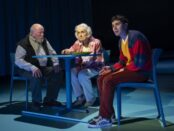
George Bernard Shaw — A salon-style evening at the American Irish Historical Society brought artists and educators together as David Staller led a candid, contemporary look at Shaw’s ideas in 2025.
[more]
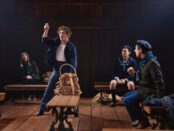
Schiff’s book so slavishly follows her screenplay without adding new material that there is nothing much to wait for. The lyrics by Sanford and Jay alternate between not scanning and extremely simple rhymes. None of the songs tell us anything we don’t already know. With one or two exceptions, Hanggi has directed her cast to be as much like the movie as possible, leading to pale imitations of more robust characterizations. Jason Sherwood’s unit set is augmented by Caite Hevner’s projection design, neither of which creates much atmosphere. Tina McCartney’s costumes seem to be clones of those used in the movie. Much of the look of the period is created by Tommy Kurzman’s hair, wig and make-up design.
[more]
At Winter Rhythms, the lights warm, the lobby hums, and Sue Matsuki runs Urban Stages with the grace of a mentor and the stamina of a producer who loves every beat of the work. More than 150 artists gather for 11 nights of music, community, cookies, and the unmistakable generosity that defines this festival.
[more]
1
2
3
…
114
»
Copyright Jack Quinn, 2001-2023