
Spare Parts
A darkly funny, unsettling play asks: Would you live forever—and at what cost? Blind ambition and billionaire privilege collide in a battle over immortality.
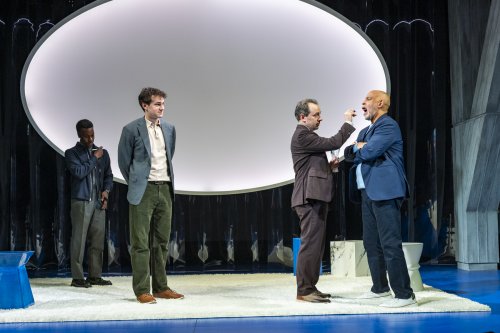
Jonnny-James Kajoba, Matt Walker, Rob McClure and Michael Genet in a scene from David J. Glass’ “Spare Parts” at Theatre Row Theatres (Photo credit: Russ Rowland)
In the contemporary imagination, the billionaire occupies a curious niche somewhere between monarch and mythological creature: a figure whose power seems limitless until it collides with the one inconvenience no amount of venture capital can dissolve—mortality. Imagine, if you will, a man who has spent decades assembling a globe-straddling technology empire from sheer force of will. Governments answer his calls. Employees tremble at his calendar invites. Entire nations can be nudged into compliance with a well-timed conference call. And yet—his knees ache, his bladder betrays him at three in the morning, and the mirror begins to whisper uncomfortable truths about time. What, precisely, is the point of ruling the world if the world insists on outliving you?
This is the impishly provocative premise of Spare Parts, a new play by David J. Glass, directed by Michael Herwitz and currently running Off Broadway at Theatre Row Theatres. At once a swaggering comedy of egos and a more contemplative meditation on scientific hubris, the play concerns what might be called the ultimate billionaire inconvenience: the stubborn refusal of the human body to remain indefinitely young.
Glass frames the dilemma with a mordant wit. The fabulously wealthy, he suggests, are a species defined by appetite. They want because wanting has always worked for them. Houses, companies, governments, entire industries—these things have been acquired, conquered, optimized. What remains, finally, is the last unclaimed commodity: time itself. Perhaps another six months. Perhaps another sixty years. If you possess unimaginable wealth and influence, why not attempt to purchase the future wholesale?
Herwitz’s direction wisely resists the temptation to clutter the stage with blinking gadgets and pseudo-scientific theatrics. Scott Penner’s scenic design is sleek, almost austere, allowing the performances to carry the moral weight of the story. Zack Lobel’s lighting shifts and Ryan Gamblin’s sounds and musical textures underscore the characters’ growing desperation without dictating the audience’s emotional response.
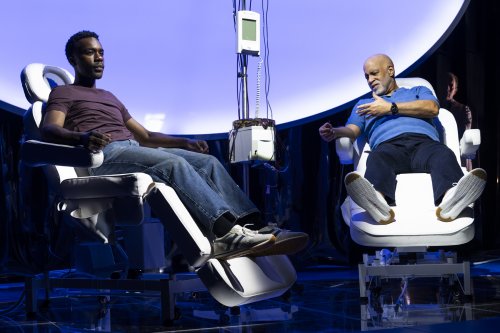
Jonnny-James Kajoba and Michael Genet in a scene from David J. Glass’ “Spare Parts” at Theatre Row Theatres (Photo credit: Russ Rowland)
At the center of this philosophical experiment stands Zeit Smith, embodied with flinty authority by Michael Genet. Zeit is the sort of man who appears less to inhabit the world than to rearrange it. The head of a technology conglomerate that provides free internet across the globe—a generosity that quietly doubles as a mechanism for harvesting unimaginable quantities of user data—Zeit presides over what amounts to a private planetary infrastructure. In one casually revealing moment, he instructs his assistant to “call Malaysia back and get them on board,” with the mild irritation of someone correcting a barista, “I said OAT milk, not whole milk.”
Yet Zeit’s ambitions have outgrown geopolitics. The empire is built. The fortune was secured. What troubles him now is chronology. Born too early, he fears, to enjoy the scientific breakthroughs that might someday extend human life indefinitely. “I just want to make the cut,” he confesses—a line that lands with both comic absurdity and genuine pathos.
Assisting him in this improbable quest is Ivan Shelley, played with a graceful reserve by Jonny-James Kajoba. Ivan is young, observant, and quietly indispensable—a gatekeeper to Zeit’s ambitions and a witness to his vulnerabilities. Kajoba lends the character a delicacy that offsets Zeit’s bulldozing temperament, suggesting a man whose loyalty may conceal a more complicated interior life.
To transform the billionaire’s fantasy into biological reality, Zeit and Ivan enlist two scientists: Professor Chris Coffey and his graduate assistant Jeffrey Jordan, portrayed respectively by Rob McClure and Matt Walker. Amanda Roberge’s costumes function as a quiet yet eloquent guide to the play’s social hierarchy. With a few well-considered choices of cut and fabric, she delineates entire worlds of status and aspiration. Professor Coffey and the graduate student Jeff appear in the sort of standard-issue, slightly rumpled suits that signal academic respectability on a budget—serviceable garments that seem purchased for conferences rather than power lunches. By contrast, Ivan moves through the evening in a wardrobe of sleek precision, the lines sharper, the fabrics richer, the effect unmistakably cosmopolitan. The distinction is subtle but telling: even before a word is spoken, we understand that Ivan inhabits the polished orbit of immense wealth, while the scientists remain tethered to the more modest economics of university life.
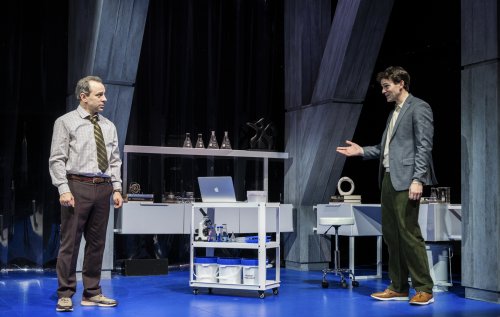
Rob McClure and Matt Walker in a scene from David J. Glass’ “Spare Parts” at Theatre Row Theatres (Photo credit: Russ Rowland)
Their proposed experiment—radical even by the elastic standards of speculative science—involves linking Zeit’s aging body to that of a younger individual, siphoning youthful plasma in hopes of rejuvenating the older man’s physiology. At first, the arrangement unfolds like a diplomatic summit between rival tribes. The tech titans arrive armed with money and impatience; the academics with jargon and wounded pride. Genet captures Zeit’s weary contempt for anything that cannot be summarized in a pitch deck, peppering his speech with the motivational clichés of a Silicon Valley podcast guru. He exhorts his assistant to exploit adversaries’ weaknesses with the brisk certainty of a man who has mistaken corporate warfare for philosophy.
Coffey, meanwhile, proves a splendidly cantankerous foil. McClure—best known for his elastic physical comedy and bravura lead performances in Broadway musicals Chaplin and Mrs. Doubtfire—infuses the professor with an air of principled exasperation, a man determined to preserve scientific integrity even as the scent of funding begins to intoxicate him. There is a certain comic pleasure in watching the two men circle each other, each convinced that the other represents a lesser species.
The grad student Jeffrey, portrayed with sly ambiguity by Walker, complicates matters further. Moppy-headed and outwardly deferential, he possesses an instinctive understanding of how to flatter power while quietly pursuing his own ambitions. Walker allows flashes of intellectual impatience to flicker beneath Jeffrey’s genial exterior; one senses that he finds authority simultaneously useful and faintly ridiculous.
What begins as a satirical clash between corporate swagger and academic idealism gradually deepens into a more unsettling inquiry. The play’s true subject, it turns out, is not merely the arrogance of billionaires but the universal temptation to trespass upon the limits of the body. Humanity, after all, has always been drawn toward transgression—whether through cosmetic surgery, pharmaceutical enhancement, or the relentless drive to improve the species one experiment at a time.
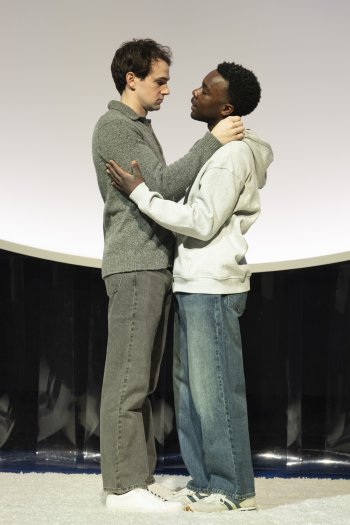
Matt Walker and Jonnny-James Kajoba in a scene from David J. Glass’ “Spare Parts” at Theatre Row Theatres (Photo credit: Russ Rowland)
Glass’s script shrewdly recognizes that scientists and moguls share a certain psychological kinship. Both groups believe, with varying degrees of justification, that the world exists to be pushed forward. Coffey’s lofty rhetoric about benefiting humanity begins, under McClure’s carefully calibrated performance, to reveal a more personal hunger: the desire to be remembered as the man who solved aging itself.
The play’s architecture reflects this slow escalation of stakes. Rather than presenting its central procedure midway through the drama, Glass builds the entire evening toward the moment when Zeit’s rejuvenation experiment must finally occur. The impending transfusion—half medical procedure, half gladiatorial spectacle—acquires the tension of a ritual whose outcome could be either miraculous or monstrous.
The play’s final movements introduce a series of revelations and violent reversals that slightly strain the elegant psychological framework established earlier. Characters behave with a sudden ferocity that may surprise those who have been tracking their subtler motivations. Yet the ensemble’s commitment—particularly Kajoba’s quietly riveting Ivan—grounds the escalation in recognizable human impulses: greed, curiosity, vanity, and fear.
What lingers, in the end, is the uncomfortable recognition that the characters’ hubris is not entirely alien. The dream of conquering mortality is as old as myth itself. Like all the other Frankensteins before them, these modern minds understand perfectly well that their experiment may unleash something monstrous. And yet the temptation persists.
Spare Parts (extended through April 30, 2026)
Theatre 3 at Theatre Row Theatres, 410 West 42nd Street, in Manhattan
For tickets, visit www.bfany.org/theatre-row/shows/spare-parts/
Running time: 95 minutes without an intermission


Leave a comment