
Manon! (Heartbeat Opera)
Massenet's opéra-comique tale of its century's "material girl" allows Heartbeat Opera to once again make a strong case for the return of opera in translation.
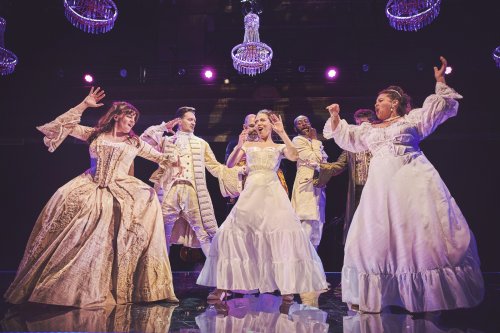
The company of Heartbeat Opera’s production of “Manon!” at The Space at Irondale (Photo credit: Andrew Boyle)
For Heartbeat Opera’s presentation of Massenet’s exquisite Manon, the co-adaptors Rory Pelsue, who also directs, and Jacob Ashworth, the company’s artistic director, take a scalpel to Massenet’s expansive five-act opéra comique, paring it down to a fleet, intermissionless ninety minutes. In the process, they excise subsidiary characters and the bustling choral tableaux that French opera has traditionally treated as both ornament and social panorama. What remains is not a diminished work but a distilled one: the narrative’s spine emerges with unusual clarity, its emotional stakes thrown into sharper relief by the absence of decorative detours, oh, and it’s performed in English.
Based on Abbé Prévost’s 18th-century novel and refracted through the perfumed romanticism of Massenet’s 1884 opera, Manon!—the Heartbeat’s production pointedly brandishing its exclamation point—unfurls as a cautionary tale dressed in lace and candlelight. At its core is a heroine suspended between yearning and appetite, innocence and acquisitiveness, whose predicament feels less antiquated than perennial. The story’s familiarity does not dull it; rather, it sharpens our awareness of how reliably society scripts the rise and fall of a young woman who wants too much.
Manon enters as a provincial ingénue, radiant and restless, dispatched toward a convent as if piety might contain her volatility. She slips instead into the arms of the ardent Chevalier des Grieux, and the pair flee to Paris, buoyed by the fragile fantasy that love alone can finance a future. Des Grieux’s father has his son abducted to prevent the match. Manon, tipped off, permits the separation, grasping with unsentimental clarity that romance cannot thrive on an empty purse. Her choice marks the opera’s emotional hinge, where girlish impulse gives way to worldly calculation.
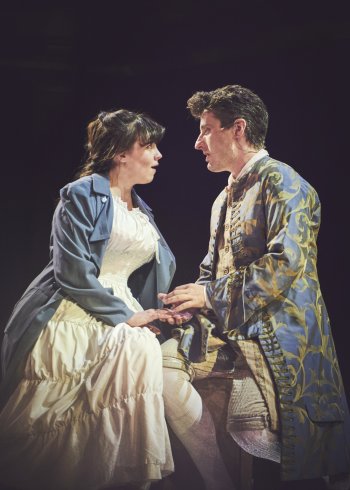
Emma Grinsley as Manon and Matt Dengler as the Chevalier des Grieux in a scene from the Heartbeat Opera’s production of “Manon!” at The Space at Irondale (Photo credit: Andrew Boyle)
Installed as the wealthy Guillot’s mistress, Manon tastes luxury but not contentment, and soon retrieves Des Grieux from the brink of holy orders. Their reunion burns brightly and briefly, ending at a gambling table where a triumphant win provokes Guillot’s spite and an accusation of cheating. Authority moves swiftly—arrest, judgment, and the tidy preservation of male reputation. The Chevalier is rescued; Manon is condemned, deported, and ultimately extinguished in his arms before the journey’s end. What remains is the troubling recognition that her true transgression is not sensuality but insight: she perceives the world’s transactional logic too well.
The result moves with the tensile momentum of a contemporary Broadway musical while still pulsing with Massenet’s melodic sophistication and rhythmic cunning. The English translation proves a nimble vessel for the score, preserving its elegance while allowing the text to speak with a colloquial sparkle. Dialogue crackles with immediacy, and the arias arrive not as museum pieces but as living confessions, unfurling with the directness and emotional accessibility of modern ballads. In this form, Massenet’s music feels less like an artifact than a current running straight into the present.
Massenet’s score has always spoken in two dialects at once. On one tongue, it flirts with a powdered, Baroque elegance—minuets, gavottes, and Rococo curlicues that evoke the ornamental etiquette of the 18th century. On the other, it pours itself out in the lush, heart-forward lyricism of the 19th, where feeling refuses containment and melody becomes confession. The tension between these styles is the opera’s lifeblood. For many years, the reigning visual and musical ideal of Manon in New York was Tito Capobianco’s City Opera production, which resembled a Fragonard canvas coaxed into motion, all pastel decadence and courtly shimmer, and which served as a gilded frame for the incomparable Beverly Sills, whose vocal radiance defined the role for a generation.
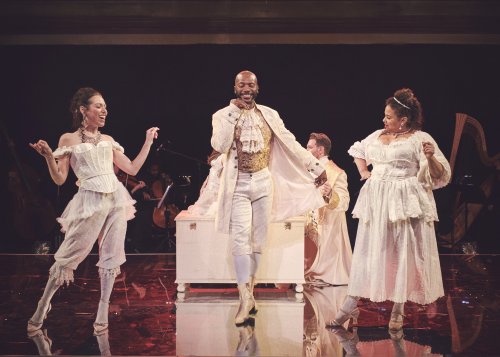
Natalie Walker as Javotte, Jamari Darling as Lescaut and Kathryn McCreary as Pousette in a scene from the Heartbeat Opera’s production of “Manon!” at The Space at Irondale (Photo credit: Andrew Boyle)
Heartbeat’s chamber incarnation, under the ingenious stewardship of music director and arranger Dan Schlosberg, trades opulence for acuity without sacrificing color. Eight musicians—violin, cello, bass, horn, oboe doubling English horn, bassoon, harp, and keyboard—conjure a surprisingly ample world, capable of both diaphanous intimacy and theatrical swell. Schlosberg has a knack for identifying the score’s essential pigments and mixing them anew; his reductions do not feel like compromises but like revelations. The familiar phrases emerge with a renewed profile, and one hears, with fresh ears, how cunningly Massenet built this music to balance grace with ache. Schlosberg’s arrangements consistently land with the quiet shock of inevitability—the sense that, once heard, they could hardly be otherwise.
In Rory Pelsue’s inspired staging, Manon is less a heroine than a specimen under glass—rarely absent, perpetually observed, her presence a kind of social experiment in desire. The production places her, almost cruelly, in the center of our gaze, as if to ask not who she is, but what we make of her. Emma Grimsley meets this exposure with a performance of striking fearlessness and fine-grained intelligence. Her Manon does not simply sing; she calibrates. Each phrase feels weighed for its dramatic temperature, each gesture tuned to the moral weather of the moment. Hers is a lustrous soprano shot through with a filament of grit. The sound can bloom into disarming sweetness or narrow into a blade of irony within a single musical line, suggesting a young woman who has already learned that charm and calculation are neighboring arts. She is alert to the currencies around her—money, status, affection—and occasionally shrewd in how she trades among them. The tragedy here is not that she doesn’t know the cost of her choices, but that she does.
Opposite her, Matt Dengler’s Chevalier des Grieux offers a study in ardent transparency. He brings a boyish, open-faced sincerity to the role, as if the character’s heart were permanently visible just beneath the skin. Vocally, Dengler sometimes presses the upper reaches of the part, but these moments read less as strain than as revelation: the sound itself enacts the character’s emotional overreach. Des Grieux is a young man who believes—despite the accumulating evidence of the world—that love is a sufficient shelter. Dengler makes that belief feel first radiant, then ruinous, and finally, in its persistence, almost heroic. The result is a portrait of devotion that is quietly devastating.
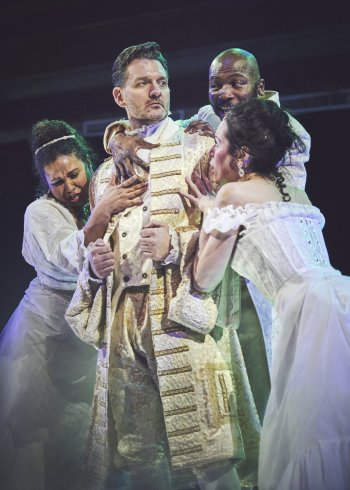
Kathryn McCreary as Pousette, Glenn Seven Allen as Guillot, Jamari Darling as Lescaut and Natalie Walker as Javotte in a scene from the Heartbeat Opera’s production of “Manon!” at The Space at Irondale (Photo credit: Andrew Boyle)
Pelsue encourages a vocal idiom that leans toward the pliancy and text-forward immediacy of Broadway rather than the vaulted projection of grand opera, and he marries this to characterization shaded with commedia dell’arte flourishes—arched brows, sudden pivots of status, humor edged with cruelty. The hybrid suits the production’s tonal world, where artifice and candor coexist. The words and their dramatic payload always land cleanly.
Traditionally Guillot arrives as an aging libertine whose appetites have outlived his dignity. Styled as a Casanova he exerts a comic gravity that pulls laughter and revulsion into the same orbit. Glenn Seven Allen understands that predation in this milieu often wears a grin; his charm is precisely calibrated to make the audience complicit before it makes them recoil. If recent interpreters of Guillot—tenors such as Christophe Mortagne and Carlo Bosi—have tended toward a certain age-appropriate verisimilitude, leaning into the character’s decay, there remains the famous counterexample of Nico Castel, who in his early forties famously submitted to layers of theatrical decrepitude to suggest a man long past his prime. That tradition of emphasizing Guillot’s rot is, in this staging, mischievously upended. The handsome Allen early in the evening parts his robe to reveal a conspicuously well-tended, “gym-honed” torso, a visual gag that lands somewhere between burlesque and provocation.
The moment subtly recalibrates the moral geometry of the piece. Guillot is still a lecher and a figure of ridicule, but he is no longer safely quarantined in the realm of the grotesque. By granting him a body that signals vitality rather than ruin, the production toys with the audience’s calculus: if desirability in Manon is so often entangled with wealth and surface allure, why should Guillot be exempt? The joke, of course, is double-edged. We laugh at the incongruity, yet the reveal exposes how easily the opera’s critique of material temptation can slide into its own form of seduction. In that fleeting flash of abdominal definition, the production invites an uncomfortable thought—perhaps Manon’s pragmatic choices are not as irrational, or as condemnable, as romantic tradition prefers to insist. Some of us don’t lose sight of the fact his Guillot is hot.
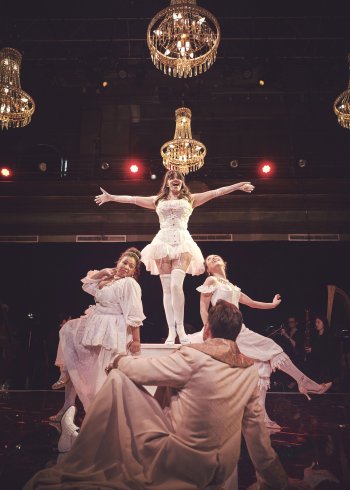
Kathryn McCreary as Pousette, Emma Grinsley as Manon, Natalie Walker as Javotte and Glenn Seven Allen as Guillot (clockwise from left) in a scene from the Heartbeat Opera’s production of “Manon!” at The Space at Irondale (Photo credit: Andrew Boyle)
As Lescaut, Jamari Darling injects the evening with a jolt of contemporary voltage. His performance glitters—socially, morally, kinetically. With movement inflected by the sheen of the ballroom floor and a presence that seems to scan every room for advantage, he fashions Lescaut into a figure of opportunism as a survival skill. Justin Lee Miller, appearing later as the Count des Grieux, shifts the atmosphere on entrance. His vocal authority and clipped, controlled severity sketch a patriarchy that does not need to leer to dominate. The Count embodies power in its sanctioned, institutional form—colder, quieter, and in some ways more formidable. Kathryn McCreary and Natalie Walker, as Pousette and Javotte, refuse the easy lane of decorative comedy. Humor, in these courtesans’ hands, becomes less a gag than a strategy; solidarity, less a sentiment than a means of survival.
Manon! exploits its vertical playground with a canny theatrical intelligence, treating the venue not as a neutral container but as an active partner in the storytelling. The height and openness of the space, along with its promiscuous sightlines, are folded into the dramaturgy. Action spills beyond the runway-like thrust, and the upper balcony is conscripted into service as an aerial demimonde—a gallery from which the opera’s traffic in desire, money, and attention may be coolly observed. One has the sense of a society always watching itself watch. The production declares its visual grammar from the first tableau. Six chandeliers are all we see in the first moments of the opera. They are less décor than barometer: glittering instruments that measure Manon’s rise, stall, and fall. Alexander Woodward’s set design embraces a pointed minimalism, allowing the same architectural skeleton to read, by turns, as town market, catwalk, church nave, or gambling hall. The ambiguity is the point. In a world where everything is for sale, sacred and profane begin to share a floor plan.
Yichen Zhou’s lighting completes the psychological architecture. She washes the space in cycles of honeyed warmth and crystalline chill, so that illumination itself becomes dramaturgy. Under her eye, luxury does not simply glow; it glints, it dazzles, it occasionally freezes. If Woodward sketches the world in spare lines, David Mitsch colors it in with relish. His costumes—droll, astonishing, and pitched somewhere between period pastiche and fashion fantasy—heighten the production’s self-aware artifice. They remind us that Manon has always been, among other things, a spectacle about spectacle: a parade of surfaces in which fabric, like feeling, can be both genuine and strategically displayed. Choreographer Sara Gettelfinger infuses the production with a restless, kinetic pulse, shaping movement into a language of appetite and aspiration. Her choreography does not merely decorate the score; it teases out the opera’s sensual currents, allowing bodies to register the tremors of attraction, ambition, and impulse that the music only implies. Dancers cluster, peel away, and reassemble with the logic of social ritual and private longing intertwined.
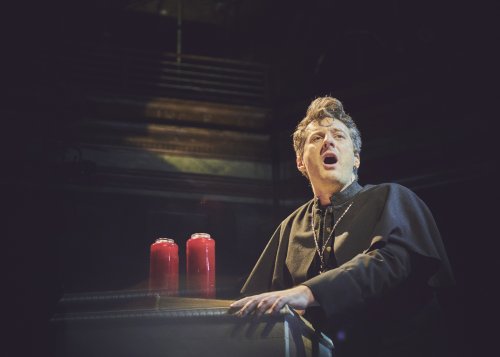
Matt Dengler as the Chevalier des Grieux in a scene from the Heartbeat Opera’s production of “Manon!” at The Space at Irondale (Photo credit: Andrew Boyle)
In a culture steeped in Instagram-polished visions of luxury, Manon! lands with a sting of recognition. The production holds up a mirror not just to 18th-century Paris but to our own marketplace of longing, where desire is so often manufactured by repetition—by what is placed before our eyes until wanting begins to feel like needing. Pleasure here is not merely pursued; it is curated, branded, and conspicuously displayed, and the opera’s cautionary tale begins to look less like a period romance than a dispatch from the attention economy. What Heartbeat Opera demonstrates, with characteristic brio, is that immediacy is not a function of scale. One need not gild the proscenium or marshal a small army of resources to make opera speak urgently to the present. With intelligence, stylistic daring, and a sharp sense of cultural crosscurrents, the company strips the form to its expressive essentials and, in doing so, finds its pulse. The result is a reminder that opera’s grandeur has always resided less in budget than in vision.
Manon! (through February 15, 2026)
Heartbeat Opera
The Space at Irondale, 85 S. Oxford Street, in Brooklyn
For tickets, visit www.heartbeatopera.org
Running time: 100 minutes without an intermission


Leave a comment