
Bat Boy: The Musical
Amid the camp and carnage, City Center’s revival revels in theater’s glorious duality—where irony kisses sincerity, and blood binds beauty to madness.
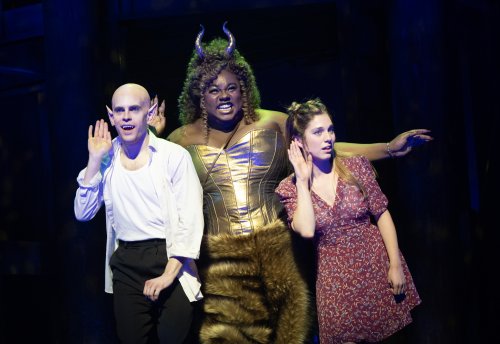
Taylor Trensch, Alex Newell and Gabi Carrubba in a scene from the Annual Gala Presentation of “Bat Boy: The Musical” at New York City Center (Photo credit: Joan Marcus)
A gleeful collision of high and low, of grand musical tropes and tabloid grotesquery, defines Bat Boy’s unruly genius. Composer Laurence O’Keefe, with co-conspirators Keythe Farley and Brian Flemming, grafts the DNA of Golden Age musicals—small-town hypocrisies, star-crossed lovers, even a climactic gospel blowout—onto a tissue of gothic farce, only to gleefully deflate it all with blood-slick irony as a God-fearing veterinarian family in rural West Virginia takes it upon themselves to civilize a feral half-human, half-bat found lurking in a cave. The result is musical theater as vivisection: both homage and autopsy.
Built from the gloriously absurd DNA of tabloid sensationalism, Bat Boy remains one of musical theater’s most delirious success stories. Its very conception—an outlandish headline torn from the inky pages of Weekly World News, proclaiming the discovery of a half-boy, half-bat in a West Virginia cave—was an act of pop-culture alchemy. That bizarre origin story took flight in Los Angeles in 1997 before fluttering Off Broadway in 2001, where it earned a Drama Desk Award for Outstanding Musical and cemented its place in the canon of campy, blood-soaked brilliance. With a book by Farley and Flemming and a score by O’Keefe that ricochets between grunge, gospel, and gleeful pastiche, Bat Boy still feels like a fever dream that somehow obeys its own logic. (And yes, one cannot discuss it without noting that O’Keefe would later pen the pop-rock juggernauts Heathers the Musical and Legally Blonde.) O’Keefe’s score erupts like a gothic volcano, not a polite descent into darkness. It is an ecstatic exorcism, a riot of satire, blood, and glorious noise, bursting straight out of the cave and into our collective jugular.
Its story of Edgar, the feral foundling adopted by a small-town veterinarian and his family, still carries a potent allegorical sting—an outsider tale wrapped in latex and irony. As Edgar learns to speak and love, the town’s pious citizens turn on him with righteous fury, exposing the moral rot that festers beneath their crosses and cattle.
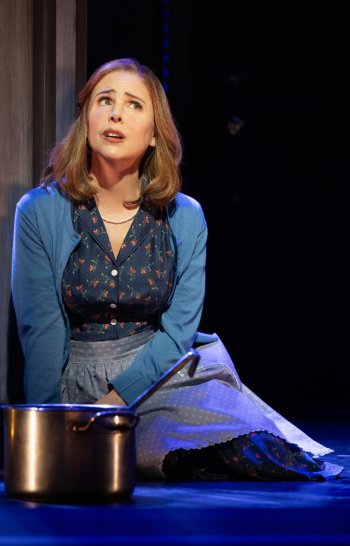
Kerry Butler in a scene from the Annual Gala Presentation of “Bat Boy: The Musical” at New York City Center (Photo credit: Joan Marcus)
Before the elusive creature himself had even emerged, the ensemble’s opening cry—“Free me, Bat Boy!”—filled the theater with a feral, full-throated plea that felt less like musical theater and more like invocation. Their harmonies clawed upward, summoning this tabloid-born myth into being. And when at last Taylor Trensch’s Edgar slinked into view—half-acrobat, half-animal, all aching heart—the audience was instantly his. Trensch, who has made a career of giving fragile souls fierce dignity, delivers a performance of uncanny precision: funny, frightening, and heartbreakingly human.
At City Center, director Alex Timbers embraces the chaos like a ringmaster presiding over a carnival of depravity. His staging throbs with manic energy, and the orchestra—pulsing, snarling, occasionally exultant—leans into O’Keefe’s anarchic score with muscular exuberance. It is the kind of evening when theater becomes séance, ritual, and rock concert all at once. As thunder rolled and lightning fractured the proscenium, the air itself seemed to shimmer with the promise of exquisite, high-camp catastrophe. The result is a live-action tabloid fantasia: a National Enquirer exposé reimagined by a company of theatrical demigods who know precisely what show they’re in and revel in it without restraint.
Timbers contends with the paradox of scale: a show that was meant to feel like a secret shared between performer and audience now sprawls across a cavernous proscenium, yet he triumphs. The raucous opening number—an invitation to join the townsfolk in their collective mania—creates a conspiratorial electricity when broadcast to the rafters. Timbers conjures moments of wicked invention: a perfect example is a shadow-puppet tableau depicting Bat Boy’s conception is pure theatrical delight, equal parts Grand Guignol and children’s storybook. David Korins’ towering, multilevel set, with its looming cave walls and gothic sprawl, unearths the show’s grime and darkness—its humor and horror. Jennifer Moeller’s costumes oscillate between Sunday best and gothic burlesque. Justin Townsend’s lighting design slashes between crimson horror and tender luminescence, and Connor Gallagher’s choreography turns hysteria into art, bodies moving as though possessed by the same restless spirit that animates the show.
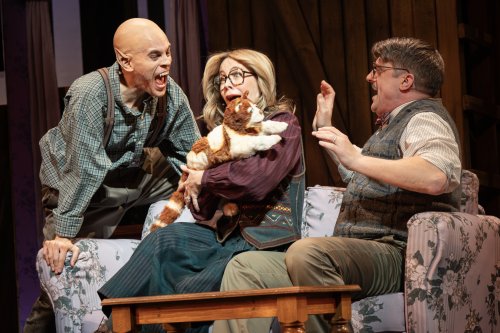
Taylor Trensch, Mary Faber and Christopher Sieber in a scene from the Annual Gala Presentation of “Bat Boy: The Musical” at New York City Center (Photo credit: Joan Marcus)
Trensch’s titular Bat Boy is a marvel of physical precision—spidery, twitching, and oddly touching—and when he finally channels that sinewy energy into song, his vocal clarity cuts through the chaos like a scalpel. A creature of pure empathy trapped in the monstrous, his wide-eyed sincerity becomes its own kind of rebellion, and when he sings, the audience seems to lean in instinctively, as if to protect him from the world’s cruelty.
Kerry Butler and Christopher Sieber, as the veterinarian and his wife, wield their hammy virtuosity like a well-honed cleaver. Butler, once the ingénue Shelley in the original Off-Broadway production, returns now as Meredith Parker, the town’s conflicted matriarch, and her performance is a miracle of metatheatrical poise—a master class in playing both parody and pathos at once. She is self-referential yet sincere, her comic timing surgical, her warmth unmistakable. Her performance grows ever more incandescent as her character’s sanity unravels. Gabi Carrubba’s Shelley is the perfect foil: rebellious, radiant, and gloriously exasperated. Their duet, “Three Bedroom House,” becomes a cathartic anthem of independence, sending the audience into rapturous applause. On leave from Death Becomes Her, Sieber, syringe in hand, is magnificent as the deranged Dr. Parker—a dark cupid of repression and guilt—his every gesture a study in moral decay. Sieber chews the scenery with Olympian flair, embodying small-town patriarchy at its most deranged.
Around them orbits a constellation of talent—Alex Newell, Andrew Durand, Jacob Ming-Trent, Marissa Jaret Winokur, and Tom McGowan—each lending firepower to Timbers’ overstocked circus. Winokur offers a wickedly funny trailer park trash turn as Mrs. Taylor, her vengeance sharpened to comic perfection, while Durand’s Rick burns with redneck rage and gleeful idiocy. McGowan uncovers compassion for the role of the sheriff.
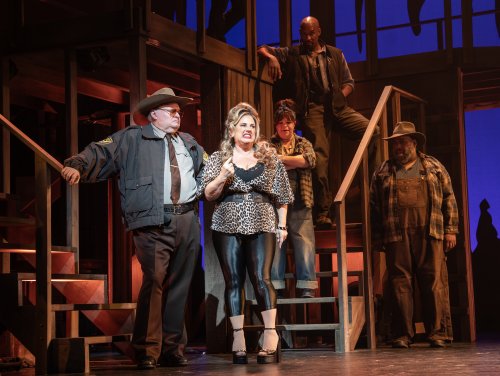
Tom McGowan and Marissa Jaret Winokour in a scene from the Annual Gala Presentation of “Bat Boy: The Musical” at New York City Center (Photo credit: Joan Marcus)
Act Two erupts into inspired lunacy: characters scatter into the woods, where the show finally unleashes its gleeful, bloodstained id. Cameos by Ming-Trent and Newell as a fire-and-brimstone minister and the satyr god Pan, respectively, inject jolts of gospel grandeur and pagan chaos. The ensemble, too, deserves its own lurid headline. Newell stops the show cold with a voice that could raise the dead (or at least wake the cave); and the chorus, a pack of feral townsfolk, deliver both menace and musical precision.
Ultimately, for all the director’s nods toward moral introspection—“don’t deny your inner beast”—the production’s truest insights emerge from its most excessive moments. Bat Boy, like its title creature, is most alive when it stops trying to pass as civilized. The finale, a full-throated descent into Grand Guignol, is a blissful reminder that the show’s heart beats strongest when it’s covered in blood.
Beneath the camp and chaos, Bat Boy remains what it always was: a parable with a pulse. O’Keefe’s rock-opera score jabs with wit but bleeds sincerity; his lyrics cut deep with irony and compassion. The story still howls against hypocrisy—the intolerance of difference, the fear of the Other, the absurd theatre of morality that masquerades as virtue. Bat Boy feels less like a musical and more like a communal exorcism of repression, guilt, and joy. In the capable, chaotic hands of this remarkable company, it doesn’t just sing—it soars, claws, and howls. To want to belong has rarely felt this thrilling. What emerges, through all the shrieks and laughter, is something profoundly moving: a hymn to belonging, a love letter to strangeness, a primal scream for empathy.
Bat Boy: The Musical (through November 9, 2025)
New York City Center Annual Gala Presentation
New York City Center, 131 West 55th Street, in Manhattan
For tickets, visit http://www.nycitycenter.org
Running time: two hours and fifteen minutes including one intermission


Leave a comment