
The New York Pops —2025 Opening Night
Steven Reineke and The New York Pops opened their Carnegie Hall season with a luminous concert tracing the path of great songs from Broadway to Hollywood. Hugh Panaro and Elizabeth Stanley lent the evening its beating heart, blending theatrical soul with cinematic sweep.
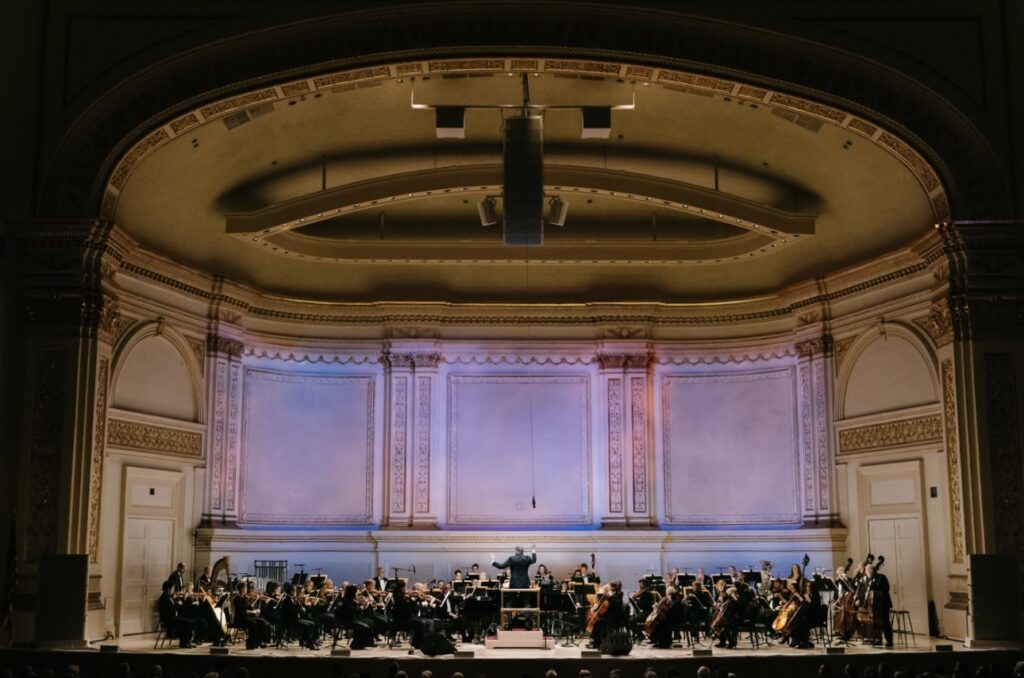
Conductor Steven Reineke and the full New York Pops. Photo by Fadi Kheir
by Jack Quinn
Publisher, Theaterscene.net
The New York Pops opened its 2025–26 season at Carnegie Hall with From Stage to Screen, a program of Broadway and Hollywood storytelling conducted by Steven Reineke. For longtime followers, it was less an opening night than a homecoming — that heady blend of symphonic sweep and show-tune immediacy that Reineke has made his hallmark.
My husband Curtis and I took our familiar places in Box 34 — one box to the left of dead center, perfectly aligned. Our usual companions had passed their seats to our friends, newlyweds Nick and Christina Mendoza, only a week after returning from their European honeymoon, in time for a glamorous evening.
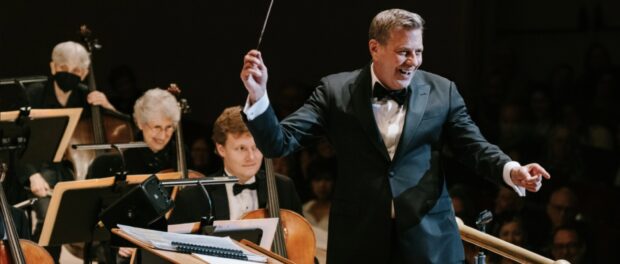
Maestro Steven Reineke conducting the New York Pops. Photo by Fadi Kheir
From Stage to Screen
Reineke launched the night with Leonard Bernstein’s Overture from West Side Story (1957 Broadway, film 1961, arr. Maurice Peress). “It dances and fights at the same time,” he told the audience, and the orchestra answered — brass snarling, strings chasing, percussion cracking like alley echoes.
Then came Jule Styne and Leo Robin’s “Diamonds Are a Girl’s Best Friend,” from Gentlemen Prefer Blondes (1949 Broadway, film 1953). “A kiss on the hand may be quite continental,” Stanley teased, her tone all mischief and mastery. She wrapped each consonant in satin, proving that wit, when sung well, gleams brighter than any gemstone.
Her next offering, Stephen Sondheim’s “Children Will Listen” from Into the Woods (1987 Broadway, film 2014), shifted the air. When she whispered “Careful the things you say, children will listen,” the phrase hovered like a benediction. Reineke called it “a lullaby for grown-ups,” and the orchestra obeyed, thinning to a hush.
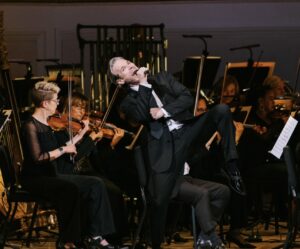
Hugh Panaro with the New York Pops. Photo by Fadi Kheir
Hugh Panaro followed with Mitch Leigh and Joe Darion’s “The Impossible Dream” from Man of La Mancha (1965 Broadway, film 1972). Reineke described it as “a declaration of purpose,” and Panaro delivered it without grand gesture — just clarity and conviction. “To reach the unreachable star” rose from his throat not as ambition but as fact, landing squarely in the heart of the hall.
Alan Menken and Stephen Schwartz’s “Out There,” from Disney’s The Hunchback of Notre Dame (1996 film, stage 1999 Berlin / 2014 U.S.), gave Panaro a cathedral’s worth of space. “Out there, living in the sun,” he sang, his voice swelling to stained-glass brightness. Reineke noted that it was “a film song that behaves like an aria,” and the brass agreed.
John Williams’s Excerpts from Fiddler on the Roof (1964 Broadway, film 1971) let the Pops show its klezmer soul. Violins laughed, clarinets spun circles, and the basses danced as if the whole pit had become a wedding band in Anatevka.
Maury Yeston’s “Unusual Way,” from Nine (1982 Broadway, film 2009), found Stanley alone in a pool of light. “In a very unusual way you’re such a part of me,” she sang, her vibrato trembling like confession. Reineke called it “a love song for our mistakes,” and she made it sound like forgiveness.
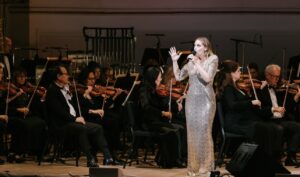
Elizabeth Stanley and the New York Pops. photo credit is Fadi Kheir
From Les Misérables (1980 Paris, 1985 Broadway, film 2012) came “Bring Him Home.” Reineke reminded us, “It’s the quiet moments that travel farthest.” Panaro’s “He’s young, he’s only a boy” floated on a thread of air so fine the audience scarcely dared breathe until it broke into applause.
The first half ended with Jason Robert Brown’s “One Second and a Million Miles,” from The Bridges of Madison County (2014 Broadway, from the 1992 novel and 1995 film). “I don’t want to live without you,” they sang together, voices weaving like twin rivers. It was the most honest chemistry of the night — two actors meeting in perfect musical present tense.
The Overture and “Oh, What a Beautiful Mornin’” from Rodgers and Hammerstein’s Oklahoma! (1943 Broadway, film 1955) opened the second half with prairie light. “There’s a bright golden haze on the meadow,” Panaro sang, easy and unhurried, and for a moment even Carnegie Hall felt sun-drenched.
From Sweeney Todd (1979 Broadway, film 2007) came “Johanna.” “I feel you, Johanna,” he sang softly, his phrasing tender against the orchestra’s quiet menace. Reineke had introduced it as “beauty in the midst of horror,” and Panaro found both in equal measure.
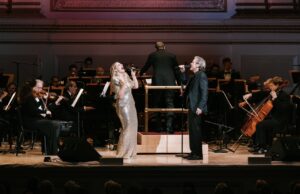
The New York Pops Conducted by Steven Reineke with Elizabeth Stanley (l) and Hugh Panaro (r). photo credit is Fadi Kheir
Stanley returned for The Sound of Music (1959 Broadway, film 1965), beginning with the “Prologue” and title song. “My heart wants to sing every song it hears,” she sang with unforced warmth. The flutes shimmered like morning air, and Reineke smiled: “You can almost see the mountains.”
Then came “Don’t Rain on My Parade” from Funny Girl (1964 Broadway, film 1968). “I’m gonna live and live now,” Stanley belted, fire meeting brass. Reineke called it “Broadway’s declaration of independence,” and she claimed it utterly — triumphant, grounded, joyfully her own.
Andrew Lloyd Webber’s “Jellicle Ball,” from Cats (1981 London, 1982 Broadway), gave the Pops license to prowl. Reineke quipped, “No one leaves this stage without channeling a cat,” and the percussion section obliged with sinuous delight.
Stephen Flaherty and Lynn Ahrens’s “Back to Before,” from Ragtime (1998 Broadway adapted from E. L. Doctorow’s 1975 novel), brought Stanley to a slow boil. “We can never go back to before,” she sang, every word weighted with earned wisdom. Reineke introduced it as “a song that whispers the word revolution,” and she let it bloom into resolve.
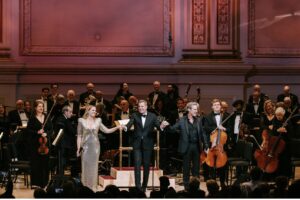
The New York Pops with guest stars Elizabeth Stanley and Hugh Panaro. Conductor Steven Reineke. photo credit is Fadi Kheir
Panaro reclaimed his signature role with “The Music of the Night,” from The Phantom of the Opera (1986 London, 1988 Broadway, film 2004). “Let your mind start a journey through a strange new world,” he invited, and the audience followed willingly. Reineke, smiling, murmured, “He practically owns this one.” The ovation began before the final chord resolved.
For the finale, Panaro and Stanley joined for Alan Menken and Howard Ashman’s “Suddenly Seymour,” from Little Shop of Horrors (1982 Off-Broadway, film 1986, Broadway 2003). “Nobody ever treated me kind,” Stanley began; “Suddenly Seymour is standing beside me,” Panaro answered, and the house roared. Reineke called it “a love song for people who never thought they’d get one.” They made it feel earned — funny, fierce, and real.
When the last chord faded, the evening’s thesis stood proven: songs born for the stage, shaped by the screen, and reborn again in the hands of Reineke’s Pops still speak directly to the heart. Great melodies, like great dreams, never settle in one home — they travel.
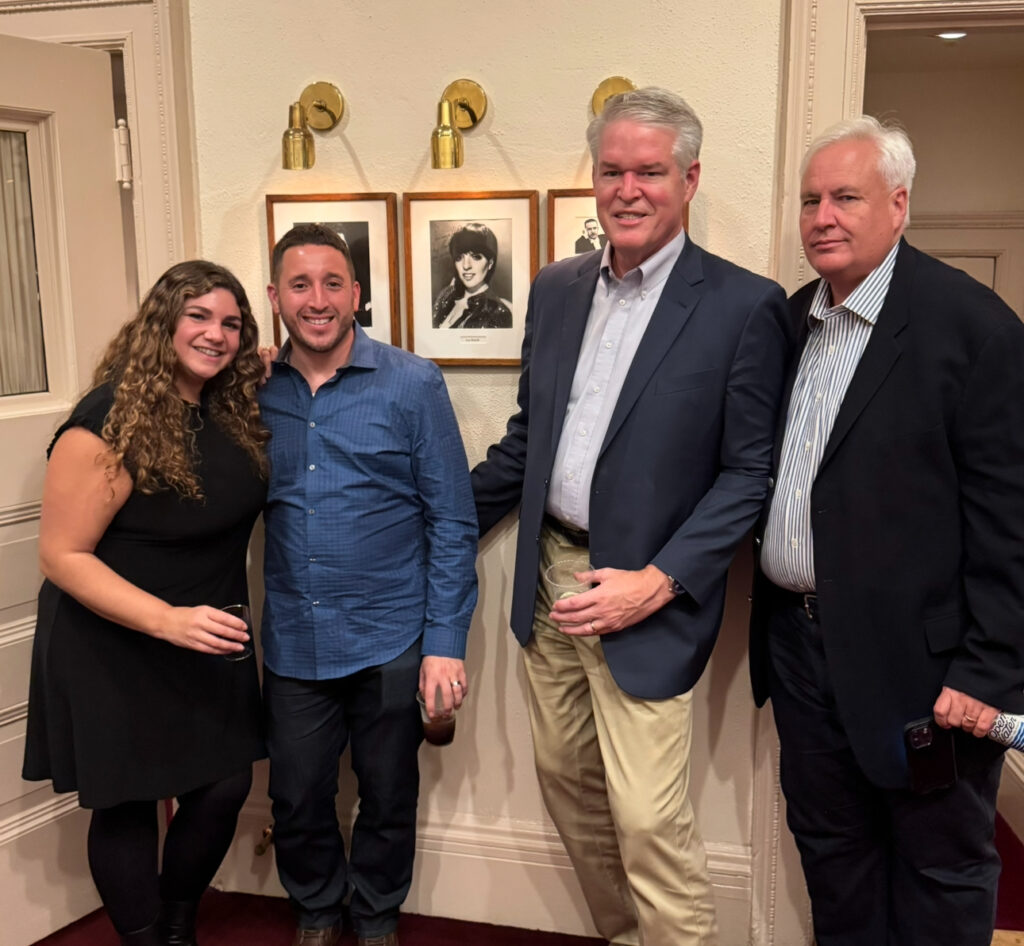
Christina Mendoza, Nick Mendoza, Jack Quinn, Curtis Strohl


Leave a comment