
Other
Tony Award-winner Ari’el Stachel sweats (a lot), stuns, and soul-searches in his riveting solo odyssey through mental illness, identity, and the ache to belong.
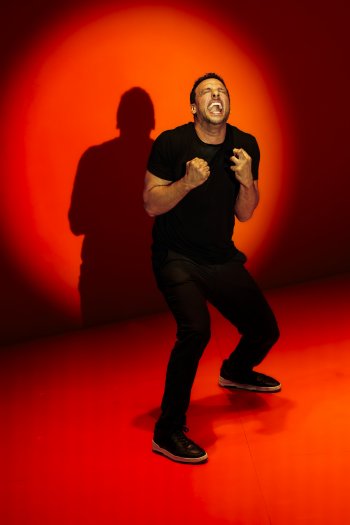
Ari’el Stachel in his one-man show “Other” at Greenwich House Theatre (Photo credit: Ogata Photography)
In his solo show Other, now unfolding with searing intensity at the intimate Greenwich House Theater, Tony Award-winner Ari’el Stachel lays bare not only his prodigious talents but also his deeply unsettled psyche. From the opening scene—an almost comic vaudeville of nervous breakdown—Stachel invites us into the sweaty, trembling engine room of his own selfhood. It is, by turns, impressive, courageous, and undeniably unsettling.
Audiences may remember Stachel’s Broadway debut in The Band’s Visit, where he embodied a suave Egyptian trumpeter with disarming charm and humor—a performance that earned him the Tony and, with it, the heavy mantle of public recognition. From the grand stage of Radio City Music Hall, Stachel stood, visibly moved, and delivered a tear-streaked acceptance speech that was as heartfelt as it was historic. With emotion catching in his throat, he paid tribute to his parents whose unlikely union shaped the complex heritage he had, for years, struggled to embrace. He spoke candidly of the shame that once led him to conceal his Middle Eastern roots, offering both a confession and a reclamation. In honoring The Band’s Visit’s triumph that evening, Stachel reframed the show’s success not merely as a theatrical achievement, but as a cultural milestone—lifting it up as a rare and resonant moment of representation for both Jewish and Arab identities on the Broadway stage.
But as Stachel shows us here, that glamorous moment of triumph quickly devolved into a private storm of panic: overwhelmed by congratulations, he fled repeatedly to the bathroom, desperately mopping sweat from his brow with paper towels. This moment—both comic and tragic—is the dramatic overture to Other, and it sets the tone for what follows: a raw, intricately choreographed confession delivered by a performer in perpetual motion, not only physically, but emotionally, culturally, and spiritually.
What first impresses is Stachel’s range. He is a human kaleidoscope, cycling through an array of vivid impersonations—a Korean-American bro, a kvetching elderly Jewish couple, a tipsy white woman, a gushing gay publicist—all congratulating him in the wake of the Tony win. These portrayals are sharply observed, often hilarious, and performed with such specificity that they feel almost hyperreal. They are not caricatures; they are fully inhabited beings. And they serve as a kind of chorus, reminding us of the performative self that Stachel has long been forced to curate, adapt, and protect.
But Other is not merely a showcase of mimicry. It is, more fundamentally, a reckoning. Stachel tells us early on that his sweating is not theatrical exaggeration—it is a symptom of his long-diagnosed obsessive-compulsive disorder, a condition that first made itself known when he was just five years old. The sweat, then, becomes its own kind of character: visible, undeniable, unavoidable. It’s a physiological emblem of mental torment, of the effort required not only to perform a role but to contain a mind in perpetual unrest.
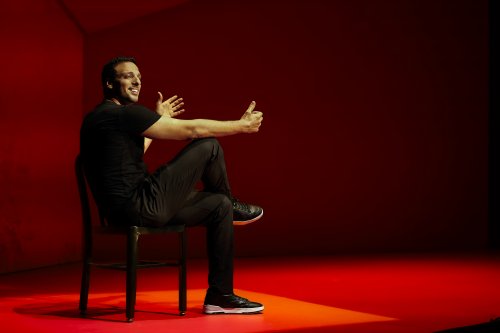
Ari’el Stachel in his one-man show “Other” at Greenwich House Theatre (Photo credit: Ogata Photography)
To manage his anxiety, Stachel tells us, his therapist suggested he name the intrusive, destabilizing voice inside his head. He christened it “Meredith,” after the calculating stepmother-to-be in The Parent Trap—a nod to both his humor and his pain. Meredith becomes a literal presence in the play, a dark whisper of self-sabotage, and in dramatizing this internal saboteur, Stachel invites the audience into the most private of spaces: the battle between selfhood and self-erasure.
One can be easily haunted by the very questions the performance provokes. Is this catharsis or exposure? Therapy or trauma reenacted on cue? Is it appropriate to feel concern for the artist beyond the frame of the work? Do we, as spectators, have a moral obligation to wonder if the stage is helping or harming? Or are we simply projecting our discomfort, our need to categorize suffering into palatable narrative arcs? These questions, unanswerable as they are, linger in the theater air long after the house lights go down. And perhaps that is precisely the point. Though the prevailing throughline of Other is anxiety—and that choice is reportedly a directorial emphasis by veteran theater-maker Tony Taccone—the show also touches on another equally rich and resonant theme: Stachel’s complex, sometimes contradictory cultural identity.
The title Other gestures toward this duality, or rather, multiplicity: Stachel is both Arab and Jewish, both Yemeni and Ashkenazi, both New Yorker and outsider. His parents’ unlikely courtship—his father, an Israeli Yemeni cab driver, and his mother, an American-born Ashkenazi Jew studying medicine—began in a folk dance circle in San Francisco and ended in divorce. “They thought being Jewish was enough to build a life together,” he remarks with weary wit, “but as it turns out, Ashkenazi Americans and Yemenite Israelis are different species.”
In another poignant and revelatory scene, Stachel recalls his childhood in the wake of 9/11. He was ten years old. The first time he saw people on television who looked like his father, they were being identified as terrorists. When he asked his father, “Aba, are we Arab?” the answer came swiftly: “No. We Jews.” But the world around him wasn’t so easily convinced.
Bullied, ostracized, and confused, Stachel began an elaborate and heartbreaking process of camouflage. At one school, he pretended to be white. At another, Black. He even skipped his high school graduation, fearing his father’s visible presence would undo the persona he had so carefully constructed. These moments are disturbing, yes—but also achingly familiar to anyone who has ever tried to pass, to please, to disappear inside a more palatable version of himself.
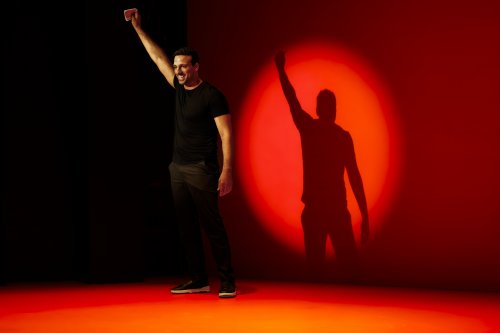
Ari’el Stachel in his one-man show “Other” at Greenwich House Theatre (Photo credit: Ogata Photography)
There are moments of levity—genuinely funny, sly, even joyful passages—particularly as Stachel recounts the camaraderie he shared with fellow Middle Eastern actors. At one point, he meets Aziz, another struggling performer, in a waiting room for an audition to play “Terrorist #2” on CBS. The absurdity of this moment is rendered with righteous satire, but also with a tenderness for the brief hope that solidarity can offer. Together, they help found MENASA—a community for Middle Eastern, North African, South Asian actors. But solidarity, like identity, is fragile. The group fractures when Stachel’s casting as an Egyptian in The Band’s Visit sparks controversy. Is he Arab enough? Is he too Jewish? Is he appropriating? Betraying? Bridging?
The dream of unity disintegrates, definitively, in the aftermath of the Hamas attacks on October 7, 2023. In the play’s most politically fraught moment, Stachel tries to express a truth that feels both ancient and radical: “I don’t even understand these divisions. We come from the same land. Eat the same foods. We sing the same melodies. How can I pick a side when all sides are inside of me?” It’s a powerful statement—one that refuses to simplify or sanitize. And predictably, it draws ire. Onstage, projected in brutal clarity, we see the social media backlash: invective from all sides, cruelty masquerading as purity. What he hoped would serve as a gesture of unity instead ignites a digital firestorm, unleashing a torrent of antisemitic vitriol from every corner of the internet. It is a moment of cruel irony: an olive branch consumed by flames.
Projection designer Alexander V. Nichols masterfully conjures the chaos with a blinding visual onslaught—tweets, slurs, threats, and denunciations cascading across the stage in a relentless deluge, evoking the dizzying, suffocating violence of public shaming in the digital age. The effect is both visually and emotionally overwhelming, an apt theatrical corollary to the disintegration of intent in the age of weaponized perception. But this moment, more than any other, clarifies the necessity of this work. In a time of increasing polarization, what could be more radical than complexity?
Directed with a firm yet unfailingly sensitive hand by the seasoned Tony Taccone, Other unfolds with a kind of elegant sparseness that allows its emotional and narrative weight to take full command of the space. The elegant austerity of Afsoon Pajoufar’s stage provides the ideal canvas upon which Stachel paints his deeply personal portrait. Eschewing theatrical excess in favor of restraint, Pajoufar crafts a space that feels at once spare and resonant—a kind of emotional echo chamber in which Stachel’s expressive body and richly modulated voice command full attention. This simplicity is not a lack, but a revelation: every gesture, every pause, every intake of breath becomes magnified, imbued with consequence.
Nichols’ lighting and projection design work in exquisite tandem with this minimalism, layering the stage with a visual and emotional texture that amplifies rather than distracts. His light shifts are tender yet exacting, and his projections bloom across the space like memories struggling to materialize—by turns ethereal and overwhelming. Together, these design elements cultivate an intimacy that pulls the audience ever closer, collapsing the distance between performer and spectator.
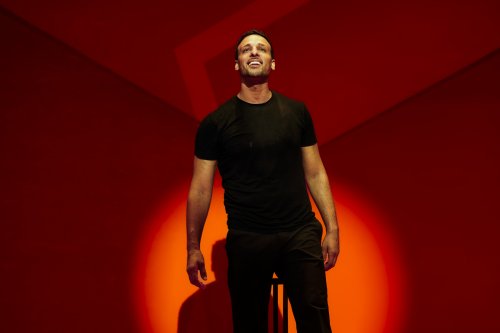
Ari’el Stachel in his one-man show “Other” at Greenwich House Theatre (Photo credit: Ogata Photography)
Other is not a perfect play, nor does it try to be. It is a deeply personal, frequently chaotic, occasionally uncomfortable excavation of one man’s interior landscape. But what it lacks in polish, it more than compensates for in truth, specificity, and urgency. Stachel is not just acting—he is offering himself as a kind of living document, a trembling bridge between identities, communities, selves.
There are times, yes, when we can be worried for him, when the sweat seemed too real, when the confession felt too raw. But perhaps that’s exactly what live theater is for—to make us feel not only entertained, but implicated: to blur the lines between performer and witness, character and soul. It is no small feat to thread such a dense tapestry of themes—mental illness, cultural dislocation, familial legacy, public scrutiny—into the confines of a single, uninterrupted act. Yet Stachel, in collaboration with director Taccone and dramaturg Madeleine Oldham, has sculpted a remarkably lean and purposeful script that manages to carry this considerable weight without buckling. The result is a performance marked by a delicate interplay of charm, emotional nakedness, and raw theatrical intensity. At times, the evening flirts with catharsis; at others, it barrels headlong into something more primal—less a monologue than an exorcism, as if the stage itself must be purged of long-buried ghosts before it can hold the possibility of healing.
In Other, Ari’el Stachel gives us himself, unguarded and unedited. We are lucky to receive him, even as we squirm in our seats, unsure whether we are witnessing healing or harm. The only certainty is this: he has something urgent to say, and he has earned the right to say it—on his own terms, in his own words, and through the body that has borne it all.
Other (through December 6, 2025)
La Chanze Productions
Greenwich House Theatre, 27 Barrow Street, in Manhattan
For tickets, visit http://www.othertheplay.com
Running time: 90 minutes without an intermission


Leave a comment