
Unstuck and Unflinching: Olivia Levine on Comedy, Control, and Coming Clean
The actor, writer, and comedian on queerness, OCD, and learning to laugh at the things that once scared her.

Actor, writer comedian Olivia Levine, star of her woman show “Unstuck at the SoHo Playhouse
Few performers can turn public masturbation and poop stains into tools for empathy, but Olivia Levine does it nightly in her fearless solo show. Unstuck isn’t just confessional—it’s an act of liberation disguised as stand-up therapy.
“I love playing with that dynamic — every audience changes what happens in the moment, and that’s the fun of it.”
On opening night of Unstuck, Olivia Levine’s one-woman show at the Soho Playhouse, I found myself seated just across the aisle from her mother. Watching both of them became its own kind of theater. As Olivia moved through scenes that merged queerness, OCD, and family history into a comic exorcism, her mother’s expressions registered every beat—laughter, discomfort, pride—as though she were hearing some of it for the first time.
Three days later, when we met for an interview, Levine was radiant and quick-witted, part comedian and part confessor, still riding the afterglow of exposing so much of herself onstage.
“I’ve been doing this show for a long time,” she began. “The last time my mom saw it was probably four or five years ago, when it was in a really different shape. So a lot of it was new to her, which was cool.” She smiled. “Part of this show is having a relationship to the audience and cultivating that every night a little bit differently. My mom’s such a good audience member. She brought a ton of friends that night, and it made the room feel really alive.”
The Art of Audience
For Levine, the crowd isn’t a backdrop—it’s a living collaborator. Her show is intimate, often exposing the kind of stories most people bury: intrusive thoughts, shame, and the messy intersections of sex and control. She relies on the audience to meet her there.
“Sometimes people’s reactions change what happens in the moment,” she says. “When my mom’s friends came, they’d whisper or gasp or laugh in surprise—and I can feel that energy. It changes how I tell a story.”
Not all audiences are alike, and that’s the beauty of it. She recalls performing an early version for an older crowd brought by her director’s grandparents. “I was like, oh God, what are they going to think?” she laughs. “But afterward, they all wanted to talk. Maybe not about queerness or OCD, but something human underneath. That’s what I love—people relate to what they relate to.”
At the Edinburgh Fringe, where the show ran for nearly a month, she found yet another rhythm. “It’s exhausting but magical,” she says. “Fringe is like summer camp for adults—chaotic, fun, a citywide performance experiment. You’re handing out flyers in the street saying, Hey, you like OCD, gay things, and public masturbation? Come see my show! And people actually do.”
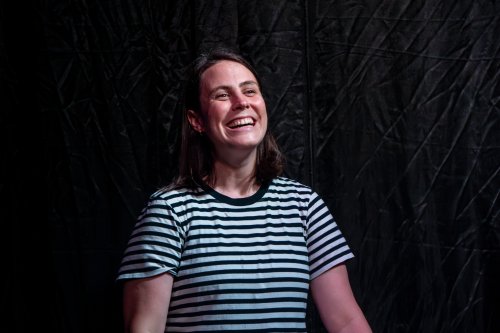
Olivia Levine as she appears in her one woman show “Unstuck” at the SoHo Playhouse
Comedy, Shame, and the Body
At its core, Unstuck intertwines two of Levine’s most personal journeys—her coming-out story and her lifelong struggle with obsessive-compulsive disorder. Both, she says, trace back to control and shame.
“A lot of the shame I had around my body probably tied to internalized homophobia,” she explains. “My OCD really flared up around body stuff, vagina stuff—whatever. Once I came into my sexuality, that shame dissipated a lot.”
Realizing she was queer made her more honest about her disorder. “There’s always a sense of otherness anyway,” she says. “In high school I was terrified to talk about anything sexual—now I talk about it onstage! The more comfortable I became with my sexuality, the more comfortable I became talking about everything else.”
Laughter as Language
Levine’s humor began as armor and evolved into something sharper and more generous. “In retrospect, I realize I was masking,” she says. “When I came out, I thought I was open—but it took me until my mid-twenties to realize I still wasn’t fully comfortable. Once I was honest about that, I became better at using comedy truthfully.”
Now, laughter is both a scalpel and a balm. “I know I’m talking about things that make people uneasy,” she says. “So I play with audience engagement—like asking who gets poop stains. If no one raises their hand, that’s funny too. It’s about disarming people.”
Family, Risk, and Reflection
Despite her fearlessness, Levine remains mindful of how her honesty lands at home. “I’m comfortable sharing the cringy body stuff,” she says, “but what makes me more anxious is possibly offending my parents—especially when I say my anxiety fed into my mom’s anxiety. Early on my dad felt sad and a little defensive hearing it. I’m always aware of that.”
Still, her willingness to lay bare private material is rooted in tenderness. “It’s cool and weird to see those things externalized,” she says. “It didn’t change my relationship to my body as much as how I see my OCD’s impact. I love being onstage—discovering moments with the audience makes me feel alive.
Getting “Unstuck”
“When my OCD is bad, I feel stuck—like I can’t move on until I complete a compulsion,” Levine says. “I later found out there’s actually a movie about kids with OCD called Unstuck! I had no idea. But it fits. It’s about how we get unstuck not just from OCD, but queerness, relationships, all of it. It’s both aspirational and real—it’s a practice.”
She’s frank about the misconceptions. “Most people think OCD is counting or cleaning,” she says. “But harm OCD—the fear of hurting others—was a big part of my childhood. Once I was properly diagnosed, everything changed. The right therapy isn’t talk therapy; it’s exposure work. If people don’t know they have it, they don’t get the right help.”
The Voice Inside
A recurring presence in Unstuck is “The Big O,” a guiding inner voice that interrupts her thoughts. “It’s the more knowledgeable version of myself,” she explains. “The voice telling me to slow down, to be gentler. It keeps me honest. Sometimes that honesty is painful, but it’s always truthful.”
Earlier drafts leaned heavier on the device. “We had to balance explaining OCD and keeping it theatrical,” she says. “Now it’s pared down. It’s not an angel or a devil—just the honest part of me.”
The Company She Keeps
Outside of theater, Levine finds belonging through queer sports—what she affectionately calls “Dyke Soccer” and her current queer basketball league. “It was freeing to be around queer people who looked and lived differently,” she says. “Growing up, my teams were all straight girls, so being in a queer athletic space felt like home. Now I play basketball with queer friends—it’s the same energy.”
Looking Forward
After years of performing Unstuck, Levine feels both grateful and ready to move forward. “I’d love to keep doing the show as long as anyone will have me—tour it, film it, anything,” she says. “But I’m also writing a new solo show and a few film projects. My comedy will always be personal, but it doesn’t have to be about OCD. I’m really interested in desire right now—understanding relationships through a queer lens.”
She pauses, thoughtful but smiling. “At the end of the day, I think it’s important to expand and explore other dynamics,” she says. “But I have a lot to mine from my own life, and it would be a shame not to use that.”
Full Circle
As we wrapped up our conversation, I thought back to opening night—to her mother’s face, alive with recognition and surprise. In Unstuck, Levine wrestles publicly with the private rituals of control, shame, and love. Yet watching her mother laugh in the same breath that her daughter confesses, it was clear: Olivia Levine has already achieved what her show’s title promises. Onstage and off, she’s finding her way—unstuck at last.
Unstuck (through November 2, 2025)
SoHo Playhouse, 15 Vandam Street, in Manhattan
For tickets, visit http://www.ci.ovation.com/35583/production/1250027
Running time: 60 minutes without an intermission

Leave a comment