
The Wild Duck
Ibsen's tragicomedy gets a rare revival, a co-production of Brooklyn's Theatre for a New Audience and D.C.'s Shakespeare Theatre Company.
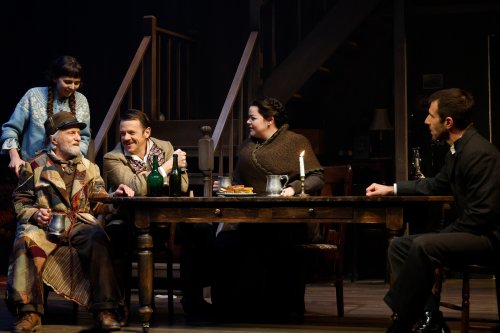
Maaike Laanstra-Corn as Hedvig, David Patrick Kelly as Old Ekdal, Nick Westrate as Hjalmar Ekdal, Melanie Field as Gina Ekdal and Alexander Hurt as Gregers Werle in a scene from the Theatre for a New Audience & Shakespeare Theatre Company’s production of Ibsen’s “The Wild Duck” at the Polonsky Shakespeare Center (Photo credit: Gerry Goodstein)
Although the influence of Henrik Ibsen’s The Wild Duck can be seen in Gorky’s The Lower Depths, O’Neill’s The Iceman Cometh, Arthur Miller’s All My Sons and many of the plays of Tennessee Williams, it is not revived very often. This may be explained by the fact that it has a much larger cast than most of Ibsen’s prose dramas: the last major New York revival at the Brooklyn Academy of Music in 1981 had a cast of 23. However, there may be another reason: it is probably Ibsen’s most melodramatic play which makes it difficult to stage.
The latest revival has been directed by Simon Godwin, artistic director of Washington, D.C.’s Shakespeare Theatre Company, in a co-production with Theatre for a New Audience. This revival uses the contemporary version by David Eldridge, first seen at London’s Donmar Warehouse in 2005 which combines some of the minor characters, shortening the cast list. While the text is clear, the uneven acting and interpretation of the characters undermines the play’s powerful and tragic resolution.
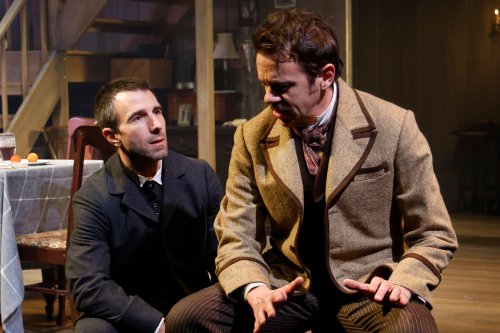
Alexander Hurt as Gregers Werle and Nick Westrate as Hjalmar Ekdal in a scene from the Theatre for a New Audience & Shakespeare Theatre Company’s production of Ibsen’s “The Wild Duck” at the Polonsky Shakespeare Center (Photo credit: Gerry Goodstein)
The Wild Duck begins with a dinner party scene at the home of the merchant Håkon Werle in honor of the return of his son Gregers that is meant as a prologue in which we are introduced to the characters and the conflicts. The play has a great deal of foreshadowing and symbolism: the injured wild duck, two of the characters going blind, two marriages -one based on total honesty and one on total secrecy, a dishonest business deal which sent one character to prison but not the other, etc. Some critics have called this play a tragicomedy but that may be as a result of the play’s blatant melodrama rather than its comic content.
Gregers has returned home to his father’s house in town for the first time in 17 years after running his mill in the far North, and since his mother’s death. To the celebratory dinner, he has invited his former schoolmate Hjalmar Ekdal who he has not seen or heard from in all this time. His father had written him that Hjalmar had gotten married but failed to mention that he had married Gina, their former maid whom his late mother believed to be having an affair with her husband. It is also revealed that both Gregers’ father and Hjalmar’s daughter with Gina are going blind, though Hjalmar credits his wife’s mother for this turn of events. We also find out that Hjalmar’s father who had been the elder Werle’s partner had gone to jail but Werle was probably just as guilty. To make amends, Werle set Hjalmar up in a photography business (which he has little interest in) and given his father copying work since he has gotten out of prison.
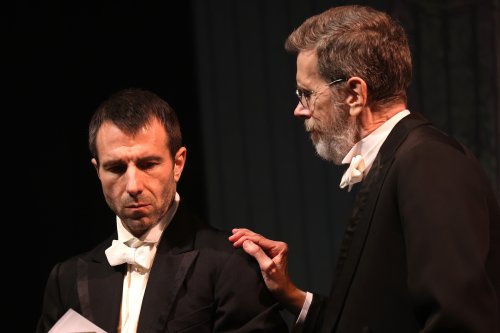
Alexander Hurt as Gregers Werle and Robert Stanton as Håkon Werle in a scene from the Theatre for a New Audience & Shakespeare Theatre Company’s production of Ibsen’s “The Wild Duck” at the Polonsky Shakespeare Center (Photo credit: Hollis King)
Unfortunately, Gregers is the worst kind of idealist and reformer, one who thinks everyone should face the truth of their illusions, not realizing that man cannot live with too much truth and no illusions. Visiting the home of Hjalmar, Gina and their daughter Hedvig, Gregers decides that Hjalmar needs to know about the affair between his wife and his father all those years ago in order to clear the air. He has also put two and two together and figured out that Hedvig’s father is really the elder Werle. Hedvig, who is kept home from school to safeguard her eyes, spends her time helping retouch her father’s photographs and caring for a wounded wild duck that lives in their attic, shot by Gregers’ father on one of his hunting trips. What occupies Hjalmar while his wife runs the business is dreaming up an unnamed invention that he hopes will restore the family reputation. Unfortunately, Gregers sorely misunderstands his self-absorbed friend’s ability to deal with the truth and tragedy results from the revelations of the past.
Godwin’s production is extremely uneven as the actors do not all have a strong hold on their characters. While The Wild Duck has no central hero or protagonist it is Gregers Werle who propels the action with his constant meddling and offering advice. As played by Alexander Hurt, Gregers does not have a clear interpretation: is he simply a serious reformer and idealist, is he a comic character, is he a truly misguided do-gooder, or is he a warped character trying to get back at his father? Hurt never makes this clear. Gregers’ hero worship of his boyhood friend Hjalmar Ekdal is nearly absurd as Hjalmar has done nothing as of yet to deserve it and in the time we see him he uses every excuse to procrastinate as to starting any meaningful work. Nick Westrate is more successful in making Hjalmar a pathetic character who has little or no self-knowledge, but seems to live in a dream world of unreality.
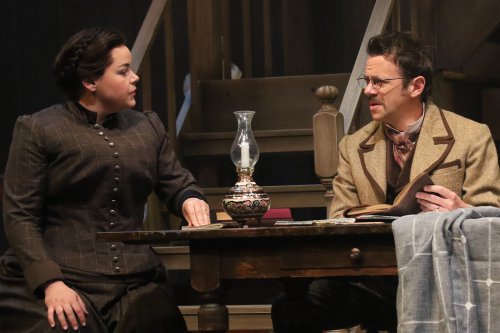
Melanie Field as Gina Ekdal and Nick Westrate as Hjalmar Ekdal in a scene from the Theatre for a New Audience & Shakespeare Theatre Company’s production of Ibsen’s “The Wild Duck” at the Polonsky Shakespeare Center (Photo credit: Gerry Goodstein)
As his wife Gina, Melanie Field seems too ironic needling her husband at all times, though as written she seems to be perfectly satisfied with the man and his limitations. Unaccountably Godwin has allowed Maaike Laanstra-Corn as their 14-year- old daughter Hedvig to shriek almost all of her lines which does not make her seem younger, only misguided. As Hjamar’s father Old Ekdal, a broken man after his prison term and loss of his military rank, Daniel Patrick Kelly is credible as the alcoholic former hunter who is satisfied to go hunting in his attic to shoot rabbits. On the other hand, Robert Stanton as the hypocritical elder Werle cannot make up his mind whether he is a shrewd businessman or a villain caught out by his son. Matthew Saldívar’s Dr. Relling is almost insultingly paradoxical toward the idealistic Gregers.
The design team is also uneven in the treatment of this material. Andrew Boyce’s set for Werle’s dinner party is too small for the elegant mansion, while his design for Hjalmar’s photographic studio and home is too big causing the actors to continually have to cross the stage in Godwin’s blocking. While Heather C. Freedman’s costumes are generally satisfactory, Hjalmar is too well dressed for a man only eking out a subsistence wage. Stacey DeRosier’s lighting has to take into consideration the skylight in Hjalmar’s studio whose shades obscure much of the light source.
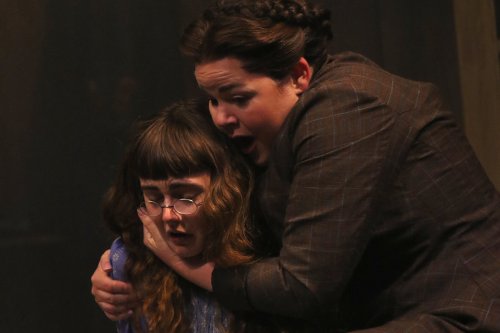
Maaike Laanstra-Corn as Hedvig and Melanie Field as Gina Ekdal in a scene from the Theatre for a New Audience & Shakespeare Theatre Company’s production of Ibsen’s “The Wild Duck” at the Polonsky Shakespeare Center (Photo credit: Gerry Goodstein)
It is a disappointment that this rare revival of The Wild Duck is not more successful. However, it must be recalled the last New York production in 1981 directed by Arthur Penn using Thomas Babe’s then new version was also deemed a failure. It seems that Ibsen has written a play that presents directors and actors with insurmountable problems and choices.
The Wild Duck (through September 28, 2025)
Theatre for a New Audience & Shakespeare Theatre Company
Samuel H. Scripps Mainstage at the Polonsky Shakespeare Center, 262 Ashland Avenue, in Brooklyn
For tickets, visit http://www.tfana.org
Running time: two hours and 30 minutes including one intermission


Leave a comment