
The Essentialisn’t
Davis explores a world of uncertainty and finds her voice while seeking to answer one question: can you be Black and not perform?
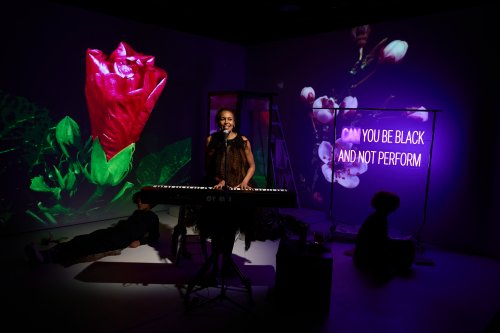
Elsa Davis in a scene from her “The Existentialisn’t” at HERE Arts Center (Photo credit: Daniel J. Vasquez)
The Essentialisn’t, by design, defies easy categorization. Creator/performer/director Eisa Davis’ (Passing Strange, Warriors with Lin-Manuel Miranda) new work veers between mediums and makes use of many tools while exploring its themes of what it means to perform as Black woman in a hostile world.
Before the show, the audience is ushered into a mini-art-gallery that introduced the themes of the work regarding performance and Blackness. The art pieces are minimalistic yet thought-provoking, and the use of a different format is quite admirable. The main show itself is a mix of experimental performance art, stream-of-consciousness-style philosophical musings from Davis, and improvisation.
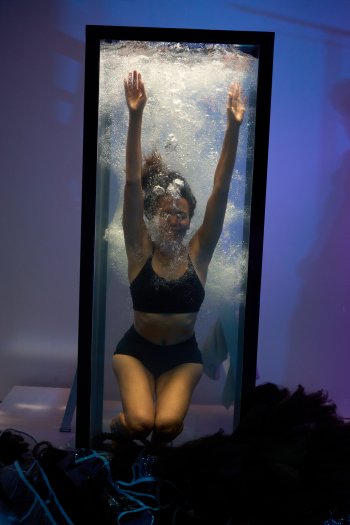
The most prominent feature of the cluttered stage (overseen by stage manager Alexus Jade Coney) is a large tank of water. Davis begins and ends the show in the tank. She pontificates on the thematic resonances of water and what it might represent, tying it back to the gallery exhibition nicely. Davis herself is quite poised during this scene, giving herself over entirely to the ethereality of the moment. Water, in this case, best functions as a catharsis in the show. When Davis finally immerses herself, there’s a sense of triumph and rebirth, a baptism of self-actualization. Combined with a backing track (overseen by sound designer Chris Payne) that Davis harmonizes with, the sequence evokes a sense of awe and history. The rest of the show intentionally deviates from that tone, allowing for an interesting contrast.

Elsa Davis in a scene from her “The Existentialisn’t” at HERE Arts Center (Photo credit: Daniel J. Vasquez)
Davis is generally personable on stage. She has a quiet ease to her demeanor that makes everything in the show feel perfectly natural, as if there is no performance and she is simply talking to whoever happens to be there. Through her stage presence she excellently blurs the line between performing and not-performing, musing that the latter might not be possible at all.
Her singing, a major piece of the show, is deliberately un-theatrical, evoking quiet idle time rather than a grand display of melodrama and technical ability. Frequently accompanying herself on the keyboard, Davis dips in and out of singing and talking, performing and not-performing, as if she’s just at home at the piano, thinking out loud. Davis’ personal charisma grounds the show in reality and keeps it emotionally engaging. The nature of performance itself may be complex, but Davis is a delight to watch onstage.
Davis sometimes invites the audience to share in the impossibility of performance qua performance, most strikingly when she asks the audience to sing as badly as possible, because that’s something nobody ordinarily does in front of other people. It’s an oddly personal moment, a room full of total strangers doing something so embarrassing yet so mundane, and it speaks to the charisma of Davis that she could rope the attendees into fully participating. Given the show’s central premise, one can appreciate the forcible dropping of all pretensions inherent to such an experience. The lights (coordinated by lighting designer Cha See) go back on for this section, removing the usual darkness-provided anonymity from the audience.
Video screens (handled by video designer Skye Mahaffie) are employed to mixed effect. More often than not they seem a distraction from Davis herself, who rarely needs the help of a video screen to explore the show’s ideas.
Jamella Cross (Bulrusher) and Princess Jacob (The Christians) play the Sovereigns, who are onstage with Davis throughout. At points they serve as a kind of Greek chorus for Davis, responding to her rhetorical questions directly or becoming representations of larger forces the work seeks to represent. The duo maneuver gracefully around the cluttered stage, doing an excellent job of knowing when to draw the audience’s attention and when to not.
The costumes (overseen by costume designer James Gibbel) are quite innovative, particularly the cloak made of wigs that appears early on in the show. Davis herself goes through a few different costumes, from a white dress to the aforementioned wig getup.
The Essentialisn’t is a complex piece. Davis explores a world of uncertainty and finds her voice while seeking to answer one question: can you be Black and not perform? This question is ultimately unanswerable, and so the show doesn’t try. The personal anecdotes and philosophizing are rarely satisfying, often not building to anything in particular, but the show stays entertaining and interesting off the back of Davis’ force of personality.
The Essentialisn’t (through September 28, 2025)
HERE Arts Center, 145 6th Ave, New York, NY, 10013
For tickets, visit http://www.here.org
Running time: 95 minutes without an intermission


Leave a comment