
we come to collect: a flirtation, with capitalism
OBIE-winner Jenn Kidwell and ASL artist Brandon Kazen-Maddox dive into the filthy, hilarious chaos of capitalism in this bold, biting, must-see ride.
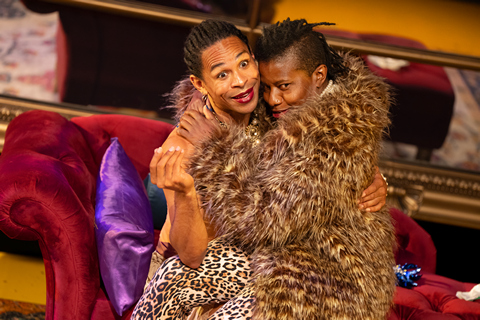
Brandon Kazen-Maddox and Jennifer Kidwell in a scene from Kidwell’s “we come to collect: a flirtation, with capitalism” at The Flea Theater (Photo credit: Julieta Cervantes)
Jennifer Kidwell’s we come to collect: a flirtation, with capitalism is not so much a theatrical production as it is a revelation—an offering, a conjuring, a glittering séance of self-examination draped in velvet and lit by the shimmer of a slightly crooked chandelier. Co-conspirators Kidwell and Brandon Kazen-Maddox are not here to collect, as the title slyly suggests. No, far from it. They have arrived bearing gifts: extravagant, irreverent, and comforting…gifts of laughter, of vulnerability, of truth. Gifts that ask nothing in return but your full, unguarded presence. Premiering at The Flea Theater in TriBeCa, this audacious production gleefully dismantles the social and economic scaffolding that props up our daily lives, only to replace it with something far more anarchic, more tender, and ultimately more human.
Jian Jung’s scenic concept for the stage, lush and decadent, recalls the parlor of a haunted Southern estate—heavy drapery, a faintly leering chandelier dangling askance, and a massive mirror that doubles as a projection screen, reflecting both our faces and our complicity. Evan Spigelman’s lighting is sensitive to the mirrored surface as well as the lush fabrics throughout.
Reclined upon a velvet settee is Kazen-Maddox, who signs with an expressive fluency that becomes its own mode of choreography, a language of both urgency and play. Beside him, Kidwell, equal parts philosopher and provocateur, gazes into the mirrored abyss and beckons us in.
From this beguiling mise-en-scène, the duo embarks on a wild, exhilarating ride that feels equal parts confessional, carnival, and consciousness-raising encounter group. The audience is implicated from the start—not merely as spectators, but as participants, as subjects, as co-authors of the evening’s emotional and political inquiry. And what, you ask, are we invited to contemplate? Time. Race. Labor. Desire. Value. Shame. The indignities of work. The lies we buy and sell in order to make it to the next paycheck.
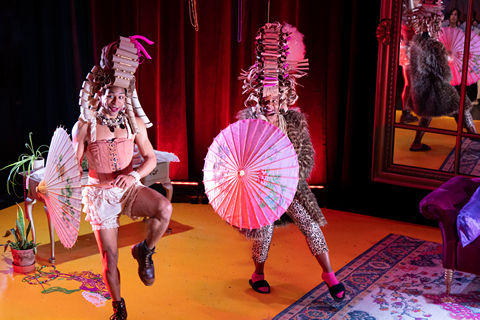
Brandon Kazen-Maddox and Jennifer Kidwell in a scene from Kidwell’s “we come to collect: a flirtation, with capitalism” at The Flea Theater (Photo credit: Julieta Cervantes)
Here, the question of labor—of wage work, of hustle culture, of the soul-numbing performance of productivity—is not merely asked; it is stretched, sung, signed, shouted, and slyly giggled through with a delicious theatricality. Kidwell and Kazen-Maddox do not so much seek answers as they swirl in the absurdity of the question itself, pulling us into their whirlpool of wit and wonder.
What, indeed, is the point of working at all? This deceptively simple question—part provocation, part existential koan—is the luminous pearl nestled deep within the richly layered, deeply irreverent oyster that is we come to collect: a flirtation, with capitalism. The insidious casual cruelty of cocktail party small talk, “So, what do you do?”—that ostensibly innocuous question, tossed off by strangers at weddings, networking events, and family gatherings alike—is, in truth, a coded interrogation. It is not an inquiry into your passions, your pastimes, or the rich interior tapestry of your existence. No, it is a swift and ruthless social sorting mechanism. What it truly asks is: What is your job? How much power do you wield? How much money do you make? And thus—how much respect do you deserve from me in this moment?
Kidwell skewers this dynamic with scalpel-like precision. “It’s shorthand,” she says from the stage, “for how much do you make and how important are you while you make it, so I know how to perform my role as it relates to you.” It is a moment of distilled, crystalline insight amid a swirling, unrelenting cascade of theatrical provocation. In that single line, Kidwell does what many playwrights attempt and few accomplish: she tears the polite mask from contemporary social life to expose the cynical machinery grinding beneath.
This moment is all the more striking for its rarity—because what surrounds it is not a tidy narrative, nor a play in any conventional sense, but 90 minutes of audacious, confrontational, genre-defying performance art. Kidwell and her co-director Adam Lazarus are less interested in gently guiding the audience toward epiphany than in grabbing them by the collar and dragging them, heels scraping, through the gaudy carnival of American capitalist mythology. In their hands it is not so much about performing a play as orchestrating a theatrical reckoning—a full-bodied, high-octane assault on the “alluring tale of American economic might,” with all its empty promises and predatory lies.
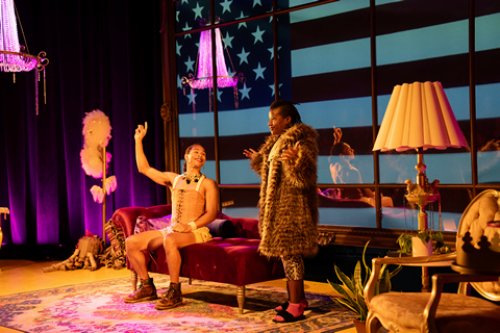
Brandon Kazen-Maddox and Jennifer Kidwell in a scene from Kidwell’s “we come to collect: a flirtation, with capitalism” at The Flea Theater (Photo credit: Julieta Cervantes)
The theatricality here is aggressive—at times exhilarating, at times disorienting, and occasionally exhausting. There is no pretense of comfort. Kidwell is not offering balm; she’s administering a slap. She demands attention, provokes discomfort, and, in the process, conjures a space where long-held assumptions can be questioned—then smashed to bits.
In lesser hands, such a fragmented, confrontational approach might collapse under the weight of its own ambition. But Kidwell’s charisma and intellectual rigor hold the chaos together, barely, with a wink and a snarl. The performance dares to alienate, and in doing so, insists on its own urgency.
So yes, when someone asks what you do, they are not seeking to know you. They are asking for your résumé, your salary bracket, your utility in the great American machine. Kidwell knows this. And in we come to collect, she dares to ask the far more dangerous question: What if we stopped answering?
At the heart of this raucous inquiry lies a core discomfort familiar to many: the gnawing, unspoken dread of trading our finite hours for paychecks, prestige, or the illusion of security. Why do we do it? What are we working toward, exactly? And what might we be doing instead?
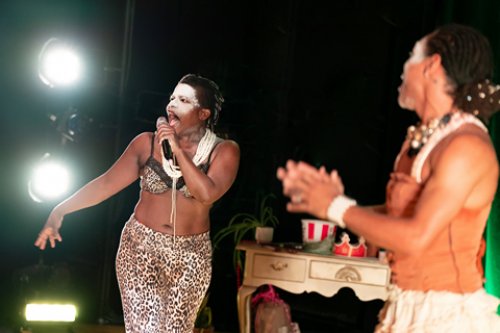
Jennifer Kidwell and Brandon Kazen-Maddox in a scene from Kidwell’s “we come to collect: a flirtation, with capitalism” at The Flea Theater (Photo credit: Julieta Cervantes)
The piece doesn’t offer tidy resolutions, thank heavens. What it offers instead is a shimmering, unorthodox, and often hilarious reimagining of what it means simply to be alive, to be present, to be. It dances between critique and celebration, between rage and revelry. The performers are equal parts spiritual guides and trickster demigods, drawing the audience into a shared space of reckoning—and release.
Make no mistake: this show may have economic consequences. One could easily emerge from the theater blinking into the downtown lights of TriBeCa with the overwhelming urge to tender one’s resignation, delete one’s LinkedIn account, and dive headlong into the luxurious, defiant art of contemplating one’s navel. If you’ve already quit, or been laid off, consider this show your benediction, your welcome party, your ribbon-cutting ceremony for a life less driven.
What transpires over the course of this genre-defiant 90-ish minutes is not merely theater in any traditional sense. It is an installation. It is a ritual. It is a mirror—at once literal and metaphorical—into which we, the audience, are invited to peer, to squirm, to recognize ourselves, and perhaps even to forgive ourselves. “This isn’t about us,” the performers tell us, and indeed, they mean it. They are facilitators, yes, but also provocateurs, caretakers, jesters, and shamans leading us through the murky thickets of late-stage capitalism, identity, joy, and the quietly desperate need to be seen.
Mardi Gras—both as symbol and spectacle—emerges as a chaotic throughline in this delirious meditation on excess and erasure. But even as the themes careen from the cosmic to the carnivalesque, the performers keep us grounded with one invaluable tool: laughter…honest, unvarnished laughter. It is the glue that binds this beautifully anarchic journey together. It is also the scalpel that cuts straight to the bone.
we come to collect is not a play, per se—it is an encounter. A reckoning. A party with teeth. A love letter in disguise. It is also, quite simply, a damn good time. And in these uncertain days, that may be the most revolutionary gesture of all.
we come to collect: a flirtation, with capitalism (through September 27, 2025)
The Flea Theater, 20 Thomas Street, in Manhattan
For tickets, visit http://www.ovationtix.com
Running time: 90 minutes without an intermission


Leave a comment