
Sober Songs
A darkly comedic chamber musical delves into the fragile lives of six young adults navigating addiction, identity, and hope in AA's embrace.
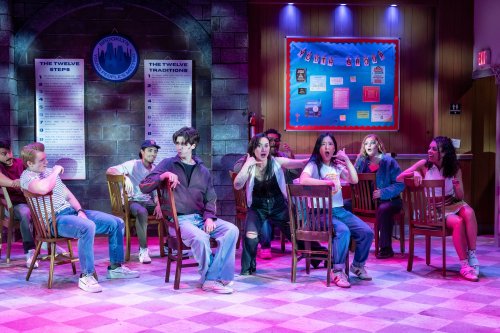
The cast of Michael Levin’s “Sober Songs” at Theatre Row (Photo credit: Shawn Salley)
Michael Levin’s Sober Songs emerges as a darkly comic, emotionally charged new musical that dares to traverse the jagged terrain of addiction and recovery with unflinching honesty and surprising warmth. At its core is a motley group of six young adults—each broken in their own beautifully human way—bound together not by blood or fate, but by the shared ritual of a local Alcoholics Anonymous meeting.
What begins with biting wit and a breezy charm gradually unspools into something far more profound: a searing, character-driven exploration of identity, pain, and the fragile hope that flickers in the aftermath of rock bottom. The show oscillates between razor-sharp humor and aching vulnerability, pairing acerbic, quick-fire dialogue with plaintive ballads that pierce straight through the armor of cynicism.
As each character confronts their demons—be they substance, self-worth, or the ghosts of who they used to be—Sober Songs avoids the platitudes and clichés so often endemic to “issue-based” theater. Instead, it embraces the mess: the relapses, the awkward silences, the gallows humor, and the small, hard-won victories that feel anything but small when you’re trying to stay afloat.
Through its deft tonal balancing act the piece finds its beating heart in the shared humanity of its ensemble. Sober Songs doesn’t simply depict recovery culture; it lives in it, breathes it, and invites its audience to sit in the circle. What results is not just a musical, but a cathartic communion—a testament to resilience, community, and the song that can still be sung when all seems lost.
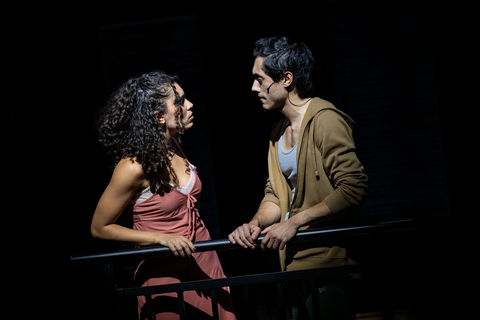
Jocelyn Trimmer and Jason Fio in a scene from Michael Levin’s “Sober Songs” at Theatre Row (Photo credit: Shawn Salley)
Now playing a limited Off-Broadway run at Theatre Row Theatres, Sober Songs’ librettist, composer and lyricist Michael Levin takes the dictum “Write what you know” to heart—perhaps a bit too earnestly. Drawing from his own lived experience with alcohol addiction, sobriety, and the ever-turbulent journey of recovery, Levin delivers a deeply personal, fictionalized narrative rooted in the dingy yet sacred space of a Brooklyn church basement, complete with flickering fluorescents, where a band of young adults gather for AA meetings under the weary but watchful eye of their mentor, the gruff yet big-hearted sponsor known simply as “Cap.”
Helmed by director Chris Mackin—himself no stranger to the ravages of addiction within his personal orbit—the production seeks to shine a compassionate light on the power of shared struggle and communal healing. Unfortunately, while the intention is undeniably sincere, the execution is far less compelling. What promises to be a darkly comedic and emotionally candid exploration of recovery too often lapses into a kind of musical-theater shorthand—clunky exposition, and theatrical tropes that lack the visceral punch and psychological nuance the subject demands.
The ensemble of nine—featuring Bernard Holcomb’s quietly commanding Cap; Melani Carrié’s fiery, emotionally dexterous Angie; and Henry Ryeder’s Dean, a deeply troubled singer-songwriter with a suspiciously untethered guitar—carries us through a loosely stitched sequence of scenes and vignettes, punctuated by two dozen songs spanning an array of genres. Rock, country, blues, Broadway balladry—you name it, Sober Songs tries it, though not always to cohesive effect. Brian Reynolds’ musical direction works hard to maintain stylistic continuity, but the result is more a musical mosaic than a fully integrated score.
Opening with the full company arranged in a direct-address semi-circle—a formation now overly familiar to anyone who’s ever seen an ensemble drama about addiction or trauma—the show kicks off with characters firing off jokey one-liners about their lives and lows. Rather than illuminating, these early moments feel like checkboxes: the stripper-turned-misfit, the guitar-strumming brooder, the flamboyant comic relief. While some of these characterizations grow more dimensional over time, the writing rarely delves deep enough to transcend stereotypes, though at its best, the show feels earnest and heartfelt.
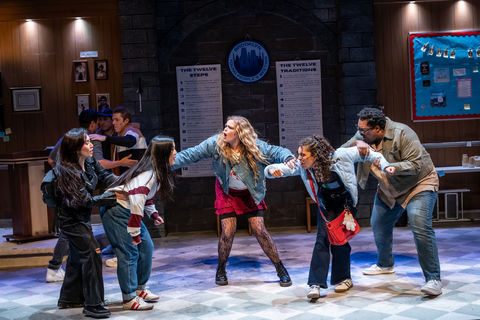
Merrill Mitchell and the cast of Michael Levin’s “Sober Songs” at Theatre Row (Photo credit: Shawn Salley)
That said, certain performances do manage to rise above the material. Carrié, as Angie, channels both grit and vulnerability in a role that teeters between self-parody and pathos, and her vocal chops lend emotional weight to some of the score’s more resonant numbers. Holcomb’s Cap, meanwhile, serves as both narrator and moral compass—his presence lends a grounding gravitas to the production, and his rendition of “Hey, Hey, A.A.” injects welcome humor without sacrificing the character’s emotional integrity.
Jocelyn Darci Trimmer as Nina, who falls in love with Jason Fio’s Roque, occupies one of the subplots of a sad fall from sobriety that ends in suicide. Both are given just enough text to make an audience mourn, yet not quite understanding or seeing the real depths that underpin Roque’s despair. As Bri, Merrill Mitchell paints a picture of a young woman whose dealing with addiction gives her enough space to finally blossom into someone open to love, here smitten with a bakery employee.
Somewhat conspicuous, though not in a different register, is the curious underutilization of three ensemble members whose presence onstage is largely relegated to the margins. The cast, a modest ensemble of nine, is by no means unwieldy—indeed, many a masterwork has been conjured with far fewer. But herein lies the problem: while the core players are given space to evolve, spar, relapse, and reflect, these three performers, Lennie Disanto, Jake Kleve and Sarah Sun Park—whose participation is limited to fleeting group vocals (notably in the opening number, “And I’m an Alcoholic”) and background movement—remain spectral figures, denied narrative substance. Their roles, such as they are, feel vestigial rather than vital, more like echoes of unrealized character arcs than integrated parts of the ensemble.
It is not, to be clear, the size of the cast that prompts critique, but rather the lopsidedness of its utilization. In a musical so deeply concerned with personal testimony, shared experience, and the universality of struggle, the absence of fully rendered inner lives for a third of the onstage bodies feels like a missed dramatic opportunity. We see them—again and again—in scenes of communal confession and emotional catharsis, yet we remain strangers to them. What are their demons? Where are their voices? One cannot help but wish for a dramaturgical deepening that offers these silent figures more than mere chorus duty. After all, in recovery—as in theater—every voice counts.
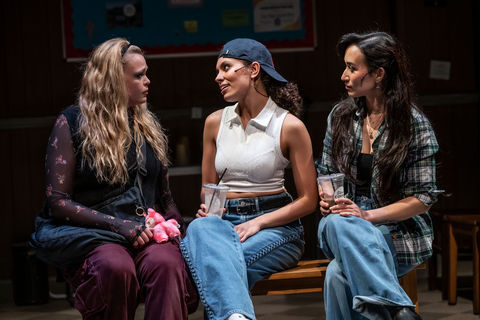
Merrill Mitchell, Jocelyn Trimmer and Melani Carrié in a scene from Michael Levin’s “Sober Songs” at Theatre Row (Photo credit: Shawn Salley)
Another seemingly minor yet undeniably distracting detail arises in a moment that, while ostensibly small in the grand scheme of the production, nonetheless speaks volumes about the often-overlooked interplay between theatrical illusion and audience perception: the matter of the onstage guitar. It may appear trivial—perhaps even nitpicky—to quibble over whether a performer’s fingers align with the notes the audience is hearing. And yet, in a production otherwise marked by a thoughtfully constructed set, a cohesive design aesthetic, and a capable creative team, such inconsistencies become conspicuously amplified. When the visual narrative diverges from the auditory experience, especially in a moment that is neither musically essential nor dramatically pivotal, the artifice becomes visible—and in live theater, visible artifice can unfortunately break the spell.
Still, for a piece that purports to tackle the complexity of addiction, Sober Songs often fails to excavate its deepest layers. Relapses, romantic entanglements, suicidal ideation, and earnest confessions flit across the stage, but many are handled with a frustrating brevity, giving the sense that we are skimming the surface of lives meant to be far more turbulent than the book or score allows them to be.
Visually, the production fares better. Joshua Warner’s set design transitions efficiently from church basement to coffee shop to rooftop with minimal shifts in scenery, aided by Annie Garrett-Larsen’s evocative lighting and Travis Joseph Wright’s subtly effective sound design. Izzy Kitch’s costumes offer practical, character-specific touches that reflect both sobriety and relapse.
Choreographer Megan Roe deserves credit for injecting energy into the proceedings, but the variety—ranging from Broadway-style chair dancing to hoedown-style stomping—occasionally feels tonally misaligned with the show’s darker undertones. Meanwhile, the offstage band, led by conductor Devin Wong, keeps the score moving, though the illusion of actor-instrumentalism is occasionally broken—most notably during Dean’s guitar solo, clearly dubbed in from the wings.
In the end, Sober Songs is a production that wants badly to say something important—and it might yet, with revision. Levin’s personal stake in the material is evident, and admirable, but the work itself remains in need of refinement. The book too often leans on cliché, the songs on sentimentality, and the cast—while committed—must labor to elevate material that doesn’t always support the depth of their performances. Certainly the bones of something meaningful are here. With a sharper dramaturgical scalpel, more cohesive musical storytelling, and a willingness to embrace the rawness it only intermittently touches, Sober Songs could evolve into a truly affecting portrait of recovery. For now, it remains a well-meant but not completely realized ode to sobriety—tuned to the right frequency, but not quite in key.
Sober Songs (through September 28, 2025)
Theatre Three @ Theatre Row Theatres, 410 West 42nd Street, in Manhattan
For tickets, visit http://www.bfany.org
Running time: two hours including one intermission


Mr. Marinelli! Thank you for your well-written and thoughtful review. I play Dean, and can confirm that all those guitar notes are coming live from my own hands. Thank you for bringing any audience confusion to my attention, though!
Best,
Henry