
Alan Turing & The Queen of the Night
A bold Alan Turing reborn: no meek genius here, just raw defiance and the wild muse who showed him how to survive. A queer icon redefined, gloriously.
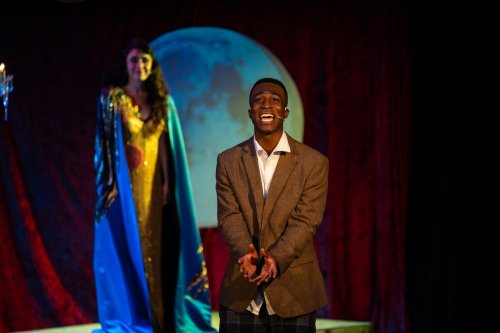
Sara Lucille Law as the Queen and Malcolm Holmes as Alan Turing in the musical “Alan Turing & The Queen of the Night” at The Players Theatre (Catalin Stelian @Catalainmedia)
Michael Vegas Mussman and Payton Millet’s Alan Turing & The Queen of the Night is a queer fantasia of extraordinary ambition and tender heartbreak, where the cool rigor of mathematics meets the shimmering enchantment of high opera. Imagine a stage where history and myth collide: the tragic, all-too-human life of Alan Turing is reimagined through the fantastical lens of Mozart’s The Magic Flute, yielding a rich tapestry of grief, genius and romantic yearning.
We open with a boy: navigating the austere halls of an English boarding school, young Alan Turing, all sharp intellect and soft heart, finds himself drawn to a fellow student, Christopher Morcom—a boy whose presence electrifies him, whose intellect matches Alan’s and whose soul stirs something deeper, whose companionship suggests the possibility of a future neither of them has the words, or the freedom, to name. But the cruel mechanics of fate interrupt before anything tender can be spoken aloud, before the boys’ affections can bloom into something more than subtext. Christopher dies—suddenly, senselessly—and thus begins the defining sorrow of Turing’s life.
In the wake of this heartbreak, Alan pens a letter of condolence to Christopher’s mother, Mrs. Morcom, a woman of eccentric bearing and oracular poise. What begins as a condolence grows into a curious kinship—a lifelong companionship between the brilliant boy and the woman who becomes, for him, a sort of muse, a guide, and, eventually, a specter of his own longing. From this early fracture in the soul, the narrative unfolds with operatic grandeur and psychological complexity. In reaching out to Mrs. Morcom, Christopher’s enigmatic, idiosyncratic mother, Alan unknowingly steps onto a path that veers from the strictly historical into the richly symbolic.
Mrs. Morcom does not remain merely mortal in Turing’s grief-stricken mind. No, she is transfigured. Inspired by her theatrical flourishes and impassioned philosophies, Alan begins to envision her as no less than the Queen of the Night herself—Mozart’s furious, glittering monarch from The Magic Flute. It is through this imagined incarnation that Turing escapes into an operatic realm of trials, transformations, and impossible quests. The libretto of his life takes a turn toward the phantasmagoric. In this hall of mirrors, biography and opera refract one another until the borders between real and imagined dissolve. History gives way to myth; grief to aria.
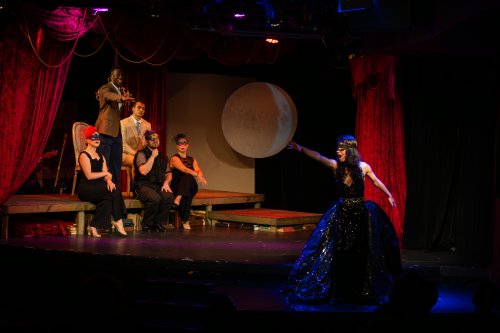
Alan Turing (Malcolm Holmes) reacts to hearing the Queen of the Night’s aria in the musical “Alan Turing & The Queen of the Night” at The Players Theatre (Catalin Stelian @Catalainmedia)
And yet, even the most enchanted of journeys must yield to the world’s darker music. Years later, amid the blood-stained urgency of the Second World War, Turing finds himself at Bletchley Park, engaged in a battle of intellect against the arcane encryptions of the Nazi Enigma machine. The Queen—his Queen—returns to him, not in flesh, but in fierce memory, her aria echoing through his mind as he wrestles with the impossible. It is her resilience—her dramatic fury, her unyielding force—that rekindles his fire when odds grow insurmountable. With her spectral inspiration, he constructs a machine unlike any other: tireless, logical, astonishingly ahead of its time…the prototype for what we now call the computer.
And yet—here is the devastating coda—what triumph is there in invention, when the ache of lost love still haunts every calculation? Turing, the hero of both history and this operatic reimagining, cracks the code of war, but cannot decode the silence that followed Christopher’s death and cannot decipher the enigma of his own heart. His journey through fantasy and reality leaves us not only marveling at his mind, but mourning the love denied him by time, by death, and by a world that refused to understand.
A queer fantasy, yes—but also a requiem, a celebration and a defiant aria of what might have been, a glittering, and unapologetically theatrical celebration, this work casts off the grey flannel of historical reverence and reimagines its central figure not as the tortured, stammering genius of textbook lore, but as something far more vital: a queer icon ablaze with yearning, wit, and subversive grace.
Here, Alan Turing does not quietly shrink into the background of his own tragedy. No—this Turing strides boldly onto the stage, flanked by fever dreams and operatic flair. Gone is the restrained mathematician content to disappear into machines and algorithms. In his place: a soul burning with questions, grief, and the undying echo of love unfulfilled. It is a radical act of reclamation—an assertion that genius, too, can be flamboyant; that vulnerability is not weakness, but rebellion.
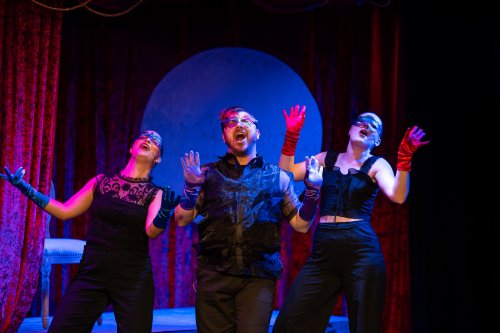
Shayna Rives, Sam Seleznow and Emi Sullivan as the Three Ladies in the musical “Alan Turing & The Queen of the Night” at The Players Theatre (Catalin Stelian @Catalainmedia)
To watch this show is to be invited into a universe where logic and longing dance cheek-to-cheek. Where code-breaking becomes spell-casting. Where Turing, guided by the indomitable Queen of his own creation, undertakes a journey not only to save the world from tyranny, but to recover something far more elusive: a love lost to time, to silence, to death. This is no dry chronicle of wartime innovation. This is operatic psycho-biography: lush, queer, bold, and deeply, devastatingly human. It asks not simply what Alan Turing did, but who he was—and what parts of him were exiled, exalted, or extinguished in the name of history, duty, and love.
There’s a lot going on in this new musical about Alan Turing—and perhaps too much. In attempting to encompass the breadth of Turing’s extraordinary life, the production ends up overwhelmed by its own ambition. It is too long to sustain its narrative with somewhat underdeveloped characters, and too short to provide the necessary depth to the relationships that are meant to drive its emotional core.
The central problem lies in characterization—or, more precisely, the lack of it. Director Andrew Coopman, who also provides the choreography, works with what he has been given. Discussing backstory and motivations with the actors can only go so far; the audience members are not mindreaders. Despite being the title character and emotional nucleus of the piece, Turing himself remains frustratingly vague. We learn early on that he loves math and once had a formative connection with a school friend named Christopher, but beyond that, his personality is oddly amorphous. Is he a reserved conformist, reluctantly agreeing to marry a woman to hide his sexuality? Or a fearless nonconformist, openly challenging authority and societal norms? The musical seems unsure, offering contradictory scenes in close succession without charting any meaningful transformation between them. It’s not that a character can’t contain contradictions, but here, the contradictions aren’t dynamic; they’re simply unexamined.
This lack of definition in Turing’s character in turn undermines the show’s most important relationship: his bond with Christopher. The musical hinges on the impact of Christopher’s early death, yet he is given little more than a single song before vanishing from the stage. His absence is meant to haunt the rest of the show, but it’s difficult to feel the weight of that loss when we were never given a clear sense of who he was in life. What did Christopher value? Why did Turing love him—beyond proximity and adolescent intensity? Without specificity, the relationship becomes more symbolic than real, and symbols alone cannot carry the emotional weight the show asks of them.
Malcolm Holmes does the heavy lifting as Turing throughout the play despite the fact that the character is set up to suffer and live the loss of a love that we the audience never really get to know. Niko Rissi as Christopher just doesn’t have enough stage time in the beginning to make us deeply feel that loss. Sara Lucille Law brings the gravitas and warmth to Mrs. Morcom that makes us understand how Turing can open up to her about feelings for her son that not even he can adequately comprehend. Emily Welter as Joan Clarke, the colleague that falls in love with Turing but not so very blindly as one would think, shines in “Joan’s Song” and makes us feel the depths of their friendship, a relationship that lasted until his death. Randall Scott Carpenter is convincing as Knox, Turing’s boss, as he tries to warn Turing of how his off-duty behavior will cloud any true accomplishments in his career.
Thematically, the show gestures toward grand ideas: Turing’s desire to defy death, to build a machine that might one day bring Christopher back, or at least preserve his memory. But this motivation—poetic as it is—lacks grounding. The emotional or intellectual bridge from Turing’s historical work at Bletchley Park to this abstract yearning for resurrection is tenuous at best. The script suggests he’s inspired by the endurance of the Queen (or Mrs. Morcom), but those characters are never given the depth or presence for that inspiration to land. The result is a protagonist driven by a goal that feels metaphorically rich but emotionally hollow.
One suspects that this problem stems from a backward construction: the writers know where Turing’s story ends—tragically, with his suicide—and they attempt to write the show in service of that ending. The notion of “coming full circle,” with Turing reunited with Christopher in a stylized afterlife, is poignant in theory. But because Turing’s internal trajectory hasn’t been fully articulated throughout the show, the ending, rather than feeling earned, feels imposed.
There are moments when it sparks to life: the opening number “The Opera Is For You” sung by the three ladies is a great way to begin the journey and the ensemble number “Army of Eggheads” is a highlight, full of wit and kinetic staging. “What Am I To Say?” is a lovely way to introduce the relationship that will blossom between Turing and Mrs. Morcom. And there’s a chaotic, bizarrely memorable sequence involving a blackboard, mathematical notation, and a doomed attempt at heterosexual intimacy that is as bold as it is bewildering. These flashes of clarity, of theatrical invention, suggest the show could work—if it trusts itself enough to slow down and dig deeper.
Alan Turing’s life is rich with dramatic possibilities—not just as a tragic cautionary tale, but as a story about intellect, identity, loneliness, and legacy. This team clearly cares about his story. With substantial revision—focused on clarifying character, deepening relationships, and anchoring thematic ambiguity in emotional reality—this musical could truly honor the man at its center. But right now, it’s running too many calculations with not enough code.
Alan Turing & The Queen of the Night (through August 31, 2025)
The Players Theatre, 115 MacDougal Street, in Manhattan
For tickets, visit https://www.alanturingandthequeenofthenight.com/
Running time: two hours including one intermission


Leave a comment