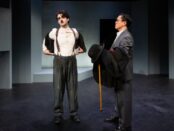
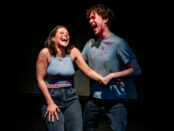
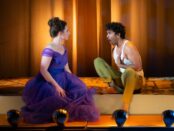
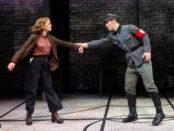
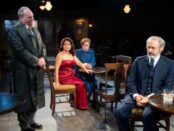
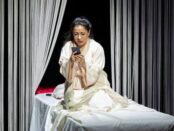
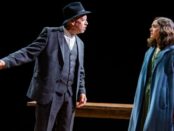
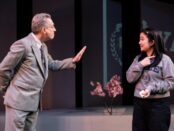
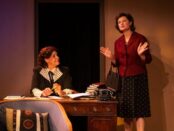
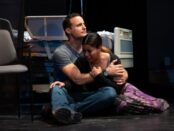
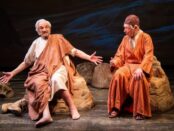
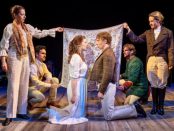
Russ Rowland photographs everything from theater and corporate events to portraits, abstracts, street scenes, landscapes and images that he creates on the computer in various ways. Many things interest him visually, and he’s a relentless experimenter. http://www.rrsnapshop.com
What begins as a satirical clash between corporate swagger and academic idealism gradually deepens into a more unsettling inquiry. The play’s true subject, it turns out, is not merely the arrogance of billionaires but the universal temptation to trespass upon the limits of the body. Humanity, after all, has always been drawn toward transgression—whether through cosmetic surgery, pharmaceutical enhancement, or the relentless drive to improve the species one experiment at a time. [more]
Legendary composer Burt Bacharach died in 2023 and it has taken until now for there to be a fitting stage tribute to his 1,000 song output (mainly written with lyricist Hal David) which includes six Grammy Awards and three Academy Awards. Entitled Going Bacharach: The Songs of an Icon, the musical revue has been conceived by producer Jack Lewin along with Will Friedwald (who has been called “the poet laureate of vintage pop music,”) musical supervisor Tedd Firth and musical director Adrian Galante, who is also responsible for the arrangements and orchestrations as well as playing piano and clarinet in the show. While Bacharach was best known for his mellow sound as sung by Dionne Warwick who recorded most of the songs in the show, the volume of this Going Bacharach is very loud, though this may be the fault of sound designer Matt Berman. Those of us who grew up with these songs won’t recognize the arrangements while younger people may be pleased to experience them for the first time. [more]
Sketches are performed, in this case approximations of the originals, which is understandable (the authors Erik J. Rodriguez and Charles A. Sothers didn't have the rights to use the actual SNL material) but also a little odd for the more famous bits. It mostly doesn't matter though, and only hardcore fans will notice the difference. The women feel slighted, which makes sense if you watched the show in the 70s (and the 80s). [more]
Although the advance press materials suggest that Ali Keller’s "(un)conditional," the 2024 Lighthouse Series winner at SoHo Playhouse, is about wife swapping, it is, in fact, about two couples with different sexual problems that eventually become one story when it transpires that two of the people know each other from work. Director Ivey Lowe has used a suitably light touch to deal with this delicate and sensitive subject matter. While the play is never erotic, it may be the most intimate play you have ever seen so far. The actors playing the two couples are excellent at handling this tricky theme, one that cries out to be addressed more often even though it may make some uncomfortable. [more]
Among her most haunting and meditative works is the slim yet searing "From Trinity to Trinity," an autobiographical pilgrimage undertaken in 1999 to the Trinity Site in New Mexico where the world’s first atomic bomb was tested. It is, in essence, a journey back to the beginning of the end. Published in 2000 and rendered into English by Eiko Otake—half of the hauntingly expressive performance duo Eiko & Koma—the work was later published in 2010, bringing Hayashi’s voice to new ears, and new hearts. But it was in 2009 that Eiko, recognizing the performative potential and piercing immediacy of Hayashi’s words, reached out to the accomplished New York-based actress Ako—known for her roles in "Shogun," "God Said This," and "Snow Falling on Cedars," and the visionary founder of the Amaterasu Za theater company. Eiko posed a proposition: Could this text—so personal, so painful, so charged with historical weight—be embodied on stage as a one-person play? The answer, though tentative and reverent, was yes. It is Ako’s own adaptation for the stage that she performs today. [more]
Austin Phillips’s puppet design deserves special mention. His owlet creation is imbued with uncanny charm—Wesley is clearly an owl, yes, but one whose subtle articulation suggests personality rather than anthropomorphism. The puppet becomes a living character, thanks in large part to the finely tuned performance of Daniel Sanchez, making an impressive Off-Broadway debut. As Wesley, Sanchez navigates a delicate balance: he gives the owl presence, agency, even affection, without sacrificing the essential strangeness of the animal. His portrayal renders the owl’s devotion to Casey moving and believable, even as we are always aware that this is a bird, not a human in disguise. As he dances with Casey during the “Winter is Coming” sequence we are painfully aware of how little time they can expect to share together. [more]
Already seen at 200 venues across North America, "Bear Grease," the all Indigenous musical, arrives in New York for a three-month residency. While its subtitle declares that it is a “reimagining of the musical Grease by Jim Jacobs and Warren Carey told through an Indigenous lens,” it is more of a variety show with songs, dances, and video while including iconc scenes and songs from "Grease" paying tribute to Native American culture. Written and created by LightningCloud (Crystle Lightning and Henry Cloud Andrade,) the exuberant cast made up of members of the Enoch Cree Nation, Beaver First Nation, Big Stone Cree Nation, Frog Lake, Muskeg Lake, Gift Lake, Mvskoke and Navajo Nation makes this an entertaining evening in the theater. [more]
Each dancer contributes a unique personality and approach to the parade of styles, but when they all perform together it is as if they had been together forever. Each has a solo and a chance to speak about how they came to love hip-hop and how it changed their lives. Several impressed: Choung Woo Hyun has an elegance and lanky quality; Irina Brigita Laiciu’s bare midriff is as expressive as any ballerina’s toe-shoed feet; and Adrian T. Martin has a loose-limbed, easygoing quality. The other principal dancers are Jihad Ali, Messiah Brown, Kayla Muchotrigo, Rafaela Oliveira and Nicholas Porter, all displaying terrific individual qualities. [more]
At an hour and 40 minutes, "Cracked Open" is an earnest but often exhausting theatrical experience. Its heart is unquestionably in the right place—tackling the vital and still-stigmatized subject of mental illness with sincerity—but the journey can feel more dutiful than illuminating. Despite these shortcomings, the cast’s unwavering commitment and playwright Kriegel’s courage in confronting such difficult terrain deserve commendation. [more]
We get evocative shadow screens, puppetry and a silent-film fantasia. Heartbeat Opera’s two-hour whirlwind adaptation has everything—except an intermission. True to the company’s bold, iconoclastic style, this fiercely distilled staging trades grand opera’s lush orchestra for a lean, expressive band led by artistic director and violinist Ashworth. Brass and reeds give the score grit and immediacy, while the unexpected addition of a harmonium injects a raw, streetwise character—part cabaret, part back-alley prayer. The result? A "Faust" not of gilded prosceniums, but of shadows, sweat, and sharply focused vision. [more]
"Wounded," written by Jiggs Burgess, is a story using a cloak of humor to obscure the pain and dark feelings being hidden by the protagonists. Although referred to as a comedy or dark comedy, it should be noted that the simple addition of humor does not make it so. This play is a serious drama, in the full meaning of that form, with some humorous elements. Del Shores skillfully directs an excellent ensemble of three players to expose layers of emotional and physical wounds in the characters. Shores and the cast successfully create a deceptive cover for the story's final destination, with the dramatic tension slowly building to a surprising and unexpected ending. It is a play worth experiencing, even with a few issues concerning the logic in some of the characters' interactions. [more]
Urban Stages conducted a Dynamic Duos playwriting competition for one-act, two-character stories covering any subject during their 2023-24 season. Eight plays out of over three hundred submissions were chosen for staged readings. Two were selected for a full production as part of the current season. Those shows, "The Audit" by Lynda Crawford and 'The American Dream" by Juan Ramirez, Jr., opened on February 27 in a twin bill. They are both interesting stories told well with solid performances. [more]
Director Shira Milikowsky keeps increasing the tension as the 85-minute play peels away revelation after revelation. Each man has a guilty secret and may have betrayed a friend which is eating him up. Although there are never more than two men on Lawrence Moten III’s pitch perfect set for the rather shabby blue and white hotel room which suggests a dorm, we eventually witness and learn about two other stories that they are both stewing over: what happened between Teddy and Ed before Ed stormed out and Jeremy’s encounter in Uganda with Nicholas, a gay man in need of more than medical help. [more]
Director SuzAnne Barabas takes a muted approach, choosing to emphasize the intimacy of the narrative. Mags and Bernie are the only two characters in the play, and both are on stage nearly the entire time. There is little in the way of action, as the 80-minute runtime consists almost entirely of Mags and Bernie reading the letters they send to each other. Day and McKeon spend long periods sitting down and reading their letters out loud, and set designer Jessica Parks arranges the stage as two living rooms, separated by an invisible barrier that neither can cross. Maintaining the physical distance between the characters, the set and directing evoke the feeling of being in both living rooms at once, listening to Bernie and Mags casually read their letters out loud before mailing them. [more]
The trio demonstrates that their voices are as supple and fine as they ever were. Each gets to play their best suit: Winokur’s loud, clarion voice, Bundy’s wry wit and Butler’s recounting her hilarious but painfully missed opportunities even though she has appeared in 12 Broadway shows and been nominated for the Tony Award. Their patter and narration is entertaining and hilarious and the musical numbers are both tributes to their careers as well as songs we have not heard them sing before. [more]
We’ve come a long way from "Annie Get Your Gun" to the new musical "Distant Thunder" produced by Amas Musical Theatre at the A.R.T./New York Theatres. The Irvin Berlin song “I’m an Indian, Too” from "Annie" is filled with silly clichés about our indigenous people that "Distant Thunder" puts to rest. "Distant Thunder," written by Lynne Taylor-Corbett and Shaun Taylor-Corbett (book) and Shaun Taylor-Corbett and Chris Wiseman (music and lyrics), (with additional music and lyrics by Robert Lindsey-Nassif and Michael Moricz,) deals sensitively with issues facing Native Americans today. All of the actors are members or descendants of Native Americans and all give body and soul to their characters. [more]
"It’s Not What It Looks Like," is a two-hander, written by John Collins in collaboration with Chesney Mitchell. It is the winner of the 2023 Soho Playhouse Lighthouse Series competition for new plays. The play is a cleverly devised procedural drama that does justice to its title: somebody died, but the how and why are unknown. It is a mystery with which to spend a summer evening. [more]
"David" now at the AMT Theater is an ambitious Off Broadway musical dramatizing the story of the youth of the hero David, later second king of Israel. It has a bouncy contemporary score by Albert Tapper and a large talented cast. Somewhat indebted to Andrew Lloyd Webber’s Biblical musicals, it is narrated by the older King David on his deathbed to the Prophet Nathan. Most of David’s adventurous exploits take place off stage, while the dramatized scenes are mainly political and dramatic. [more]
When it comes to coffee klatches, wine seems to be a good substitute, or at least that is the case with the women in "Winesday: The Wind Tasting Musical," with book and lyrics by Jenne Wason and music by Joseph Benoit. It is a show that could leave you tipsy at the end but generally satisfied with the experience. The songs are clever and well-sung by a solid group of five actors, and the book doesn't rely on a straightforward plot but provides a series of entertaining vignettes that help define the characters' lives with details about their ups and downs. Jamibeth Margolis's direction effectively guides the cast to deliver funny, well-integrated performances in a constrained setting. [more]
Dan Lauria’s "Just Another Day" is quite leisurely in its delivery but Lauria and McCormack inhabit their roles. While the play could use some pruning, it is a charming portrait of two elderly people drifting into an age when they cannot count on their memories but know that there is something important they wish to recall. Their hidden backstories and their changing recollections at times make this play like a mystery as well as a comedy. "Just Another Day" is a tribute to those people old enough to know that their pasts are slipping away unless they can pin them down. [more]
Enter young baritone Edwin Joseph. He has that dark curly hair and handsome face, yes, and the crucial understanding of the necessary swagger and selfishness that carries this character through the opera, yes. Mr. Joseph brings to mind the earthy and always sexy television star Shemar Moore, someone who has the confidence without even trying; it’s just there, and in spades. Joseph is helped with Mr. Wills’ ingenious staging. Tatyana’s letter scene is performed with Onegin perched on the top stairs of a stage ladder in full view just stage left of her bedroom space. The implication that he is well aware he is desired by Tatyana is there long before he reads the letter. He doesn’t need to read her outpouring of her soul to know he has that effect on her. In the birthday party scene, it’s not the flaunting of Onegin’s flirtations with Olga that sets the tone for Lensky’s challenge to a duel, it is a brazen handjob administered by Onegin to an already emasculated Lensky off in a corner where Lensky hopes no one sees that is the trigger for everything that follows. And throughout, particularly in his closing aria in Gremin’s palace, Joseph with his rich resonant baritone has this score in the palm of his hand. [more]
Christopher Rhoton's Double Dare-inspired set belies these weightier autobiographical details, offering enough of a time-warping simulacrum to help middle-aged members of the audience shed a few decades when Summers interrupts his fraught remembering to twice become a kid's game show host again. Those who legibly scribble their names on a piece of paper dropped into a fishbowl before the performance, eventually get the chance to head onstage (not sure if mezzanine ticket buyers are eligible), answer trivia questions, and launch pies on a catapult (a warning for the first few rows). Amid all the cheers, laughter, and chaotic fun, there's also an opportunity for the quick-witted Summers to go off-script, asking the theatergoers-turned-contestants trite questions like "Where are you from?" and "What do you do?" to set up a slightly mischievous back-and-forth. [more]
While we are presented with characters who are doing a noble thing and can be touched by what they go through to accomplish their task, Brian Belding’s book and lyrics repeatedly take us out of 1942. In breaking up a fight between her brother and her old flame, Sophie blurts, “Are we seriously doing this?!”…Seriously? The tone is not “then” in 1942, it’s a university student of present day. When Willi walks in on the scene, he asks “What the f*@k is going on?!” We don’t doubt the impulse behind it, but was that really the vernacular in 1942? Natalie Brice’s score has its moments with some of the solos, but the full company songs sound like retreads of "Les Miserables" chorus numbers. “Munich” sounds like “Blind Eye” sounds like “Why Are You Here?” sounds like “The Mess They Made” sounds like “We Will Not Be Silent.” All are full throttle songs with the same sentiment, so why are there so many? [more]
Through a technologically astute production and fine acting, their intertwining stories unfold in a dramatic tapestry that reveals the sad business of mail-order brides. Using an intricate combination of pre-recorded videos, live video feeds and “ghost voices” (Joy Tamayo), the live actors emerge as engaging and moving women, their fates becoming ever more fascinating and heartbreaking. [more]
How does a Holocaust-themed play land with such emotional impact as Leslie Epstein’s "King of the Jews" at the HERE Theatre? Based on his novel of the same name, "King of the Jews" is a searing, eye-opening glimpse of a dark period in world history. Set in the formerly elegant Astoria Café in 1939 and 1941 Poland, "King of the Jews" turns the employees and customers into a microcosm of Jewish society, a community being crushed under the boots of the invading Nazis. These trapped Jews emerge as real people. As the eleven p.m. curfew, enforced by Gestapo goons, approaches, they each react in their own way. [more]
Olson might very well be the three-way love child of Thomas Dolby, Bill Irwin, and Max Headroom. He carries the show with an unbridled, infectious, childlike enthusiasm, sharing what he knows and loves--science and music--using songs he wrote in his car and lyrics that support his storytelling. He puts on this show like a life-long project that he couldn’t wait to find the barn for. Olson reels us all in as he fills our minds with profundities in the same ease and flair he might have if he were telling us an evening of dad jokes. He shares postulates about time, space, color, light, thought, consciousness, love, and existence, in easy-to-grasp terms using purposeful words and with exquisite imagery. [more]
The Nazis persecuted not only Jews, political opponents and its own, but also homosexuals. Jews were forced to wear the infamous yellow stars; gays, the pink triangle. Alan Palmer, in his one-man show "Chanteuse" at HERE Arts Center, gives an intimate, heartbreaking look at one victim—fictional or not—that turns impersonal facts into passionate theater. [more]
"The Gospel According to Heather," with book, music, and lyrics by Paul Gordon, is a story about a teenager's struggles with fitting in with her contemporaries, finding a boyfriend, and dealing with the supernatural powers which she seems to have acquired after finding a Roman coin in a fish. On the surface, this show appears to be a coming-of-age tale with music, but it is much more: it is a cleverly done and, at times, pointed commentary on the socio-political nature of contemporary America, and of religion. [more]
Heartbeat Opera seems to have found the way to separate themselves from the rest of the pack of alternative opera companies here in New York. Their way is to inject the standard repertory of grand opera with fresh ways of presenting the rich beloved scores. Enter music director Daniel Schlosberg, a Brooklyn-based composer-pianist who is their ingenious arranger for both Puccini's "Tosca" and Verdi's renamed "Lady M," and conductor and pianist for "Lady M." He arranges "Tosca" for a band of eight, "Lady M" for a band of six. Consider both of these Herculean feats with sumptuous results. [more]
Just when you think you’ve seen an opera so many times you can’t imagine it being told anew along comes Heartbeat Opera with a riveting take on Puccini’s "Tosca." Director Shadi G. sets it as a thriller in Teheran, Iran with a cast of singers trying to get through a performance in defiance of the censors. The opera "Tosca" has always been set under a dictatorship of an authoritarian regime. It is usually set 1800 with the Kingdom of Naples’s control of Rome threatened by Napoleon’s invasion of Italy. The Heartbeat production underlines the usual terror with Irani police officers in shadows, hidden in stairwells and behind stage entrances ready to arrest the performers if they do anything outside the strict code of ethics and behavior in the Irani culture. This added layer to the story provides a lot of exciting running exits into the audience to avoid capture by the authorities. [more]
"War Dreamer" is a compelling exploration into the psychology of a female veteran who served in Iraq. It is a depiction of the struggles of a veteran to make sense of the memories, nightmares, paranormal events, and mental dislocations that intrude daily. Those experiences are more than a function of post-traumatic stress disorder. They result from a life lived in the alien world of war and all that is that experience. The play is a frighteningly accurate presentation of the process that some veterans must navigate as they try to return to a "normal" life. Written by Leegrid Stevens, "War Dreamer" has a storyline that is not straightforward in time and place. It is disconnected from a regular flow of action, with jumps in time, place and reality. However, he skillfully keeps the audience guessing what is real and what is not without losing the story's underlying thread. Stevens makes the audience both witness and participant as he brilliantly weaves his story of trauma and disassociation. [more]
The ensemble in this show does an outstanding job. Christina Bennett Lind as Annie gives us a direct and well executed view of a frightened, emotionally conflicted woman amid a psychological breakdown. Wilson convincingly plays Izzy, showing us a character who appears balanced and somewhat detached from the emotional conflict but still leaves room for questions about what may be behind that stable, rational façade. Eckert, as the Warden, plays a crucial part as the bridge to the understanding of the show's central theme and later provides a path to the ending. Finally, Ingulsrud is both Paul and Eddie, presenting characters who, although growing up together, developed radically different reactions to the dysfunction that was and is their family. His embodiment of the disturbed mental state of Paul is exceptional, as is his detached, somewhat arrogant depiction of Eddie. [more]
Rapp’s show—directed by Steve Maler, with musical direction/orchestrations by Daniel A. Weiss (who was the associate conductor/second keyboards player of the original Broadway production of Rent)—is quite moving. I was held by it throughout. And it is extraordinarily rich with Jonathan Larson songs, including “No Day but Today,” “We’re Dying in America,” “Rent,” “La Vie Boheme,” “One Song Glory,” “Seasons of Love,” “Without You.” Hearing these familiar songs—which I’ve heard so many times in Rent, performed by multiple singers—in new contexts, now sung solo—gives me an even greater admiration for them. They are such well-crafted songs, and they have enormous impact here, just as they did in their original contexts. Rapp has an especial affinity for Larson’s work; no one performs Larson’s songs more compellingly. He has long been the foremost interpreter of Larson’s music. He “gets” the music completely. It resonates for him. No one interprets Larson’s work better. [more]
And that's the agonizing tension in "Without You;" in his lyrical responses to Larson, Rapp is well aware that it's not a back-and-forth, that Larson can't say anything more than he has already. But, just as with "Rent," there is still solace, because I'm sure Rapp, the show's impressive five-member band cozily tucked into Southern's set, and the production crew could hear what I did in the audience: lots of crying. It came with a palpable feeling of not being alone in your thoughts for the dearly departed, especially those taken much too soon. A generation or two removed from having attended "Rent," it was an unspoken bond not only worth revisiting but, if I'm being honest with myself, desperately needed. [more]
Not only is Livian Yeh’s "Memorial" revealing in its historic depiction of a recent piece of American history, it is additionally a very satisfying dramatic work. It is also very pertinent now with its depiction of racism against Asians shown to have been just as prevalent 40 years ago, as well as how deeply ingrained our unexpressed prejudices go. Jeff Liu’s direction mines all of the play’s nuances, twists and turns. The superb design adds greatly to bringing the play to life, suggesting more than is actually on the stage. With this world premiere, the Pan Asian Repertory Theatre has a current winner as well as a play that should travel well to other theaters around the country. [more]
Ellen Abrams’ new play "Eleanor and Alice – Conversations Between Two Remarkable Roosevelts" explores their superficial courtesies in a series of conversations spanning 1904 until 1962, agreeable conversations that reveal an often disagreeable, if not downright adversarial relationship. Scenic designer Frank J. Oliva has divided the stage at Urban Stages into two discrete areas, one representing the Roosevelt estate, Sagamore Hill in Oyster Bay, Long Island, and the other Eleanor Roosevelt’s charmingly simple home, Val-Kill, in Hyde Park, New York. Kyle Artone’s costumes are simple representations of the two women as they travel their different paths through history. [more]
Most poignantly, when Drew starts to wonder if maybe their son's survival has been the opposite of a blessing, Andrea expresses horror for a thought that, thanks to Pimentel's touchingly subtle performance, we know she's had herself. To its strongest credit, MacDermott's play affords all three of its actors the opportunity to find meaning beyond their characters' words. Though, of course, with a less capable trio, this sort of dramatic freedom could have been a disaster. [more]
A fresh antidote to the usual brassy, loud rock musicals of today, "Los Otros" slows down the tempo and the sound level with a story of the experiences of two people who learn to love, cope and risk over the course of many decades. Luba Mason and Caesar Samayoa are quite endearing as the two California residents whose lives overlap. They give remarkable performances mainly appearing alone on stage telling and singing their stories. Cudos to librettist Ellen Fitzhugh and composer Michael John LaChiusa for bucking the trend and giving us a deep but small-scale musical revealing two lives through variously well-chosen experiences which add up to lives well lived. Long after you see it, it you will recall incidents that Lillian and Carlos recount. This may be the result of the fact that Los Otros is based on real people and true life experiences. [more]
As a piece of writing, "The Near Disaster of Jasper & Casper" is whacky and creative, and except for a couple of out-of-place bits of humor, one involving a middle finger and another a candle called “Blow Me,” it is charmingly humorous. The story even becomes lightly touching when Jasper’s love for his brother Casper is tested, and Jasper learns the real meaning of family and what it is to be responsible for others besides himself. "The Near Disaster of Jasper & Casper" is a thoroughly enjoyable, quirky fairy tale told by an expert storyteller, Jason Woods. By the end of this foray into the woods, it was time to go, I hated to leave, I had to, though. Worth a second viewing. [more]
If Samuel Beckett had been a Jew, his "Waiting for Godot"’s Estragon and Vladimir could have emerged as the equally quirky "Two Jews, Talking," in the appealing new two-hander by Ed. Weinberger starring Hal Linden and Bernie Kopell, all three TV legends. The two characters in each one-act play, talk and talk and get nowhere—very pleasantly with just the right touch of surreal mystery. Weinberger ("The Tonight Show," "The Mary Tyler Moore Show," "Taxi," etc.) has fashioned a quiet tour de force for these two veterans. Linden, a spry 92, is not only a TV veteran ("Barney Miller") but a star of the Broadway stage, including his Tony Award winning performance in "The Rothschilds." Kopell (89) is remembered for his long-running turn as the ship’s doctor in "The Love Boat" among many other appearances. [more]
The animated Aline Salloum fearlessly embraces all of Najaf’s unsettling complexities, delivering a riveting performance. In the early sexually frank verbal exchanges, Ms. Salloum marvelously recalls Elaine May’s matter of fact comedic brilliance. With his captivating boy next door presence, Erik Larsson as Drew offers a smashing characterization combining naiveté and Machiavellianism. As Josh and Ben, the equally commanding and personable Jalen Ford and Jake Bryan Guthrie wonderfully evoke boyish randiness and adolescent confusion. Though clearly not teens, this youthful quartet are totally and effortlessly believable in their roles. [more]
While this is not an in-depth interpretation and at times seems a bit superficial, Will Pomerantz’s production of "Three Sisters" is a true ensemble making it appear that these people have lived together for years. His new adaptation in contemporary idiom is easy on the ears and easy to comprehend. The pacing of the production is always on the move which is saying a good deal when it comes to Three Sisters which is often performed in a glacial style to mirror the characters’ boredom and disappointments. Here the characters complain about their fate but get on with their lives. [more]
Freshman playwright Charles Gluck, a retired gastroenterologist who has finally followed his dream to write a play, has turned out one terrific piece of theater. There is virtually no superfluous dialogue in this script; almost every line serves a specific purpose, whether it’s to provide key exposition, continue to build the play’s fully three-dimensional characters or to accelerate and intensify the dramatic through point. [more]
Margaret Edson’s Pulitzer Prize winning play Wit, an exquisitely literate and dramatically poignant piece, would certainly suffer in the hands of less than able artists. Fortunately, the production currently running at The Paradise Factory is in well-talented hands and does the material proud. Director Brynn Asha Walker (who also provides sound design and plays Nurse Susie Monahan) has carefully shaped this production for maximum impact, cultivating Stage Four ovarian cancer patient/professor Dr. Vivian Bearing’s (Erin Cronican) gripping descent from dignity to death in a compelling manner. The lighting design by Scott Monnin coupled with Phoenix Lion’s projections of well-placed phrases from the script artfully provide mood and thought provocation, all enhanced by Walker’s sound design. [more]
Sadly, these promises aren’t kept in this mishmash of plots and characters that never quite meshes into a viable whole; it remains an unsteady comedy/fantasy never morphing into a smooth-running play. Cissel awkwardly interrupts the play, alternating reality—such as it is—with colorful dance/mime sequences. The characters—including the Mother/aka Severed Head—yell at each other, most often about that poor, ubiquitous head, garishly made up for the Mexican celebration of El Día de los Muertos. Every time the head speaks her mind the play comes to impudent life. [more]
The problem with the show now at The Jerry Orbach Theater is director Tim Drucker’s frenetic, over-the-top staging and the artificially broad presentational style of the acting, similar to - but beyond - what he did in his 2019 production of "Love Actually? The Unauthorized Musical Parody" at the same theater. It is as though he does not trust the material. Matthew Fischer’s sound design for the taped score by composer Assaf Gleizner (to Gleizner’s orchestrations) is overly loud and fast, overpowering the clever lyrics which are well worth hearing for their stinging barbs at the television series. It also makes all of the songs sound the same, except for some short, slower folk ballads set to guitar accompaniment which are mostly oddball numbers for Phoebe to play in her gig as a folksinger. [more]
The inspiration for "About Love" is Ivan Turgenev’s "First Love," one of the greatest of all novellas. Subtitled “a play with songs and music,” that is exactly what it is: a dramatic presentation with five songs and underscoring by jazz musician and composer Nancy Harrow. However, unlike Harrow’s adaptation of Hawthorne’s "The Marble Faun," retitled "For the Last Time," director Will Pomerantz’s text appears to be taken directly from a translation from the original Russian without anything additional. The lovely show is best described as story theater in which all of the characters narrate at one time or another, at times alternating a single event, and all but the hero and heroine playing multiple roles. If one is looking for a musical, this is not it, but it eventually is a captivating staging of the story, if a bit on the long side. [more]
"Extremities" on a ship best sums up its playwright William Mastrosimone’s adept, if off-kilter, new psychological thriller "Rules of Desire," that’s been given a tidy production. In it, a dim 22-year-old U.S. Navy enlistee smuggles his troubled 18-year-old girlfriend in a duffel bag onto the aircraft carrier on which he is stationed. The couple surreptitiously sets up house in an airlock, but their connubial bliss is threatened by the licentious Chief Petty Officer discovering their love nest. Psychosexual hijinks ensue. [more]
Although J2 Spotlight’s artistic director Robert W. Schneider who staged this show has given it a vigorous production and cast a delightful Gittel in Stephanie Israelson, he is unable to disguise the show’s flaws. He is not helped by the trite, derivative choreography by Caitlin Belcik for a show that is mainly dance and has eight dancers out of a cast of nine. The many production numbers are both busy and familiar, and keep the ensemble composed of Kyle Caress, Chaz Alexander Coffin, Katie Griffith, Caleb Grochalski, Morgan Hecker and Halle Mastroberardino spinning throughout the show. [more]
Mr. Droege’s sharp and well-observed writing renders each of these familiar figures with biting depth, achieving grand mini-portraiture. Though preoccupied with comedy, an undercurrent of proportioned sentiment elevates the work above mere caricature. Promiscuity, aging, drugs, alcohol, loneliness and the past are among the issues eloquently explored in relation to the gay male lifestyle. Droege’s shrewd structure has each of the participants alternatively popping up to chatter while imparting pertinent personal details, fueling the semblance of a narrative. [more]
"Romeo & Bernadette," a fresh take on Shakespeare’s oft-adapted tale of love, is an unabashed valentine to inter-era romance. Shakespeare’s Romeo (cutie-pie Nikita Burshteyn, perfectly cast) is magically time-travelled to 1960’s Brooklyn to seek Bernadette (beautiful Anna Kostakis who plays both the foul-mouthed Bernadette and the demure Juliet), a striking doppelganger of his beloved sixteenth century Juliet. There he meets members of two rival Italian mobs who substitute, 1960-style, for the Capulets and Montagues. [more]
An essay more than a play, with players as opposed to characters, "How to Load a Musket" is a racist diatribe that fails to make its points coherently. The costumes and appointments on the walls of a black box space say all that there is to say in a play that ultimately leaves one wanting for more. The scenic design by Lawrence E. Moten III is the show’s best asset. [more]
Houses on the Moon Theater Company’s delightful and earnest mission is to “dispel ignorance and isolation through the theatrical amplification of unheard voices.” "The Santa Closet," another one-man show written and performed by the company’s co-founder Jeffrey Solomon, doesn’t reach the lofty goals of some of his other plays; however, the newly updated, tenth-year anniversary production of this frothy, zany tale is nevertheless aloft with quite a few grins and chuckles. [more]
Political plots can be dry as toast. Hatem attempts to spice things up by crossing the genders of the actors playing Carter and young Cynthia; the convention is an interesting choice although it really doesn’t add any new light to the characters or story and is sometimes distracting. Not to worry, though, the script is smart, imaginative, humorous at the right times and keeps its audience interested. [more]
Although the show is 80 minutes without an intermission, it just breezes right by and one is never bored. The music, played by Peter Dizozza (on piano), Ralph Hamperian (on bass) and Art Lilliard (on drums), keeps the show moving at perfect tempo. From ballads to disco tune, from rap to group numbers, the music is spot on. Sound designer Alex Santullo delivers a pitch-perfect musical. [more]
While the original production had a great many one-of-a-kind stars supporting Merman, one of the distinctions of the York production is its cast: Montel has been able to obtain the services of Klea Blackhurst for Hattie Maloney, the Ethel Merman role. Blackhurst, you may know, has specialized in Merman for years including her tribute show "Everything the Traffic Will Allow" as well as appearing in the Merman roles in revivals of "Anything Goes," "Red, Hot and Blue," "Call Me Madam" and The York’s staging of "Happy Hunting." Montel has also surrounded her with seasoned theater veterans including Stephen Bogardus, Simon Jones, Gordon Stanley and David Green. The members of the singing and dancing chorus are equally talented. [more]
The play’s dynamic—with the two brothers trying to stay in sync even as they find themselves polar opposites in nearly all areas of their lives—seems at points to make the play a kind of clunky “what if” scenario from a modern-problems textbook (the punny title doesn’t help). However, Goodwin’s talent for writing smart, occasionally amusing dialogue and for making his characters seem like real people rather than emblems largely mitigates that concern. Also, the work of the actors in this production is quite strong. [more]
Katsura Sunshine is the stage name of this charismatic 49-year-old Toronto-born performer who relocated to Japan and apprenticed to a Rakugo artiste. Mr. Sunshine eventually became a notable practitioner in his own right and has the distinction of being a Westerner. Sunshine is affable, animated and possessed of a pleasing fast-paced vocal delivery that demonstrates comic timing and dramatic heft with a Canadian lilt. This vocal expressiveness combined with his shock of jagged blonde hair, striking facial features that he contorts into a gallery of expressions enables him to command the stage. Wearing a kimono, kneeling at a small table and handling the hallowed props of a fan and a hand cloth, he evokes the genre’s essence with assured authenticity. [more]