At Roundabout Theatre Company, it’s about you. Everything we do—every story we tell, every production we mount, every experience we create in our theatres—is about you. http://www.roundabouttheatre.org
Unlike "Glengarry Glen Ross" which also begins at luncheon meetings in a Chinese restaurant but then took us to the office in its second act, "Chinese Republicans" is mostly set at the monthly luncheons with one flashback to Ellen’s first interview with Phyllis years before and a dream sequence. Each scene reveals new pieces of information but the play seems too schematic finding no other way to reveal what we need to know. The title needs to be taken on faith as very little is made of their all being Republicans (probably to fit in at the office.) Nevertheless, the language of the play is raw, the insults cutting and the humor biting. The play covers many women’s issues found in other fields: sexual harassment, corporate culture, prejudice and racism against Asians, generation gap, social justice, and the treatment of women in the business world. "Chinese Republicans" is a tight expose of how women particularly Asian American women are treated in the work place in the 21st century. [more]
Icke’s version avoids the religious and ethical themes of the original but instead makes it a riveting thriller as the tension rises to almost unbearable heights – even if you know the outcome of this classic tale. In rearranging the story and telling it differently, Icke gives us the hope against hope that this time it will turn out differently. Set on the night of a political election in an unnamed country, Oedipus is first seen on video making a speech to reporters and the populace. He is not yet the ruler but a shoo-in to be elected on this night. However, he makes two promises that will lead to his downfall but he doesn’t know it yet; he will release his birth certificate and he will investigate the death of Laius, a previous leader and the previous husband of his wife Jocasta. [more]
Not seen on Broadway since 1982 but racking up 26 productions up to that time since its New York premiere in 1879, the Roundabout Theatre Company’s new version of the Gilbert and Sullivan classic operetta, "The Pirates of Penzance," has been given a delightful facelift: retitled "Pirates! The Penzance Musical" is has now been Americanized and reset in a jazzy 1880 New Orleans by the team of director Scott Ellis, adapter Rupert Holmes, choreographer Warren Carlyle and music director and co-orchestrator Joseph Joubert. The energetic cast is led by Ramin Karimloo as the Pirate King, Jinkx Monsoon as Ruth and two-time Tony Award-winner David Hyde Pierce as Major-General Stanley, backed by a lusty crew of singers and dancers. [more]
Bess Wohl’s latest play is the ambitious and engrossing "Liberation," her attempt to investigate the roots of the Women’s Liberation Movement back in the 1970s from a decidedly contemporary point of view. Calling it a “memory play,” she uses a narrator “Lizzie,” who tries to recreate the consciousness raising group her mother started back in 1970 in Ohio where she lived at the time. Complicating things for the viewer, Lizzie also plays her own mother (who also seems to be named “Lizzie”) in the flashbacks, showing us seven meeting from the many the group had in their weekly encounters back in the seventies. She also interviews the survivors now in the present about what they recall of those days as her mother has recently passed away and she is sorry she didn’t ask her more questions. [more]
Clearly, Hwang’s playwright-within-the-play has been on a colorful journey, full of characters that amuse, anger and move him. Hwang’s genius here is his ability to spin his real life into a fascinatingly entertaining work using all these events and characters. He is artful in balancing the lighthearted with the sardonic and the dramatic, the result being a colorful portrait. The flier for "Yellow Face" shows its handsome star Daniel Dae Kim holding a mask of his smiling face away from his own scowling visage, a witty take on the Greek Comedy/Drama masks, a shorthand for "Yellow Face"’s richness. Of course, having Daniel Dae Kim in the central role embodies his character with depth and subtlety. [more]
Despite this obvious shortcoming of The Counter, Anthony Edwards, a growing New York stage presence after much TV and movie fame, resolutely ignores it, never letting Kennedy's contrived writing come between him and the character (as a frustrated fan of ER, I've seen this steadfastness before). The scraggly bearded Edwards portrays Paul, a retired firefighter from far upstate New York whose geniality occasionally gives way to pronouncements about the monotony of his remaining days and the unfairness of his former ones. Although these gnawing thoughts are "secrets," he shares them with Katie (Susannah Flood), a fairly new transplant to the area who is also a waitress in the diner he frequents when nobody else is around. That's essential for Kennedy's ludicrous plot, because Paul's inner turmoil manifests itself in a grave request for Katie to do something that, if overheard, would cause any sentient adult to immediately contact the authorities, resulting in the play ending not too long after it begins, unless Kennedy felt like keeping the story going through a depiction of Paul's psychiatric treatments. [more]
No matter where you grew up, that place always elicits a tangled mix of memories, including sorrows that were often beyond one's control. That's certainly true for Cephus Miles (Tory Kittles), the Black protagonist of "Home" who endures a particularly powerless coming of age in lawfully segregated North Carolina. The play, which earned Tony Award-nominated success on Broadway, in 1980, after a critically acclaimed downtown run, was revived Off-Broadway at the Signature Theatre in 2008 as part of a season-long tribute to the Negro Ensemble Company, the artistic home of "Home" and its author Samm-Art Williams. Sadly, he passed away right before previews began for his sensitive work's current and only Broadway reappearance, a beautiful production that has now also turned into a fitting memorial. [more]
In this Roundabout/Scott Ellis production, Amy Ryan’s Sister Aloysius (stepping in for the originally cast Tyne Daly) comes across as less absolute in her suspicions while Liev Schreiber’s Flynn is less wavering than was the more nervous O’Byrne. Perhaps this is partly due to the fact that, unlike the original casting, Schreiber is physically more imposing than Ryan making her seem more like a small creature attempting to take down much larger prey. The current production, brilliantly and realistically designed by David Rockwell and costumed by Linda Cho, has a more human feel than the original which, unfortunately, makes the play’s last scene less effective. The war Sister Aloysius imposes on her church and school becomes more a battle of old against new and the lack of power of nuns versus the entitled males of the Catholic Church. [more]
The play is best at its mysteries which are only slowly revealed. However, audience members may be confused part of the time as to the sequence of events and the relationships. A great deal is never resolved. The scene transitions are accompanied by blaring sound and flashing lights (sound by Kate Marvin; lighting by Amith Chandrashaker) which at times suggest that at least one or more scenes may be fantasies. The costumes by Kaye Voyce remain basically the same but Gabby Beans as Ana seems to grow in poise and maturity though very subtly from teenager to maturity. Although set at first 20 years ago, the male characters often talk of permission for intimacy, something that was not common parlance that long ago. [more]
A repetitively thin outlook on grief, "I Need That" ostensibly concludes with an image of healing, but I'm not sure why, or if it actually does. It's possible the famously prolific Rebeck had another play to write and figured DeVito would leave the audience feeling better no matter what she put on the page. That wasn't a bad bet, I suppose, but not everyone has the privilege of casting DeVito to pull attention away from writing that ultimately falls prey to a cheaply metaphoric sunrise (no knock on lighting designer Yi Zhao who was just doing his job). [more]
Eboni Booth’s "Primary Trust" at the Roundabout Theatre Company’s Laura Pels Theatre is a genial, gentle tale of a genial, gentle young man and his difficulty negotiating the speed bumps of life. What keeps "Primary Trust" afloat is the light touch of its director, Knud Adams, who never lets Booth’s play bog down. Rather than wallow in sadness, Adams permits the actors—all fine—to ride the gentle waves of their fates. [more]
Roundabout, under Haimes' leadership, was noted both for new works and for revivals of older shows with strikingly new elements (like this season's gender-bending revival of "1776.") He was the first producer to try livestreaming a Broadway show ("She Loves Me" in 2016). And somehow, besides producing lots of shows (and 11 Tony Awards), Haimes also found time to teach at Yale University and Brooklyn College. The biggest change he saw in theater in his career, he said, was the change in audience composition, with Broadway growing more and more reliant on tourists. He said it bothered him that nowadays, in his opinion, so many theater ticket buyers preferred to see crap so long as a star they knew from TV or film was heading the cast, than see a better play with better (but not necessarily famous) actors. [more]
The latest play to reach New York by Anna Ziegler, author of 'Photography 51," "Boy," "The Last Match" and "Actually," has a complicated structure she appears to have invented. "The Wanderers," her fascinating study of faith, love and fulfillment, parallels two Jewish couples a generation apart who appear to have been each other’s destiny (the Jewish concept of “bashert”) but who do not seem to be able to live together successfully. The play also has an email correspondence between a celebrated and controversial novelist and a Hollywood film star played by Katie Holmes, who really is a Hollywood film star. Barry Edelstein who also directed the play’s world premiere at The Old Globe theatre in San Diego keeps the separate parts bubbling along but without achieving the depth of character that the play implies. [more]
Ostensibly a comedy, or a tragi-comedy, or a dystopic mashup of "The Wizard of Oz" and "Field of Dreams," Diaz's play could possibly be enjoyed as a befuddling trifle if not for its serious pretensions about morbidity and mortality. Both aspects of this double downer involve a young man (the hopelessly adrift Daniel K. Isaac) recently diagnosed with a terminal disease that Diaz, desperately straining for universality, never identifies. He also doesn't note any character names in the program's cast list, referring to each of the actors only by the numbers 1 through 5, even though character names are used in the script. This concealment likely is a way of protecting the play's huge final reveal, or it could have another point that exists in Diaz's noggin but not in mine. [more]
Directed by Jeffrey L. Page (who also did the simplistic choreography) and Diane Paulus, this production’s well-meaning gimmick is to have all the historic characters played by a “cast that includes multiple representations of race, ethnicity and gender [who] identify as female, transgender and nonbinary,” to quote the exacting language of the production’s press release. This casting coup works most notably as a political statement, hopefully forcing the audience take a fresh look at the original all-male contingent, however brilliant they may have been, and their flaws. The word “woman” never appears in the Declaration of Independence (nor the Constitution) and the millions of Black slaves were quite purposely and expediently left out of the Declaration. This multi-racial cast is a not-so-subtle slap in their faces. [more]
In four scenes spanning a few months, Ra renders his gay family trio’s life events, medical situations, numerous clashes and resolutions with pungent topicality. The pandemic is referenced, gender and pronouns are discussed, and cultural bromides are stated: “Black people can’t be racist. I read that on the Facebook.” Ra’s characters are given rich portrayals by the splendid cast. With his melodious voice, priceless facial expressions and stage presence, veteran actor Keith Randolph Smith grounds the production with his towering performance as Bartholomew. As Maxwell, the fiery Emerson Brooks supremely conveys the character’s bottled-up emotions, offering a moving psychological portrait. The personable Gerald Caesar’s Tony is a vivid take on adolescent struggle. Randy Harrison as Charles offers a winning take on the supportive spouse with his straightforward vocal delivery and calm manner. Lithe, animated and spunky Ryan Jamaal Swain hilariously and poignantly tranmits all of Antoine’s facets. The radiant Tiffany Villarin combines levity and warmth as the noble Chloe. [more]
"Birthday Candles" also has an unusual theatrical device: we follow Ernestine Ashford from 17 to 107 meeting her on her various birthdays that are depicted. The other characters come and go (by death, moving away, or dropping out of her life). Inspired by Thornton Wilder’s 1931 "The Long Christmas Dinner" which like "Birthday Candles" covers 90 years in one family, Wilder’s landmark play has also inspired Paul Vogel’s "The Long Christmas Ride Home" and Dan LeFranc’s "The Big Meal," as well as the breakfast table scene in Orson Welles’ "Citizen Kane." While Vivienne Benesch’s production for the Roundabout Theatre Company at the American Airlines Theatre is beautifully done giving Debra Messing a bravura role as Ernestine Ashworth in which she is onstage throughout, the play is devoid of surprises in covering 90 years in 90 minutes in the life of one woman, too predictable to feel fresh. And once the characters are introduced, they pretty much stay the same throughout the rest of the play. [more]
You may have never thought about it before but you are defined by your language. Your identity is shaped by the words you have and the words you don’t. You can say certain things in one language but not in another. Being bilingual you have one identity, two, or have a split personality. Learning a new language may be like finding a new identity as an adult after you have learned to live with the old one for a long time. These ideas are all beautifully handled in Sanaz Toossi’s lovely, poignant new play, "English," under the astute direction of Knud Adams, now being given its world premiere in a co-production between Atlantic Theater Company and Roundabout Theatre Company at the Linda Gross Theater. We grow to care about the characters as we watch them struggle with learning English as though their lives depended on it. [more]
If Alice Childress’ 1955 Off Broadway hit, "Trouble in Mind," had transferred to Broadway in 1957 as it was scheduled to do, it would have been the first play by a Black playwright to reach the main stem. As if happened, the white producers wanted continual softening of the play’s ending and after two years of rewrites Childress threw in the towel. Ironically, this is exactly the theme of her backstage play. As things worked out, the softer Raisin in the Sun by Lorraine Hansberry, less critical of its white audience, became the first play by a Black woman writer to reach Broadway in 1959 and the rest is history. Now history is being remade with the Roundabout Theatre Company’s production of "Trouble in Mind" at Broadway’s American Airlines Theatre 64 years later with a fine cast led by Tony Award winners LaChanze and Chuck Cooper. [more]
"Caroline, or Change" is an important musical, more now than in 2004. It should be seen. The Roundabout production, though somewhat flawed, still communicates the complicated relationship between Blacks and Jews, clearly an issue in today’s New York City. It is an excellently constructed show, its message surviving mostly intact. [more]
To be sure, Serafina and Alvaro's romance is less than credible, but director Trip Cullman wisely commits to it completely, recognizing that Williams really hasn't given him any other choice. Luckily for Cullman, he has the ebullient Tomei to portray Serafina and keep the audience from losing faith that the character's happy ending is just over that lovely Gulf Coast horizon, no matter what miseries she's endured. [more]
Lydia R. Diamond’s "Toni Stone" is a tour de force for one actress and Obie Award winner April Matthis gives a bravura performance as the first woman to play professional baseball as part of the Negro League. Although she is backed by eight men who from time to time make up the teams she was on, this is basically a one-woman show. In fact, this might have been a better play if Toni was the only character we had to follow on stage. However, director Pam MacKinnon excellently defines each character as we meet them in various combination; we just don’t know who they are most of the time. [more]
Unfortunately in a play that is already crammed full of ominous hints, O’Brien’s production is very heavy-handed, underscoring the foreshadowing with a double line under each and every clue and signal of things to come. While the play has been given a most realistic production for the backyard of a house on the outskirts of an Ohio town by set designer Douglas W. Schmidt and costumes by designer Jane Greenwood that are redolent of the late 1949’s, the actors have been allowed to emote from the moment the curtain goes up. If you don’t guess the surprise ending in this production, you haven’t been paying attention. This may be intended to suggest Greek tragedy by the final curtain but there is no need to make it look like an antique production of "Medea," "Electra" or "Oedipus the King" – which would probably be more subtly staged today. [more]
While many of the greats have tackled Kate over the years ever since it premiered in 1948, O’Hara brings a subdued charm to the usually more boisterous part of Lilli, even if she is positively beaming when she first arrives on stage. The first was Patricia Morison, and the most recent on Broadway--before O’Hara--was the late Marin Mazzie, who received a Tony Award for the 1999 revival, as did the revival itself. And then there was Kathryn Grayson in the 1953 film version. [more]
Usually considered one of Sondheim’s lesser musicals, albeit with one of his best scores--and needless to say, that’s saying a lot--this production provides a heft and a story that are sorely lacking in previous versions. There is no denying or gainsaying its power to impress, as each and every song comes through with its capacity to build characters and tell stories. If the stories are less than satisfying in earlier productions, that’s due more to bookwriter George Furth (adapting the original play by George S. Kaufman and Moss Hart) than to Sondheim or to his other collaborators, each of who has provided an impeccable contribution to the current enterprise. [more]
Having seen it at least four times before, I can say with certainty that Sam Shepard’s "True West" (1980) is a firm and solid play: a play to be pondered both while you’re watching it and afterwards, when you consider what you saw. But the current Roundabout production leaves more than just a little to be desired: it’s slow and plodding and contemplative, instead of explosive, which is what it’s designed to be. [more]
Channing is by turns aggressive, assertive, jittery, neurotic, imperious, and even petulant in the first act, only to become bewildered and subdued in the second. To rewrite Dorothy Parker’s notorious put-down of Katherine Hepburn, Channing runs the gamut of emotions from A to Z in "Apologia," even as she takes us along for the ride. [more]
"Bernhardt/Hamlet" is structured as a backstage comedy. Sarah rehearses with French stage star Constant Coquelin playing both The Ghost and Polonius, worries that she is losing 29-year-old lover, playwright Rostand to his wife – or to his new play "Cyrano de Bergerac," and frets over her son Maurice, at 29 years old still a college student who in need of money. Added to her troubles her illustrator Alphonse Mucha whose posters of her productions have added to her fame and glory is unable to make a sketch of her as Hamlet which suits them both. Worse still all the men in her life – including the Parisian critical establishment – plus the women of Paris are saying that it is not appropriate for her to play Hamlet in breeches as it is a man’s domain. Although the new play is not entirely about women in a man’s world, Rebeck does give this theme major importance. Ultimately, Sarah receives a visit from Rostand’s clever wife Rosamund which leads to the play’s denouement. [more]
Harmon’s new play resembles "Admissions," his last New York offering seen at Lincoln Center this March, in that it debates a topic from many sides but then fails to give us the author’s point of view on it at the end. Like all of his four plays so far it offers a strong character who has a very big gripe with the way things are and who attempts to change people accordingly. And like the others, "Skintight" is very funny while it deals with a serious topic but ultimately seems rather superficial, though here that maybe because of the extremely wealthy milieu in which money is no object and things magically appear via live-in servants. As is Harmon’s wont, the acerbic repartee is tossed about plentifully and as directed by Daniel Aukin, the six actors get the most out of their snappy lines. [more]
The play is narrated by Carr through his memories as an doddering 80-year-old man, returning him (and us) to his days as a 30-year-old resident of Zurich. As such he both unreliable, altering his story as he narrates his life, with “time turns” allowing us to see the same scene in an alternate form. Travesties is set in both his apartment as well as the then new Zurich Public Library simultaneously, while scenes from "The Importance of Being Earnest" keep intruding into his story both in literally as well as satirical form with Tzara as Ernest Worthing, Joyce as Lady Bracknell and Carr playing his original stage role of Algernon Moncrieff. Shades of Oscar Wilde, his sister named Gwendolyn is Joyce’s secretary as he writes his novel "Ulysses," while the librarian who is helping Lenin on his book is named Cecily. Gwendolyn and Cecily also play out the breakfast scenes from Wilde’s play around the tea table. A knowledge of Wilde’s comedy is mandatory. [more]
Casting of Brewer (best known for her several roles on "American Horror Story"), an individual with Down syndrome, is a real coup as she doesn’t have to be inventing a role she knows intimately. Her feistiness, timing and personality make Amy a three dimensional character from the time we first meet her. (A program note tells us that her understudy is another individual with Down syndrome, Edward Barbanell and when he plays the part the play is known as "Andy and the Orphans" in a rewritten version.) Another note reveals that Ferrentino’s heroine is based on her Aunt Amy who grew up with Down syndrome when the medical community had no idea how to deal with it except to institutionalize such people rather than to give them training and support. The play is a fitting tribute to Ferrentino’s aunt who the playwright never got to know as much as she would have liked. [more]
But in John Lithgow: Stories by Heart, Lithgow tells an even more compelling tale about growing up with his father Arthur Lithgow, an actor who taught Shakespeare even as he opened and ran Shakespeare festivals throughout the Midwest. Lithgow’s peripatetic experience with this show is not unlike, in other words, his father’s experiences when his son John was growing up. Though it’s truly sui generis, "Stories by Heart" is reminiscent of Lynn Redgrave’s tribute to her father, Sir Michael. [more]
With so many interruptions, it hardly makes for riveting theater, and it never becomes as riveting as a genuine tennis match can be, even though one is ostensibly taking place from the beginning of the play to the end, which essentially presents a chronological series of sets between the two players, the Russian Sergei (Alex Mickiewicz) and the American Tim (Wilson Bethel). [more]
If you saw the original New York production of "Marvin’s Room," you may find yourself feeling that the play was more effective when it was presented in the far more intimate environment of Playwrights Horizons. The otherwise fine cast--which also includes Luca Padovan as Charlie and Carmen Lacivita and Nedra McClyde in various roles-- simply gets lost in the expansive space of the American Airlines Theatre. [more]
True, here these Italian American sisters growing up in Park Slope, 1960, don’t want to get to some place as much as get away from someplace else. As they exit their teens, their home has been made a war zone by their brutal and violent Neapolitan father Nic Muscolino who cannot deal with these women (including his Italian born wife) who think for themselves and want to follow different paths than the traditional roles defined for them. [more]
Maybe “fireworks” is too strong a word for a production that is more of a slow burn. The play begins when Mark Ruffalo, as Victor, walks up, into the top floor of the home his family was consigned to, when the Great Depression of 1929 hit and their father lost his fortune. The essence of the conflict between Victor (a policeman) and Walter (a doctor) boils down to economic inequality. (As Walter says to Victor, “It’s very complicated between us.”) Though they both grew up with a chauffeur, the older Walter went on to a successful career while Victor stayed behind to care for their father when everything was lost during the Depression. [more]
It’s well constructed, the dialogue is snappy and filled with some funny one-liners. The milieu is that of upper middle class Manhattan white-collar workers. Moderately entertaining, it attempts to explore a prevalent societal issue, but is undermined by its off-putting main character and its rarified sensibility. There is minimal sex talk and that is mostly cute, rather then revelatory. Jordan rhapsodizes about a male co-worker’s body, but doesn’t extoll anything much below the waist. [more]
Steven Levenson’s "If I Forget" is the kind of family drama that doesn’t get written much anymore: one that has something to say other than just depicting a dysfunctional situation. Not only are we pulled into the family wrangling, the issues under debate are major ones and their outcome is serious business. Director Daniel Sullivan and a splendid cast of seven make this one of the most compelling plays of the season. This is a play you won’t soon forget and its provocative nature should trigger much discussion. [more]
British actor Richard Armitage making his New York stage debut and Tony and Academy Award nominee Amy Ryan work hard to make Kenneth and Sandra three-dimensional, likeable people, but, as written by Mr. Bartlett, their crassness is the fatal flaw in "Love, Love, Love." Why should we enjoy spending so much time with two people who so adroitly care only for themselves? [more]
Directed by high profile new British director Simon Godwin, associate director of the U.K.’s National Theatre, making his New York debut, this "Cherry Orchard" seems to have no interpretation or explanation for a new staging. Stephen Karam, the author of last season’s acclaimed "The Humans," has written a new version which seems to be heavy on American ideas in this Russian play, while both the sets and costume designs get in the way of coherence and understanding. All in all this is a great disappointment considering the talent involved. [more]
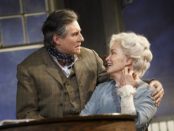
Jessica Lange and Gabriel Byrne joyously enter through a porch door after the sounds of the ocean have been heard. Their love and attraction for each other is palpable. Mr. Byrne embraces her and with his Irish accent says, “You’re a fine armful now, Mary, with those twenty pounds you’ve gained.” It is instantly clear that this revival of "Long Day’s Journey into Night" is going to be beautiful. [more]
Scott Ellis’ direction avoids caricature, even in the most broadly drawn characters like the man-hungry Ilona, the gigolo Steven and the scared, but pragmatic clerk Sipos. He make the one touch of melodrama, involving Maraczek’s marriage, seem human and a touch tragic, helped by Mr. Jennings subtle, but exuberant performance. He also draws a tender performance from Ms. Benanti who gets to use the more operatic part of her marvelous voice. [more]
While Frayn’s roles are juicy parodies of very specific kinds of people, for the laughs to roll in one on top of the other, the play must be performed fast enough that we don’t have time to think about it or what we are laughing at. Consequently, though the production is entertaining for its comic portrayals, it fails to trigger all the laughs inherent in the script or become the laugh riot it is intended to be. Possibly, as the actors have more performances under their belts, the play may pick up speed and more laughs along the way. [more]
For the first half of Stephen Karam’s “The Humans,” the Blake family Thanksgiving seems to be nothing but a banal seasonal gathering. And then suddenly the author’s message comes into focus and the play becomes a haunting drama and unnerving ghost story which is unlike anything you have seen lately. The superb cast headed by Reed Birney and Jayne Houdyshell under the direction of the always interesting Joe Mantello who has piloted many important new plays turns The Humans into a memorably unique experience. Karam, whose plays include Speech and Debate and Son of the Prophet, has been given a splendid Roundabout Theatre Company production for its third premiere of one of his plays. [more]
Roundabout Theatre Company has commissioned yet another new stage adaptation from British playwright Helen Edmondson, whose previous plays also include stage versions of Tolstoy’s "Anna Karenina" and George Eliot’s "The Mill on the Floss." In the title role, Keira Knightley who has been associated with period drama in her distinguished film career ("Atonement," "Pride and Prejudice," "Anna Karenina," and, of course, the "Pirates of Caribbean" movies) has chosen to make her Broadway debut. She is supported by Tony Award-winner Gabriel Ebert ("Matilda"), British actor Matt Ryan, and two time Tony Award-winning actress Judith Light ("Lombardi," "Other Desert Cities," "The Assembled Parties.") Unfortunately, director Evan Cabnet has chosen to stage this most French of tales in a bloodless, refined English style which doesn’t serve with the material well. [more]
The production includes the Broadway debuts of British screen and television stars Clive Owen and Kelly Reilly, and a return of British stage star Eve Best after her Tony Award nominated performance in the 1908 revival of Pinter’s "The Homecoming." Unfortunately, to some extent they are appearing in three different plays so different are their acting styles. Even Constance Hoffman’s costumes take your mind away from the play before you. A pity actually as "Old Times" has not been seen in New York since the Roundabout’s Off Broadway revival which ran from 1983-84 but had an odd combination of American and British actors of film and stage. [more]
Why another stage production of the Stephen Sondheim-James Lapine "Into the Woods" while the film version is currently playing? The Roundabout Theatre Company is hosting the ingenious, clever and witty Fiasco Theater production (previously seen at the McCarter Theatre Center in 2014) of this iconic musical using fairy tales from the Brothers Grimm which is the best musical revival in town. This is what every revival should be – a reinvention of the original material making it new enough that it wipes out memories of the original. If you did not see Fiasco’s six-character version of Shakespeare’s Cymbeline which had an extended run Off Broadway in 2011, then you are in for a delightfully surprising treat. [more]
An interesting and touching early musical from the composer of "Shrek," "Caroline, or Change," and "Fun Home." It may be in keeping with the notional scar, but sometimes "minimalist" fades into "generic." An inherent problem with the show, it's possible that even a small Broadway house like this one (740 seats) will always be too big.
The climactic sequence, following Violet's discouraging experience in Tulsa, takes place mostly in Violet's head and as such is almost unstagable, and in any case hard to understand. Last and most problematic is that these soldiers react relatively casually to Violet's allegedly repellent deformity. [more]
Longbottom's choreography and musical staging is busy, busy, busy, but not joyful or inspired. As conducted by David Holcenberg, Strouse's bouncy score is played at too slow a pace, even with orchestrations by the legendary Jonathan Tunick. The comedy is played too broadly, and the love scenes are passionless. [more]
Raul Esparza, the dynamic young actor who made great impressions in such not so great shows as Taboo and Chitty Chitty Bang Bang , plays Robert, whose tainted attitudes about attachment and commitment to women, and specifically to his three concurrent girl friends, appear the direct result of observing his friends' disintegrating relationships. Esparza delivers the insecurities of his character with a brio and confidence that also drives his two big songs "Marry Me a Little" (not in the original show, but restored here as it was in the earlier revival) and "Being Alive." Pivotal as he is, Robert often stands at the outside of his friends' lives as they are revealed in a series of skittish skits. [more]
The best moment finds Chenoweth putting a torrid spin on "I've Got What You Want," and yet not quite able to master the cracking of a whip. It's pure silliness. In Passionella …, Chenoweth plays Ella, a lonely sooty chimney sweep, who is magically transformed by her fairy godfather (Kudisch, who also serves as the story' s narrator), into a blonde sex pot of a movie star. She is destined to find true love, however, with a rock singer (James). Chenoweth's talent for breaking through the sound barrier with her high notes is the highlight of this skit. Fans of Chenoweth will be delighted; others will find the triptych trying. [more]
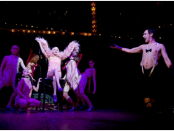
The best way to imagine what has happened to the beggars, the bourgeoisie, the pimps and whores, and the sordid denizens of the underworld in this operatic rant on the evils of capitalism is to think of a Cirque du Soleil troupe on Valium and under neon (what was lighting designer Jason Lyons thinking?). Worst of all, it is plodding and dull and an eyesore thanks to Isaac Mizrahi's Halloween-on-Fire-Island costuming. [more]
Weidman's book is especially clever in its anecdotal cohesiveness, and with additional material credited to Hugh Wheeler, will probably be thought of as more vindicated than it was initially. Yet one wonders if the sadness we feel as we watch the Japanese lose their will to resist American determination is actually compounded by the new ending that brings Japan into the modern age and includes an image of the bombing of Hiroshima. [more]
or all the handsome production values contributed by Scott Pask's handsome silvery unit setting and Vicki Mortimer's ravishing and revealing costumes, it is the presence and performance of Antonio Banderas, in the role of director Guido Contini (originated by the late Raul Julia), that pilots the action to perfection. Banderas, who is making his Broadway debut, proves an excellent choice both dramatically and vocally. That the Spanish-born actor was a member of the National Theater of Spain before he was discovered by Hollywood, accounts for his accomplished stage presence and the authority that he brings to both his singing and his character. [more]