PLAYWRIGHTS HORIZONS is a writer’s theater dedicated to the support and development of contemporary American playwrights, composers and lyricists, and to the production of their new work. Click to go to Playwrights Horizons website
Like Beth Wohl’s Liberation, Jacob Perkins’ "The Dinosaurs" follows a group of women who meet weekly to discuss a problem that interests them, in this case alcoholic addiction. Covering many years, the play gives six women with different stories a chance to talk candidly about their lives and travails. Beautifully written, the play, however, feels thin and repetitious and doesn’t seem to get anywhere. Directed by Les Waters, the six actresses led by Off Broadway stalwarts Kathleen Chalfant and Elizabeth Marvel create very different portraits, though at a brief 70 minutes we don’t learn that much about each one. [more]
With a three-hour running time (the first act runs two hours straight without an intermission) the play is too long for its repetitiousness having the actors go over the same theater games and monologues over and over again. Of course, the play becomes an endurance test for the actors as well as viewers, whether it was intended to or not. Actors who have undergone this kind of training may be amused; those of us who have not may be bored or lose interest. Although the actors who make up the ten-member cast of "Practice" play very different personalities, we see so little of them individually that it is hard to keep them separate and they become a big blur. [more]
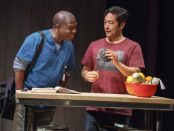
In a sharply observed and emotionally layered turn, "Prince Faggot" brings a fresh perspective to the classic "meet the parents" trope—with a royal twist. John McCrea’s George, the openly gay Prince of England, brings his boyfriend Dev (an excellent Mihir Kumar) home to meet his parents: the seemingly progressive Prince William (K. Todd Freeman, masterfully restrained) and Princess Kate (a poised and quietly complex Rachel Crowl). At first glance, the royal welcome is warm, even congenial. But beneath the polished surface lies a prickly nest of social expectation, national identity, and unacknowledged privilege. [more]
That balance—between emotional vulnerability and razor-sharp humor—is what elevates "Hold Me in the Water" beyond the sea of solo shows that mine personal experience for applause. Haddad’s artistry lies in his fierce honesty and unsparing introspection. He examines his own longing, joy, and heartache with something approaching clinical precision, yet never loses the pulse of the deeply human. He never asks for pity, and when disappointment inevitably arrives, he extends surprising compassion—even to the one who’s let him down. [more]
Walking into the Peter Sharp Theater we have no hint of what is behind what look like opaque vinyl shower curtains from one end of the stage to the other. Within moments of her appearance, decked out in a black suit and tie like the kid who hates to dress up to go to Grandma’s for Sunday dinner, we know Francesca D’Uva just doesn’t want to be here. At the end of 80 minutes, we are so glad she came. She breaks the ice by letting us know how sensitive she is to mouth sounds telling us about a high school teacher who smiled so hard you could hear it. On the count of three, we all try to copy the smile noise. “I love bringing people together like that. That will be the only piece of crowd work I do tonight. So hope you enjoyed it. You’re done.” [more]
Gabriel Kahane’s pair of song cycles are a welcome throwback to when lyrics were poetry and told great stories. Think of the 70's when the airwaves were blessed with the voices and songwriting of Harry Chapin, Joni Mitchell and Cat Stevens and you will have a basic understanding of what Kahane has successfully put together here. [more]
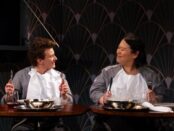
Koogler began writing "Staff Meal" in January 2020 and completed the first draft in April 2020…well, he certainly had time on his hands, but so did a lot of people. It’s a wonder we didn’t have a great outpouring of “the great American novels” during Covid, or at least as we were being released from our lockdowns so we’d have something to read as we made our way back into the subway. What is striking about "Staff Meal" is that we begin with what passes for so much normalcy – two people begin conversation, even if it’s minimal Millennial-bleats, and graduate towards commiserating about the coffee in this particular café finally leading up to finding lunch somewhere…but this won’t be a quick run into a (low-end) McDonald’s or (slightly better than low end) Pret a Manger…this will be a foray into Ruth Reichl territory. They land in a high-end perhaps Michelin-starred restaurant where the staff gathers to eat gourmet cuisine before the dinner crowd comes in. [more]
David Adjmi’s "Stereophonic" at the Golden Theatre, a transfer under the auspices of Playwrights Horizons, is a minutely detailed, almost minute-by-minute recreation of a recording session by a rock band, purportedly based on Fleetwood Mac’s creation of its epic album "Rumours" in 1976. (Adjmi has denied that this was his inspiration, claiming that the show has an amalgam of sources.) [more]
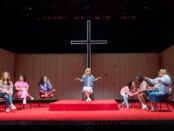
Sarah Benson’s direction is spot-on, but we find ourselves wishing the closing scene was more than just a plethora of bloody penises. This is where the creatives needed to say, “Okay, this is probably not what we wanted to say”. Adam Rigg’s scenic design though spare, is perfect for a mid-America room that can pass as a small church, or AA meeting. The neon cross is a great touch and Jane Cox and Stacey Derosier’s changing colors do not go unnoticed…particularly when the cross is pink amidst a lavender wash when Ryan is in the scene. Enver Chakartash’s costume design is appropriate across the board, although the women’s outfits in the closing scene are a mélange of Tina Turner’s castoffs from "Mad Max Beyond the Thunderdome." Choreographer Raja Feather Kelly provides fine ensemble suites for the Promise Keeper Girls. [more]
There are frequent breaks in thought such as “I forgot to mention at the top that I will be injecting my jokes with a bit of humor tonight as a way to keep them both engaging and fun.” Thanks for clarifying the job description. This is just one of many exclamations to the obvious. Director Nemuna Ceesay keeps us guessing. Are we watching an actor portraying a comedian/lounge performer? Does the comedian/lounge performer think he’s funny? What if no one laughs? A bit later there’s a recitation that goes on longer than it needs to. We start waiting for a punchline that never comes. And then it does…As it was introduced as a voice-over, “That was the opening paragraph of Moby Dick by Herman Melville, sold wherever Moby Dick by Herman Melville is sold. [more]
Milo Cramer’s delightful solo musical "School Pictures," part of a festival of new one person shows running in repertory at Playwrights Horizons, is wildly inventive, hilarious funny, and extremely insightful about adolescence, class, over-privilege and the New York education system. Almost entirely sung throughout, School Pictures tells us in a series of 11 songs about Cramer’s experiences working as a private tutor in NYC after school with mostly rich, brilliant students who are damaged by their parents – and their own – expectations. All of them hope to get into one of the eight elite specialized high schools for which they will need the SHSAT (Specialized High School Admissions Test) or top colleges and the competition as both the parents and students know is fierce. [more]
Tatarsky uses language in a fresh way, ultimately giving the sensation of having created her own. There are so many thoughts overlapping, and there are accompanying unintelligible sounds and gurgling (some of that happens during her coffee “breaks” and those coffee cups seem to be hidden absolutely everywhere), yet we follow her. When she references a new text, she will nonchalantly drop “I assume everyone here has read the book, yah? Great.” Of course, hasn’t everyone read "Die Ausbildung und Reisen von Wilhelm Meister"??? Her spontaneous body language may very well be choreographed but even there we have a very approachable and comforting whimsy throughout. [more]
Not since Stephen Sondheim’s "Sunday in the Park with George" have “civilians” gotten so close to the creative individual’s “process” when attending a theater piece. David Adjmi’s "Stereophonic" is an intensely personal work that examines the creation of a rock album, a group’s follow-up to a late-blooming debut, in the very competitive music scene of the 1970’s. As the characters in the play have been compared to the celebrated Fleetwood Mac members in many articles appearing before the opening of this production, it’s safe to say this is an exquisite fantasia on the creation of the now-legendary rock masterpiece known as "Rumours," an album firmly in Rolling Stone Magazine’s Top 10 of “The 500 Greatest Albums of All Time.” [more]
Caswell’s dialogue for and wry observation of a family this dysfunctional is quite compelling. Scenes where two of the siblings verbally gang up on the third are fraught with humor as much as real-life situations. Communication is “at your own risk,” with each goading the other about their addictions, instigating full-on relapses at every turn. It is no secret this is a very personal piece for the author. The dedication to the play reads: ”For my father if he’s out there. And for my siblings.” It is a play as much about love and loss (and grief) as it is about the addictions that create chasms in a family. And it is a play that deep down reveals a family with a lot of heart. [more]
Larissa Fasthorse’s "The Thanksgiving Play" gives a good tweaking to those who are so hung up on political correctness that they dare not make a decision. On the other hand, the play reminds us how difficult it is to be fair to all sides of the historical spectrum. The erasure of the Native American point of view is made clear by their very absence from the play, while the problem of educators knowing how to walk the fine line between inclusion and suitability is given a rare airing in this delightful parody. The use of in jokes, theatrical, historical and educational notwithstanding, "The Thanksgiving Play" is a satire that entertains while it makes some very real and needed points about political correctness when dealing with unpleasant American history. [more]
Silliness and whimsy can often be admirable qualities in a play, but not when taken to the degree playwright Julia Izumi has in her new work, "Regretfully, So the Birds Are," a co-production of and WP Theater and the Playwrights Horizons where the show has been well launched. "Regretfully," directed by Jenny Koons, centers on the trials and tribulations of the Whistler family: mother, Elinore, in prison for burning her husband alive; Illy and Neel, brother and sister who want to marry each other; sister Mora the cynical third sibling; and Cam, the dead father who has morphed into a snowman. [more]
Borinsky’s dialogue is filled with colorful, quirky lines which are often funny and entertaining, but the entire script borders on absurdity without a cohesive through point. There are a handful of lines which carry a promise of meaning, but most are tossed into the air like tweets, missing connections and lacking purpose. There’s a passage inspired from Deuteronomy 20:19, which, if it’s supposed to be the inspiration for the plot, stands alone as one of the few sage moments in the story. [more]
Norris’ smart and effective script is packed with controversy; its characters are stained by the trauma in which their lives have been steeped, and it’s uncertain they will ever feel clean again. So many questions come to mind as this play unfolds. ... "Downstate" is a stirring, thought-provoking play about a deeply painful topic that plagues societies around the world. It’s an extremely tight piece of writing; every word and action is relevant. I can’t wait to see it again. [more]
Chung has the six characters played by three actors, each playing a parent/child duo switching from one to the other in confusing frequency. In addition, each actor plays a parent of the opposite gender. To muddy things even further, all the characters are played by Asian-Americans who make honest, but failing, attempts to adopt working class Italian and Irish Catholic accents and attitudes. Lon/Daniela are played by Cindy Cheung; Roberta/Robbie by Jon Norman Schneider; and Theresa/Tim by Rob Yang. [more]
Deliriously and explicitly profane, Michael R. Jackson’s Pulitzer Prize winning musical, "A Strange Loop" has—unbelievably—made it to Broadway, produced by Playwrights Horizons, Page 73 and the Woolly Mammoth Theatre Company. Jackson’s explicit portrait of a lost soul’s salty journey is alternately stunning and amusing, appealing and appalling, told at a breakneck pace through his book, lyrics and music. It’s a rare, if dispiriting, portrait of a gay man who isn’t a paragon, a man who isn’t conventionally handsome, successful or rich. [more]
In the 13 years that span this earnest, thought-provoking play, three weddings, fear, war, and death all serve to test the strength and sanctity of these women’s bonds. Toossi’s script is intimate, and searching, both funny and heartbreaking; "Wish You Were Here" is a beautiful testament to the strengths and allegiances women find with each other in times of turmoil and oppression. [more]
The dynamic W. Tré Davis and Tyler Fauntleroy deliver rousing performances as Tambo and Bones. Each is possessed of a limber physicality, superior comic timing and dramatic depth. Their immense chemistry is such that they appear to be long-time show business partners instead of just actors in a play. With their imposing physiques, close-cropped hair and vocal talents, Brendan Dalton and Dean Linnard are hilarious as the robots. Taylor Reynolds' fizzy staging realizes Harris’ vision with theatrical flair, each scene is perfectly presented. Lighting designers Amith Chandrashaker and Mextly Couzin and sound designer Mikhail Fiksel respond to three diverse settings with resourceful artistry. Composer Justin Ellington’s delightful original music ranges from jaunty melodies to rap tunes. [more]
Will a former Afghani U.S. Armed Forces interpreter get himself and his family out of the country before he’s captured by the Taliban in 2013? This is the crux of playwright Sylvia Khoury’s gripping, thoughtful and suspenseful drama, "Selling Kabul." In a straight through 100 minutes, Ms. Khoury crafts an accessible overview of that conflict, sets up a compelling story and employs a classic plot device. Khoury’s smooth passionate dialogue imparts exposition and biographical details while advancing action with technical accomplishment. [more]
The declarative lyrics are written by Mr. Goldstein and the show’s composer Michael Friedman. Mr. Friedman was a notable musical theater figure who died of HIV-related causes in 2017, at the age of 41. With its derivative melodies echoing Stephen Sondheim, John Kander and William Finn, "Unknown Soldier" is not a posthumous masterpiece. [more]
After pillaging Ibsen in "A Doll's House, Part 2" and lampooning the former First Couple for "Hillary and Clinton," vaunted playwright Lucas Hnath’s latest piffle, "The Thin Place" is a Wallace Shawn-style talkathon aptly dedicated to the late magician Ricky Jay as it’s an exercise in flimflam. There is more craft and profundity in the first season "I Love Lucy" episode “The Séance” with its immortal lines, “Ethel to Tillie. Ethel to Tillie. Come in Tillie.” [more]
Numb from two straight-through hours of far-right speechifying emoted in perpetual semi-darkness, the audience at "Heroes of the Fourth Turning" then endures a ghastly aria of despair by a Lyme Disease-debilitated character. We also soon learn a deafening recurring sound that was thought to be innocuous, may have supernatural ramifications as the play ends on an unjustified cryptic note. The shooting and implied mutilation of a deer during the awkward prologue was an omen that this was going to be a lulu of a bad play. It’s symptomatic of the uneasy symbolism threaded throughout. [more]
Ms. Backhaus’ writing is erudite, well-shaped and imaginative but isn’t funny which is problematic considering it’s intended as a barbed comedy until its heartfelt metaphysical conclusion. Much of it frantically plays out with Monty Python’s intellectualism crossed with Mel Brooks’ coarseness and dashes of Alan Bennett’s pathos. Virginia Woolf figures prominently in one part. Though noble in intent, it’s an unsatisfying exercise that’s more synthetic than profound. [more]
Twenty-five-year-old African-American Michigan native and New York University graduate Usher is an usher at a Disney Broadway musical who is writing an autobiographical musical about his troubled life. His religious Christian parents are scornful of his sexuality and dubious of his career goals as he doesn’t emulate the commercial simplisticness of Tyler Perry who gets skewered in a production number. This exploration is light on plot and so we get a series a of overheated vignettes often laden with wan shock value. The often didactic dialogue relies on scatology peppered with the N-word. Dark comedy crossed with poignancy abounds. [more]
Jaw-dropping plot twists, painfully forced au courant dialogue, awkward sex scenes and a jagged central performance all make the world premiere of Halley Feiffer's "The Pain of My Belligerence" a fascinating doozy of a bad play. The tone is a blend of Ingmar Bergman and Nora Ephron and the cosmopolitan milieu is reminiscent of Woody Allen and Lena Dunham. There’s the sensation of guiltily scanning a highway car accident scene that you can’t take your eyes away from. [more]
In 90 minutes, Ms. Raffo packs in a great deal. We learn about Iraq’s past and present, religious lore, marital conflicts, unrequited love and the hardships of immigrants. The stiff treatment is schematic rather than polished and the resorting to soliloquies feels off. Without a defined plot, it plays out as a limp multi-character study that’s resolved with a talky and unconvincing denouement. Raffo does create appealing characters including the substantive title role which she herself plays. [more]
Many comic artists have noted that great humor often comes from great tragedy, though, inevitably, sometimes the latter overwhelms the former, and all you’re left with is a lot of indignation and nobody laughing. As the late Joan Rivers once remarked, "comedy is anger, but anger is not comedy." It's a maxim that the Sicangu Lakota writer Larissa FastHorse takes to heart in "The Thanksgiving Play," as she manages to keep us smiling while four white characters attempt to turn a half-millenium of genocide into a 45-minute children's show. [more]
In Craig Lucas’s "I Was Most Alive with You," two down-on-their-luck television writers mine recent personal tragedy for their latest project, hoping, with the Book of Job as their inspirational guide, to set both their careers and the universe in order. Although suffering has touched each of them, Ash (Michael Gaston), a late middle-aged recovering alcoholic in a bad marriage, is the much more forlorn figure. Like Job, Ash has hit one of those rough patches in life, where, if you’re a person of faith, you might start to suspect that your higher power doesn’t like you very much. [more]
Harrison’s dialogue is well-crafted and often in setup punchline mode peppered with plentiful pop culture references that falls flat. The overall effect is of a rote accumulation of touchstones appealing to this strata. It’s all without resonance unless one is like the characters being depicted. It’s certainly possible to dramatize the concerns of differing classes with cross-sectional interest but that is not the case in "Log Cabin." This title is most likely a play on Log Cabin Republicans who are gay and might reflect that some of the characters are actually more Conservative then they let on. [more]
Ms. Barron’s conception is more of an agenda driven fantastical tract rather than a well-crafted play with a cohesive plot. Her tone is of exaggeration and artifice with mannered dialogue that is intended to be hilarious yet thoughtful. A brief gag about "A Chorus Line" and a reference to the actual Telsey & Company Casting are some of the smug inside humor tossed in. [more]
But, unfortunately, Ferrentino squanders this intriguing setup, getting lost in existential musings that end up being nowhere near as complicated as her subject matter. The first signs of trouble are actually percolating even before the play begins. As we enter the theater, Cloris (Lynda Gravátt), Julie and Dan’s elderly neighbor, is already perched in the upstairs apartment of Dane Laffrey’s two-story set. And there she remains for the entire play, a constant presence hovering over the action below. Initially, you wonder about her and, then, you feel sorry for the actor, hoping she’ll be given something more to do than just putter around. Eventually, however, after a couple of pat exchanges with Julie, it all becomes cringingly clear. Cloris isn’t a character at all; she’s an inspirational device, one that Ferrentino unleashes with full, and shameless, force at the play’s tear-jerking conclusion. [more]
Playwrights Horizons has a real winner with the first entry in its new Redux Series bringing back worthy Off Off Broadway plays for a longer run Off Broadway. First up is "Miles for Mary," a company project from The Mad Ones, a New York City-based troupe dedicated to creating “ensemble-driven highly detailed theatrical experiences that examine and illuminate American nostalgia.” Seen previously at The Bushwick Starr during the 2016-17 season, "Miles for Mary" is a brilliant satire on group dynamics in an ongoing school fund-raising committee told in real time. While hilarity abounds as the committee does its pedantic and minimal work, an inevitable explosion is promised by the end and it is a doozie when it finally occurs. [more]
Playwright Robert O’Hara’s fertile premise might have made for a provocative, sober sci-fi take on gender roles, sexuality and parenthood. Instead, it’s broadly conceived and lame. The flat dialogue is in the vein of Abbott and Costello with numerous jokes about “fathers” since there are no mothers. The “Dude, I’m pregnant” bit gets painfully recycled. [more]
With her slim physique, flawless diction, melodiously husky voice and imperious bearing, Dunagan is commanding. She conveys the character’s arrogance, selfishness and harrowing mental decline due to dementia with steely flair. She forcefully embodies the archetypal distant mother who damages her children. [more]
Featuring an energetic, game cast headed by bigger-than-life Ashley D. Kelley as the title character, "Bella" follows this “big booty Tupelo girl,” as she travels (under an assumed last name) to meet her staid fiancé, Buffalo Soldier Aloysius T. Honeycutt (handsome, sweet voiced Britton Smith) and to escape the law. She meets a slew of fascinating characters—some who really existed and some fictitious—and finds her life taking a surprising turn in her bumpy road to marital bliss. [more]
Playwright Zayd Dohrn has a facility for setups, punch lines and zingers that might play well as an HBO situation comedy attempting to mix humor with seriousness. As a theater piece, his premise has potential but his execution is deficient. [more]
Playwrights Hannah Bos and Paul Thureen with developer Oliver Butler, creatively evoke the tragic, nostalgic spirit of Booth Tarkington’s "The Magnificent Ambersons" and the wonderment of the works of humorist Jean Shepherd. The scenario is engaging and the characters are lovingly rendered. [more]
LeFranc’s dialogue is a marvelous blend of the realistic and mundane. The well-delineated main characters all express themselves with true to life simplicity. Plot developments are the combination of subtle details that gradually do build to a satisfying resolution. It all has the sense of John Cheever’s suburban short stories where the darkness behind bonhomie is revealed. Swimming pools are mentioned in passing. [more]
Pierce coolly addresses the audience while delivering this mundane litany. His superb comic timing, long evident on the television situation comedy "Frasier," is on glorious display here. That quality combined with his dramatic depth and soothingly funny delivery makes this opening sequence mesmerizing. [more]
Playwright Julia Cho has crafted an engaging and universal work that unevenly blends reality with mysticism. The characters are all very well delineated and the dialogue is flavorful and realistic. It’s structured as a series of short scenes that include monologues, flashbacks and fantasies. The play’s two-act form diminishes its momentum, running two hours and fifteen minutes with an intermission. Repetitiveness and a preoccupation with profundity sidetrack its effectiveness at times. [more]
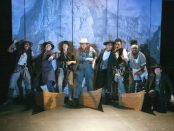
In this swashbuckling comedic play, 'Men on Boats" takes an innovative approach by casting ten women in the roles of the first “white” discovers of the Grand Canyon. However, this was not a nod to the current trend of casting cisgender or transgender actors. The use of “on boats,” instead of “in boats,” indicates the state of being in which the actresses find themselves — a history panorama where gender and race play little part. [more]
Gregory S. Moss’ "Indian Summer" at Playwrights Horizons is an uneasy mix of two stories, the first about the doomed romantic encounter between two teens and the second concerning the quiet existential suffering of an elderly man. Despite sudden shifts of tone, Moss manages to leave the audience feeling deeply for each of these characters. [more]
Rachel Hauck’s scenic design is the most outstanding feature of the interminable "Antlia Pneumatica." Ms. Hauck accurately and vividly represents the Texas ranch setting by an elaborate kitchen counter top in the center of the bare stage that is surrounded by shrubbery. It’s very functional as much of the activities involve preparing a feast. [more]
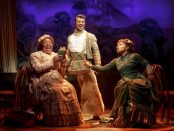
The family tension is defined in terms of the strong female relationships between mother Marvelous (Tamara Tunie) and the bride-to-be, who differ when it comes to wedding plans as well as the bride and her younger sister, Nyasha (Ito Aghayere) who clash over lifestyle choices. Big sister is the accomplished, serious professional woman who is strongly tied to her religious beliefs and customs, and the free-spirited little sister (who wasn't even asked to be a bridesmaid) who is tired of being berated for her choices. Tendi looks more to her aunt from Africa for guidance than her mother and is determined to have her look upon her choices as favorable. The source of comic relief in Familiar is Donald, the father (played by Harold Surratt), who sits back observing all the conflict and tries his best to take it all in stride. This family is one for the ages and how they deal with each other and common familiar issues is something all audiences can relate to. [more]
Playwright Jordan Harrison is a graduate of the Brown University M.F.A. program and the recipient of several prestigious awards such as a Guggenheim Fellowship and the Kesselring Prize. On a technical level "Marjorie Prime" is expertly constructed and contains serviceable dialogue that propels the plot, but in totality it never rises above the level of an academic contrivance. The premise is a familiar but promising one, but in execution it is flat. The exposition and setup never really become emotionally involving and the closing revelations are consciously sensationalistic. [more]
Ms. Nielsen has long been a treasured award-winning fixture of the New York stage with her quirky idiosyncratic comedic and dramatic talents. Here as the omnipotent matriarch Paige she is colossal. With her animated features, giddy voice, and frantic physicality, she delightfully mines every bit of the abundant dark comedy in the play. Alternately when slowing down to express fiercely serious sentiments she is chilling. This searing performance is yet another memorable turn from this incomparable actress. [more]
"The Christians," Lucas Hnath’s examination of the intricacies of religion currently playing at Playwrights Horizons, comes to us at a unique cultural moment: every day, scientific advances further challenge the existence of God; ostensibly in an attempt to stay palatable to his mainstream constituents, The Pope has issued a series of proclamations regarding the acceptability of homosexuality, the truth of evolution, and other topics; "The Book of Mormon"—a patronizing, tongue-in-cheek assessment of the Church of the Latter Day Saints—is still playing to sold-out houses after five years on Broadway. Indeed, the fact that "The Christians"’ opening line, “Brothers and Sisters, let us pray,” was met with a hearty laugh is telling: today, New York audiences are largely secular and conditioned to sharpen their daggers at the very mention of Christ. To Hnath, however, the subject of religion is no joke. [more]
Anna Ziegler’s "A Delicate Ship" is an intelligent, intensely absorbing play that treats its three thirty-something characters like chess pieces moving warily about Reid Thompson’s raised platform apartment set, floating amidst a rock garden which becomes a life-sized game board. [more]
Norris is interested in examining issues so often argued in black and white terms by drawing out the—pun intended—shades of grey. However, while wryly entertaining and largely incisive, his new work suffers from some of the same missteps as does his aforementioned "Clybourne Park." Namely, he paints Chris—his ostensibly well-intentioned, under-informed, straight white male character—as so downright nasty that it is almost impossible to listen to any of his arguments, however logical some of them may be. While the action of the play operates under the guise of an engaging debate that includes various different perspectives, the scales are tipped and its presentation of arguments is uneven. [more]
The play’s scenes alternate between the scientific research institute and the couple’s apartment. The theatrical device of having one set representing both places is well rendered by scenic designer David Zinn’s realistic and well-appointed set. Matt Frey’s lighting design and Ryan Rumery’s sound design contribute requisite razzle dazzle effects for the transitions from one setting to another. Mr Zinn also designed the purposeful costumes.
[more]
This brilliant production of Samuel D. Hunter’s "Pocatello" is characterized by tremendous depth in characterization and engaging simplicity in presentation. Leo Tolstoy famously observed, “All happy families are alike; each unhappy family is unhappy in its own way.” Here, a clash over gluten-free pasta becomes a memorably chilling pretext for psychological warfare. [more]
Throughout the play there are many visual and spoken references to Michael Jackson, showing how large the presence and influence of The King of Pop in his heyday loomed in the consciousness of many growing up and living in that era. This symbolism adds greatly to the detailed specificity of this passionate, suspenseful and bold work. [more]
Gideon Glick as Matthew is terrific, physically disappearing into his character so completely that he would not be recognizable in the street. Actors can get away with playing misfits as a collection of tics, so it's a great thing to see Glick dig deeper and infuse Matthew's every movement with his particular personality. [more]
Time has caught up with Jon Robin Baitz’s 1991 play and bankrupting one’s company over issues of integrity no longer seems quite admirable. Jon Robin Baitz writes literate, thoughtful plays like his 2012 Pulitzer Prize finalist, Other Desert Cities. However, like the revival last fall of his earliest play The Film Society showed, plays may date badly or their attitudes become artifacts of another generation. [more]