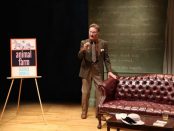
Grand highlights of Mr. Horton’s dynamic work includes an analysis of "Animal Farm" while he erases the novel’s seven animal commandments that are written on a blackboard as they are overturned one by one, by the pig Napoleon who represents Josef Stalin. There’s also a dramatic demonstration of American versus British rationing during W.W. II as Orwell produces bountiful American foodstuffs comparing them to the meager provisions allowed in Great Britain. [more]
The beauty of Chen’s technique lies in engaging the audience in a guessing game that they don’t immediately know they are a part of – presenting them with certain messages that appear to be true, but challenge them to think about it from a different perception. One of the main themes is examining the different viewpoints between the Chinese and American cultures and how perceptions can be skewed. The result is a clever and eye-opening puzzle that teaches important lessons around the human experience in a shocking way by offering extremes. [more]
Richard Alfredo’s 'The Dark Clothes of Night," a brilliant parody/homage to film noir and hardboiled fiction, the third play of Summer Shorts – Series B, is so good it alone is worth the price of admission. The other two plays which precede it in this year’s 10th Festival of New American Short Plays have interesting but undeveloped premises. But "The Dark Clothes of Night" is an instant classic, a humorous satire that is also a brilliantly theatrical study in paranoia, fear and evil and the elements that made film noir irresistible. Directed by playwright Alexander Dinelaris, the three actors in this memorable short work play multiple roles with assurance and aplomb. [more]
Thomas G. Waites has a long list of major credits that go back to the film "The Warriors" in 1979. As Austin, he gives one of the strangest performances in memory. It’s a monotonously upbeat steamroller turn that recalls the hyper enthusiasm of the young Donald O’Connor combined with the cloying seriousness of the older Mickey Rooney at his most lachrymose. Watching Mr. Waites is exhausting and bewildering. [more]
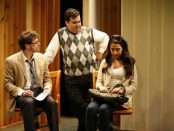
As might be expected LaBute’s new one act, "After the Wedding," contains a shocker. However, when it arrives in Maria Mileaf’s production, it is so matter-of-fact that it has little or no impact. Elizabeth Masucci and Frank Harts play a married couple of six years. Named simply “Him” and “Her,” they alternate telling (different) versions of their years together without interacting. However, both of them recall an event that occurred on their way to their honeymoon which should have been a game-changer. For these self-absorbed people millennials, it was simply another incident along the way. Sitting in chairs facing the audience, Masucci and Harts are rather charming as the amoral couple but the play seems like a scene from a longer play not yet written. [more]
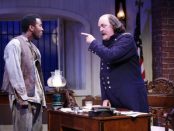
Taking place during the time of the Civil War, "Butler" is a tale of conscience, courage, and transcendence. As Major General Benjamin Butler, Ames Adamson has risen to power but is faced with a decision that could change the game for slavery in America. Many of the themes surrounding a nation divided such as injustice, prejudice, and lack of understanding remain extremely relevant today and are just as impactful with events occurring every day in our world. Instead of ignoring the issues or using power as the only weapon, Butler flips the script and uses empathy and understanding as a means to connect. [more]
While "A Class Act" covers material dramatized elsewhere, Norman Shabel’s play, seen at The Playroom earlier this year, is always absorbing, always unpredictable. The seven member cast is totally believable in their roles as lawyers and corporate bigwigs. This is a tense and enlightening evening in the theater that demonstrates the startling inner workings of the legal system even in what seems like an open and shut case. [more]
At one point stumbling around in a sleep mask and wearing a colorful nightgown, the 88 year-old Estelle Parsons has a field day as the 88 year-old Evelyn, a former journalist for The International Herald Tribune. Ms. Parsons delightfully barrels through the play growling, cursing, and exhibiting vibrant physicality. Being the skillful old pro that she is, Parsons has the technique to tone it down when needed. [more]
Samuel D. Hunter’s latest play, "The Healing," is a commission by Theater Breaking Through Barriers, dedicated to advancing the work of performers with disabilities. Not surprisingly, the play gives roles to six disabled actors out of the seven characters in the play, and they acquit themselves well. This story of a reunion of childhood friends in their thirties who have gathered for the funeral of one of their members is made very real by the acting of the cast. The problem with the play is that it appears so tentative and low-key that the explosion we keep waiting for never happens. Under the direction of Stella Powell-Jones, the healing of the title is so subtle that the play could be said to be anti-theatrical. [more]
Since his youthful career heyday of the 1980’s with major roles on Broadway in Neil Simon plays and starring in the enduring cultural touchstone film "Ferris Bueller's Day Off," Mr. Broderick has since continued on in such films as "Election" and the Broadway smash hit, "The Producers." Now 54, he is stockier, his hair is gray and his features are fuller but his charisma and commanding talent remains as does his inimitable grin and twinkling eyes. Considering his indelible past successes, this role is quite challenging and he is winningly up to it. Much of the part consists of relatively uninterrupted monologues that Broderick terrifically delivers that range from harrowing recollections to a visit to a brothel that is hilarious. His characterization of this drab, depressed and tormented man is very moving and is a joyous case of riveting star/character acting. [more]
This production combines the simplicity of the 1967 Off Broadway original version with the additions from the 1999 Broadway revival, using two of Mr. Lippa’s songs and much of Mr. Mayer’s additions. Most notable is replacing the character of Patty with Charlie Brown’s sister Sally. For this role, Kristin Chenoweth won that year’s Tony Award for Best Featured Actress in a Musical. [more]
Playwright William Francis Hoffman offers a quirky, weirdly compelling if not totally satisfying take on contemporary American life. Mr. Hoffman’s dialogue is richly expressive bordering on poetic and enhances his true to life melancholic characters. The plot is slender and problematic. It has the sense of a symbolism-laden short story adapted for the stage rather then a developed play. [more]
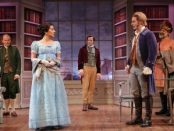
Red Bull Theater which has specialized in Elizabethan and Jacobean tragedies has moved on to the 18th century with Marc Vietor’s exquisite and stylish revival of "The School for Scandal," Richard Brinsley Sheridan’s famous but rarely revived classic comedy of manners. With impeccable casting and a pitch-perfect production team, this School is as witty, delightful and accessible as one could wish. The 18th century look of the play is both historic and satiric. Anna Louizos’ clever settings transform one into the other with the turn of a wall or a door and a rearrangement of the furniture, highlighted by Russell H. Champa’s lighting. Her witty use of props (a chamber pot, a trunk, empty picture frames) adds to the fun. [more]
The show’s creator and director Ramesh Meyyappan also plays a character named Nabokov. The Lolita author Vladimir Nabokov was a renowned butterfly enthusiast. Naomi Livingstone plays Butterfly, a kite maker who hunts, kills and mounts butterflies. She meets Nabokov and they fall in love. Chris Alexander plays a customer who visits Butterfly’s shop and falls in love with her. Their relationships are ultimately marred by violence and tragedy. [more]
Playwright Henry Naylor achieved prominence in Great Britain as a television writer most notably for the satirical program "Spitting Image." This work is not groundbreaking but it does very effectively depict the two women and their plights with shrewdly imparted historical and cultural details that conjure up exotic imagery reminiscent of David Lean’s epic films. Humor and tragedy are seamlessly combined. There are topical references to Donald Trump, Ted Cruz, drone strikes and the British tabloids as well as 19th century specifics. [more]
You might wonder why Morag, Fiona’s mother, in Sharman Macdonald’s groundbreaking Scottish play, "When I Was a Girl I Used to Scream and Shout," is so repressive about sex. What the program doesn’t tell you about this play having its Off Broadway premiere at the Clurman Theatre is that it was first produced in 1984 in London and that the daughter’s childhood goes back to the fifties when female sexuality was frowned upon. Then it becomes obvious that this play is now a period piece dealing with a time when feelings about female sexuality were changing but the older generation was still stuck on the other side of the divide with the teachings of their childhood. While the play seems to be two generations behind the times, what the play continues to be is a blistering portrait of a toxic mother-daughter relationship. [more]
Shoving a grapefruit into Mae Clarke’s face in "Public Enemy," George M. Cohan’s "Yankee Doodle Dandy" song and dance numbers for which he won the Academy Award for Best Actor, and the “Top of The World, Ma!” finale from "White Heat" are among the exciting factual highlights of this old-fashioned chronicle. [more]
"Southern Comfort" is an ambitious and admirable attempt to depict a community that till now has been left off of our stages. Though the material at times seems tamer that the content would warrant, it is ultimately a very moving musical. It also is a showcase for Annette O’Toole to give one of the finest performances of the season. [more]
At the top of the show Cariou tells us that he made his Broadway debut in the Stratford Connecticut Shakespeare Festival’s transfer of "Henry V" in 1969 and six months later in the spring of 1970 appeared at the Palace Theatre in the new musical" Applause." Ever since then, he has had the idea to combine Shakespeare and song with “tunes that either support the text or are the antithesis.” The evening proceeds to pair Shakespeare and song thematically, like the opening sequence which offers Orsino’s “If music be the food of love, play on” from "Twelfth Night," followed by Sondheim’s “Love, I Hear” from "A Funny Thing Happened on the Way to the Forum" and Rodgers and Hart’s “Falling in Love with Love,” from "The Boys from Syracuse," based on Shakespeare’s "The Comedy of Errors." [more]
So begins a remarkable comedy-drama of two very opposite teenagers who shouldn’t have met and wouldn’t have if Anthony had not chosen the reclusive, mysterious Caroline for his partner. The play makes use of opposites, beginning with the theme of the poem, love and death, and in Whitman’s typical fashion, everything in between. But Caroline and Anthony are also opposites in every possible way: pessimistic/optimistic, sedentary/athletic, closed minded/open minded, white/black, friendless/popular, careless student/straight A student. They appear to have nothing in common, but by the end of the play they are drawn to each other through the magical words of Whitman and Leaves of Grass. Ultimately, Caroline and Anthony have revealed their dreams, fears and true selves to each other and to us. [more]
Robert Langdon Lloyd’s eloquent performance as the blind prophet Tiresias energizes what had been a stilted presentation of this small-scale production of "The Burial at Thebes." Before Mr. Lloyd’s commanding midway appearance there had been a good deal of static expositional recitation and declaiming with only slight dramatic sparks. [more]
Brendan (NBC’s "Blindspot") Gall’s sexy and seductive new thriller, "Wide Awake Hearts," thrusts audiences into a challenging game of cat and mouse, as they are left to decipher the story of four friends in a case of art imitating life. An actor, director, writer and actress are faced with the intricacies of dealing with relationships, infused with passion and threats of infidelity, as they are in the process of creating a movie dealing with these very themes. [more]
The opening one is British author Lexi Wolfe’s delightfully wistful "Stand Up for Oneself." It’s a Chekhovian romantic comedy with clipped Noel Coward-style dialogue taking place in the room of a house where a party is going on. Lucas, a 42-year-old morose music professor sits alone drinking with his cane nearby when the free-spirited 26-year-old Lila enters. There is flirtation and revelations. Sensitively directed by John Pierson, the play’s very fine writing is boosted by the wonderfully detailed and effecting performances of Alicia Smith and Mark Ryan Anderson. [more]
"Maurice Hines: Tappin’ Thru Life" is a pleasantly entertaining look at the personal and professional life of Maurice Hines. Of course, his life and career were closely intertwined with his late brother Gregory’s, his dance partner for many years. The story of how their parents, Maurice and Alma, pushed them—willingly, it seems—into show business and their almost immediate success is the gist of this smooth, occasionally exciting show. Two boys from D.C. made good. [more]
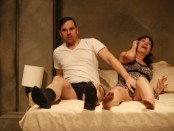
Jerry Mayer’s "2 Across" will remind of a great many other romantic comedies but in the hands of Andrea McArdle and Kip Gilman, it is a charming light-hearted evening in the theater. At least half way through the 90 minute encounter you will be rooting for this seemingly mismatched couple to get together – if not long before. Brought together by a love of the daily crossword puzzle, this warm and wise comedy covers a great many topics that engage couples to day. [more]
Directed by Daisy Walker, "How Alfo Learned to Love" is chock full of Italian-American stereotypes. The characters are just heightened enough that the gimmick works, but there is also a lot of heart behind this story. Walker has brought to life a group of characters who are quirky and lovable, and in the end it really feels like a family affair. All of this is contingent on Thom’s performance as Alfo whose character arc is fleshed out and brimming with variety. This redemption story about learning to love is a rollicking good time. Backed by strong performances and direction, a slick and consistent pace, and an entertaining script which sticks to a winning formula, nary a soul is likely to leave this theater without a smile. [more]
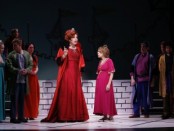
Jackie Hoffman is famous for her combination of sarcasm and wit in a small, rubber-faced package and John “Lypsinka” Epperson, for his uncanny way of taking lip-synching to the heights of great art. Hoffman imbues the character of Princess Winnifred with New York street smarts, despite coming from a Swamp. (Well, maybe NYC is a swamp!) Lypsinka’s Queen Aggravain is, amazingly, the most possessive mother ever and at the same time the most self-involved human in the kingdom. She does not want her simpering son, Prince Dauntless (the sweetly shlumpy Jason Sweet Tooth Williams), to marry—ever!—but if he doesn’t marry, no one else in the kingdom can, either. [more]
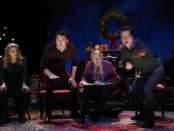
The tale of their demise in 1964 en route to a show in their native Pennsylvania and their temporary 2015 resurrection still works brilliantly. Even though "Tidings" cover a good deal of the "Forever Plaid" musical territory, the holiday songs they’ve added give this show seasonal warmth. [more]
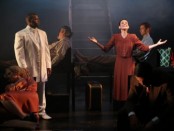
The Peccadillo Theater Company’s "A Wilder Christmas" is a gentle and genteel evening of theater: two early Thornton Wilder one-act plays, directed with an attention to detail and a leisurely sense of timing by Dan Wackerman, the company’s artistic director. "The Long Christmas Dinner" (1931) and "Pullman Car Hiawatha" (1930) together make for a rich sampling of Wilder’s familiar themes of family and the unavoidable specter of death (which, in Wilder, is only the beginning of another journey). These themes were perfected in his 1938 masterpiece, "Our Town," including the conceit of a godlike Greek chorus in the form of a Stage Manager who explains and even supervises the action. [more]
"Gigantic," the new feel-good musical, is a dynamic up-to-date show about teenagers at a summer weight-loss camp. Previously seen as Fat Camp in the 2009 New York Musical Theatre Festival, Gigantic’s book by Randy Blair & Tim Drucker may be conventional, but its pulsating pop-rock score by Matthew roi Berger to lyrics by Blair is vigorous and high-powered and the energetic, first-rate cast under the fast-paced direction of Scott Schwartz makes the material seem better than it is. This is one of the few teen musicals in which the characters actually sound like modern youth rather than what adults think they sound like. [more]
Over the course of just over an hour, the actors enact Dylan Thomas’ classic prose work of his childhood recollections interspersed with their sweet performances together and solo of familiar Christmas songs including “Silent Night” in his native Welsh. Cullum often sits in a chair holding an elaborately covered edition of the book, reading from and sometimes referring to it as if grandly telling a story. [more]
The legendary stage actress Kathleen Chalfant is appearing in her second one-woman show, a follow-up to her “Mrs. Dalloway” in The Party, from the Virginia Woolf stories in 1993. This time she plays Rose Fitzgerald Kennedy, the 79-year-old matriarch of the most famous political family in 20th century America. It is July 1969 and we meet her in the tasteful living room of her Hyannis Port, Massachusetts, home (designed by Anya Klepikov) one week after her youngest son Teddy’s tragic accident at Chappaquiddick. The premise of "Rose, The Kennedy Story as Told by the Woman Who Lived It All" is that we are members of the Ladies Auxiliary of the Knight of the Redeemer visiting from Dublin. We are invited to stay until Teddy comes back from sailing which he has been doing since the previous day. Her husband Joe, Sr., who has had a stroke eight years before is being cared for in an upstairs bedroom. [more]
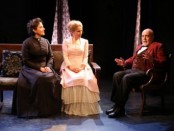
Pendleton has made some strange directorial choices. Characters appear on stage and stand silently long before their entrances. This is distracting as one wonders are they supposed to hear the conversations taking place. Many of the entrances and exits take place through the main aisle of the theater which breaks the fourth wall convention continually. He has also cast several actors as older than they are described so that this shifts the character relationships appreciably. The most famous scene in the play when Nora slams the door, possibly the most iconic moment in modern drama, is diluted considerably as there is no door for Nora to slam. Harry Feiner’s set design has the drawing room and bedroom visible side by side throughout the play which seems somewhat inappropriate for the 19th century setting. [more]