Carol Rosegg
One of the leading show photographers in New York. http://www.carolrosegg.com/
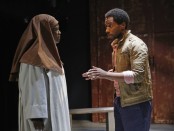
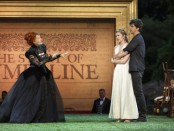
The playwrights have a keen understanding of this place and time, helped by the simple, but telling scenery of Stephen C. Jones, who also lit the small performing space to give the illusion of multiple settings. Molly R. Seidel’s costumes also hit the nail on the head as far as period and character are concerned. The glamorous dress Mária creates for Irma is in direct contrast to her own dreary housedresses, and Robert’s fancy western style suit makes Robi even more eager to leave Romania. [more]
The Big Broadcast on East 53RD
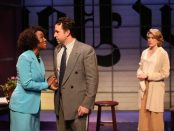
Rounding out the cast are Alexis Bronkovic as Ruth--Penny’s best friend--and Bill Tatum, who plays Ray’s boss. Once again, the driving motivation behind nearly every character is nowhere to be found. It seems that simply for the sake of creating a play about fake news, Brukenfeld opted to fill his script with lifeless characters that don’t question anything and are content to believe that Ray is dead. The performances across the board are unsympathetic and played mind-bogglingly straightforward. For what it’s worth, the actors do all that they can with the material at hand, turning in acceptable performances given the circumstances. [more]
Georgie: My Adventures with George Rose
What truly distinguishes the show is Dixon’s fearless psychological focus on Rose and himself. The predominant theme is of hero worship and its bruising disappointments. It also attempts to explore the issue of the often-dark contrast between the on-stage and off-stage lives of great entertainers. In examining their involvement, Dixon doesn’t spare Rose or himself from honest scrutiny. [more]
2017 LaBute New Theater Festival
Reading David Foster Wallace’s Infinite Jest while lying on a couch is Jay, a slacker-looking type in his 30’s. Sitting in the living room nearby is his 60ish mother who enjoys watching Dr. Phil on television and complaining about her ailments. Gabe McKinley’s Homebody is an enthralling black comedy with shades of Grey Gardens. Mother and son bicker, rehash recriminations and share their joy over the possibility of Jay’s novel being published. In 35 minutes, Mr. McKinley delivers a very well written, plotted and satisfying one-act play. It’s so pleasurable that a full-length version would be most welcome. [more]
The Mikado Reimagined (NYGASP)
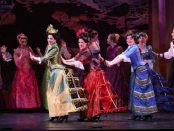
In keeping with Sullivan having been hit over the head, the cast is clothed in a motley collection: a combination of late Victorian and Japanese styles. Some are in all Japanese, some in all Victorian, most are in a combination of the two. Even the Victorian costumes have baroque additions to make them look exotic. The women all wear Victorian gowns with bustles open in the back just as though they had not finished dressing. The concept while colorful is quite a mess with every possible variation on stage at the same time. [more]
This Day Forward
"This Day Forward" shows much tighter control than many of Nicky Silver’s early anarchic plays. However, aside from offering a few wonderful characters in Malka and the older Irene, the play is disappointing as it sets up expectations which don’t play out. When "This Day Forward" is over, it leaves a feeling of something missing that has failed to take place. It can’t simply be saying that the sins of the parents are visited on the children – or could it? [more]
Terms of Endearment
It isn’t until the second act of Dan Gordon’s stage adaptation of "Terms of Endearment," based on both the Larry McMurtry novel as well as the Academy Award-winning screenplay by James L. Brooks, that the play takes off. Featuring the now grown-up film star Molly Ringwald in the role of Aurora Greenway that won Shirley MacLaine the 1984 Oscar for Best Actress, the first act jumps around, skipping huge chunks of time as you can in movie cutting, but seems like something is has been left out on stage. [more]
Finian’s Rainbow
Moore’s adaptation successfully uses the small, recently renovated stage of the Irish Repertory Theatre so that even with 13 actors the performance area always looks populated with the people of Rainbow Valley. James Morgan’s clever unit set is redolent of the South with its huge live oak draped above the stage. Mary Jo Dondlinger’s lighting is redolent of the warm southern sun as well as the cool evening moonlight. The four piece orchestra sits neatly tucked in the back of the stage without distracting from the performance. [more]
A Taste of Things to Come
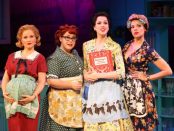
During the first half of the 20th century, the perception of women and their place in society was archaic and harmful to say the least. In fact, it wasn’t until the late 1950’s that the widely accepted oversimplification of the role of women was truly called into question and brought under scrutiny. Documenting the influential and crucial decade between the ‘50’s and ‘60’s, Debra Barsha and Hollye Levin’s new musical "A Taste of Things to Come" is a very pointed yet enjoyable exploration of these transformative years for the housewife, told through the eyes of four women who have a common interest in cooking. [more]
The Babies
Musical numbers are catchy and silly while sharing important life lessons. “What Are Friends For” and “All Alone” examines feelings of sadness, loneliness, and finding your tribe no matter your family circumstances. You may not be able to choose your family, but these babies will always have each other’s back. The emotional ballad, “We Will Get through This,” tugs at the heartstrings and is sung beautifully by Mallory. The scenic and lighting design by Josh Iacovelli brings light and warmth to the space with minimal props as not to distract from the group dynamic on stage – while ensuring that the babies are comfy and cozy in their distinctive onesies. [more]
Othello: The Remix
In this smart, clever version of the story, Iago, slightly uptight longtime member of Othello’s crew believes that he is not appreciated when newcomer Cassio, a much happier rapper who just enjoys performing gets more notice from Othello. As in the original, Iago plots Othello’s downfall by making him jealous, hinting that Cassio was romancing Desdemona, Othello’s love. Roderigo, the nerdy techie, with a lisp and a heavy heart, also yearns unrequitedly for Desdemona. [more]

Coriolanus (Red Bull Theater)
Just as Ulysses S. Grant and Dwight D. Eisenhower did centuries later, Coriolanus, urged on by his powerful mother, Volumnia (a startling, stinging Lisa Harrow), uses his military success as a springboard for a high political office, Consul, which he easily wins with help of two Tribunes of Rome, Sicinius Velutus (a wily Stephen Spinella) and Junius Brutus (Merritt Janson, playing cross gender to perfection) and a friend, Menenius Agrippa (Patrick Page, using his weighty voice and commanding eyes brilliantly). [more]

Vietgone
Not only does Nguyen have a unique sensibility and style, but the story is told entirely from the Vietnamese-American point of view, one not often seen on our stages. We hear the Americans as the Vietnamese do and as the Americans attempt to speak in Vietnamese. While the structure of the play is quite challenging going backwards and forwards in time from July 1975 in a Middle America relocation camp and breaking out in rap songs periodically, "Vietgone" is a very compelling portrait of displaced people trying to make a new life for themselves while wishing they were back home where they cannot go. [more]
Cox and Box & Trial by Jury
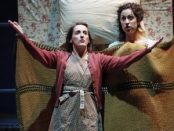
Introducing what he dubbed a pair of “Comedies of Crime,” NYGASP’s artistic director Albert Bergeret offered what he said was a first of a new series for the company: intimate performances of works by Sir Arthur Sullivan in the jewel box Marjorie S. Deane Little Theater performed to one piano, rather than to the usual full orchestra. In addition, the cast of "Trial by Jury" was comprised of the NYGASP’s Wand’ring Minstrels, a quintet of singers made up from the company, rather than using the full chorus, while the production of "Cox and Box" featured a newly edited version by singer/director David Macaluso. The new format for these delightfully entertaining productions had their advantages and disadvantages. [more]
Tick, Tick… BOOM!
Out of this frustration, Larson in 1991 began performing a rock monologue about his life and stalled career called 30/90, as it was set in 1990 as he turned thirty. Later it was retitled "Boho Days" and then "tick, tick... BOOM!," as a chief device is the ticking of a clock. The show was performed for short engagements at several New York City venues and ignited Larson’s career, leading to the creation and presentation of Rent Off-Broadway in 1996. [more]
The Maids
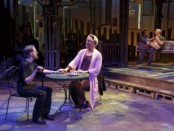
Obie award-winning playwright José Rivera is an Oscar nominee for his adapted screenplay for "The Motorcycle Diaries." For this adaptation, he has set "The Maids" (which premiered in Paris in 1947) in Vieques Island in Puerto Rico in 1941. This was a politically tumultuous era with native factions resisting the U.S. presence there. Mr. Rivera’s script reflects this situation and locale and is filled with cultural references to sugar cane, bustellos and revolutionaries. [more]
Inner Voices
Paulette Haupt, producing artistic director of Premieres, should be very proud of herself. Her "Inner Voices" program at the TBG Theatre managed to shock, move and entertain. The three short one-act musical monologues, each with a distinctive voice and each performed by an expert singer/actor were sweetly bizarre ("Just One 'Q' "), shattering ("The Pen") and heartwarming ("The Booty Call"). [more]

The Clearing
Playwright Helen Edmundson whose stage plays have been mostly adaptations of famous literature ("The Mill on the Floss," "War and Peace," "Anna Karenina," as well as "Coram Boy" and "Thérèse Raquin" both seen on Broadway) tells her story in the leisurely way one might write a novel. While the material is both shocking and surprising, director Pamela Moller Kareman has undercut the inherent tension in the play by the choices she has made. [more]
Orwell in America
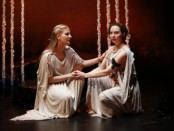
Grand highlights of Mr. Horton’s dynamic work includes an analysis of "Animal Farm" while he erases the novel’s seven animal commandments that are written on a blackboard as they are overturned one by one, by the pig Napoleon who represents Josef Stalin. There’s also a dramatic demonstration of American versus British rationing during W.W. II as Orwell produces bountiful American foodstuffs comparing them to the meager provisions allowed in Great Britain. [more]
Caught
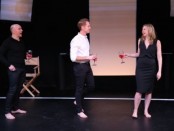
The beauty of Chen’s technique lies in engaging the audience in a guessing game that they don’t immediately know they are a part of – presenting them with certain messages that appear to be true, but challenge them to think about it from a different perception. One of the main themes is examining the different viewpoints between the Chinese and American cultures and how perceptions can be skewed. The result is a clever and eye-opening puzzle that teaches important lessons around the human experience in a shocking way by offering extremes. [more]
Summer Shorts 2016 – Series B
Richard Alfredo’s 'The Dark Clothes of Night," a brilliant parody/homage to film noir and hardboiled fiction, the third play of Summer Shorts – Series B, is so good it alone is worth the price of admission. The other two plays which precede it in this year’s 10th Festival of New American Short Plays have interesting but undeveloped premises. But "The Dark Clothes of Night" is an instant classic, a humorous satire that is also a brilliantly theatrical study in paranoia, fear and evil and the elements that made film noir irresistible. Directed by playwright Alexander Dinelaris, the three actors in this memorable short work play multiple roles with assurance and aplomb. [more]
Austin
Thomas G. Waites has a long list of major credits that go back to the film "The Warriors" in 1979. As Austin, he gives one of the strangest performances in memory. It’s a monotonously upbeat steamroller turn that recalls the hyper enthusiasm of the young Donald O’Connor combined with the cloying seriousness of the older Mickey Rooney at his most lachrymose. Watching Mr. Waites is exhausting and bewildering. [more]
Summer Shorts 2016 – Series A
As might be expected LaBute’s new one act, "After the Wedding," contains a shocker. However, when it arrives in Maria Mileaf’s production, it is so matter-of-fact that it has little or no impact. Elizabeth Masucci and Frank Harts play a married couple of six years. Named simply “Him” and “Her,” they alternate telling (different) versions of their years together without interacting. However, both of them recall an event that occurred on their way to their honeymoon which should have been a game-changer. For these self-absorbed people millennials, it was simply another incident along the way. Sitting in chairs facing the audience, Masucci and Harts are rather charming as the amoral couple but the play seems like a scene from a longer play not yet written. [more]
Butler
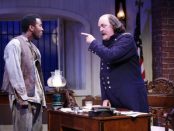
Taking place during the time of the Civil War, "Butler" is a tale of conscience, courage, and transcendence. As Major General Benjamin Butler, Ames Adamson has risen to power but is faced with a decision that could change the game for slavery in America. Many of the themes surrounding a nation divided such as injustice, prejudice, and lack of understanding remain extremely relevant today and are just as impactful with events occurring every day in our world. Instead of ignoring the issues or using power as the only weapon, Butler flips the script and uses empathy and understanding as a means to connect. [more]
A Class Act
While "A Class Act" covers material dramatized elsewhere, Norman Shabel’s play, seen at The Playroom earlier this year, is always absorbing, always unpredictable. The seven member cast is totally believable in their roles as lawyers and corporate bigwigs. This is a tense and enlightening evening in the theater that demonstrates the startling inner workings of the legal system even in what seems like an open and shut case. [more]
Out of the Mouths of Babes
At one point stumbling around in a sleep mask and wearing a colorful nightgown, the 88 year-old Estelle Parsons has a field day as the 88 year-old Evelyn, a former journalist for The International Herald Tribune. Ms. Parsons delightfully barrels through the play growling, cursing, and exhibiting vibrant physicality. Being the skillful old pro that she is, Parsons has the technique to tone it down when needed. [more]
The Healing
Samuel D. Hunter’s latest play, "The Healing," is a commission by Theater Breaking Through Barriers, dedicated to advancing the work of performers with disabilities. Not surprisingly, the play gives roles to six disabled actors out of the seven characters in the play, and they acquit themselves well. This story of a reunion of childhood friends in their thirties who have gathered for the funeral of one of their members is made very real by the acting of the cast. The problem with the play is that it appears so tentative and low-key that the explosion we keep waiting for never happens. Under the direction of Stella Powell-Jones, the healing of the title is so subtle that the play could be said to be anti-theatrical. [more]
Shining City
Since his youthful career heyday of the 1980’s with major roles on Broadway in Neil Simon plays and starring in the enduring cultural touchstone film "Ferris Bueller's Day Off," Mr. Broderick has since continued on in such films as "Election" and the Broadway smash hit, "The Producers." Now 54, he is stockier, his hair is gray and his features are fuller but his charisma and commanding talent remains as does his inimitable grin and twinkling eyes. Considering his indelible past successes, this role is quite challenging and he is winningly up to it. Much of the part consists of relatively uninterrupted monologues that Broderick terrifically delivers that range from harrowing recollections to a visit to a brothel that is hilarious. His characterization of this drab, depressed and tormented man is very moving and is a joyous case of riveting star/character acting. [more]
You’re a Good Man, Charlie Brown
This production combines the simplicity of the 1967 Off Broadway original version with the additions from the 1999 Broadway revival, using two of Mr. Lippa’s songs and much of Mr. Mayer’s additions. Most notable is replacing the character of Patty with Charlie Brown’s sister Sally. For this role, Kristin Chenoweth won that year’s Tony Award for Best Featured Actress in a Musical. [more]
Cal in Camo
Playwright William Francis Hoffman offers a quirky, weirdly compelling if not totally satisfying take on contemporary American life. Mr. Hoffman’s dialogue is richly expressive bordering on poetic and enhances his true to life melancholic characters. The plot is slender and problematic. It has the sense of a symbolism-laden short story adapted for the stage rather then a developed play. [more]
The School for Scandal
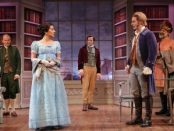
Red Bull Theater which has specialized in Elizabethan and Jacobean tragedies has moved on to the 18th century with Marc Vietor’s exquisite and stylish revival of "The School for Scandal," Richard Brinsley Sheridan’s famous but rarely revived classic comedy of manners. With impeccable casting and a pitch-perfect production team, this School is as witty, delightful and accessible as one could wish. The 18th century look of the play is both historic and satiric. Anna Louizos’ clever settings transform one into the other with the turn of a wall or a door and a rearrangement of the furniture, highlighted by Russell H. Champa’s lighting. Her witty use of props (a chamber pot, a trunk, empty picture frames) adds to the fun. [more]
Butterfly
The show’s creator and director Ramesh Meyyappan also plays a character named Nabokov. The Lolita author Vladimir Nabokov was a renowned butterfly enthusiast. Naomi Livingstone plays Butterfly, a kite maker who hunts, kills and mounts butterflies. She meets Nabokov and they fall in love. Chris Alexander plays a customer who visits Butterfly’s shop and falls in love with her. Their relationships are ultimately marred by violence and tragedy. [more]
Echoes
Playwright Henry Naylor achieved prominence in Great Britain as a television writer most notably for the satirical program "Spitting Image." This work is not groundbreaking but it does very effectively depict the two women and their plights with shrewdly imparted historical and cultural details that conjure up exotic imagery reminiscent of David Lean’s epic films. Humor and tragedy are seamlessly combined. There are topical references to Donald Trump, Ted Cruz, drone strikes and the British tabloids as well as 19th century specifics. [more]
When I Was a Girl I Used to Scream and Shout
You might wonder why Morag, Fiona’s mother, in Sharman Macdonald’s groundbreaking Scottish play, "When I Was a Girl I Used to Scream and Shout," is so repressive about sex. What the program doesn’t tell you about this play having its Off Broadway premiere at the Clurman Theatre is that it was first produced in 1984 in London and that the daughter’s childhood goes back to the fifties when female sexuality was frowned upon. Then it becomes obvious that this play is now a period piece dealing with a time when feelings about female sexuality were changing but the older generation was still stuck on the other side of the divide with the teachings of their childhood. While the play seems to be two generations behind the times, what the play continues to be is a blistering portrait of a toxic mother-daughter relationship. [more]
Cagney
Shoving a grapefruit into Mae Clarke’s face in "Public Enemy," George M. Cohan’s "Yankee Doodle Dandy" song and dance numbers for which he won the Academy Award for Best Actor, and the “Top of The World, Ma!” finale from "White Heat" are among the exciting factual highlights of this old-fashioned chronicle. [more]
Southern Comfort
"Southern Comfort" is an ambitious and admirable attempt to depict a community that till now has been left off of our stages. Though the material at times seems tamer that the content would warrant, it is ultimately a very moving musical. It also is a showcase for Annette O’Toole to give one of the finest performances of the season. [more]
Broadway & the Bard
At the top of the show Cariou tells us that he made his Broadway debut in the Stratford Connecticut Shakespeare Festival’s transfer of "Henry V" in 1969 and six months later in the spring of 1970 appeared at the Palace Theatre in the new musical" Applause." Ever since then, he has had the idea to combine Shakespeare and song with “tunes that either support the text or are the antithesis.” The evening proceeds to pair Shakespeare and song thematically, like the opening sequence which offers Orsino’s “If music be the food of love, play on” from "Twelfth Night," followed by Sondheim’s “Love, I Hear” from "A Funny Thing Happened on the Way to the Forum" and Rodgers and Hart’s “Falling in Love with Love,” from "The Boys from Syracuse," based on Shakespeare’s "The Comedy of Errors." [more]
I and You
So begins a remarkable comedy-drama of two very opposite teenagers who shouldn’t have met and wouldn’t have if Anthony had not chosen the reclusive, mysterious Caroline for his partner. The play makes use of opposites, beginning with the theme of the poem, love and death, and in Whitman’s typical fashion, everything in between. But Caroline and Anthony are also opposites in every possible way: pessimistic/optimistic, sedentary/athletic, closed minded/open minded, white/black, friendless/popular, careless student/straight A student. They appear to have nothing in common, but by the end of the play they are drawn to each other through the magical words of Whitman and Leaves of Grass. Ultimately, Caroline and Anthony have revealed their dreams, fears and true selves to each other and to us. [more]
The Burial at Thebes
Robert Langdon Lloyd’s eloquent performance as the blind prophet Tiresias energizes what had been a stilted presentation of this small-scale production of "The Burial at Thebes." Before Mr. Lloyd’s commanding midway appearance there had been a good deal of static expositional recitation and declaiming with only slight dramatic sparks. [more]
Wide Awake Hearts
Brendan (NBC’s "Blindspot") Gall’s sexy and seductive new thriller, "Wide Awake Hearts," thrusts audiences into a challenging game of cat and mouse, as they are left to decipher the story of four friends in a case of art imitating life. An actor, director, writer and actress are faced with the intricacies of dealing with relationships, infused with passion and threats of infidelity, as they are in the process of creating a movie dealing with these very themes. [more]
2016 LaBute New Theater Festival
The opening one is British author Lexi Wolfe’s delightfully wistful "Stand Up for Oneself." It’s a Chekhovian romantic comedy with clipped Noel Coward-style dialogue taking place in the room of a house where a party is going on. Lucas, a 42-year-old morose music professor sits alone drinking with his cane nearby when the free-spirited 26-year-old Lila enters. There is flirtation and revelations. Sensitively directed by John Pierson, the play’s very fine writing is boosted by the wonderfully detailed and effecting performances of Alicia Smith and Mark Ryan Anderson. [more]
Maurice Hines: Tappin’ Thru Life
"Maurice Hines: Tappin’ Thru Life" is a pleasantly entertaining look at the personal and professional life of Maurice Hines. Of course, his life and career were closely intertwined with his late brother Gregory’s, his dance partner for many years. The story of how their parents, Maurice and Alma, pushed them—willingly, it seems—into show business and their almost immediate success is the gist of this smooth, occasionally exciting show. Two boys from D.C. made good. [more]
2 Across
Jerry Mayer’s "2 Across" will remind of a great many other romantic comedies but in the hands of Andrea McArdle and Kip Gilman, it is a charming light-hearted evening in the theater. At least half way through the 90 minute encounter you will be rooting for this seemingly mismatched couple to get together – if not long before. Brought together by a love of the daily crossword puzzle, this warm and wise comedy covers a great many topics that engage couples to day. [more]
How Alfo Learned to Love
Directed by Daisy Walker, "How Alfo Learned to Love" is chock full of Italian-American stereotypes. The characters are just heightened enough that the gimmick works, but there is also a lot of heart behind this story. Walker has brought to life a group of characters who are quirky and lovable, and in the end it really feels like a family affair. All of this is contingent on Thom’s performance as Alfo whose character arc is fleshed out and brimming with variety. This redemption story about learning to love is a rollicking good time. Backed by strong performances and direction, a slick and consistent pace, and an entertaining script which sticks to a winning formula, nary a soul is likely to leave this theater without a smile. [more]
Once Upon a Mattress
Jackie Hoffman is famous for her combination of sarcasm and wit in a small, rubber-faced package and John “Lypsinka” Epperson, for his uncanny way of taking lip-synching to the heights of great art. Hoffman imbues the character of Princess Winnifred with New York street smarts, despite coming from a Swamp. (Well, maybe NYC is a swamp!) Lypsinka’s Queen Aggravain is, amazingly, the most possessive mother ever and at the same time the most self-involved human in the kingdom. She does not want her simpering son, Prince Dauntless (the sweetly shlumpy Jason Sweet Tooth Williams), to marry—ever!—but if he doesn’t marry, no one else in the kingdom can, either. [more]
Plaid Tidings
The tale of their demise in 1964 en route to a show in their native Pennsylvania and their temporary 2015 resurrection still works brilliantly. Even though "Tidings" cover a good deal of the "Forever Plaid" musical territory, the holiday songs they’ve added give this show seasonal warmth. [more]
A Wilder Christmas
The Peccadillo Theater Company’s "A Wilder Christmas" is a gentle and genteel evening of theater: two early Thornton Wilder one-act plays, directed with an attention to detail and a leisurely sense of timing by Dan Wackerman, the company’s artistic director. "The Long Christmas Dinner" (1931) and "Pullman Car Hiawatha" (1930) together make for a rich sampling of Wilder’s familiar themes of family and the unavoidable specter of death (which, in Wilder, is only the beginning of another journey). These themes were perfected in his 1938 masterpiece, "Our Town," including the conceit of a godlike Greek chorus in the form of a Stage Manager who explains and even supervises the action. [more]
Gigantic
"Gigantic," the new feel-good musical, is a dynamic up-to-date show about teenagers at a summer weight-loss camp. Previously seen as Fat Camp in the 2009 New York Musical Theatre Festival, Gigantic’s book by Randy Blair & Tim Drucker may be conventional, but its pulsating pop-rock score by Matthew roi Berger to lyrics by Blair is vigorous and high-powered and the energetic, first-rate cast under the fast-paced direction of Scott Schwartz makes the material seem better than it is. This is one of the few teen musicals in which the characters actually sound like modern youth rather than what adults think they sound like. [more]
A Child’s Christmas in Wales 2015
Over the course of just over an hour, the actors enact Dylan Thomas’ classic prose work of his childhood recollections interspersed with their sweet performances together and solo of familiar Christmas songs including “Silent Night” in his native Welsh. Cullum often sits in a chair holding an elaborately covered edition of the book, reading from and sometimes referring to it as if grandly telling a story. [more]
Rose, The Kennedy Story as Told by the Woman Who Lived It All
The legendary stage actress Kathleen Chalfant is appearing in her second one-woman show, a follow-up to her “Mrs. Dalloway” in The Party, from the Virginia Woolf stories in 1993. This time she plays Rose Fitzgerald Kennedy, the 79-year-old matriarch of the most famous political family in 20th century America. It is July 1969 and we meet her in the tasteful living room of her Hyannis Port, Massachusetts, home (designed by Anya Klepikov) one week after her youngest son Teddy’s tragic accident at Chappaquiddick. The premise of "Rose, The Kennedy Story as Told by the Woman Who Lived It All" is that we are members of the Ladies Auxiliary of the Knight of the Redeemer visiting from Dublin. We are invited to stay until Teddy comes back from sailing which he has been doing since the previous day. Her husband Joe, Sr., who has had a stroke eight years before is being cared for in an upstairs bedroom. [more]
Nora
Pendleton has made some strange directorial choices. Characters appear on stage and stand silently long before their entrances. This is distracting as one wonders are they supposed to hear the conversations taking place. Many of the entrances and exits take place through the main aisle of the theater which breaks the fourth wall convention continually. He has also cast several actors as older than they are described so that this shifts the character relationships appreciably. The most famous scene in the play when Nora slams the door, possibly the most iconic moment in modern drama, is diluted considerably as there is no door for Nora to slam. Harry Feiner’s set design has the drawing room and bedroom visible side by side throughout the play which seems somewhat inappropriate for the 19th century setting. [more]
Kick
Ms. Rush is also the performer and she is stupendous. In addition to playing Bernadette, she portrays a gallery of characters she encounters. These include her parents, a priest, her gay male best friend, her Rockette confidante, her husband, her son and a few others. Rush effortlessly switches back and forth among these multiple roles with precision and vivid physical and vocal details, offering great depth to each. [more]
Shear Madness
The energizing conceit of the play is its reliance on audience participation that adds considerably to the entertainment. During the action, the audience gets to ask questions of all those involved and at the intermission a detective is in the theater’s lobby to confer with. It all means that the actors besides sticking to the script must also improvise a great deal. This breaking of the “fourth wall” is done very cleverly and believably. The audience also votes on who the killer is based on all of the facts that have been presented. Therefore, each performance varies based on those in attendance. [more]
The Widow of Tom’s Hill
In Aleks Merilo’s play, "The Widow of Tom’s Hill," human nature is tested in the face of a life-threatening plague. Under Rachel Black Spaulding’s direction, this play takes place in a small town off the coast of Washington in 1918, with audiences first meeting a young widow named Aideen (Lucy Lavely) struggling to provide for her young child. She must fight for survival and take caution against anyone who crosses her path. From the beginning scene, audiences can surmise the rough past she’s encountered that’s forced her to become her own soldier against the cruel, harsh outside world. [more]
Travels with My Aunt
Havergal’s adaptation is unusual in that it uses four male actors to play 25 roles including the central role of Aunt Augusta, with all the actors taking turns narrating the story. Dressed exactly alike in each act, Thomas Jay Ryan, Jay Russell, Daniel Jenkins and Rory Kulz switch identities, nationalities, age, and genders in a madcap adventure told with decided British understatement. This is challenging for the audience as well as the actors: since the performers do not change costumes, it is necessary to follow the plot closely to follow who is who, with the actors sometimes changing characters in the same scene. Steven C. Kemp’s minimal but clever unit set is not much help either as it remains basically the same in each act throughout all of the outrageous adventures that unlikely hero Henry Pulling is taken on by his aunt. [more]
The Quare Land
Mr. Maloney is a veteran character actor of stage and screen with New York City theater credits going back to 1964. This leading role of Hugh Pugh is a marvelous showcase for his immense talent. With a perfect accent, graceful physicality, and his grandly expressive face, deep set eyes, and prominent bald head he creates a riveting characterization out of Samuel Beckett. Visually and vocally he effortlessly combines humor, pathos and malevolence in this towering and memorable performance. [more]
Desire: An Evening of Plays Based on Six Stories by Tennessee Williams
Having commissioned evenings of one act plays by major American playwrights based on the short stories of Anton Chekhov and the sonnets of William Shakespeare, The Acting Company has now turned to the work of a native author. As directed by Michael Wilson, the result, "Desire: An Evening of Plays Based on Six Stories by Tennessee Williams," is a mesmerizing work of one acts in which each author handles the original material differently and the brilliant group of nine actors, mainly Acting Company alums, get to tackle two – four roles each. Many give such vivid and varied performances that it is necessary to examine the program to realize that you have seen the same performer in a contrasting role. [more]
Sense of an Ending
Mr. Urban does an excellent job of dramatizing and explaining a complex historical situation in this fictional treatment of a real case. In 1994, Rwandan President Juvénal Habyarimana died when his plane was shot down. This assassination instigated a brutal tribal conflict between the majority Hutus who blamed Tutsi extremists for the death of the Hutu president. Varying estimates of the death toll range from 500,000 to 1,000,000. [more]
Cymbeline
At The Public Theater’s Shakespeare in the Park venue, director Daniel Sullivan has proved himself a brilliant interpreter of the Bard’s comedies, both dark and light, from the evidence of his "Merchant of Venice," "The Comedy of Errors" and "Twelfth Night," to name only a few. Therefore it is a great disappointment to report that his "Cymbeline," the second and last 2015 Shakespeare in the Park offering, based on his 1999 Old Globe Theatre, San Diego, staging, is both confused and uneven, both visually and theatrically. Even more discouraging, the production wastes the talents of noted stage stars Kate Burton, Raúl Esparza, Patrick Page, and Lily Rabe and Hamish Linklater, the acting couple being reteamed on the New York stage for the fifth time. [more]
Summer Shorts 2015 – Festival of New American Short Plays – Series B
Series B of Summer Shorts 2015 is similar to Series A in that all three plays are also relationship dramas, here between a woman (or three women) and a man in which the men aren’t sure they want to give in to the women. Unlike Series A, all three have endings that are open ended and rather unsatisfying to varying degrees. Although two of the three authors have excellent credits (Lucy Thurber and Robert O’Hara), the plays may feel unfinished or early drafts. [more]