
The Last Audition
Shearman offers a haunting solo play about an aging Shakespearean actor confronting the one play for which no rehearsal is possible: the anguish of letting go.
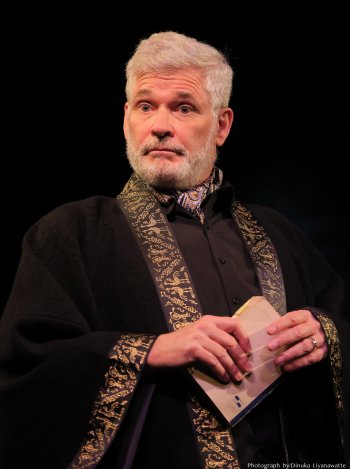
Paul Shearman in a scene from his “The Last Audition” at the Chain Theatre (Photo credit: Dimuka Liyanawatte)
There is, in The Last Audition, something almost defiantly modest—a chamber piece of sorrow that refuses the grandiloquence of tragedy even as it circles one. The play, a solo vehicle of hushed ambitions, written by and starring Paul Shearman, sensitively directed by David St John, unfolds like a fading echo in an empty theater, its emotional register pitched not to catharsis but to the quieter, more unsettling key of recognition. It is, at heart, a drama about diminishment—of memory, of stature, of self—and yet it proceeds with a delicacy that feels, in its way, like a form of grace.
At its center stands an actor who has outlived his own legend. Paul Shearman, in a performance of grave and unshowy intelligence, inhabits this man with an almost disarming transparency. Once a figure of Shakespearean authority—one imagines him bestriding the stage in roles that demand both thunder and wit—he now finds himself in the antiseptic purgatory of an audition waiting room, a space that reduces even the most storied careers to a numbered slot and a casting assistant’s glance. Shearman resists any temptation toward caricature; instead, he offers us a portrait of erosion in real time, a man who does not so much deny his decline as fail, poignantly, to apprehend it fully.
We encounter Sebastian Drake as a creature of the theater in its grandest, most vanishing sense—an actor forged in the cadences of Shakespeare, sustained by a lifetime of command, and still fiercely, almost defiantly, independent. It is precisely this hard-won autonomy that renders the erosion of his memory so exquisitely painful to behold. The mind that once summoned verse with ease now falters, and the stage that once affirmed his identity begins, imperceptibly, to recede from him.
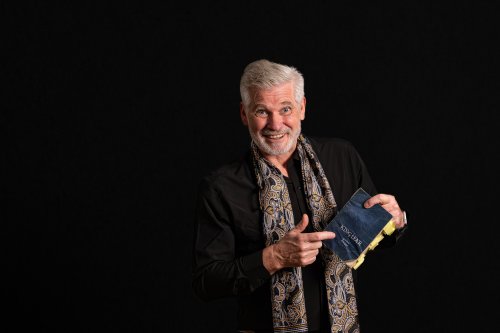
Paul Shearman in a scene from his “The Last Audition” at the Chain Theatre (Photo credit: Eric Moore)
And yet, Shearman ensures that we do not observe Drake at a distance; we are made to invest in him, to will him forward, to hope—against mounting evidence—that he might summon one last, transcendent act of recall, despite the fact he shows up to the audition wearing two different color socks. “Who’s dressing you these days?,” he asks. Our allegiance is unwavering, even as the truth becomes impossible to ignore. For alongside our admiration runs a quieter, more sobering recognition, one shared by those who orbit his life: that the theater, which has given him so much, may no longer be his to claim. It is this tension—between devotion and inevitability—that gives the portrait its aching resonance, transforming Drake’s struggle into something at once deeply personal and universally understood.
The play’s action—if one can call it that—is deceptively simple. We watch him wait. We listen as he rehearses the past, summoning old triumphs like half-remembered incantations, while the present intrudes in the form of phone calls from a daughter whose concern is edged with a dawning alarm. Gradually, almost imperceptibly, the scaffolding of his identity begins to falter. Lines once etched into muscle memory slip away; thoughts fracture mid-sentence. What emerges is not a single dramatic rupture but a slow unspooling, rendered with a restraint that makes it all the more devastating.
Though rooted in the theatrical profession, the play’s true subject lies elsewhere—in the fragile architecture of the mind, and the particular cruelty of its betrayal. This is a drama of cognitive decline, of the creeping disorientation that attends dementia, and it is to Shearman’s immense credit that he approaches it without sentimentality. His performance is suffused with dignity, but it is a dignity under siege: flashes of irritation and anger break through the surface calm, only to be hastily suppressed, as if the character himself were determined to maintain the decorum of a life spent in service to language. Indeed, it is language—specifically Shakespeare—that becomes his last redoubt. A well-turned phrase, a remembered cadence, offers momentary order against the encroaching chaos, as though the iamb itself could hold the mind together.
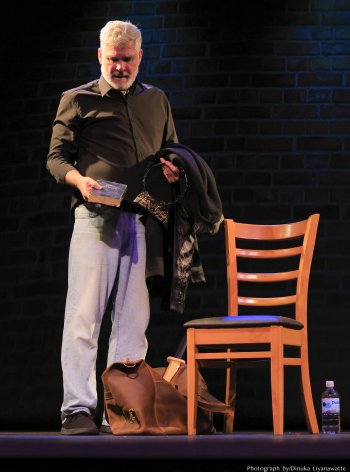
Paul Shearman in a scene from his “The Last Audition” at the Chain Theatre (Photo credit: Dimuka Liyanawatte)
And yet, what proves most remarkable is the play’s refusal to submit to the blunt mechanics of conventional dramatic force. Its thematic richness is allowed to breathe, to dilate in time, so that reflection becomes not a lapse but a method—a kind of dramaturgy of duration. The writing lingers, yes, but it lingers with purpose, permitting each moment to accrue a delicate sediment of feeling rather than rushing toward effect. What might, in a cruder rendering, seem diffuse here gathers into something more atmospheric, more humane: an emotional landscape shaped by hesitation, by return, by the fragile persistence of thought itself.
There is, in this measured pacing, a profound fidelity to the inner life the play seeks to illuminate. The discursive passages feel less like indulgence than like the very texture of consciousness under strain—thoughts circling, doubling back, searching for purchase. Far from requiring a firmer editorial hand, the text seems guided by an exacting sensitivity to rhythm, trusting silence and extension as expressive tools. The emotional contour that emerges is not sharply etched but softly contoured, like a memory half in shadow, and all the more affecting for it.
So, too, with the interplay between lucidity and confusion: rather than announcing itself in bold contrasts, it flickers with an unnerving subtlety. The transitions are nearly imperceptible, as they so often are in life, and this very restraint becomes the source of the drama’s quiet power. The actor’s modulations—vocal and physical alike—are finely calibrated, favoring nuance over display, and in doing so invite the audience into an unusually intimate act of attention. One does not simply witness the character’s disorientation; one begins, almost involuntarily, to share it. We take his impatience with the misplaced Lear crown to heart; we can all see it dangling on the chair.
The Last Audition exerts a quiet, persistent hold. It is a play that does not insist upon its importance, yet reveals it gradually, like a memory one is reluctant to confront. In its gentle way, it addresses a condition that is becoming ever more common, and ever more feared, in an aging society. With great precision—both textual and technical—it achieves a piercing resonance. As it stands, it is a work of considerable tenderness, carried, above all, by Shearman’s finely calibrated performance, which lingers in the mind like the ghost of a line half-remembered.
The Last Audition (through April 17, 2026)
Presented by Bango & Bongo Productions for New York City Fringe 2026
Mainstage at The Chain Theatre, 312 West 36th Street, in Manhattan
For tickets, visit www.frigid.nyc
Running time: 55 minutes without an intermission


Leave a comment