
The Life and Death of King John
A tale of conflict within the English court of King John attributed to William Shakespeare.
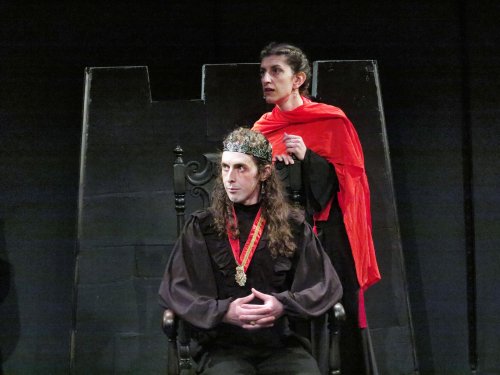
Bellamy Woodside Ridinger as King John and Victoria Hedgeberry as Queen Eleanor of Aquitaine in a scene from Smoking Mirror Theatre Company’s production of William Shakespeare’s “The Life and Death of King John” at A.R.T./New York Theatres (Photo credit: Jonathan Slaff)
The Life and Death of King John is a play attributed to William Shakespeare. It first appears in printed form in the First Folio of supposed Shakespeare plays in 1623, but is believed to have been written in 1590 and appears to be based on The Troublesome Reign of King John, a play from 1589 by an anonymous playwright or at least an unknown playwright.
One of the interesting ways that early English history has been preserved is in the dramas from the Elizabethan period. A group of these plays has been attributed to William Shakespeare, although there are serious doubts about his authorship as a playwright, much less his depth of knowledge to write serious drama about English history. On the other hand, Christopher Marlowe was a highly educated and well-known poet and writer who would have possessed the knowledge and skill to write some of the great plays of English history from that period.
The Life and Death of King John, directed by John Gordon, tells the tale of conflict within the English court of King John (Bellamy Woodside Ridinger) involving the French court of King Philip II (Fareeda Pasha). The dispute concerned who was the rightful heir to the throne: King John, the youngest son of Henry II and Queen Eleanor of Aquitaine (Victoria Hedgeberry), or Arthur, Duke of Brittany (Tessa Grace), son of King John’s brother Geoffrey II and Lady Constance (Ruby Rich). Lady Constance has formed an alliance with King Phillip of France to pursue her claim that Arthur is the rightful heir to the throne, as Geoffrey was the eldest son of Henry II.
The core of this historical drama is more about the manipulations of Eleanor and Constance on the respective kings than about the direct actions of the kings themselves. King John is not a heroic figure, but more of a scheming, egocentric manipulator. He is more concerned with pleasing his mother and giving the appearance of being powerful and in control than with achieving a more independent regard.
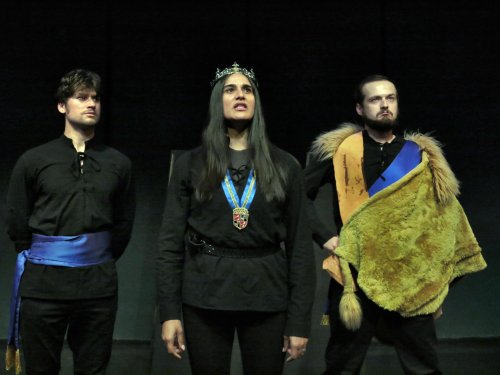
Robert Gordon as Louis the Dauphin, Fareeda Pasha as King Philip II and Tony Savage Thorn as the Duke of Austria in a scene from Smoking Mirror Theatre Company’s production of William Shakespeare’s “The Life and Death of King John” at A.R.T./New York Theatres (Photo credit: Jonathan Slaff)
The depiction of these characters is important in understanding the internal dynamics of the familial relationships. Ridinger’s characterization may be off-putting for some because of the lack of heroic presence, but it is consistent with the nature of King John. His lack of concern for the feelings of those around him and his superficial attachment to the traditions of the nobility in his kingdom ultimately leads to his downfall. At this point, Ridinger delivers a solid presentation of the emotional side of King John, only hinted at over the course of the play.
Victoria Hedgeberry plays two essential characters in the play, Queen Eleanor and Lady Faulconbridge, solidly embodying both. However, her performance would be more effective with a clearer distinction in the character’s appearance, either through makeup or costume. Ruby Rich fully inhabits the character of Lady Constance, Arthur’s mother. She is one of the ensemble members with a full grasp of iambic pentameter, and her emotional delivery as a distraught mother late in the play is first-rate.
Another notable character is Bastard Philip Faulconbridge, perfectly embodied by Mateu Parellada. This character operates as a guide, to a certain extent, breaking the fourth wall and addressing the audience with comments that are, at times, humorous and at other moments, informative. He serves as a device that provides guiding consistency to the narrative.
The story of the internal familial machinations over who is the rightful heir is complicated by the intrusion of the Roman Catholic pope through the offices of his legate, Cardinal Pandulph (Martin Challinor). The cardinal manipulates the two kings into conflicts that are then resolved by his intercession, all in the service of the Pope’s political ambitions.
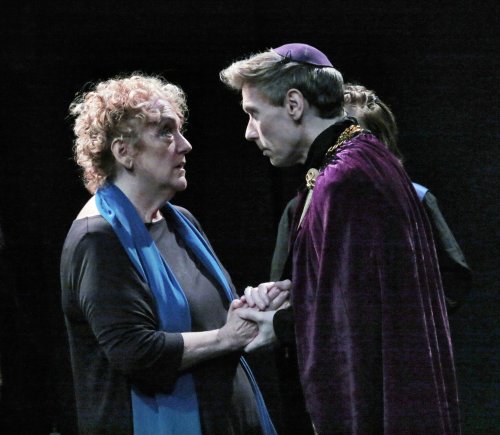
Ruby Rich as the Lady Constance and Martin Challinor as Cardinal Pandulph in a scene from Smoking Mirror Theatre Company’s production of William Shakespeare’s “The Life and Death of King John” at A.R.T./New York Theatres (Photo credit: Jonathan Slaff)
Challinor is charged in this production with playing two pivotal characters, the other being Hubert, a knight and supporter of King John. He will be the one charged by King John to dispose of Arthur, a task he ultimately is unwilling to complete. Challinor is effective in embodying the two very different characters, but more importantly, he is one of the few in the ensemble with a solid grasp of blank verse.
An element of the story is the behavior of the English noblemen. They switch allegiances depending on the behavior of either King John or King Philip II. It is not easy to follow these shifting loyalties in the context of the internecine conflict being played out, and this is made more difficult by the fact that many of the characters are portrayed by the same actors. Since some in the ensemble are tasked with playing two or three characters, this introduces an element of confusion in the production. Given the constraints imposed by the need to play multiple characters, the cast makes a solid effort to achieve a reasonable level of transparency.
Even with the efforts of the actors playing multiple characters, there are situations where it simply doesn’t work. Tessa Grace is tasked with acting as four characters, with two of them being necessary to the dramatic arc. She is solid in her depiction of Robert Faulconbridge, but not so as Arthur, the reason being that he is an 11-year-old boy. The depiction of Arthur as a child is crucial to understanding the various interactions between characters at critical points in the play. There are other examples of character confusion, but none as serious as the one with Arthur.
One other area that has been touched on is the execution of the poetic dialogue. It is important in the structure of iambic pentameter, or blank verse, that the rhythm of the dialogue be consistent, with a few exceptions. The lines must be spoken as a normal speech pattern without particular attention to the rhyming scheme. If done correctly, the rhymes within the dialogue flow naturally without having attention paid to them. Unfortunately, the delivery by the ensemble varies widely, with some members delivering solid blank verse. In contrast, others give a textual reading, and some are completely out of character for the words being spoken.
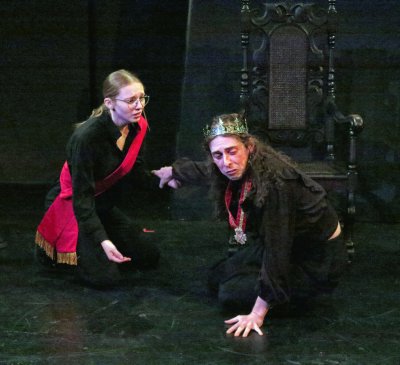
Erica Cafarelli as Prince Henry and Bellamy Woodside Ridinger as King John in a scene from Smoking Mirror Theatre Company’s production of William Shakespeare’s “The Life and Death of King John” at A.R.T./New York Theatres (Photo credit: Jonathan Slaff)
The production is a bare-bones affair. The set design by John Gordon and Ruby Rich suggests a castle battlement with a large chair for the throne of King John. The costuming by Janet Holmes (assited by Jancie Crobsby) is also minimalist, with sashes, hats, footwear, and crowns to depict the various personages. Bellamy Woodside Ridinger cleverly and effectively uses cast members as clashing Ninja warriors to present stylized battle scenes. Eric Nightengale’s lighting is effective in supporting the various scenes.
The Life and Death of King John (through September 7, 2025)
Smoking Mirror Theatre Company
Jeffrey and Paula Gural Theatre at the A.R.T/New York Theatres, 502 West 53rd Street, in Manhattan.
For tickets, visit //www.smokingmirrortheatreny.com
Running time: three hours including one intermission


Leave a comment