
The Burning Cauldron of Fiery Fire
Anne Washburn's latest play tells the story of a North California commune dealing with the death of a recent member.
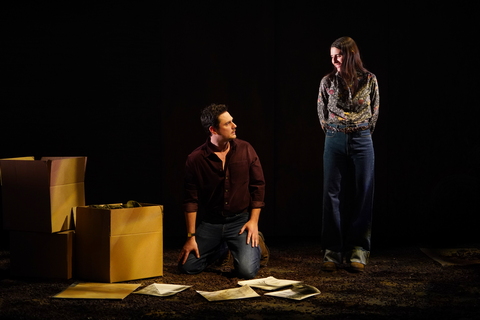
Tom Pecinka and Marianne Rendón in a scene from Anne Washburn’s “The Burning Cauldron of Fiery Fire” at The Vineyard Theatre (Photo credit: Carol Rosegg)
Playwright Anne Washburn who does not write conventional plays has often written about people dealing with grief in a private community as in both Mr. Burns, A Post–Electric Play and Antlia Pneumatica. In her new play, The Burning Cauldron of Fiery Fire, she leaves us with many unanswered questions and many sources of confusion which will make the play feel unsatisfying to some theatergoers. Steve Cosson who also directed Mr. Burns has staged the play in semi-realistic fashion, in tune with Washburn’s sensibility.
The play begins with a choral passage on a nature which may intend to set the scene but seems extraneous. (The choral passages continue periodically throughout the play.) We next find out that the play is set in a self-sufficient commune in Northern California with people who want to get away from organized society to be free from “cars and pollution and the noises of the city, and freedom from media propaganda designed to arrest the progress of our consciousness by providing easy answers to questions which are almost impossible to answer…”
The story seems to be narrated by Milo (an ironic Bobby Moreno) aged mid-30s recounting events that happened two and a half decades before when he was six. Recent arrival Peter (Tom Pecinka) appears to commit suicide one night and not wanting to bring in the authorities, the commune arranges to burn his body on a pyre. Thomas (a domineering Bruce McKenzie), as the oldest member of the commune who appears to be the one with the most authority, decides to pull out their phone in case Peter’s parents call and the women decide to get rid of some of his possessions to protect them in case someone comes visiting.
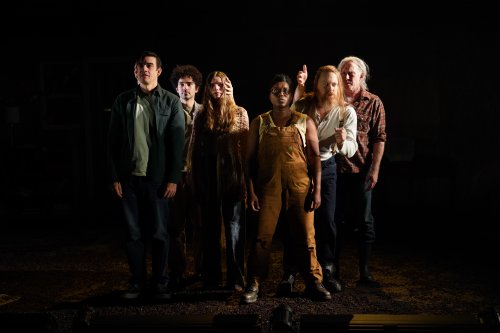
Bobby Moreno, Bartley Booz, Cricket Brown, Donnetta Lavinia Grays, Jeff Biehl and Bruce McKenzie in a scene from Anne Washburn’s “The Burning Cauldron of Fiery Fire” at The Vineyard Theatre (Photo credit: Carol Rosegg)
In fact, Peter’s brother Will (also played by rather wry Pecinka) arrives soon after to find him but is reassured by their joint story that he left in the middle of the night. He accepts the information that Mari (the compassionate Marianne Rendón) broke off an affair with Peter that upset him greatly. Will reveals that Peter was a trust fund kid about to come into a fortune when his ailing grandmother dies.
However, they tell him that the children were in the process of creating a play with Peter to be called “The Incredible Pageant of Peter who Died Three Times and came Three Times back to Life.” They offer to perform the play for him without its ending that evening after dinner. The play which we witness is a fairy tale about a princess (a sanguine Cricket Brown) whose father the King (Donnetta Lavinia Grays) puts her boyfriend suitor, Pageant Peter (a swashbuckling Bartley Booz), through a series of tests, all of which should lead to death but don’t. The play includes puppet animals and the cauldron of the title. The grieving children have also decided that Peter has been incarnated as one of the piglets and they attempt to discover which one. The children have to be kept from telling Will what they know. The ending of The Burning Cauldron of Fiery Fire challenges all we think that we know about Peter’s death leaving the audience to put it all together.
All eight of the adult characters also play children between the ages of three and nine which is not at first obvious, making the play harder to follow. With seventeen people to know it is rather difficult to keep most of the names straight except for a few main characters. Milo also tells us that the adult Paul sexually abused him in the woods two years after these events suggesting that these adults did not all make good decisions. We never know who are the parents of the children nor the relationship between Thomas and Mari who appear to run the community. And why is the door to the cellar always padlocked?
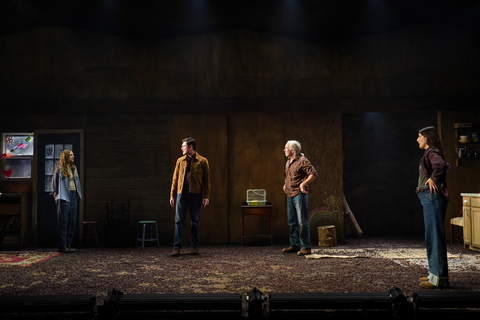
Cricket Brown, Tom Pecinka, Bruce McKenzie and Marianne Rendón in a scene from Anne Washburn’s “The Burning Cauldron of Fiery Fire” at The Vineyard Theatre (Photo credit: Carol Rosegg)
Visually the production is a mixed bag. Andrew Boyce’s single set for the rural premises has to stand in for many different rooms from the dining room to bedrooms to the barn but never looks very different. However, the costumes by Emily Rebholz do suggest people who live on the land without a great deal of money. Amith Chandrashaker’s lighting creates the dim look of a house lit by fireplaces and candlelight. Credit must be given to the witty animal puppets designed by Monkey Boys Productions. Ryan Gamblin’s sound design realistically recreates the sounds of the animals in the barn, while special effects consultant Steve Cuiffo is responsible for the two different burning fiery fires.
Anne Washburn’s The Burning Cauldron of Fiery Fire makes use of whimsy, the supernatural, the sinister, and conflicting stories. There are definitely too many characters considering everyone doubles and two actors play three roles each. Aside from the fact that you may not always be able to follow the play which has its own reasons for being obscure, you will have trouble being able to put your finger on the message but leave the theater wondering what did it all mean.
The Burning Cauldron of Fiery Fire (extended through December 7, 2025)
The Vineyard Theatre & The Civilians
The Vineyard, 108 E. 15th Street, in Manhattan
For tickets, visit http://www.vineyardtheatre.org
Running time: two hours and ten minutes including one intermission


Leave a comment