
minor•ity
A tale of clashing artistic egos encompassing issues of Black identity, cultural influences, and financial support.
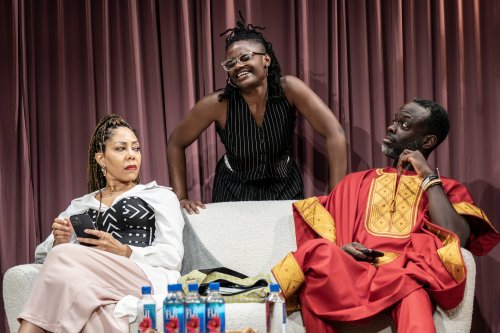
Nedra Marie Taylor, Nimene Sierra Wureh and Ato Essandoh in a scene from francisca da silveira’s “minor•ity” at WP Theater (Photo credit: Joan Marcus)
Consider, if you will, the role of storytellers. They reveal meaning in their words without defining them. Storytelling is a very human thing from the moment of birth until the last breath one takes. As children, we excitedly tell anyone who will listen about a discovery that is new to us but may be as old as time. Sometimes, our tales are long in description, filled with excitement and wonder, and other times, a more direct statement of fact. In all cases, we engage the audience, whether one or many, in experiencing what we experienced in that moment of discovery. They will share that moment with us if we are lucky or good enough.
minor·ity is a wonder of a play written by francisca da silveira and skillfully directed by Shariffa Ali telling a tale of clashing artistic egos encompassing issues of Black identity, cultural influences, and financial support. The cast of three leaves no question in the viewers’ minds that what is being witnessed are real people telling a story through their actions, not actors playing roles. There is a message in the name of the show presented in the script but not in the show which is important enough to repeat here:
“minor
adjective: lesser in importance, seriousness, or significance. “minor alterations”
-ity
suffix: denoting an instance or degree of a quality or condition. “a profanity””

Ato Essandoh and Nedra Marie Taylor in a scene from francisca da silveira’s “minor•ity” at WP Theater (Photo credit: Joan Marcus)
Ato Essandoh starts the journey as the Senagalese-British storyteller Cheikh Malick Diallo. He is telling his classroom of Senegalese students, the audience, a story of the Baobab tree. Essandoh is so engaging with this prologue that one is swept into the moment of the storytelling as a participant reacting to the questions he is asking and responding at the end of his monologue to his call and response. “…When I call out léeboon, “there was a story,” you say back lippoon, “our legs are crossed.” And when I say amoon na fi, “it happened here,” you say back daa naa am, “and so it was.” Let’s try, yeah?” Da silveira’s use of this dramatic device reduces the idea of a fourth wall between the performers and the audience, making the audience a participant in the story that is about to be acted out. The audience, in essence, becomes part of the story, encompassing the action on stage.
Set in Paris in the backstage lounge of Diaspora Now!, an international African arts conference, Sami Monroe, a second-generation Ghanaian-American director, sits on a couch next to Céza Depina, a famous artist from Cape Verde, a regular attendee of the conference, with a jaded attitude towards the commercial side of the art world. It is Sami’s first time, and it shows in her nervous, rapid-fire conversation.
Nimene Sierra Wureh is outstanding as the energetic Sami. Her character represents a younger generation’s view of the whole African identity question and the issues of exploitation of Black artists by rich white collectors. She is also a foil to Céza and Cheikh as the dynamics of their relationship are played out over the course of the conference.

Nimene Sierra Wureh and Nedra Marie Taylor in a scene from francisca da silveira’s “minor•ity” at WP Theater (Photo credit: Joan Marcus)
Nedra Marie Taylor exquisitely embodies the character of Céza Depina, who appears as a cool, almost detached person known for her evocative paintings of the volcano of her childhood. The paintings are so visually powerful that viewers react as if there is heat coming from them. Céza’s cool demeanor may cover an emotional core as hot as the images in her paintings. Her past relationship with Cheikh is the story’s dramatic core as it impacts each of their reasons for attending the conference and finding sponsorship.
When Cheikh arrives in the lounge, the chill with Céza is unmistakable. The details of their romantic relationship from years past are slowly revealed during each of the periods as they await going on stage for the next panel. The various interactions between the characters, sometimes all three and at other times just two, provide the backstory for the characters, giving depth to their definition. It also provides a platform for the exploration of the issues of the African diaspora with Black identity, artistic exploitation, and survival as an artist. The cast skillfully handles these explorations without seeming didactic or preachy, a testament to the deft direction of Ali and Silveria’s text.
Cheikh is looking for financial support for a storytelling school he runs in Senegal. In the prologue, it is the school which the audience-students are in. Céza is trying to break out of the artistic block that has kept her from completing any paintings in the last year. Her future sponsorship depends on it. Sami is the free spirit who isn’t sure what she is looking for but is an information sponge gaining critical insight into how the sponsorship game works. When all is said and done, each character gains important insights into their current emotional state, with one character achieving a surprising ending.

Nedra Marie Taylor and Ato Essandoh in a scene from francisca da silveira’s “minor•ity” at WP Theater (Photo credit: Joan Marcus)
And now Cheikh is back as our teacher, having told this tale of discovery and understanding. It is an epilogue to the tale showing the diverse elements of the African artistic experience and the exploitative compromises to be made to continue producing art. There is a sweetness to this epilogue even if the moral of the story is ambiguous, a fact pointed out by Céza, who appears after the class is dismissed. The closing dialogue is a fitting ending to this delightful play.
The WP Theater is a small theater with excellent supporting features, including lighting, sound, and seating. Brittany Vasta’s set design is outstanding for such a small venue. Her use of curtains to represent various scenic elements is solid, from a baobab tree in the prologue to the walls of the off-stage lounge. The lighting design by Daisy Long perfectly defines the space and expertly guides the action. Tosin Olufolabi’s sound design stands out, with the muffled sounds of an audience waiting for the panelists and the humorous announcements of the frequent delays in starting a panel. The salutes to the various conference sponsors inject a bit of social commentary into the humorous pronouncements. Celeste Jennings’ costume design perfectly defines each of the characters at different stages of their interactions, from the jeans and casual shirts of Sami, the elegant, sophisticated outfits of Céza, to the transition of Cheikh’s ethnic attire from a wild ensemble to a more subdued casual style.
minor•ty (extended through May 4, 2025)
Colt Coeur and WP Theater
WP Theater, 2162 Broadway (at 76th Street), in Manhattan.
For tickets, call: 929-458-0636, or visit http://www.wptheater.org/tickets/
Running time: 100 minutes without an intermission


Leave a comment