
Jesa
Korean American family drama in which four estranged sisters get together to honor their late parents and many revelations are disclosed
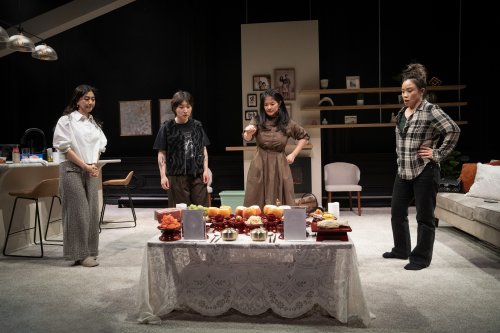
Laura Sohn, Christine Heesun Hwang, Shannon Tyo and Tina Chilip in a scene from Jeena Yi’s “Jesa” at The Public Theater (Photo credit: Joan Marcus)
The dominant form of American theater since Edward Albee’s Who’s Afraid of Virigina Woolf? has been the dysfunctional family drama of which there have been countless such plays. The newest one, Jeena Yi’s debut play Jesa presented by Ma Yi Theater Company in residence at The Public Theater, adds a new wrinkle. This time the family is Korean American and the cast is all women, four sisters to be exact who meet to perform their parents’ jesa. Jesa is a Korean ceremony honoring the dead on the anniversary of their passing that includes food, ritual and requesting their blessings. It is this ceremony that brings together the four estranged for the first time in a long time, the first time they are honoring their mother who died a year ago.
The event take place in the Orange County suburban home of Grace, the second born. She has a reputation for trying to always be perfect and was their mother’s favorite. She is the only one of the four who is married and her husband Mike is an executive who never seems to be home anymore and has a daughter Lily with whom she has a strained relationship. First to arrive is Tina, a chef who is the first born, who wants her respect as the eldest, but doesn’t always get it with her reputation as a screw up. Having had a child out of wedlock at age 16, no one ever lets her forget. She is also a heavy drinker like their father five years gone. Next to arrive is Elizabeth, the youngest but also the most successful. As a wealthy executive with presumably a financial firm she gives money to her sisters but also spends freely on herself. However, she has a temper and an anger management issue both with her family and at work. Last to arrive is Brenda, the third born, the artistic one, a theater director who left home at 18 to go to New York and hardly ever returns for a visit. However, her career has not gone well and she is not where she wants to be. She also is very casual about Korean traditions and rituals to the horror of her sisters.
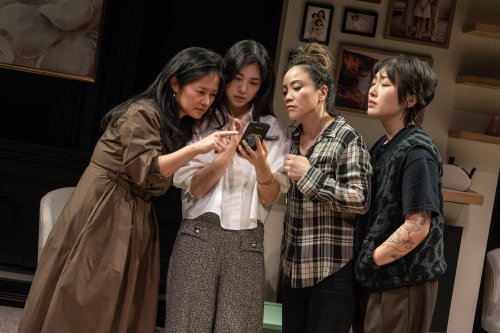
Shannon Tyo, Laura Sohn, Tina Chilip and Christine Heesun Hwang in a scene from Jeena Yi’s “Jesa” at The Public Theater (Photo credit: Joan Marcus)
Told in real time, Jesa follows the evening which begins a little before midnight, the traditional time for such a ceremony. Usually performed by the male members of the family, as there are no sons the sisters have decided to do it themselves. Without telling the others, the hostess Grace has decided to honor both parents on the same night as the anniversary of their parents’ death are only a month apart and the sisters get together so rarely. Ironically, they cannot remember the ceremony correctly (which their mother led the last five years) and their Korean is too poor to find the instructions online. They also refuse to call any of their male cousins who could have quickly answered their questions.
The sisters argue, fight, bicker, reminisce. In the course of the evening there are revelations. Each has a different memory of their parents who they refer to as Umma (Mother) and Appa (Father). Eventually we discover that Amma was a strict disciplinarian and Umma was an abusive alcoholic. Like many children with difficult upbringings, the sisters both loved and hated their parents but hope to be nothing like them. Anger spills over and physical fights take place (staged by fight director Chelsea Pace.) While the play has an authenticity rarely seen on our stages, though not autobiographical according to the author herself, the play is too dense, giving us more than we can remember about the four or told too fast to keep it straight. Except for two supernatural occurrences, Mei Ann Teo’s realistic direction keeps everything on too much of the same level and once all four are together the arguments and insults circle around again and again. We get the feeling that they are reverting to their behavior when growing up around their parents.
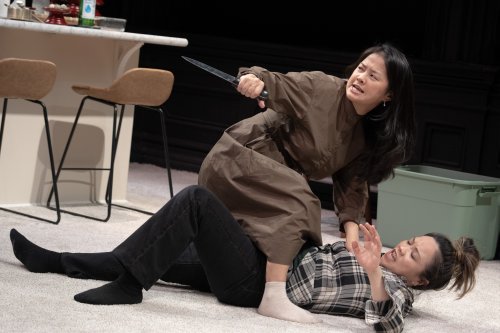
Shannon Tyo and Tina Chilip in a scene from Jeena Yi’s “Jesa” at The Public Theater (Photo credit: Joan Marcus)
While one could criticize the play for being all talk, about halfway through the temperature rises with a ghostly vision not seen by Grace. Did the jesa ceremony cause it or speaking of the dead? Then towards almost the final curtain another scarier visitation takes place, this time witnessed by all. Again it raises the temperature of the events on stage. Both are aided by Hao Bai’s sound design and Jeannette Oi-Suk Yew’s lighting design which reveal to us what the sisters hear and see. Several of the revelations are hinted at so often that when they are confirmed we are not the least bit surprised and they remain anticlimactic.
The cast is uniformly fine but dressed in similar colors (browns, black and whites in Mel Ng’s designs) it is often difficult to tell them apart or their back stories. Even though You-Shin Chen’s attractive ground floor set with kitchen, dining room and living room in earth tones is large, Teo has so much milling around that they often blur as to who is who. Shannon Tyo as hostess Grace is the most strict and formal, but also with the most to hide. Repeating the same excuses over and over to their questions, it seems as if she is holding her life together by a thread. As Tina, the oldest, Tina Chalip is the most animated, having a tongue with no filter, and the most provocative, causing fights wherever she goes. If this is fueled by her character’s drinking or personality, we never know for certain.
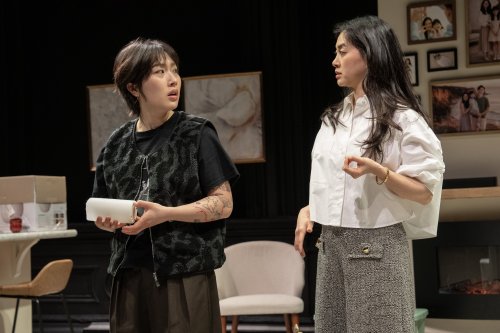
Christine Heesun Hwang and Laura Sohn in a scene from Jeena Yi’s “Jesa” at The Public Theater (Photo credit: Joan Marcus)
A time bomb waiting to happen, Laura Sohn’s successful Elizabeth is always critical, always on edge. We are not entirely surprised when she takes a knife to an aggravating sister. She is also sitting on the most revelations ultimately. On the surface, she has everything one could want but seems to meddle in the lives of her sisters quite a lot and not living her own life. Christine Heesun Hwang as Brenda is the biggest enigma of the four. Much of what she has told her sisters about her career has not happened and they know little of her life in New York. It is suggested that she is lesbian but this is not pursued so we never know if this accurate. Dressed in casual clothes for a formal occasion, she is the rebel who may have missed her time.
Jeena Yi’s Jesa is fascinating in its revealing a culture and a world most theatergoers know little about. On the other hand, its structure, staging and dialogue tend to overwhelm us with information which is then contradicted by other statements. It is also a play that is universal in that many religions and cultures have such ceremonies to honor their dead ancestors. The story of these sisters will resonate with many who have been in the similar family situations.
Jesa (through April 12, 2026)
Ma-Yi Theater Company in residence at The Public Theater
The Public Theater, 425 Lafayette Street, in Manhattan
For tickets, visit http://www.publictheater.org
Running time: 100 minutes without an intermission


Leave a comment