
Glass. Kill. What If If Only. Imp.
An evening of four unrelated one acts, tackling some eternal themes new to Caryl Churchill: love, murder, death and faith.

Adelind Horan, Ayana Workman, Sathya Sridharan and Japhet Balaban in a scene from Caryl Churchill’s “Glass.,” part of the “Glass. Kill. What If If Only. Imp.” at The Public Theater (Photo credit: Joan Marcus)
Legendary British playwright Caryl Churchill (Cloud 9, Top Girls, Serious Money) has in the past written plays that were cutting edge in terms of subject matter and form. Her latest plays entitled Glass. Kill. What If If Only. Imp., an evening of four unrelated one acts, tackles some eternal themes new to Churchill: love, murder, death and faith. James Macdonald who has directed six previous Churchill plays in New York pilots a company of ten (with two children alternating), most of whom appear in more than one play. A most unusual evening, between the second and third short plays there are circus performers, acrobat Junru Wang and juggler Maddox Morfit-Tighe, attempting incredible feats, and relieving some of the tension in these dramatic plays.
Three of the four plays have a supernatural air about them. “Glass” is a fantasy version of Romeo and Juliet reduced to its common denominator. A young man introduces his friend to his sister who is made of glass. She lives on the mantle among a clock, a red plastic dog and a vase in order not to get broken. When the friend starts dating the glass sister, his father attempts to keep them apart. This leads to the tragic conclusion. Macdonald’s unusual staging has the four performers situated on a floating platform on which they turn to face the audience when they have lines (set by Miriam Buether who also created the same design for the London production). Sathya Sridharan as the Brother, Ayana Workman as the Girl, Japhet Balaban and Adelind Horan as the Girl’s friend and her Mother perform the play as though it is a realistic piece of theater. Enver Chakartash’s contemporary costumes set the play firmly in the present.

Deirdre O’Connell in a scene from Caryl Churchill’s “Kill.,” part of the “Glass. Kill. What If If Only. Imp.” at The Public Theater (Photo credit: Joan Marcus)
Dressed entirely in white and sitting on a cloud, in “Kill,” Deirdre O’Connell plays a character called the Gods. In a taut two-page monologue she recounts the many murders in Greek mythology (without naming the murderers or victims) as if it were all in one family: Orestes, Clytemnestra, Agamemnon, Iphigenia, Jason, Medea, etc. There are several markers to help with the mythological references, wind needed for sailing to the Trojan War, the Golden Fleece, Pandora’s Box. O’Connell recounts all this with tremendous control and authority.
The third play, “What If If Only” has a great many characters who come and go as ghosts, past, present and future. Sridharan sits grieving over the death of his wife at a table with a wine glass and a coffee cup. A woman representing the Ghost of a Dead Future (Workman) appears to him, but not the beloved that he is in mourning for. If he can make her happen, she can bring his beloved back to life. Unfortunately he does not know how. They are then joined by six other ghosts including one of the Present and a Child of the Future. Sridharan poignantly represents a person in mourning. John Ellison Conlee is amusing as an all knowing Ghost of the Present. Buether’s all-white room makes it feel like we are floating in a disembodied atmosphere. Only this play is bathed in white lighting designed by Isabella Byrd, while the other three are clothed in black backgrounds.

Ayana Workman and Japhet Balaban in a scene from Caryl Churchill’s “What If If Only.,” part of the “Glass. Kill. What If If Only. Imp.” at The Public Theater (Photo credit: Joan Marcus)
“Imp.,’ the longest play at almost an hour, takes up the entire second half of the evening. If memory serves, this is Churchill’s first domestic play to be performed in New York. Two platonic cousins, fiftyish Jimmy and Dot live together. Set in a living room, Dot remains lying in a chair and hassock as she has a bad back. In 12 scenes, they alternately host their younger Irish niece Niamh (pronounced “Neve”) and Rob, a homeless man and former addict, that Jimmy has met in his jogs around the neighborhood. Eventually Rob and Niamh are introduced and begin dating. Rob is separated from his common law wife while Niamh has just started a very good job.
Along the way we are apprised that Dot keeps a closed wine bottle by her side in which she claims is trapped an imp that can grant wishes. She herself never opens it for fear of the imp getting out. However, in the one scene in which she does not appear, Jimmy and Rob open the bottle and make a wish. Has the imp gotten out? Does the wish come true? Is the imp still there? Rob and Niamh have their ups and downs while Jimmy and Dot simply seem to get older.
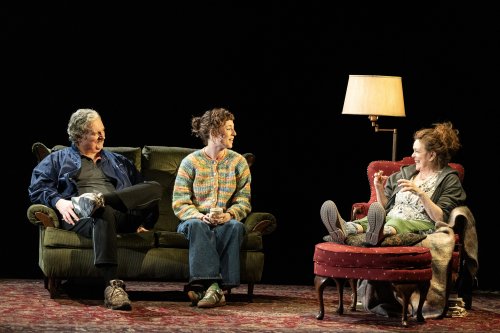
John Ellison Conlee, Adelind Horan and Deirdre O’Connell in a scene from Caryl Churchill’s “Imp.,” part of the “Glass. Kill. What If If Only. Imp.” at The Public Theater (Photo credit: Joan Marcus)
The play brings back actors we have seen earlier in the evening: O’Connell’s Dot is rather menacing and unfiltered, while Conlee’s Jimmy is level-headed and amiable. Horan and Balaban as the younger couple aren’t given much to do but they reveal pieces of their lives little by little. The realistic dialogue makes this play a slice of life drama except for the imp in the bottle, somewhat less threatening than Pinter’s weasel under the cocktail cabinet, but serving the same function. The green sofa and red armchair over a Persian carpet put us in a realistic vein after the fantasy and supernatural elements of the first three plays.
The cumulative effect of the four plays is greater than the sum of its parts. The quartet of plays seems to demonstrate Caryl Churchill in a new mode. While the plots are slight, the themes are of major importance and suggest new ways of thinking about them. James Macdonald’s production and the acting of his cast are quite assured even though the plays are mainly non-realistic and require their own kind of suspension of disbelief.
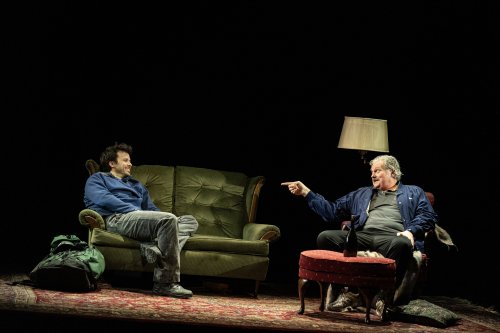
Japhet Balaban and John Ellison Conlee in a scene from Caryl Churchill’s “Imp.,” part of the “Glass. Kill. What If If Only. Imp.” at The Public Theater (Photo credit: Joan Marcus)
Glass. Kill. What If If Only. Imp. (extended through May 25, 2025)
The Public Theater
Martinson Hall, 425 Lafayette Street, at Eighth Street, in Manhattan
For tickets, call 212-539-8500 or visit http://www.publictheater.org
Running time: two hours and 20 minutes including one intermission


Leave a comment